

Home Blog Page 60

MAGAcademy


How Corporatism Paved the Way for the Hostile Takeover of Higher Ed

Nolan Higdon, Jan 23

Note: The following is an excerpt from the book MAGAcademy.


“People can have a difference of opinion.” Farley, a gray-faced bureaucrat from the university’s labor relations office, repeated the phrase for what felt like the tenth time in a twenty-minute meeting. He looked like an archetype of “the administrator” that modern universities fetishize: an overweight white man in a wrinkled white button-down shirt, glasses slipping down his nose, exuding the confidence of someone whose most radical undergraduate reading was probably scribbled in Sharpie on a bathroom stall.

What gnawed at me wasn’t just the repetition, it was the categorical error. Farley was conflating opinion and argument, pretending they were interchangeable. Yes, people can have different opinions. But not every position is grounded in evidence, and not every perspective deserves equal weight. Not everyone has a compelling argument, as demonstrated by Farley.

What bothered me even more was that my training in a doctoral program for education managers had taught me the script that he was following: show up to “stakeholder” meetings, make faculty feel heard, but never actually listen, because faculty had little formal power. Farley was following the manual to the letter.

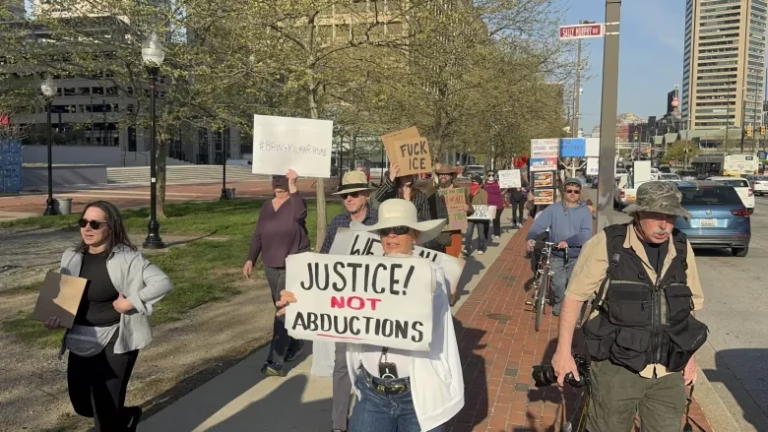
And here we were, the faculty labor representatives, meeting because the university had rolled out a new set of policies in response to student protests and encampments that were critical of U.S. support for Israeli attacks on civilians in Gaza after October 7, 2023. The policies were conveniently drawn up while faculty were on summer break, and the new draconian rules effectively outlawed protest on campus. Practiced by generations of graduate and undergraduate students and constitutionally protected, student expression is as varied as departmental majors.

Whether they are marches, sit-ins, vigils, or boycotts—celebratory or confrontational—their core purpose is to highlight glaring injustices and demand change. In the United States, the First Amendment explicitly protects the rights of students to protest by guaranteeing their freedoms of speech, assembly, and petition. Although governments, and by extension administrators, can regulate the time, place, and manner of protests in order to allow the expression of even unpopular views, restrictions on them are legally mandated to be content-neutral. Courts consistently uphold such protests as central to democratic self-governance, and banning or dispersing them is permitted only under conditions defined as “clear and present danger.” There are independent requirements that constitute such danger: one is the threat of serious harm that the government can prevent, and the other is a real and immediate danger.

To justify the new policies, campus administrators cited unsubstantiated claims about how faculty and students felt “discomfort” with the activism. Dense layers of new restrictions on timing, where events could take place, and how loud they could be, sadly had the predictable effect—meaningful protest would be nearly impossible. It was a classic administrative tactic: weaponize social-justice language about caring, and the campus community, to mask a bureaucratic process built to restrict rights and silence dissent.

It was the fall term of 2024, and the protests of the previous spring had shaken the nation. Footage of police in riot gear confronting students on college campuses was broadcast across major news channels and widely circulated across social media platforms. Establishment media and political pundits conflated student protests against the Israeli government with antisemitism, providing a rhetorical weapon for the incoming Trump administration. But that administration was still months away. The assaults on constitutional rights on college campuses were happening under the leadership of the president and political party most people in higher education seemed to support: Joe Biden and the Democratic Party.

Many of my colleagues accepted the prevailing propaganda about the activists and welcomed the crackdown on student and faculty rights. Their instinct to side with the Democratic Party and legacy news media’s narratives—no matter the cost to collective bargaining power or faculty freedoms—was already a well-established pathology.

The meeting with Farley unfolded over Zoom, now the standard videoconferencing platform for labor disputes. Faculty union members occupied one side of the screen, while the administrators, including Farley, sat on the other. I was tasked with pleading our case to defend the rights of our labor union, students, and faculty. There I was, reduced to begging an administrator to respect rights that should never be negotiable in a university setting. The absurdity of having to plead for free expression spoke volumes about how bureaucrats, administrators, faculty, students, and everyday citizens had collectively allowed the crisis in higher education to metastasize.

My arguments were straightforward: protect constitutional rights rather than police political debate. But nothing landed. Farley wasn’t there to consider policy; he was there to perform. I recognized the routine: nod gravely, feign thoughtful engagement, then walk away claiming, “We consulted with stakeholders and made the hard decision…” which always meant ignoring us.

And that’s exactly what happened. Across the country, campuses were tightening the screws: debates were censored, speech was restricted, peaceful assembly was banned, and even email communication about protests was prohibited under the auspices of fighting hate. Faculty and students alike were being steamrolled by increasingly authoritarian administrations. It is a bitter irony: the very administrators who championed social justice as a bulwark against Trumpism were developing the infrastructure he would eventually use to transform the university into the MAGAcademy.

The Gaza protests revealed just how far the system had deteriorated: students and faculty were punished for engaging in the very forms of activism universities once claimed to champion. Administrators leaned on narrow interpretations of laws and campus policies and manufactured public fear to silence dissent, while too many faculty chose career preservation over principle.

The U.S. support for Israeli operations in Gaza and the clampdown on campus protest were not the root causes of the crisis. They merely exposed it as an increasingly transparent political agenda. Decades of neoliberal restructuring had already hollowed out the public mission of higher education, weakened collective bargaining power, eroded shared governance, undermined academic freedom, and transformed students into customers, all while deprofessionalizing faculty. Yes, flashpoint moments like Gaza, Trump’s first election, and the Covid-19 pandemic accelerated these trends, but the decline had been underway for decades. All of this rot beneath the surface meant that when the real assault finally arrived, the system was too weak to withstand it. And the MAGAcademy was born.

Donald Trump’s second term brought a coordinated, systematic campaign to transform higher education into what I call the MAGAcademy. The “MAGAcademy” is more than a play on words—it is a description of a new reality. It captures how Trump’s “Make America Great Again” (MAGA) political movement reached beyond rhetoric to physically occupy the university, utilizing the infrastructure of neoliberal corporatism to install a new, authoritarian brand of campus life. Within weeks of returning to office in 2025, he issued sweeping executive orders banning diversity, equity, and inclusion (DEI) policies across all federal agencies, reversing Title IX protections for transgender students, and redefining sex strictly as male or female. Campuses were stripped of their “sensitive location” status, clearing the way for immigration raids and arrests. Federal agencies froze, canceled, or withdrew billions in grants and research contracts, most notably nearly $900 million from the Institute of Education Sciences, while the Office for Civil Rights was gutted and seven of its twelve regional branches eliminated. By October 2025, the White House had sent ultimatums to nine major universities demanding that they implement a list of ideological conditions in exchange for continued access to federal funds. It was an unprecedented attempt to force political conformity onto higher education.

When Trump took the reins again, he did not have to build a new apparatus of control; he simply weaponized the one the neoliberals left behind. Just as previous administrations used federal funding as a carrot to enforce identity policies, Trump used it as a stick to dismantle them. The neoliberal era normalized a culture of surveillance where people reported one another for bias; Trump merely incentivized reporting “anti-patriotism.” Neoliberals’ fetishization of corporate tech became Trump’s fetishization of AI, and the long-standing bureaucratic war on faculty unions provided the perfect infrastructure for mass funding cuts.

My goal in writing MAGAcademy is to hold up a mirror to the processes that proud anti-MAGA liberals engaged in that made this MAGAcademy possible. We cannot continue making the same mistakes and expect different results. The critiques within this book have been whispered in faculty lounges for decades; my aim is to place them in a broader context to show exactly how we built the MAGAcademy. Only by acknowledging the failures of the past can we hope to build a future for higher education that is worth defending.

By purchasing the book through Project Censored, proceeds go to support their work as a non-profit education and media literacy organization. Click Here to Purchase

Port of Los Angeles Secures Record $70M for Harbor Maintenance


LOS ANGELES – April 8, 2026 – The U.S. Army Corps of Engineers has allocated about $70 million from the Harbor Maintenance Trust Fund or HMTF to the Port of Los Angeles for harbor maintenance, seismic resiliency and navigational safety improvements. The San Pedro Bay port complex was allocated a record $131.8 million.

The HMTF is funded by a commercial cargo tax paid by U.S. importers moving goods through U.S. ports. This money is then allocated for harbor maintenance and navigation improvements at those ports. Although the Port of Los Angeles and other “donor ports” contribute over half of the total funding to the HMTF, they have traditionally received less than 3% of that funding back for harbor improvements.

Reforms enacted in 2020 established a framework to address this imbalance and an initial round of funding was allocated to donor ports in Fiscal Year 2024. However, no funding was allocated in Fiscal Year 2025, leading to additional reforms enacted this year that ensure consistent implementation of this equitable funding formula.

Congress has appropriated $3.245 billion in HMTF funding for Fiscal Year 2026, and appropriated $$416.8 million specifically for donor and energy ports through Section 102 of the Water Resources Development Act. These funds ensure that ports like Los Angeles receive the support needed to keep their ports well maintained and competitive.

The port plans to use its HMTF allocation for a variety of maintenance and repair projects, including dredging, seismic safety upgrades, wharf and fender repairs, pile replacements, sediment removal and remediation, and improvements to slips and channels. The Port of Los Angeles has identified more than $6 billion in eligible expanded-use projects, many of which are shovel-ready and can immediately utilize new HMTF funding. Priority projects include:

  • Berths 49-50 Wharf & Fender Repair – $25 million
  • Berth 305 Wharf Retrofit – $18 million
  • Berth 126 Wharf Seismic Upgrade – $322 million
  • Berths 238-239 Marine Oil Terminal Improvements – $35 million
  • Berths 167-169 Marine Oil Terminal Improvements – $44 million
  • Legacy Sediment Removal & Remediation – $140 million

Reminder: Environmental Justice Advisory Committee (EJAC) Meeting on April 24


The Department of Pesticide Regulation or DPR is hosting a public meeting for the Environmental Justice Advisory Committee or EJAC, established by Assembly Bill (AB) 652. The meeting is open to the public.

The meeting is being held in-person in Salinas and remote via Zoom. A live webcast of the meeting will be available for viewing.


Time: 4 to 8 p.m., April 24

In-person participation: Salinas City Hall (The Rotunda), 200 Lincoln Ave, Salinas, CA 93901

Online participation via Zoom Webinar: Register

Webinar ID: 853 1885 8242

Passcode: 829178

Webinar ID: 853 1885 8242

Phone Number: (888) 475-4499 US Toll-free

Members of the public may join remotely via the Zoom link or at the address listed above. To the extent that Zoom requires members of the public to enter a name or other information as a condition of attending the meeting, members of the public may enter pseudonyms or other anonymous information.

View-only: English Webcast Link, Spanish Webcast Link

To only watch the meeting and not provide verbal comments, please view via the webcast.

Materials:

  • Other materials will be posted, on the website, as they become available.

For questions, comments, additional information or assistance to participate in this meeting, or to request reasonable accommodations, please email EJACinfo@cdpr.ca.gov, no later than 10 business days before the meeting.

Language Services

This meeting will be offered in English and Spanish. To request translation of a written document, interpretation services for the meeting, or sign language services, please email LanguageAccess@cdpr.ca.gov as soon as possible and no later than 10 business days before the meeting.

LB At-Risk Missing Person – Charles Garner III


The Long Beach Police Department is asking for the public’s help in locating 60-year-old at-risk missing person Charles Garner III.

Garner was last seen on April 8, about 8:50 p.m., leaving his residence in the 3500 block of Wise Avenue on foot. He has no cell phone and no other means of tracking. He has medical condition(s) and may become disoriented.

Charles Garner III Description:
Age: 60
Hair Color: Black
Eye Color: Brown
Height: 6’1”
Weight: 165 lbs
Gender: Male
Race: Black
Clothing: Navy blue/gray Dallas Cowboys jacket, white thermal long sleeve shirt, black pants, black Nike shoes
Possible Destination: unknown
Jewelry: None
Scars/Marks/Tattoos: Cry now/smile later faces on either right or left bicep; “Donna” on either right or left wrist
Medical Alerts: Has medical condition(s) and may become disoriented

Anyone with information regarding this missing person is urged to call the LBPD missing persons detail at 562-570-7246 or LBPD Dispatch at 562-435-6711. Or anonymously at 1-800-222-8477, www.lacrimestoppers.org.


Trenches Full of Poets and Radical Conversation at Page Against The Machine

April Trenches Full of Poets

Join on for the Poetry Month installment of the . April features in-store readings from – and followed by an open mic opportunity.

– is a poet and journalist who, since 2000, has been a reporter at LAist 89.3, the NPR affiliate in Los Angeles where he reported and hosted the LAist Studios podcast, . His first collection of writing is : , 1992-2025, published by Hinchas de Poesia Press. He lives in Long Beach with his family.

Monica Miranda (she/her) is a teacher and mother currently working on a master’s degree in education leadership. She is passionate about literacy education and women’s rights.

Taking its name from a Clash lyric, is a monthly poetry series created, curated, and hosted by Los Angeles-based poets and editors, and with the goal of supporting a diverse array of published SoCal authors and the local independent bookstores that carry their works.

The event takes place on the second Thursday of every month and is open to the public, no tickets or reservations required!

Time: .., April 9

Cost: Free

Details: patmbooks.com

Venue: PATM Books, 2714 E. 4th St., Long Beach


Radical Png
A Radical Conversation with Revolutionary Artist, Historian, and Professor

A Radical Conversation with Revolutionary Artist, Historian, and Professor Akinsanya Kambon

Page Against The Machine presents an in-person, in-store lecture and discussion with revolutionary artist, historian, Professor Akinsanya Kambon

Born Mark Teemer in Sacramento in 1946, Akinsanya Kambon has led a radical, revolutionary, and artistic life. Drafted into the Marine Corps as a combat illustrator, he served in Vietnam, and upon his return joined the Sacramento chapter of the Black Panther Party or BPP. In 1968, he created the infamous Black Panther Coloring Book, where legend holds that its provocative and revolutionary imagery was deemed too incendiary by the BBP leadership but was instead circulated by COINTELPRO in their quest to discredit the Black Panthers.

Enrolled at Sacramento City College, he learned the raku ceramic firing process and thus formally began his artistic practice. After nine years of travel and study in Africa, he was given the Yoruba name Akinsanya Kambon, meaning “the hero avenges.” His paintings and sculptures weave together narratives of the Black diaspora, encompassing African histories, mythologies, and stories of violence and revolution from Africa and the Americas. Through his art and community work, Kambon seeks not only to provide in-depth history lessons on Black and Brown communities in the United States, but also to chart new visions for the future.

The first monograph on his revolutionary artwork, : , is set to be published in late April 2026 by Delmonico Books in partnership with the Hammer Museum.

Time: 7 p.m., April 11

Cost: Free

Details: patmbooks.com

Venue: PATM Books, 2714 E. 4th St., Long Beach

Earth’s Greatest Enemy – Long Beach Premiere with Mike Prysner Q+A

By Empire Files

Join Mike Prysner for the Long Beach premiere of their new feature documentary film on the environmental impact of the US military.

Special Earth Day screening.

The second documentary from journalists Mike Prysner and Abby Martin that uncovers a shocking blind spot in the climate conversation: the U.S. military.

Exempt from international climate agreements and rarely scrutinized in mainstream reporting, the Pentagon is revealed here as the world’s single largest institutional polluter—spewing carbon, contaminating water, and scarring landscapes across the globe. Combining investigative journalism, striking visuals, and stories from impacted communities, the film challenges audiences to rethink the hidden costs of a global military empire and its planetary consequences. Provocative, urgent, and eye-opening, this is a documentary that will change how you see both the military and environmentalism.

Featuring Q&A with co-director Mike Prysner following the film.

Learn more about the film and watch the trailer at EarthsGreatestEnemy.com

Time: 6 to 8:45 p.m., April 15

Cost: $10 to $20

Details: https://tinyurl.com/LB-Art-Earths-Greatest-Enemy

Venue: Art Theatre of Long BeachLong Beach, 2025 East 4th St., Long Beach

LA Supervisors Empower Department of Youth Development to Lead Programming in Juvenile Facilities

LOS ANGELES — On April 7, the Los Angeles County Board of Supervisors passed Motion 2004, a measure to transform the care of justice-involved youth. Authored by Supervisors Lindsey P. Horvath and Janice Hahn, the motion empowers the Department of Youth Development or DYD to take the lead role in establishing programs and services in halls and camps, within the confines of existing legal restrictions.

This shift authorizes DYD to design and implement essential programming to ensure high-quality, evidence-informed care that prioritizes healing and accountability. By moving beyond traditional punitive models, the initiative aims to break down bureaucratic barriers and provide youth with consistent support during and after custody.

“We are deeply grateful to Supervisors Horvath and Hahn for their commitment to reimagining youth justice through this vital motion,” said DYD Director David J. Carroll. “The well-being of young people is a shared responsibility, one that requires us to move beyond old models and invest in evidence-informed, data-driven coordination. When we meet the full range of a young person’s developmental needs, we don’t just improve their time spent in detention facilities—we ensure their lasting success back in the community.”

DYD is collaborating with county and community partner agencies to establish formal policies and secure sustainable funding.

Details: DYD.LA

Community Meeting Scheduled April 22 on Shoemaker Bridge Ramps Demolition


The Port of Long Beach will host an outreach meeting this month to inform the public and solicit feedback about a project planned for later this year that will demolish the ramps connecting the Shoemaker Bridge to the North Harbor area.

The meeting will be held April 22, in Long Beach. A presentation by the project team will be followed by an open house. Requests for translation must be received by April 15. Contact Alice Castellanos at 562-283-7720 or alice.castellanos@polb.com for translation or assistance registering for the event. Comuníquese con Alice Castellanos al 562-283-7720 o alice.castellanos@polb.com antes del miércoles 15 de abril para obtener servicios de interpretación o asistencia con el registro.

In 2026, the Port of Long Beach plans to demolish ramps between the Shoemaker Bridge and the Port as part of construction of the Pier B On-Dock Rail Support Facility. Pier B will help to accommodate the expected growth of cargo volume, while taking trucks off the road and improving the environment.

The planned demolition work will remove the 9th and 10th Street on- and off-ramps crossing over the 710 Freeway. Currently, as scheduled, the ramps will be permanently closed at the end of April. The ramps are not heavily used and sufficient alternate routes are available in the area, including Willow Street, Pacific Coast Highway, Anaheim Street, Ocean Boulevard and the Queensway Bridge. Motorists will still be able to access the Shoemaker Bridge from West Seventh Street, West Third Street, West Ocean Boulevard and West Shoreline Drive, east of the Los Angeles River.

Work will require three temporary, weekend closures this summer: first, the northbound 710, then the Shoemaker Bridge, and finally the southbound 710. Dates have not been set.

View a fact sheet about the planned Shoemaker Bridge ramp demolition project here: https://tinyurl.com/Shoemaker-bridge-ramp-demo

In a separate project, the City of Long Beach plans to replace the Shoemaker Bridge. Learn more about that project here: https://longbeach.gov/pw/projects/shoemaker-bridge/

Time: 6 to 8 p.m. April 22

Details: RSVP at www.polb.com/shoemaker.

Venue: Juanita Millender-McDonald Community Center, Admiral Kidd Park, 2125 Santa Fe Ave., Long Beach

Murder Investigation And Arrest- 400 Block Of North Pacific Avenue


LBPD Homicide detectives are investigating a stabbing that occurred on April 1, which later resulted in the victim’s death. A male adult suspect was arrested.

On April 1, about 5 a.m., officers responded to the 400 block of North Pacific Avenue regarding a stabbing. Long Beach Fire Department personnel rendered medical aid to a male adult victim with a life-threatening stab wound. LBFD transported the victim to a local hospital.

The preliminary investigation indicates a male adult suspect stabbed the victim. Detectives believe the victim and suspect did not previously know each other. The motive remains under investigation.

The suspect fled the scene prior to officers’ arrival.

Due to the severity of the injuries, both Violent Crimes and Homicide detectives responded to the scene.

Through their investigation, detectives identified the suspect.

On April 2, 2026, South Division officers located and safely arrested the suspect in the 100 block of North Pacific Avenue. The suspect was identified as Cary Odell Singletary, a 66-year-old person experiencing homelessness, who was booked for attempted murder. His bail was set at $1,000,000.

On April 6, 2026, the victim succumbed to his injuries at the hospital.

The victim was identified as James Plummer, a 72-year-old resident of South Gate.

The case was initially presented to the Los Angeles County District Attorney’s Office for filing consideration for attempted murder and was amended to murder on April 7, following the victim’s death.

Anyone with information regarding this incident is urged to contact homicide detectives Eric Thai and Chasen Contreras at 562-570-7244, or anonymously at www.LACrimestoppers.org.

The Port’s Free Harbor Tours Return for Summer 2026


Beginning in May, the Port of Long Beach will once again host free harbor tours, offering the public a chance to experience the sights and sounds of the nation’s largest seaport complex.

Registration for May tours is open from 8 a.m. to 8 p.m. on Monday, April 13.

The Port uses an online lottery sign-up system for reservations. Reservations are open on the second Monday of the month from 8 a.m. to 8 p.m. for tours the following month. The online reservation system provides a 12-hour window to register via computer or mobile device for an available tour the next month. A random drawing will select participants for each tour and within seven business days, you will receive confirmation of your reservation or notification that you are on a waiting list. You may reserve up to four seats; for larger groups, consult the FAQs.

Tours are generally scheduled four times a month, twice on Saturday mornings and twice on Wednesday evenings. Tours this year will be held May through September. Check the tour page for the full schedule.

Details: Reservations are required. Visit polb.com/porttours for more information and to make reservations on April 13.