

Home Blog Page 82

Letters to the Editor: Ship Fire, Tough Lessons, ICE & Health Worker Strain

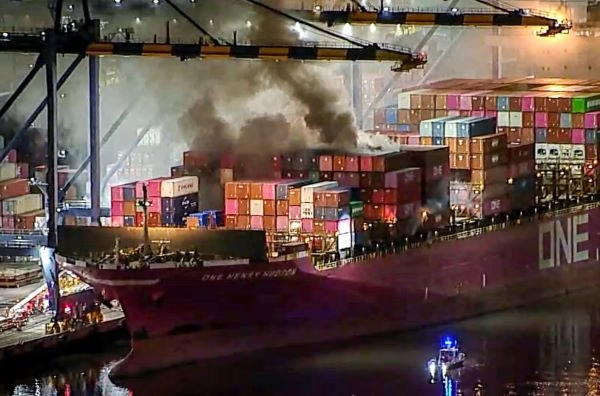
From Explosion to Recovery: Harbor Partners Rally During Cargo Ship Fire

When a crisis strikes, it reveals the character of a community. The major fire aboard the M/V ONE Henry Hudson at Yusen Terminals in the Port of Los Angeles, beginning November 21, 2025, tested our systems, partnerships, and resolve. What it ultimately revealed was the extraordinary professionalism and selflessness of those who responded.

The entire team at Yusen Terminals offers our deepest thanks to the first responders and agencies who worked tirelessly to protect lives, property, and the environment. The U.S. Coast Guard, Los Angeles and Long Beach Fire Departments, LA Port Police, and our local, state, and federal partners demonstrated seamless coordination under complex conditions. We also appreciated the on-site support of Mayor Karen Bass and Councilmember Tim McOsker. The professionalism of the International Longshore and Warehouse Union (ILWU) and the Yusen Terminals team was critical to maintaining safety and advancing recovery.

This was not a routine response. The fire, believed to have originated from an electrical source below deck and complicated by a mid-deck explosion, required sustained, multi-day firefighting. Los Angeles Port Pilots escorted the vessel to anchorage for continued firefighting and later returned it to berth so recovery, cargo offloading, and investigation could proceed under U.S. Coast Guard supervision.

Decisive actions were taken to protect the surrounding communities of San Pedro and Wilmington. Shelter-in-place orders and roadway closures were difficult but necessary steps taken with public safety as the guiding priority, and they were lifted without any reported injuries.

Moments like these remind us that resilience is built through partnership, preparation, and courage. To every firefighter, officer, mariner, investigator, and support professional involved: thank you.

Alan McCorkle, CEO, Yusen Terminals

Us, the Immigrant and the Stranger by Sophie Schoenfield, Jan. 22

Sophie Schoenfield’s recent guest column was one of the most beautifully written and humbling stories I’ve read in quite awhile. She articulated her personal history, and pain, so well (so to speak), which reads as a cautionary tale to those of us who have only begun to experience the shit show we, in this country, are now only beginning to be confronted with.

Thank you, Sophie, for your strong and compassionate perspective. We, the “privileged” in this country, have much to learn from perspectives such as yours.

Kudos to RLN for publishing her story, and doing great work!

Sincerely,

Sean Doyle

Corvallis, Oregon


Open letter re ICE

Dear Decision Maker,

As your constituent, I am appealing to you to act on behalf of the millions of people subject to random and ruthless federal law enforcement actions. No one feels safe, no one is safe. Nor can we count on the courts to employ the US Constitution as a safeguard against state sponsored violence. Without exception, any of us can be physically assaulted, detained, denied access to legal representation, transported across state and national borders. In other words, simply disappeared into a Kafkaesque system meant to exert absolute social control.

Today I learned that Ms.Tipan-Echeverria, a two-year-old American citizen, was deported to Honduras with her mother after being detained in Minnesota, transported and held for days in a hotel room in Texas, and denied the right to contact relatives or legal counsel.

Like five year old Liam Ramos and seven-year-old Diana Crespo, who now reside in ICE’s South Texas Family Residential Center, Ms.Tipan-Echeverria has had her young life shattered due entirely to an agenda which sees her as expendable.

Today, in this hellscape, I worry that my son could be at risk. Is camping alone on the Southern California coast, something a 42-year-old Native American can do these days? Will his CA driver’s license, U.S. birth certificate, and social security card even matter? If he asserts his constitutional rights, will he be detained and will this be justified by a charge of resisting arrest? Could he be shot or simply disappeared?Believe me when I say that I am not the only mother who has these thoughts and fears. The history of this nation and its capacity to justify the use of force, be it in war or in our streets, is no comfort.

So at this juncture, stand up and speak out. Defund ICE. Do what you can to remove all federal immigration enforcement from our communities, including Greg Bovino, who is reportedly returning to his previous job in El Centro. Act to restrain state and local law enforcement from aiding and abetting this campaign to racially profile, to politically profile, and to harm and abuse the most vulnerable among us. Demand basic human rights for all, without exception. Do not limit your efforts or concerns to those who are your voting base, or are white, or are U.S. born, or who immigrated “the right way” or do not say “from the river to the sea” or have no criminal record. Doing so has brought us to this exact time and place where none of us feel safe because none of us are.

Anna Christensen, Long Beach,


Health Workers Burn Out

Regarding the article “Health Workers Cite Burnout, Unsafe Conditions In Kaiser Strike Threat” (Random Lengths News, January 22), I am writing to express my support for the demands of the striking workers. As a Kaiser patient since 2007, I have seen the importance of their work firsthand and believe their concerns deserve to be addressed. I find that often the Kaiser (Cadillac location) practice is to promise more than they plan to deliver.

  1. Juan Johnson

Los Angeles

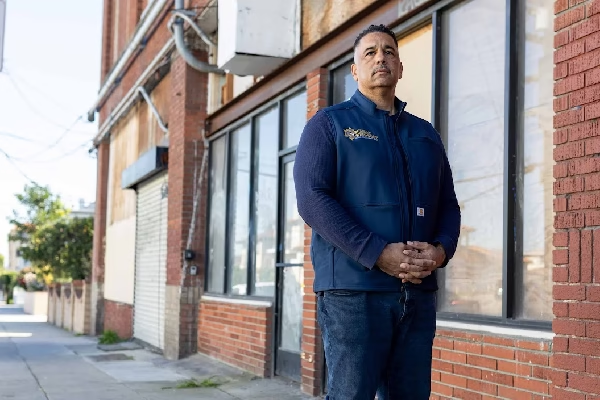
Broken From the Top: Eric Strong Says LASD Needs Real Reform, Not Promises

Editor’s note: This story was updated to include Eric Strong’s correct title and how he got there.

Los Angeles County Sheriff’s Department’s Chief Eric Strong is watching the same scenes in his news feeds as the rest of us, of masked federal agents violating civil rights… demanding documents to prove citizenship…and snatching people off streets, parking lots and classrooms… drawing weapons on bystanders filming their interactions… and at times firing those weapons and sometimes killing said bystanders… Even local police officers are being stopped.

“We have an administration that’s pushing an agenda that, candidly, I believe is rooted in racism,” said the now two-time candidate for sheriff. “If the goal is to secure the border, there are other ways to do that besides targeting workers and families.”

Strong, a 32-year law enforcement veteran, first gained countywide visibility during his 2022 campaign for sheriff. He distinguished himself as a blunt critic of what he describes as systemic corruption and leadership failures inside the department.

He questions the logic behind current federal enforcement tactics.

“If the argument is that undocumented immigrants are draining the economy — that they’re not paying taxes but receiving services — then why are tax returns and pay stubs being used to locate them?” Strong asked. “If the issue is violent crime — murder, rape, carjacking — then why are people being picked up at Home Depot parking lots and other public spaces? If this is about violent and dangerous individuals, then why are officers walking up to people in Walmart parking lots and asking, ‘Were you born here?’ To me, it feels like there’s been a green light given to return to racial profiling.”

Leadership and Accountability
In his previous campaign, Strong sharply criticized former Sheriff Alex Villanueva, describing his leadership as vindictive rather than competent. He said experienced leaders were removed not for poor performance but as retaliation and replaced by loyalists promoted beyond their training or experience.

Villanueva had been elected in part to finish the job Sheriff Jim McDonnell started in reforming a department tarnished by inmate abuse scandals during former Sheriff Lee Baca’s tenure. But according to Strong, conditions have not meaningfully improved. In September 2025, California Attorney General Rob Bonta filed a lawsuit against Los Angeles County and the Sheriff’s Department, alleging unconstitutional and inhumane conditions in county jails.

The roots of that lawsuit trace back to a 2021 state investigation into whether LASD had engaged in a pattern or practice of unconstitutional policing.

Of Sheriff Robert Luna, Strong said:

“The only real difference is he’s quiet. Villanueva was loud and toxic. Luna smiles, shakes your hand, but in many ways he’s doing the same thing — and in some ways it’s worse.”

He pointed to the boycott of the Baker to Vegas relay race, an annual competition for law enforcement. Many LASD deputies declined to represent the department.

“Instead of asking why deputies boycotted, the response was to find out who organized it and put them under investigation. That’s not introspection — that’s control.”

Strong explains that after hearing concerns about Sheriff Luna’s leadership, he personally called Luna to assess the situation. Strong says the conversation confirmed his doubts, describing Luna’s response as evasive and indirect. Concluding that advancement or meaningful reform under the current administration was unlikely, Strong began exploring opportunities outside LASD and entered the interview process with another agency.

Instead, he accepted an opportunity to go “on loan” to the Los Angeles County Probation Department, where he served for about two years as Chief of Campus Safety and Security. Strong frames this role as executive-level experience that critics had claimed he lacked, noting that he earned the chief title, gained exposure to a different sworn agency, and broadened his understanding of law enforcement operations. During that period, he also completed a master’s degree in criminal justice leadership.

He adds that he has been developing reform-oriented plans, including an outcome-based diversion program, and has been networking with outside experts. Strong contrasts this approach with what he describes as LASD’s insular culture, arguing that the department traditionally tries to solve every problem internally rather than bringing in outside expertise or innovative strategies.

The Whistleblower Allegations
During that period, Strong’s wife, Lt. Sidra Sherrod-Strong, then head of the department’s Food Services Unit, reported longstanding problems that resulted in inmates being served spoiled food. According to reports at the time, approximately 3,000 inmates were affected.

She also reported the sudden disappearance of $15 million from the unit’s $30 million budget. The funds later reappeared. Sherrod-Strong has claimed she learned the money was temporarily concealed as the department anticipated budget reductions from the Board of Supervisors.

Strong alleges that after raising these concerns, his wife faced retaliation.

“In an effort to discredit my family and me, my wife was put under a second investigation,” he said.

He described one allegation that she failed to report a policy violation.

“For you to be in violation, you have to know about it,” Strong said. “Internal Affairs didn’t even retrieve the department’s own intake report, which showed it wasn’t a policy violation in the first place.”

He called the investigation politically motivated and wasteful.

“Look at the manpower and the money spent trying to investigate employees who aren’t aligned with the regime. When you’re transparent, that kind of thing comes out.”

Strong argues that instead of using his wife’s experience to fix systemic problems in the jails, department leadership removed her.

“He had the recipe to fix it — no pun intended,” Strong said. “Instead of using her expertise, she was removed.”

LASD Resistant to Transparency Misconduct
Strong says Luna’s legal efforts to block oversight laws are designed to hide flawed use-of-force reviews, biased complaint dispositions, and decision-making processes from public scrutiny.

“Luna ran on transparency, but he’s not living up to it.”

He argued that true transparency would expose not just incidents, but how the department investigates itself.

“Transparency isn’t just about showing an incident. It’s about showing the investigative process — how decisions are made, how complaints are handled, and why cases are closed the way they are. That’s what he doesn’t want exposed.”

Strong criticized the sheriff’s legal challenges to oversight laws designed to increase public access to records.

“If the union has concerns, let the union fight it. The sheriff should comply with the law.”

Strong suggested that the resistance to disclosure signals deeper problems.

“Fighting transparency makes no sense unless you don’t want people to see what’s happening,” Strong said.

According to Strong, transparency would reveal whether investigations are being conducted properly or used selectively. Yet, despite campaign promises of transparency, Strong asserts that oversight commissions and Inspector General findings continue to be ignored or undermined by the sheriff’s administration.

Deputy Wellness in Full-blown Crisis
Strong cites unprecedented suicide numbers, excessive overtime, emotional exhaustion, and the absence of meaningful peer-to-peer or confidential mental health support systems.

Strong recalled a friend involved in a fatal traffic collision.

“He did everything right. But someone died. And even when you do everything right, that stays with you,” Strong said. Incidents like that don’t simply end when the report is filed.

“We expect deputies to just move on to the next call as if nothing happened. But they carry that. They take it home.”

He argued that wellness must address the psychological weight of repeated exposure to trauma, not just offer surface-level perks.

“A beanbag chair and a foosball table isn’t wellness in law enforcement. It has to be real support — confidential, peer-driven, trauma-informed.”

Strong connected the issue to the department’s suicide rate and burnout.

“Our deputies are depleted — emotionally, mentally, physically. If we don’t address that seriously, we’re failing them.”

Jail conditions reflect systemic leadership failure
From moldy food served to thousands of inmates to persistent sexual abuse allegations, Strong argues these issues persist because leadership refuses to act on known, fixable problems.

“If things were improving, the attorney general wouldn’t be filing suit three years into his term,” Strong said. “Conditions are getting worse.”

Other takeaway quotes:

“You have thousands of inmates being served spoiled food. That’s not a line-level problem — that’s leadership.”

“Six hundred complaints of sexual abuse and not one substantiated? Having worked Internal Affairs, I know that’s not legitimate.”

“When you see numbers like that, that’s not a coincidence. That’s failed leadership.”

“You can’t blame the deputies on the floor for systemic problems. That comes from the top.”

“These aren’t isolated incidents. When the same problems continue year after year, it reflects an administration that isn’t fixing what it knows is broken.”

Why LASD is Losing Deputies
Eric Strong argues that LASD’s staffing crisis is not simply a hiring problem — it is a leadership and morale crisis. He attributes the department being down roughly 1,500 deputies to a combination of poor leadership, retaliatory internal culture, lack of transparency, burnout from excessive overtime, inadequate wellness support, and failure to modernize recruitment.

According to Strong, deputies are leaving because they feel unsupported, overworked and politically exposed. He also suggests that recruitment efforts have been mishandled, including inconsistent standards and messaging that fail to attract qualified candidates.

“Our deputies are depleted — emotionally, mentally, physically,” Strong said. “They’re missing birthdays, recitals, family time. When you’re working excessive overtime like that, over and over again, it takes a toll.”

Reimagining Policing
It’s not lost on Strong that the worst excesses of the federal government’s masked agents have strong parallels with the Sheriff’s Department’s own issues.

Strong believes policing should prioritize transparency, accountability, and community trust rather than militarized enforcement and political agendas and advocates for moving away from punitive, fear-driven tactics toward strategies that protect civil rights, focus on serious crime, and invest in long-term community partnerships, arguing that meaningful reform requires structural change, not superficial policy shifts or performative gestures.

REEL SAN PEDRO: Celebrating Great Black Cinema Shot in San Pedro


By Rosie Knight, Columnist

If you’ve read Random Lengths News before, or have really watched a major Hollywood movie in the last few decades, you’re probably not surprised to hear that many films have been shot in San Pedro. In an ever-more-struggle-filled year, it’s joyful to return to this column to celebrate some of the incredible Black cinema that features our beautiful town.

If you’re talking about South LA Cinema, there is only one place to start: John Singleton’s iconic, game-changing, Oscar-nominated Boyz n the Hood, the movie that made him the youngest person ever nominated for best director at the 1992 Oscars. The street-level story of a group of young Black friends growing up in the Los Angeles neighborhood of Crenshaw became a smash hit and recontextualized what Black cinema could be. Starring an unbelievable cast featuring Ice Cube, Cuba Gooding Jr., Regina King, Nia Long, Morris Chestnut, Angela Bassett and Lawrence Fishburne (Oh, hi Larry, we’ll be seeing you again later), the film was nothing short of a cultural phenomenon, and it shot a pivotal scene in Pedro.

Image 20
Still from John Singleton’s Boyz n the Hood with Cuba Gooding Jr. and Morris Chestnut.


Image 22
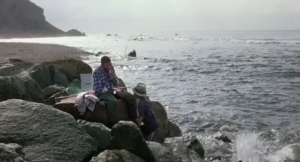
Still from Boyz n the Hood, at White Point.

While most of the film was shot on location in South Los Angeles, we get to see two local spots in the film, one is a house on Santa Cruz, and another, more idyllic sequence takes place as Furious Styles (Laurence Fishburne) and Tre (Cuba Gooding Jr.) fish at none other than White Point.

It’s not just gritty crime films that feature our beautiful town, though, as Ava DuVernay brought her unique vision to the gorgeous and underrated adaptation of Madeleine L’Engle’s A Wrinkle in Time to San Pedro’s Space Force Base. In one of the film’s most haunting moments, we see a circular cul-de-sac that looks liminal and unreal, but is in fact just one of the residential areas of the base.

There are many other incredible films starring iconic Black Hollywood stars that have filmed in San Pedro. Those include legends like Will Smith (whose superhero satire Hancock shot in Pedro), Djimon Hounsou, Morgan Freeman, and Chiwetel Ejiofor (Stephen Spielberg’s award-winning historical drama about a real-life uprising of enslaved people on the titular chattel-ship is another Pedro-starring feature). Lawrence Fishburne’s underrated neo-noir Deep Cover also took advantage of our often gritty streets. He would return to our South Bay city alongside Orlando Jones in Biker Boyz. And of course, Beverly Hills Cop 2, led by comic icon Eddie Murphy, features multiple shots of the Vincent Thomas Bridge and Terminal Island, two of our most frequently filmed landmarks.

Early Blaxploitation flicks like Truck Turner and Black Gunn also utilized the ’70s streets of our town. It’s not just fictional films either, with the Biggie & Tupac documentary by British director Nick Broomfield featuring multiple spots in Pedro throughout. So this Black History Month — and every other month — why not watch some of this brilliant Black cinema?

Love After Divorce, or How the Aquarium Became an Ocean


By Sophie Schoenfeld, MFT

Love after divorce is a different kind of love. It’s more like stepping into the ocean after a shipwreck. It’s finding your faith after you’ve lost it in the storm of life. Sometimes I have wondered if love only lives on the wings of delusion… it is a religion of sorts… it is an investment in something intangible, fragile, and unbearably light, such as another human being.

We get married to the idea and a fantasy, a thought that something solid and unbreakable can be created through commitment. That we have the conviction, the strength, and the vastness to battle something through eternity, I would say love is a human attempt to defeat death; love is a statement that exceeds human container. Marriage, an ultimate commitment to that unbreakable promise of love. “In sickness and in health, through all the storms and all the devastation, I will love you and stand by you always and forever”… with one important caveat: it only works if both people agree to the terms. And this is where the whole business of eternal love and lifetime of commitment gets turned on its head. Because two people are two separate worlds, and in some cases, the distance between those worlds is in itself infinite. It is a cruel joke. Can a bridge be built in an infinite space between two objects? And when the bridge collapses while in formation, and one must face the failure of the very limit one tries to overcome, is it even conceivable to try again?

There are things that keep marriages together, and it’s not just the whale of emotion that propels us toward each other. Longevity and sturdiness of love relationships is mostly reliant on practical things, very unromantic things in fact. Finances, social and familial pressures, children, habits. In fact, the more things we build around the relationship, the sturdier it becomes. All of the practicalities begin to serve as the scaffold. Love is not just an emotion; it is an infrastructure, an infrastructure that is not infallible, and when that structure collapses, life must go on…wounded, shipwrecked, destitute even, if not monetarily, often emotionally, nevertheless, we go on.

So what does it look like when the greatest fantasy of what one is capable of vanishes? There are stages of grief, because divorce is a death. But then there is also a process of regrowth, rebirth and reclamation. I remember strange feelings, such as euphoria, liberation, accompanied by an emotional and mental whiteout. A profound feeling of being lost in the ether. My grief was delayed, for some years I felt numb, and perfectly ok living in a cocoon of familiar comfort. This was a gestation period, because you see, when you survive the chaos of divorce, which feels more like a dissolution of a business rather than a spiritual rapture that it truly is, you discover that solitary life in many ways is much more tranquil. There are no dramatic disappointments and fights, there is no management of opposing needs and desires, life becomes blissfully unperturbed. Through this tranquility, there were years of healing. Day-to-day single life can be wonderful, peaceful and quite sustainable. In contrast, he healing process — that is the internal transformation — can be quite violent. It can leave a string of broken hearts along the way, because you are simply emotionally unavailable, you have no bandwidth to care and while on the outside you seem quite self possessed, internally you’re screaming. Not because you have let someone hurt you, but because you feel like no one can ever reach you in places where it hurts. And who would have thought that the idea of not ever hurting again could be more terrifying than being torn to pieces by a heartbreak?! And yet, this is very much the core challenge when figuring out love after divorce.

My love was vast, infinite, and all encompassing, it crossed continents and oceans, it created life, and wealth and structure, it was an underwater kingdom of all things ethereal and enchanting, until slowly it became an aquarium, restricted, polluted and unsustainable, with no natural cleansing system in place. My ex and I wobbled along in that polluted water until one day the aquarium cracked, and we both found ourselves back in the ocean, cold, powerful and disorienting, we felt small, incapable of mastering its tides. Some people at that time require another fish to attach to, because it is so scary to swim alone. Not knowing which way one is supposed to swim, and no longer trusting one’s instincts as the fantasy of one’s invincibility has shattered.

And yet we go on, we swim because we have to, and if you swim long enough, you begin to learn the ocean again. It is not the same as it was before, you begin to respect its power. If you swim alone long enough, your fantasy around what love is changes slowly, You become aware that you don’t need to build a bridge across the infinite space to reach another, that love is inside you, and all the things around you are simply representations of that infinite space within. You become the nucleus of your own universe and you are able to allow yourself to get hurt again, because now you are brave, and this is when you finally realize, you have become the big fish in the ocean, and that the ocean is you.

Uncertainty Aside, State of POLB is Nothing but Good … According to the Port, at Least


A complaint I’ve always had about Long Beach’s State of the City event is that, rather than provide an honest look of where we’re at, the mayor acts as head cheerleader, telling one and all that the city is “strong and getting stronger” (a quote we hear literally every year), with no ownership taken of what’s wrong.

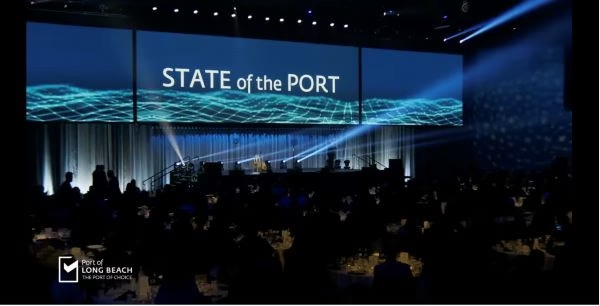
But it turns out that compared to the State of the Port event, the State of the City is almost hard-bitten realism. To hear new Port of Long Beach CEO Noel Hacegaba tell it, the only takeaway from last September’s “once-in-a-lifetime mishap” at the Port was a silver lining, in that the response of all parties involved “showed that we don’t just train to be resilient, we are resilient.”

Is there really nothing but good at the port, both now and on the horizon? We caught a few things — both substantive and trivial — that makes us wonder.


Is it really all that?

Before Hacegaba even took the stage, the spin machine was in full effect. In his introductory remarks, Mayor Rex Richardson praised the port’s recent “landmark agreement with the South Coast Air Quality Management District […] that puts a major step forward toward faster, cleaner, zero-emission[s] infrastructure while protecting our local jobs and the workers that power our economy.” Hacegaba himself went on to tout this “cooperative agreement,” saying it “contains time-bound and enforceable commitments to develop zero-emissions infrastructure […].”

But nonprofit, nonpartisan news org CalMatters urged the SCAQMD to vote against “the so-called cooperative agreement” on the grounds that “impacted community members were not meaningfully included” in the process of crafting the agreement, which “weakens the [D]istrict’s ability to reduce emissions and it creates a dangerous precedent.” CalMatters noted that the agreement “includes a five-year ban on rulemaking. That handcuffs South Coast Air Quality Management District, effectively blocking the agency’s authority to address port pollution when the South Coast Air Basin can least afford a delay.”

Port Of Long Beach CEO Noel Hacegaba With Guitar And The TEUs
Port of Long Beach CEO Noel Hacegaba, who apparently also fronts a band called the TEUs. Courtesy of Port of Long Beach


Don’t quit your day job

Immediately prior to Hacegaba’s taking the stage, we got a music video featuring of The TCUs — an ad hoc employee band featuring Hacegaba on lead guitar — performing a version of Modern English’s I Melt with You so lazily rewritten it made absolutely no sense: “Moving forward using all my breath / Making sure the port is never second-best / I saw the world the world growing all around your face / Never really knowing it was always mesh and lace …”


Busy and getting busier

Hacegaba noted that 2025 was the busiest year in the port’s 115-year history, moving nearly 9.9 million TEUs (Twenty-foot Equivalent Units, i.e., standard shipping containers), only the third time in the port’s history they’ve moved over 9 million TEUs. But that’s nothing compared to what’s coming: by 2050, the port expects to move over 20 million TEUs per year.

To handle this increase, the port is slated to complete the “largest in-port railyard in the world” by 2032. “The development of modern, sustainable infrastructure is all part of our 10-year, $3.2 billion Capital Improvement Program, the largest of any seaport in North America,” Hacegaba said. “And the centerpiece of this is the $1.8 billion-dollar On-Dock Rail Support Facility at Pier B. We call it America’s Green Gateway. It will double the acreage of the existing rail yard and more than triple the volume of cargo moved by rail from 1.5 to 4.7 million TEUs. […] Speed to market is the key to our success and rail connectivity is the key to our future.”

For all this, Hacegaba harped on the port’s goal of being “the first zero-emissions port in the world,” setting 2050 as the target date.

But he admitted that much is uncertain, at least in the near-term: “[… W]e continue to keep a close eye on the U.S. Supreme Court’s decision on the International Emergency Economic Powers Act case, which is expected to be announced any day. The Supreme Court’s opinion is poised to rule on the legality of the tariffs, but it will not remove the uncertainty already created by tariffs. The only certainty is…more uncertainty.”


Always check your work, kids

According to one graphic flashed up behind Hacegaba, between 2024 and 2025, soybean exports to Indonesia rose from 19,000 TEUs to 27,000 TEUs, which is “up 6,000 TEUs.” Let’s hope their accounting is better where it counts.


Semantics?

“With your help, we became the first green port,” Hacegaba declared. But despite being recognized as an industry leader, the Port of Long Beach was not even the first green port in California. That honor goes to the Port of Hueneme, which achieved “Green Marine” certification in 2017 — recognition that the Port of Long Beach has yet to receive, while the Ports of Stockton, Oakland, and San Diego have since joined the list. (Two terminal operators at the Port of Long Beach, Metro Ports and SSA Marine, have been certified Green Marine.)

But that’s nothing compared to this bizarre boner: “Last July, the railroad sector made major news with the proposed merger of Union Pacific and Norfolk Southern,” Hacegaba announced. “This would establish the first transcontinental railroad in U.S. history.”

Considering that the first transcontinental railroad line was completed on May 10, 1869, we’re not entirely sure what Hacegaba was talking about. But whatever it was, Union Pacific and Norfolk Southern will have to straighten some stuff out before it comes to pass, because the day after the State of the Port, their merger application was rejected.

Words, words, words

In addition to a litany of bumper-sticker slogans (e.g., “We lead with vision and inspire with action”; “Teamwork makes the dream work”; “We’re doing the right things for the right reasons in the right way”), Hacegaba occasionally extended himself into empty metaphors. “Any football fans here today?” he asked. “[…] This is what I told the team: we’re going to reset the goal line, we’re going to expand our playbook, we’re gonna update our gameplan, and we’re moving to a hurry-up offense, because here in Long Beach we play to win — and together we’re going to put a lot of points on the board.”

Whatever you say, coach.

Seroka’s “State of The Port” Speech: Another Myopic Rah-Rah Affair


Both local ports staged their annual “State of the Port” events at the end of January, touting themselves falsely as environmental leaders and honestly as commercial survivors in the face of Trump’s chaotic tariff threats.

While the State of the Nation and its state and local government equivalents are long-standing traditions that call for some serious reflection along with the self-promotion, if only out of political necessity, that’s hardly the case with the much more recent “state of the port” tradition, barely more than a decade old. It’s almost exclusively a rah-rah affair, and this year proved no different.

“Twenty-twenty-five was a year like no other. From accelerated dips in volume to record highs, it truly was a roller coaster.” Port of LA executive director Gene Seroka said, speaking to a crowd of over 930 at AltaSea.

“But at the end of the ride, the Port of Los Angeles moved 10.2 million container units. That’s our third-best year in history. And I’m proud to say that for the 26th consecutive year, the Port of Los Angeles remains America’s busiest container port.”

That much was certainly true. Not so his claim that POLA’s “environmental work we’ve spotlighted … is an essential part of our collective DNA,” given that it took decades of struggle and a landmark lawsuit to get the port to even start complying with the state’s environmental laws when it came to new terminal construction. Environmental progress doesn’t come from the port’s DNA, but from community protests and lawsuits.

In keeping with this history, both ports vigorously fought to prevent the South Coast Air Quality Management District from creating an indirect source rule that would limit their emissions, similar to the one recently passed for warehouses. Instead, they subverted the public process with a backroom deal, creating a “memorandum of understanding” that lets them continue as they will, with no possibility of outside regulation for at least five years. And both ports had the chutzpah to tout this travesty as something to be proud of, with the mayors of both cities chiming in during their introductory remarks.

Long Beach Mayor Rex Richardson praised the MOU as a “landmark agreement,” while LA Mayor Karen Bass said “there’s no better example of creating an environmental legacy than” approving the MOU “after many, many years,” which of course was due to the ports fighting regulation tooth and nail every step of the way — successfully, in the end.

Similarly, Seroka’s claim that “No other port complex in the world is tackling these challenges at this pace with this level of success” doesn’t stand up to scrutiny. While less blatantly false than Port of Long Beach CEO Noel Hacegaba’s false claim that POLB had become “the first green port,” Seroka promoted the illusion that the twin ports are world leaders, when in fact they stand out from other California ports as not even qualifying as green ports as certified by Green Marine, which describes itself as “the leading environmental certification program for the maritime industry.” Green Marine lists 57 green ports worldwide, with five in California: the ports of Hueneme, Oakland, Redwood City, San Diego and Stockton. The state’s two largest ports are conspicuous by their absence.

Green Marine also certifies individual terminals, as well as shippers and shipyards. Here, at least, POLA has four that qualify, while POLB has two. But here again, a larger truth emerges: Four of the six terminals are owned by two companies that are standout leaders worldwide. Of 124 green terminals worldwide, Ports America has 23, with three at POLA — LA Cruise, WCBT & NATSS —while SSA Marine has 15, with one at POLB, the Matson terminal.

This reflects the larger truth that political pressure is driving change and that companies with more resources and longer planning horizons are responding first. While ports could facilitate this process, as both ports’ leaders claimed they were doing, just how much they’re actually doing this is called into question by the fact that neither is certified as a green port, and that both celebrated their victory in defeating regulation.

POLA’s claims are further called into question by two towering historical facts: its history of fighting environmental law, most notably the decades-long battles involving the China Shipping terminal — and its disbanding of a highly successful citizen oversight body, the Port Community Advisory Committee. POLA first tried to build the China Shipping terminal without any environmental review, then secretly let it operate without several key mitigation measures, and when sued again, claimed it couldn’t enforce them, only to have a court rule otherwise, and finally force the law to be followed.

While the PCAC was set up to be a general oversight body, representing all community stakeholders, it was subsequently given responsibility for overseeing the distribution of funds from a 2004 settlement of the first China Shipping lawsuit. When the funds were finally disbursed, the port used that as an excuse to disband PCAC entirely, freeing it from any further community oversight. The second China Shipping lawsuit stemmed from mitigation measures that weren’t enforced, in part because PCAC wasn’t there to monitor what was going on.

None of this history figures into Seroka’s upbeat vision of the state of the port. When it comes to the community, he bragged, “Next month in Wilmington, we’ll break ground on the Avalon Pedestrian Bridge, which will link to the new Wilmington waterfront promenade,” as if a project promised 20 years ago in response to enormous community organizing was something to be proud of, rather than a cause for shame and self-reflection. Without activists like Jesse Marquez and Ken Melendez, it would never have even been promised in the first place.

But what Seroka really cared about was business, naturally. And so he scrolled through several upcoming projects, starting with the proposed 200-acre Pier 500 marine container terminal, POLA’s first new terminal in a generation. “The beauty of this project, much of the underwater foundation is already complete, thanks to the foresight of port staff more than two decades ago,” Seroka said. “They saw what we would need, and they built for it. … We want this to be the greenest, cleanest new build terminal in the world.”

What he didn’t say was that the underwater foundation was part of the Pier 400 project, which was originally proposed as an “energy island.” It was intended to move all fossil fuel handling far away from the community, but that purpose was abandoned once funding had been secured — yet another example of how community needs and interests are both manipulated and disregarded, and then officially forgotten.

And so it was throughout Seroka’s presentation. The future looks bright for the elite industry crowd inside AltaSea with Seroka, who think they can afford to wait decades for a zero-carbon transition to finally be finished.

“A hundred years ago, this building moved cargo. Today, it moves ideas,” Seroka said. “That transformation didn’t happen by accident. It happened because people had the vision and the courage to build for the future. There’s a lot of change in our world.” But the one thing that doesn’t change is the port’s disregard and disdain for the surrounding community that’s not part of their inner circle. Whole industries have repeatedly been lost, but in Seroka’s telling, it’s all been a story of progress. “Throughout our 118-year history, not a single year has gone by without headwinds,” he said “And not a single year when we haven’t risen to the challenge.”

It’s a happy bedtime story for the port to tell itself. But it doesn’t sound so convincing to those who’ve heard it all so many times before.


San Pedro’s Olympic Waterfront Promises, Neglect, and No Guarantees

By Devonte Barr, Reporter

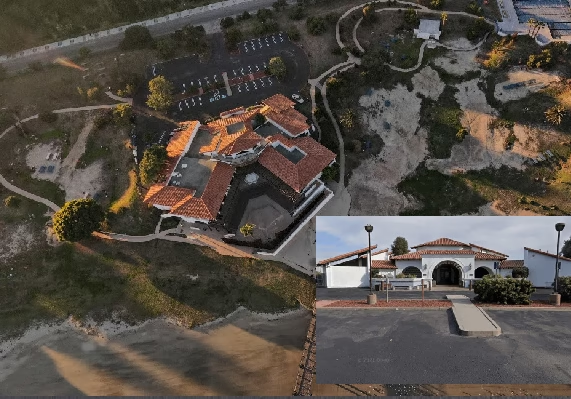
At the Central San Pedro Neighborhood Council meeting on Jan. 20th, Port of Los Angeles spokesperson Mike Galvin faced pointed questions about facilities expected to host Olympic sailing in 2028, including the Cabrillo Beach Scout camp in the inner-harbor of Cabrillo Beach. Port officials say more than 3,000 spectators could attend a single day of competition — a projection that feels increasingly unstable given how little has changed at the Outer Harbor over the last decade.

Under sustained questioning, Galvin acknowledged what many residents already knew but had rarely heard stated so plainly: the aquatic facilities have suffered years of neglect, lacked a long-term operating plan, and offered no binding guarantees of community access once the games conclude.

“Some of the internal systems have not been well-maintained over the last 10 years,” Galvin said. The admission was striking — not because it surprised anyone in the room, but because it confirmed on the record that a public waterfront asset had been allowed to deteriorate until an international event forced attention.

Those “internal systems” aren’t abstract. They include restrooms, docks, electrical infrastructure, and safety features — the basics required for any venue expected to handle thousands of visitors. The port is now racing the Olympic clock to address them, but only to a limited extent. Galvin made clear that the Harbor Department does not intend to operate the facility after the games.

“Our intent is not to be the operator long-term,” he said. Instead, once the Olympics conclude, the port plans to put the site back out for competitive bidding.

That single sentence carries major implications. It signals that the port’s priority is making the site functional enough to pass Olympic standards, not committing to what it becomes afterward. The long-term future — who runs the facility, who can afford it, and who gets priority access — is being deferred to a future operator who doesn’t yet exist.

When asked about current users, including local youth sailing programs and community boating groups, Galvin struck a careful tone. A future operator, he said, would be “expected to accommodate current users.” But expectation is not an obligation. There is no written access agreement, no enforceable standard, and no mechanism preventing a future operator from reshaping the facility around private memberships, higher fees, or restricted use.

The people who rely on the waterfront now are being asked to trust a process that has yet to be designed.

The port keeps pointing to “partnerships,” but the details fall apart under a microscope. Galvin clarified that the Boy Scouts’ role was largely limited to amphitheater decking, with the port funding the rest. This remains a taxpayer-backed facility in a working-class community that has spent decades absorbing diesel fumes, truck traffic and industrial noise for the sake of port operations.

The Olympics are now being framed as the payoff. In theory, thousands of spectators could bring hotel bookings, restaurant traffic, and long-needed economic activity. But that only happens if San Pedro is allowed to participate. If access narrows, prices climb, or local programs are pushed aside, the benefits won’t land here — they’ll pass straight through.

Transparency remains the missing ingredient. The port operates with an annual budget exceeding $1.5 billion, yet there is little public clarity on how much of that investment will meaningfully reach San Pedro — or how much will be spent simply bringing facilities up to minimum safety standards before being handed off.

Galvin repeatedly emphasized “long-term community benefit” during his remarks. The phrase sounds reassuring, but it isn’t a plan. What is concrete is the port’s current approach: address safety issues, host the games, then solicit bids from a long-term operator.

“We’ll make the basic improvements needed,” Galvin said, “and then put it back out for a competitive long-term operator.”

“Basic improvements” set the floor, not the ceiling. “Competitive operator” introduces market forces into a space that has historically functioned as public infrastructure. There is nothing in that framework stopping San Pedro residents from being pushed aside once the Olympic banners come down.

That uncertainty is why Neighborhood council members aren’t asking for Olympic promises, but written guarantees — proof that existing programs won’t be displaced and that community access won’t be sacrificed for a global event.

Local youth sailing programs are already questioning whether they’ll be priced out or pushed aside after 2028. And looming over everything is the operator question. Will the facility go to a private yacht club? A marina corporation? A nonprofit with genuine community roots — or one that simply uses the word “community” as marketing language?

The Olympics are being sold as climate leadership, economic opportunity and neighborhood investment, but San Pedro has seen this cycle before: big promises, short timelines and vague legacies. If the port can’t commit now, in writing, to real investment and enforceable access, there’s little reason to believe the post-2028 future will look any different once the boats sail and the cameras leave.

Silence is Not Democracy


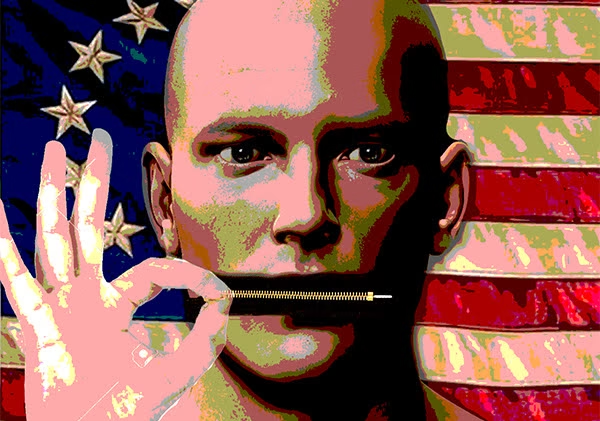
It’s not free speech when you’re afraid to say it out loud

I’ve said it many times before that we live in a community where people hold two opinions–the one that they think is acceptable to say in public and the one they whisper when no one is listening. This has become only more prevalent with the current state of despair and disruption.– Many don’t want to risk their jobs, their status or even their friends by saying what is truly on their minds. And they still believe that they have “free speech.” This is self- censorship, which is motivated, at its core, by polite cowardice.

So, I am inspired by the millions of people coming out to protest ICE and the orange Felon occupying the Oval Office, pushing to expose Epstein and his pedophile pals. And yet in the corporate owned media rarely call a lie a lie. We’ve seen it over and over where some journalist asks the right question at a news conference and the Orange Liar-in-Chief just barks back at them and their news outlet. This silences the criticism but also avoids the answer. That’s the big picture.

On a more local level, what we see are people compromised by their own personal politics or contractual obligations–NDA’s are just codes of conduct from an employer that doesn’t allow a person to speak to the press.

Part of this comes from the corporatization of communications. Questions can only be posed to the PR mouthpiece of a company or department after the question has been vetted and approved. This has filtered down to all levels of government where the freedom to speak to the press has been vilified to “leaking” information anonymously. In previous times there were “whistle blower” laws to protect employees who revealed wrong-doing, corruption or malfeasance, but now? Saying the wrong thing is considered “treason”.

The weirdest part is that this corporate speak style has now infiltrated the non-profit sector where all you get is the “happy PR newsletter”. Nothing ever is going wrong, right?

Over the course of 46 years publishing this town’s only newspaper I can’t tell you the number of times one or another non-profit has had to fire a director or treasurer or administrative secretary for fraud or theft. The boards of directors have only whispered the truth but never come clean for fear that their funding would dry up.

This is kind small potatoes compared to POLA summarily firing Chris Cannon, the director of Environmental Affairs with no excuse made public or why there was not further investigation of his Port of Long Beach counterpart, Rick Cameron, who was served with a search warrant by the FBI to search his email, before he abruptly resigned and subsequently died of a heart attack.

No one at either port admits to knowing anything about any of this. What we get from both ports are glowing reports on TEU’s numbers, profits and how they are doing a superior job on addressing the pollution from the harbors. The headline being the future is bright despite the chaos of Trump’s ever-changing tariffs. Both port directors know Trump’s tariffs are insane. Not that certain kinds of tariffs can be beneficial but blanket tariffs are just plain stupid, but nobody wants to say it out loud.

These days, speaking out against the regime gets you pelted with a barrage of pejoratives such as: radical leftist Democrat, socialist terrorist, communist. Or brought under federal investigation for some fictitious crime. We are a nation now that lives in fear of speaking truth to power, whether at a press conference, city council meeting, a neighborhood council meeting or in the private boardrooms of non-profits.– Except now people, ordinary people, are marching in the streets.

When people give up their rights to free speech we are all worse off because the debate between people on policies, provisions or practices allows for real democracy to work. Remember we believe that we are still a democracy. Try actually using your first amendment like you mean it. Just try to remember to say something intelligent!

Two Queens, One Harbor: Historic Reunion in Long Beach


By Arturo Garcia-Ayala and Terelle Jerricks

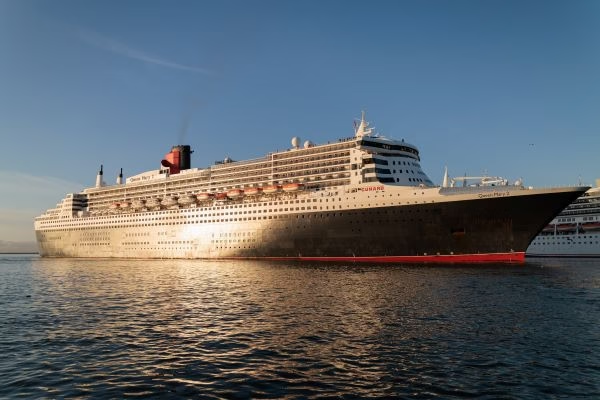
For the first time in nearly two decades, the Queen Mary and Queen Mary 2 stood side by side in the Port of Long Beach — a rare maritime reunion that drew excitement across Southern California.

“It’s just a wonderful day,” said Steve Coloca, managing director of the Queen Mary. “To have the Queen Mary 2 right alongside the Queen Mary here in Long Beach — it’s great for Southern California to have the two sisters back together.”

The last visit by the Queen Mary 2 was about 20 years ago, making the moment especially meaningful for ship enthusiasts and local residents.

For Danny Wrangel, first officer aboard the historic Queen Mary, the sight was unforgettable.

“It was an incredible moment — 20 years in the making,” Wrangel said. “To see her that close was awe-inspiring. She’s inspired by her older sister, the Queen Mary. Getting to narrate that for everyone was something special I’ll never forget.”

IMG 1091
The Queen Mary Photo by Arturo Garcia-Ayala

The bond between the two liners is more than symbolic. One of the Queen Mary 2’s horns is the original horn from the Queen Mary, transferred during the newer ship’s construction in the early 2000s. The Queen Mary 2 was launched in 2005.

During the reunion, the Queen Mary 2 sounded its horn first. Moments later, the Queen Mary answered, the blasts echoing across the harbor — a shared voice bridging generations of ocean travel.

“It’s really wonderful,” Coloca said.

The original Queen Mary, once capable of nearly 40 miles per hour, remains the faster vessel in maritime lore. The Queen Mary 2, reaching about 34 to 35 miles per hour, is currently the fastest active ocean liner in service. She is captained by Inger Klein Thorhauge of the Cunard Line.

The Queen Mary 2 is scheduled to remain in port for several days before continuing her voyage.

Random Happening: Opening Reception – Species of Magic: From the Studio of W. S. Milner


Join at Angeles Gate Cultural Center, Feb. 14 for the opening of Species of Magic: From the Studio of W.S. Milner, a solo exhibition of works by the late San Pedro artist also known as Wendy Calloway (1948 – 2025).

Curated by Phoebe Barnum and Susan Davis, this exhibition features a selection of works from the collections of many who knew and loved the late AGCC Studio Artist.

Species of Magic: From the Studio of W.S. Milner draws inspiration from a definition of poetry that characterizes it as a transformative and enigmatic force. Poet, scholar, and artist, Wendy Calloway’s rich practice was akin to alchemy, a transformative force for constructing reality and unveiling hidden truths. This celebratory exhibition offers a glimpse into her studio practice, providing insight into the creative environment where her “species of magic” took form.

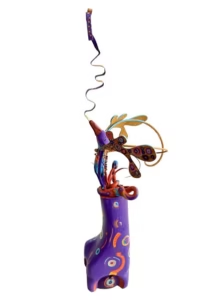
WS Milner Bird From The Collection Of Susan And Michael Davis
WS Milner Bird from the collection of Susan and Michael-Davis. Photo courtesy of AGCC.

Species of Magic: From the Studio of W.S. Milner will be on view in the gallery Feb. 14 through March 21 with free public visiting hours Thursdays, Fridays, and Saturdays, from 10 a.m. to 5 p.m.

Time: 2 to 4 p.m., Feb. 14

Cost: Free

Details: RSVP, https://tinyurl.com/Species-of-Magic

Venue: Angels Gate Cultural Center, 3601 S. Gaffey St., San Pedro