

Home Blog Page 81

The Hidden Cost of AI: How Data Centers Are Straining Water, Power, and Communities


The Hidden Cost of AI: How Data Centers Are Straining Water, Power, and Communities

By Ella Mrofka
Editor’s Note: This is the second of two Dispatches on AI data centers; read the previous article, by Alefiya Presswala,here.

The residents ofSaline Township, Michigan, are upset. Soon, construction will begin on a 2.2 million-square-foot data center located just outside the small rural town, which will ultimately serve two Big Tech companies: Oracle and OpenAI. Area residents oppose the facility because they fear it will strain the region’s power grid and increase their electricity bills, disrupt the area’s farmland, and consume much of the area’s water (as the plant will ultimately usemore waterthan any other single user in the Great Lakes region). Some residents are taking their concerns to court, while others believe these new data centers can lead by example if they protect the environment during building and usage.

Many other cities around the United States are also fighting the construction of new data centers, and for similar reasons: concern that they will lead to water shortages and soaring energy bills. Community members are signing petitions, and, according to Data Center Watch,$98 billionworth of data center investments have been blocked as communities organize to fight for more and stricter regulations on these massive facilities and their demand for water and energy.

Water Usage

Big tech companies such as Amazon, Google, and Microsoft are continuing to expand their data centers due to the rapid rise of AI. An April 2025studyby SourceMaterial andThe Guardiandetermined that these companies plan to expand the number of data centers by 78 percent.

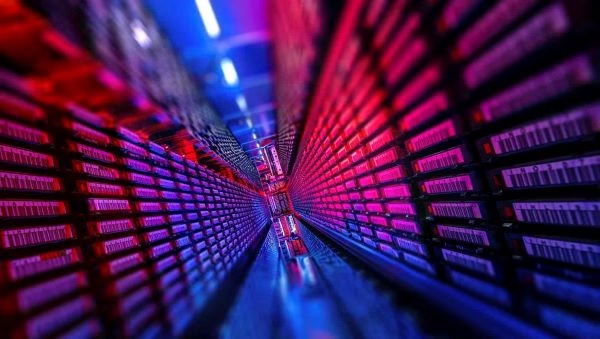
For AI to answer a prompt, it performs many calculations, all of which generate heat. Data centers use vast amounts of water to cool servers and other equipment.The Washington Postreportsthat large data centers can use up to five million gallons of water a day, equivalent to the daily water needs of 10,000 to 50,000 people.

According to a new study summarized in a December 17 article inThe Verge, AI couldconsumebetween 312.5 and 764.6 billion liters of water in 2025. To put that figure in perspective, the country’s largest metropolis, New York City,usesapproximately 1 billion gallons, or 4.5 billion liters, of water per day. So, in 2024, existing AI data centers sucked up as much water as a city of 9 million people used in 5 months.

In 2023,Microsoftacknowledged that 42 percent of its water came from areas experiencing water stress, while Amazon did not report a figure. It is common to build data centers in dry regions to decrease the risk of corrosion damage to their servers. This affects water-scarce areas like Arizona and Virginia, where many US data centers are being built. Newton County, Georgia, is on track to face a water deficit by 2030 after Meta broke ground on a $750 million data center, according to theNew York Times.

Northern Virginia is home to the most data centers in the world, even as the state continues to experience drought and increased water scarcity. Roughly 70 percent ofglobal internet trafficruns through data centers in Virginia. The Virginia Data Center Reform Coalitionfightsfor transparency from these big tech companies to connect data centers and water issues. Without full transparency, these companies can continue to target water-stressed areas without public understanding of how natural resources are being depleted.

For instance, Mike Doble, a communications advisor for the Virginia Data Center Reform Coalition, explains that demand for electricity in Virginia is expected to double or triple “over the next 15 years. … an unprecedented amount of increase.”

Microsoft claims that it will build azero-waterdata center by 2027 and will bewater offsettingalongside Google by 2030, but this does not change the fact that hundreds of already operational data centers are all highly water-reliant.

Energy Usage

As AI growth accelerates, energy usage will also skyrocket. According to a2024 reportby the Lawrence Berkeley National Laboratory, data center energy use has tripled over the past decade and is projected to double or triple again by 2028. Data centers are projected to account for nine percent ofglobal electricityconsumption by 2030.

Scientists and researchers argue that AI companies also fail to fully disclose how much energy their current models use or the projected demands of future projects.

In 2024, natural gas accounted for forty percent of the energy used by US data centers,accordingto the International Energy Agency (IEA). Renewables, nuclear power, and coal also supplied electricity to data centers. Natural gas is projected to remain the largest source of energy for data centers through 2030. Focusing on increasing renewable energy use in data centers should be a top priority.

Increasing energy demands by data centers affect electricity bills for Americans. According to aBloomberg Newsanalysis, electricitycostsin areas near data centers are as much as 267 percent higher than they were five years ago. People located near data centers are not the only ones feeling the effects. A July 2025 report by researchers at Carnegie Mellon Universityfoundthat the average US electricity bill could increase by eight percent by 2030 due to data centers and cryptocurrency mining.

The “simple” solution, according to theNew York​​ Times, is to ask big tech companies to draw less power from the grid when it is most strained, relying on batteries to power operations during those periods. However, this is not a realistic solution because there is no law requiring big tech companies to do this.

Resistance and Solutions

Acoalitionof 230 environmental groups is campaigning for a halt to the construction of new data centers, due to environmental concerns,TheGuardianreported in December 2025. “The rapid, largely unregulated rise of datacenters to fuel the AI and crypto frenzy is disrupting communities across the country and threatening Americans’ economic, environmental, climate and water security,” according to alettersent to Congress by members of the coalition, which includes national and international groups such as Food & Water Watch, Greenpeace, and Oil Change International, as well as regional and state-based organizations.

Given AI’s harmful environmental impacts, steps should be taken to slow and prevent the construction of new data centers until they are built in ways that do not contribute to further environmental destruction.

In order for AI and data centers to become more sustainable, companies would need to be transparent about how much energy and water they use. Without accurate data from all major tech companies, the effectiveness of potential solutions is limited.

Doble, the spokesperson with the Virginia Data Center Reform Coalition, recommended that “the place to make your mark is at the local and state level, knowing who’s making the decisions, because right now, big businesses are making the decisions.” To achieve data center transparency, state lawmakers must enact policy.

In 2023,Oregonlawmakers introduced a bill requiring data centers to run on entirely clean energy by 2040. Amazon lobbied against the bill, leading to its demise.

Using solar and wind energy in data centers instead of relying on unsustainable sources such as natural gas, coal, and oil can change future projections. The operation and maintenance of solar energy systems are up to 60 percent morecost-efficient than conventional technology. Solar and wind energy are becoming more efficient and should be used to power AI data centers.

Using closed-loop cooling systems allows for both rainwater and recycled wastewater to be used multiple times. This method reduces freshwater use by70 percent.

It is hard to rely fully on renewable energy sources, given the outdated electrical grid being used today.Experts believethe grid needs to be updated, as 70 percent of power lines are more than twenty-five years old.

With AI continually on the rise, there is no time to waste. As a society, we need to have conversations about potential solutions and implement them soon, so that we don’t leave future generations in further crisis.

Ella Mrofkais a sophomore journalism major at North Central College in Illinois. In summer 2025, she completed an internship with Project Censored.
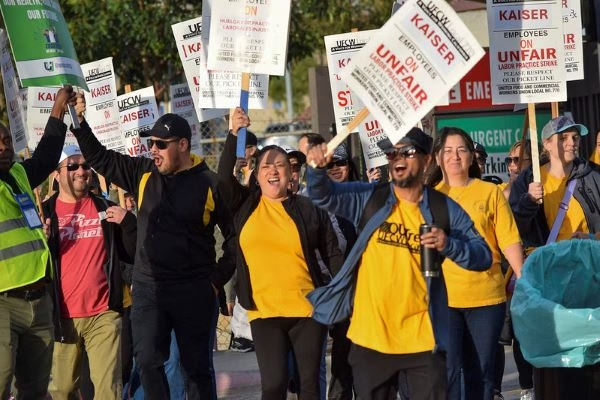
Kaiser Pharmacy and Lab Workers Launch Strike Across Southern California and Bakersfield

LOS ANGELES — Thousands of Kaiser workers and supporters showed up and showed out, Feb. 10 walking off the job at Kaiser locations throughout Southern California to protest the company’s unlawful actions that have prevented frontline healthcare workers from getting the fair contract they deserve. Picketing is taking place at select Kaiser medical centers throughout the region, and a massive solidarity rally was held in Los Angeles.

“Kaiser’s unfair labor practices are making healthcare unsafe,” said Gerardo Silva, a pharmacy assistant with 23 years at Kaiser in Los Angeles. “Workers are being intimidated, shut out of safety decisions, and punished for speaking up. When workers are afraid, mistakes happen — and patients feel that chaos. Kaiser can end this today by stopping the intimidation, ending the unfair labor practices, and coming back to the bargaining table.”

Over 3,000 UFCW members joined alongside 31,000 nurses and healthcare professionals with UNAC/UHCP who began their own ULP strike on Jan. 26, 2026.

Workers told Kaiser loud and clear that they won’t stand for the company to refuse to bargain nationally, surveil workers, retaliate against them for union activity, and block them from talking to their Union Representatives.

“As both a Kaiser pharmacy assistant and a Kaiser patient, I see the damage these unfair labor practices are causing on both sides of the counter,” said Estefany Ruiz, a pharmacy assistant at Kaiser Glendale with nine years of service. “Kaiser is breaking the law by intimidating workers, blocking our union representatives, and refusing to bargain in good faith. And that chaos is hurting patients. While patients wait hours for prescriptions and appointments are canceled with little notice, executives are paying themselves hundreds of millions of dollars. That’s not a lack of resources, it’s a lack of priorities.”

The Unfair Labor Practice strike continues today at dozens of Kaiser facilities throughout Los Angeles, Orange, San Diego, San Bernardino, Riverside, Ventura, and Kern Counties.

City Attorney Targets Landlords in Lawsuit Over Alleged Tenant Rights Violations

LOS ANGELES — City Attorney Hydee Feldstein Soto’s office Feb. 5 filed a civil enforcement action against landlords Benny Pirian, Piaman Nisan Pirian and multiple business entities under their control (collectively “Defendants”). The suit alleges systemic and ongoing violations of state and local housing laws designed to protect renters. The Defendants own and operate at least 16 multifamily residential properties in Los Angeles – comprising over 100 rental units as well as single family rental properties. They are alleged to have engaged in a pattern of unlawful business practices, including withholding security deposits, increasing rent above legal limits, and charging excessive late fees for delinquent rent.

Feldstein Soto’s lawsuit seeks an injunction to stop the defendants’ alleged unlawful activity, restitution for tenants harmed by the unlawful activity, and civil penalties.

Defendants, who have an ownership interest in numerous rental properties throughout Los Angeles County, are alleged to have flouted state and local housing laws that were enacted to protect tenants.

This lawsuit alleges:

  • The Defendants retain most or all of their former tenants’ security deposits. When called out on this practice, they first ignore the complaints and then tell the former tenants that if they want to recover their money, they can go to court.
  • The Defendants’ standard lease agreement includes an unlawful provision that they may charge 10% of base rent as a late fee in the event the tenant is late. Despite this provision being an unenforceable penalty, the Defendants have charged individual tenants hundreds of dollars pursuant to this provision.
  • By at least mid-2021, the Defendants were on notice that rental increases they imposed during the COVID-19 local emergency were unlawful. Not only did they not roll back those illegal rent increases across the board, they instructed the tenants who complained not to tell their neighbors that the rent increases were illegal.
  • Defendants fail to pay interest on security deposits held one year or longer; and
  • Defendants discriminate against tenants based on how they receive housing subsidies, unlawfully pass city fees onto tenants and fail to provide contact information to tenants regarding the rental property’s owner and manager, as required by law.

If you are a tenant who lived in one of the Defendants’ units and believe that you experienced their alleged unlawful practices, contact the city attorney’s public rights branch by email at att.pirian@lacity.org or phone at 213-922-8390.

Report Details Broad Economic Fallout of Federal Immigration Enforcement in L.A. County

LOS ANGELES – The Los Angeles County Department of Economic Opportunity or DEO and Los Angeles County Economic Development Corporation or LAEDC released a report analyzing the economic impacts of federal immigration enforcement activities on small businesses, workers, and communities across Los Angeles County. The report is the culmination of six previous reports produced by DEO and LAEDC, tracking the evolving impacts of immigration enforcement activities on the county’s small businesses, economy and workforce since June 2025.

Commissioned by a motion introduced by Supervisors Hilda L. Solis and Janice Hahn and adopted by the Board of Supervisors on June 17, 2025, the report draws on a combination of data analysis and direct input from businesses and communities across Los Angeles County. LAEDC analyzed economic and workforce data, immigration court records, and transportation and travel indicators, and conducted in-depth interviews with small business owners and community forums. To further inform the report, LAEDC conducted a countywide business impact survey open to all businesses in Los Angeles County to understand how recent federal immigration enforcement activities have directly affected local businesses and workers in LA County. The survey ran from mid-September to mid-November 2025.

Key Report Findings

  • Economic Contribution
    • Undocumented workers contribute an estimated $253.9 billion in total economic output, equivalent to 17% of the county’s Gross Domestic Product or GDP
    • These workers support over 1.06 million jobs and generate $80.4 billion in labor income across industries, including construction, manufacturing, retail, and services.
  • Business Disruptions
    • $3.7 million in reported business losses in just three months (July–September 2025)
    • 90% of business interview respondents perceived growing distrust across federal and local governments
    • 82% of businesses surveyed reported negative impacts from immigration enforcement, with 44% losing over half of their revenue
    • 52% experienced reduced daily sales/revenue, and 51% reported decreased customer traffic
    • Over $200,000 in property damage was reported by businesses in curfew and protest-affected areas
  • Workforce Impacts
    • 59% of employers expressed concern about maintaining their current workforce
    • 70% of businesses experienced staffing shortages following enforcement action
    • 33% of employers said workers were afraid to report to work
  • Community Level Effects
    • Bus ridership on high-vulnerability lines declined by approximately 17,000 monthly riders compared to baseline levels
    • The Downtown LA curfew (June 10–16, 2025) resulted in $840 million in output losses and 3,920 job-years lost

“The out-of-control ICE raids are doing senseless and catastrophic harm to our country, and we are seeing the toll right here in LA County,” said Janice Hahn, Los Angeles County Fourth District Supervisor. They are ripping apart families, treating our neighborhoods like warzones, and now we have hard data about the damage they are doing to our economy. Our businesses recorded millions of dollars in losses in a matter of months. This is entirely the Administration’s doing, and they can make this pain stop now.”

In response to these disruptions, DEO launched the LA Region Small Business Resiliency Fund (SBRF) in September 2025 to deliver targeted financial relief to small businesses economically impacted by immigration enforcement. The SBRF is backed by an initial investment from the county’s Care First Community Investment (CFCI) program. In December 2025, DEO announced that 367 businesses had been awarded more than $1.53 million in grants as part of the program’s first funding round. The fund received over 3,400 applications from across the county, with awards prioritized based on criteria such as property damage, workforce loss, and location within enforcement-affected areas, including curfew zones. Due to overwhelming demand, the Board of Supervisors approved an additional $3.33 million in CFCI funding to expand the program, which will allow DEO to support more than 650 additional small businesses in upcoming rounds.

Alongside financial assistance, DEO continues to partner with Department of Consumer and Business Affairs’ Office of Immigrant Affairs (DCBA–OIA) to co-lead a comprehensive, multilingual response to support both small businesses, residents, and workers. In July 2025, DEO launched a Immigration Resources for Workers and Businesses webpage where businesses, workers and residents can access Know Your Rights (KYR) recorded webinars and informational cards, an immigration resource guide, and a small business toolkit.

DEO has also expanded its Youth@Work programming to increase the number of paid work hours available, from 150 to up to 400, for youth and transitional-aged youth who have become primary earners due to family separations caused by immigration enforcement. DEO is working with America’s Job Centers of California (AJCCs), the Los Angeles Unified School District (LAUSD), and the Los Angeles Community College District (LACCD) to connect students and their families to these expanded opportunities.

Details: Find the full report here: https://opportunity.lacounty.gov/immigration/.


McOsker Policy Update, No New Jails


In 2019, a motion was introduced to amend the Los Angeles Municipal Code to prohibit the construction and operation of private detention facilities throughout all of Los Angeles. On Feb. 5, Councilman Tim McOsker moved to reactivate that council file, which expired under council policy, and restore it to its most recent legislative status. This step ensures that this work is carried out and not left unfinished. McOsker noted his concern is heightened amid ongoing ICE raids in our city that are creating fear and uncertainty for families and communities. The closure of the federal jail on Terminal Island raises additional and serious questions about whether the federal government could use it to detain residents and whether private operators could attempt to fill that gap. Reactivating this motion is a step to ensure Los Angeles does not allow private detention facilities to begin to operate as federal enforcement activity increases.


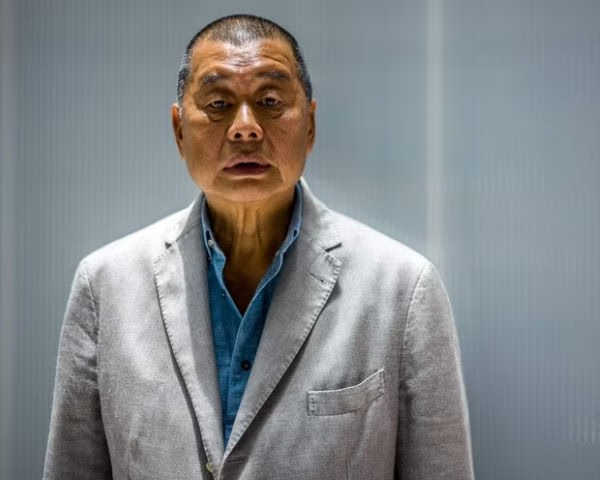
Hong Kong Hands Jimmy Lai 20-Year Sentence in Biggest Media Freedom Trial Yet


NEW YORK — The Committee to Protect Journalists Feb. 9 condemned the sentencing of publisher Jimmy Lai to 20 years in prison and jail terms of six to 10 years for former colleagues from the now-defunct newspaper Apple Daily, in Hong Kong’s largest media trial.

Lai, the founder of the pro-democracy Apple Daily and a British citizen, has been in jail since 2020, amid concerns over his deteriorating health.

Lai was convicted on Dec. 15 on two counts of conspiracy to collude with foreign forces and one count of conspiracy to publish seditious material. He was arrested in Dec. 2020 under a Beijing-imposed national security law that was used to quell protests and silence dissent, including the work of journalists.

The court also sentenced six Apple Daily editors and executives, who were arrested in 2021 and plead guilty to conspiracy to collude with foreign forces in 2022 in return for clemency on another charge. Some have served as prosecution witnesses and testified against Lai. The six are:

  • Chan Pui-man, associate publisher (sentenced to seven years in prison).
  • Cheung Kim-hung, CEO at Apple Daily’s parent company, Next Digital Limited (six years and nine months).
  • Lam Man-chung, executive editor-in-chief (10 years).
  • Ryan Law Wai-kwong, editor-in-chief (10 years).
  • Fung Wai-kong, senior editorial writer and managing editor of the newspaper’s English edition (10 years).
  • Yeung Ching-kee, lead editorial writer (seven years and three months).

The Apple Daily was forced to cease publication in 2021 after authorities froze its assets and repeatedly raided its offices, ending its 26 years of operation.

Lai has spent much of his detention in solitary confinement. Lai suffers from multiple illnesses including hypertension, diabetes, and cataracts.

CPJ has long advocated for the release of Lai, was winner of the 2021 Gwen Ifill Press Freedom Award, and the United Kingdom, Australia, Canada, and the European Union have also called for him to be freed.

Land Movement Update Voluntary Property Buyout Program Update

At the Feb. 3 city council meeting, city staff gave an update on the voluntary property buyout program in the landslide area. The city is still awaiting a formal award of $42 million in hazard mitigation grant program or HMGP funding from FEMA for the first round of the program, which is expected to fund the acquisitions of 22 homes.

In May 2025, the city applied to join a waitlist for additional HMGP funding that could open up in the event that other statewide grant projects fell through. The application sought $29 million for a second round of the program. Earlier this week, Cal OES informed staff that additional funding indeed became available, and the city has been selected for $10.16 million, which could fund the acquisition of approximately five more homes. Staff is now revising the application based on the available funding amount and will work with Cal OES and FEMA through the process. Additionally, staff is working on another HMGP grant application for $19 million to fund a third round of the program, which could cover approximately eight homes.

As a reminder, all remaining eligible applications after the initial 22 homes will maintain their order of priority for any future rounds of program funding based on factors such as safety concerns, structural condition, and utility statuses. While there is no definitive timeline for when the first properties can be purchased, the city still anticipates being formally awarded the round one grant from FEMA in at least several months from now.

From Murdering Citizens to Arresting Journalists: Trump’s Gestapo On Speedrun to Destroy Democracy


Midterm Elections In Danger

“The fascist Republican Party knows that in order to destroy democracy, it must destroy the free press.” – Mark Jacobs, former editor at the Chicago Tribune and Chicago Sun-Times.

For a full year, religious leaders have been speaking out against Trump’s anti-biblical immigration policies. They have been tear-gassed and shot with “less lethal” weapons. The Pope has publicly rebuked Vice President Vance’s defense of the policies. Churches have lost their status as sensitive locations, safe from immigration raids. One year later, in the wake of the murder of Renee Good, more than 600 clergy of all faiths flocked to Minneapolis to bear witness, support and learn from local clergy, and even get arrested with them. “The gathering heralded the emergence of a vast, faith-based network set on resisting the administration’s mass deportation effort,” Jack Jenkins reported for Religion News Service.

But Cities Church in St. Paul is different. A pastor there leads a local ICE field office. So on Feb. 18, a group of protesters led by a Black minister and civil rights attorney, Nekima Levy Armstrong, showed up to challenge what they saw as a betrayal of the gospel.

Protests inside churches are rare, but not unheard of. Attacks on churches, mosques and synagogues are unfortunately far more common. But within hours, Trump misrepresented the protest as an attack and went even further, pledging to arrest independent Black journalist Don Lemon for covering the event. “It’s notable that I’ve been cast as the face of a protest I was covering as a journalist — especially since I wasn’t the only reporter there. That framing is telling,” Lemon told CNN.

Naturally, given MAGA’s white grievance core, the Black protesters and journalists were charged under the KKK Act, passed just after the Civil War to protect freed slaves and their allies from KKK violence. Also, naturally — as with Renee Good and Alex Pretti — no violence was involved. (Though one defendant allegedly punched his fist “in the air,” and Lemon was accused of standing “so close to the pastor that Lemon caused the pastor’s right hand to graze” him.)

The speed of the Trump administration’s reaction stood in sharp contrast to its foot-dragging and even refusal to investigate the Department of Homeland Security murders of Renee Good and Alex Pretti. So too, the shaky-at-best legal foundation. After judges twice rejected the effort, a grand jury was finally persuaded to go along.

And so squads of officers were sent out at night to arrest Lemon here in LA, while another charged reporter, Georgia Fort, live-streamed her arrest from her home in Minneapolis.

“This is all stemming from the fact that I filmed a protest as a member of the media,” Fort said in a livestream from her house, “I don’t feel that I have my First Amendment right as a member of the press because now federal agents are at my door, arresting me for filming the church protest a few weeks ago.”

“I won’t stop reporting the truth,” Lemon said on Bluesky following his release on bond. “The First Amendment is the bedrock of our democracy, and I’ll continue to fight to protect it.”

In an added irony, it was later revealed that the day before the journalists’ arrest, armed ICE agents invaded church property against church wishes at North Hills United Methodist Church in an incident church officials called “terror at a house of God,” saying, it was “a violation of our sacred right to worship and serve our Lord Jesus Christ freely and safely.”

“The government’s arrests of journalists Don Lemon and Georgia Fort are naked attacks on freedom of the press,” the Freedom of the Press Foundation said in a statement. “These arrests, under bogus legal theories for obviously constitutionally protected reporting, are clear warning shots aimed at other journalists. … The answer to this outrageous attack is not fear or self-censorship. It’s an even stronger commitment to journalism, the truth, and the First Amendment.”

“The First Amendment protects acts of protest and acts of journalism equally,” said Jenna Ruddock, advocacy director of Free Press. “The criminalization of both journalists and protesters serves the same authoritarian project: shutting down dissenting voices or any content that deviates from the official narrative. These actions should outrage our leading media organizations, our elected officials, and the public alike.”

Two things were going on, Jason Stanly, author of How Fascism Works said on MS-NOW’s Velshi. First, he said, “We’re on the arresting journalists phase of fascism. And the second part is distinctively American. The whole MAGA project is about white supremacy and ethnic cleansing. So we are facing the beginning of a mass ethnic cleansing campaign. These are Black journalists. … It’s no accident that these are Black journalists.”

At the same time, Trump’s agents were seizing ballots in Georgia from the 2020 election, laying the predicate for stealing the midterms, attorney Marc Elias and others warned. “Trump has expressed regret that he did not seize voting machines in 2020. So this threat for 2026 (and 2028) is real,” UCLA law professor Rick Hasen wrote at Slate. “This is clearly a dry run for 2026,” Elias said on Bluesky.

While the attack on press freedom was straightforward, issues surrounding the protest itself were more complex, but both involve long-running right-wing efforts to redefine the First Amendment in ways that empower them at the expense of others. Equating covering an event with participating in it is one part of this redefining effort. And equating a church protest with an attack on religion is another.

While many church leaders were quick to condemn the protests, painting the church as victims of prejudice, progressive pastor and author Rodney Kennedy saw things differently. “MAGA churches are not being persecuted for righteousness but for not loving their neighbors. They are being persecuted by unexpected judgment like Jesus cleansing the temple,” he wrote at Baptist News Global.

In addition to the irony of charging Black activists and journalists under the KKK Act, they were also charged with violating the FACE Act, created to protect abortion clinics from violent, disruptive protests organized primarily by religious-based anti-abortion groups — groups that didn’t just momentarily disrupt abortion clinics providing services, but laid siege to them for weeks and even months at a time with the stated intent of shutting them down. When the act was passed, protections were added to churches as well, but those haven’t been the basis for legal action before Trump took office.

“Cities Church in Minneapolis is not being persecuted for faithfulness to the gospel, but for allegiance to the American empire,” Kennedy added. “I think God is using unexpected prophets to judge Cities Church.”

On Bluesky, retired journalist Mark Jacob put it like this:

2012: The Putin regime arrests members of the musical group Pussy Riot for a protest in a cathedral to highlight ties between the regime and the church.

2026: The Trump regime arrests protesters (and Don Lemon) over a demonstration at a Minnesota church to highlight ties between ICE and the church.

The resonance behind this comparison goes deep. Cities Church is part of the Southern Baptist Convention (SBC), which split from northern Baptists in 1845 to defend the “right” of ministers to own slaves. It did not apologize for this until 1995, 150 years later. While its official stance on race has softened, its hostility to women remains riddled with gender stereotypes, especially in the Minnesota branch that Cities Church is associated with. It’s seen as “unbiblical” for women to have control over men, as workplace bosses, according to some, though others make their arguments more nuanced.

One stereotype is that women’s greater tendency toward compassion makes them unfit for spiritual leadership. Along such lines, one of Cities Church’s founding pastors, Joe Rigney, authored The Sin of Empathy (a big hit with MAGA) and now serves as associate pastor at an Idaho church led by Doug Wilson, who has praised race relations under slavery and denounced women’s suffrage.

Religious scholar Julie Ingersoll, author of Building God’s Kingdom, explained the thinking behind “empathy is a sin” in multiple steps. “To understand how they get to this claim, it’s helpful to know that they use both the Old Testament and the New Testament in a way most Christians don’t, and they believe that what it means to be a Christian is to be obedient to the word of God in the form of biblical law,” she said. “Human behavior is governed by obedience to biblical law, not feelings such as empathy. Wilson says that empathy can lead us astray, such that we act according to feelings rather than obedience to biblical law.”

I noted that this seems jarringly at odds with what Jesus himself said — the red letter text in some Bibles — particularly when he says in Matthew 25:40, “whatever you did for one of the least of these brothers and sisters of mine, you did for me,” and one of the least of these specifically is “a stranger.”

“As for the red letter stuff, you’re right, they reject that,” Ingersoll said. “All of scripture is ‘God-breathed,’ So some specific thing attributed to Jesus is no different from the rest of the text.”

Evangelicals today actually aren’t that much divided on immigration. Just after Trump’s inauguration, a survey found that a large majority “do not want immigrants unlawfully in the country to be prioritized for deportation except if they have been convicted of violent crimes or pose a threat to national security,” according to evangelical pollster Scott McConnell, head of Lifeways Research.

This reflects basic biblical teaching, which led to the formation of the Evangelical Immigration Table in 2012 to advocate for immigration reform “based on biblical principles.” The SBC played a significant role in its founding.

Evangelicals have since grown more divided, driven by politics, despite claims to the contrary to be following the Bible. “Most evangelicals want reform that both secures the border and provides a path to citizenship — and want limited deportation,” Religion News Service summed up last September. “But few leaders want to clash with the MAGA movement.” However, that story was about the SBC breaking ties with the Evangelical Immigration Table.

The EIT has not changed its position on immigration, nor have most evangelicals, according to the polling referenced above. But MAGA leadership in SBC has justified its break by falsely claiming that the Bible is unclear, and accurately claiming that most evangelicals care more about other issues, such as abortion, which actually has a much more ambiguous biblical foundation. In short, it is very much a political battle being waged in the language of religion.

For MAGA evangelicals, a key part of that battle lies in denying that that’s what it is, which in turn is part of their broader control agenda. Another facet is interpreting “religious freedom” as a protection for them to impose their religion on others — an interpretation that conservatives on the Supreme Court have increasingly embraced, despite clear historical evidence to the contrary.

When challenged as they were by Rev. Armstrong, a Black female minister, they clearly did not feel that the same rights belonged to all. They’re about control — in the name of God, of course — not equality and dialogue. Which brings us back to free press issues again.

One particularly disturbing development was noted by Frederick Clarkson, senior research analyst at Political Research Associates.

“There is an increasing tendency for MAGA and aligned religious groups to selectively bar the press from events,” Clarkson told Random Lengths. “In the case of NAR (the New Apostolic Reformation), they tend to view all media that is not explicitly aligned with their cause as the enemy,” he said.

“I encountered this when I sat in on the World Prayer Network’s weekly podcast, led by Apostle Jim Garlow. He opens every session with a request that members of the media ‘step off’ because the podcast is a worship service. That did not stop me from reporting on this public event sponsored by a nonprofit, tax-exempt organization. They claim authority they do not actually have. But this episode offers a glimpse of their intentions should they ever get the power to enforce it.”

This perspective throws a different light on all that happened with the Cities Church protest. While it was clearly disruptive, and intended to be so, it was not a physical attack (as the KKK Act was meant to counter), nor was it intended to shut down the church (as the FACES Act was meant to counter). Disruption is a long-standing part of the civil rights tradition, along with the acceptance of appropriate punishment. Thousands upon thousands of civil rights activists willing went to jail in this spirit, as did hundreds of clergy in Minneapolis just last month. Local law enforcement began an investigation into civil disturbance charges, consistent with what occurred.

But even before that investigation could begin, top Trump officials, including Attorney General Pam Bondi, announced their intention to inappropriately make it a federal case — and a clear-cut violation of the First Amendment as well when they included Lemon and Fort.

It’s impossible to overstate how grave a threat to freedom the attack on journalists is. Without the information they provide, democratic self-government is impossible. But it’s seemingly all-to-easy to overlook how it’s also a grave threat to misrepresent protest as violence or terrorism, because if that is allowed to stand, then the state can justify anything in response. The Trump administration clearly intends to intensify both threats. It is determined to break our democracy.

TRAA Feb. 7 Event to Mark 11th Anniversary of Near Miss for Mass Casualties – Torrance Refinery


On Feb. 7, Torrance Refinery Action Alliance or “TRAA” and Indivisible South Bay or “ISBLA” will hold an event marking the 11th Anniversary of the Feb.18, 2015 Torrance Refinery explosion, a near miss for mass casualties from the world’s most dangerous industrial chemicals, hydrogen fluoride or HF. Rep. Maxine Waters will deliver an address explaining her legislation and how it will have a positive impact for communities in the Los Angeles region and across the country.

Time: 2 to 4:30 p.m.

Venue: North High School’s Performing Arts Center, 3620 W. 182nd Street, Torrance, CA 90504 (entrance/parking on Yukon Avenue).

The day’s program will include a teach-in with speakers presenting on the Torrance Refinery and the risks associated with HF/MHF (2 to 3:30 p.m.), followed by a walk to the Refinery. (3:30 to-4:30 p.m.). The community is invited to join TRAA and Indivisible South Bay to mark this important anniversary.

A concise film, created as a school project by a Torrance Girl Scout who was the recipient of the Girl Scout Gold Award, tells the HF story in 6:23 minutes. The deadly chemical refineries are reluctant to quit

The event will bring together local residents, workers, advocates, and community leaders to discuss the Torrance and Wilmington refineries and ongoing risks associated with their continued use of HF, not only to Torrance and Wilmington residents, but surrounding communities. Speakers and community members will reflect on the 2015 incident, share critical updates.

San Pedro Courthouse Deal Ends

On Dec. 2, 2025, the LA County Acting Chief Executive Officer Joseph M. Nicchitta sent Southern Pacific Realty Partners, LLC a letter basically cancelling the former San Pedro Courthouse development at 505 S. Center St., in San Pedro. The letter gave notice that “The Option Agreement is set to automatically and uncontestably terminate, and be of no further force or effect, on December 31, 2025.” As of that date, the contract was canceled. The failure of the SPRP developers to even break ground on the project after five years frustrated and angered LA County Supervisor Janice Hahn, who is now looking for other options.

The problem is that for months, the San Pedro Chamber of Commerce and the San Pedro Property Owners Alliance (commonly known as the PBID) had lobbied Hahn to extend the contract. This was seen by some as being a conflict of interest, seeing as how Elise Swanson, the executive director of the chamber, had added William M. Cockrum IV (one of the partners on SPRP) onto the board of directors.

This is just one more example of the speculative blight that has plagued parts of San Pedro’s business district for years, decades even, like the vacant lot where the Dancing Waters Night club was torn down or the vacant lot on Pacific Avenue at 22nd Street. That and several other commercial properties lay fallow or have become an eyesore in the community. The term in real estate is called “land banking,” and there’s multiple examples of investors just sitting on properties until prices rise.

Long-time observers of the development projects will recall the vacant lot where the Centre Street Lofts now stands was empty for 30 years as part of the Beacon Street Redevelopment project. And many others will recall the demolition of Old Beacon street in the 1970s that was celebrated with a street party organized by the chamber. A decade later there was some great remorse when adaptive reuse became the new thing. Clearly there has been a series of mistakes over the decades to redevelop and regenerate business in the business district of San Pedro.

There have been several “celebrated losses” that have created a certain blight on the business district that it has then tried to compensate by other means. The PBID was specifically created to address signs of blight, and yet there’s still a significant vacancy rate in the greater business district that is now attempting to be addressed by the JEDI Zone façade improvement area from First to 14th streets on Pacific Avenue. The problem there is that it was slow to get started and underfunded.

Two decades ago, the Urban Land Institute did a study of San Pedro, which concluded that this town needs 5,000 new residential units to activate its core.

That report also lists the “native arts district” as one of the top three assets to rejuvenate the town. All of this has had little success in changing the economic future of San Pedro, even the delayed redevelopment of the waterfront hasn’t helped.

There has not been 5,000 new units built, the arts district has not been significantly supported after the first $500,000 was invested by the CRA and much of the new developments are not priced to retain either artists, promote small businesses, or provide housing for the local workforce.

The significant piece that has never been discussed or overcome was the loss of 30,000 good paying jobs from 1980 to 1992, which was more than half of the workforce at that time. These were the shipyard jobs, cannery workers, the San Pedro fishing fleet and later the U.S. Navy shipyard on Terminal Island — mostly good union jobs. Nearly every family from San Pedro who lived here before 1980 probably has one or more family members who worked these jobs. It was what built the middle class in Pedro. The dramatic loss of those jobs caused a real estate crash in values in the 1980s that only recently has come back.

Yet, some community leaders still believe that there’s going to be some magic cure in the future like West Harbor and its amphitheater, the new cruise terminal with the promise of tourism dollars flowing in to save San Pedro. One recent report from the Port of Los Angeles stated (without giving a source) that every cruise ship that docks in San Pedro brings $1.4 million in economic benefit.

Supervisor Hahn, on the other hand, has soured on the promise of more housing being the cure. “I’m taking a fresh look at this property and what the options might be for it,” she said recently.

She doesn’t think it has to be housing, but it could be something else, “Perhaps workforce training or the ILWU museum … I’m open to considering any new options.”

In the meantime the PBID is having a budget crisis because Southern Pacific Realty Partners, LLC apparently didn’t pay their property taxes, a portion of which funds them.