Home Blog Page 90

California Members Press DHS, ICE on CoreCivic Disability Rights Violations


Washington, D.C. — Rep.’s Nanette Barragán (CA-44) and Judy Chu (CA-28) Jan. 15 led a letter, signed by 26 Members of Congress, to the Department of Homeland Security or DHS and U.S. Immigration and Customs Enforcement or ICE, urging immediate federal oversight and accountability for serious violations at the California City Immigration Processing Center in Kern County.

The letter calls on DHS and ICE to refer CoreCivic, the private prison contractor operating the facility, to the Office for Civil Rights and Civil Liberties or CRCL and the Office of Inspector General or OIG for investigations into alarming reports of unsafe and unlawful treatment of detained immigrants with disabilities. The lawmakers’ action follows a September site visit by Disability Rights California or DRC, conducted just weeks after the facility opened. DRC documented serious violations of federal disability protections and ICE detention standards, raising urgent concerns about the facility’s ability to safely and lawfully house individuals with disabilities. Key findings included delayed or denied medical care, missed medications, lack of mobility aids, unsafe conditions, and insufficient oversight.

The letter urges DHS and ICE to:

  • Refer CoreCivic, the private prison contractor operating the facility, to the office for Civil Rights and Civil Liberties and the Office of Inspector General for investigations.
  • Conduct immediate inspections and require corrective actions to ensure detainees with disabilities have consistent access to medications, mobility aids, and appropriate medical care;
  • Require public reporting by CRCL and OIG on investigative findings and remedial measures; and
  • Enforce federal disability laws, including the Rehabilitation Act, the Americans with Disabilities Act and ICE’s 2011 performance-based national detention standards or PBNDS across all California immigration detention facilities.


Hacegaba Sets Bold New Vision for Port of the Future

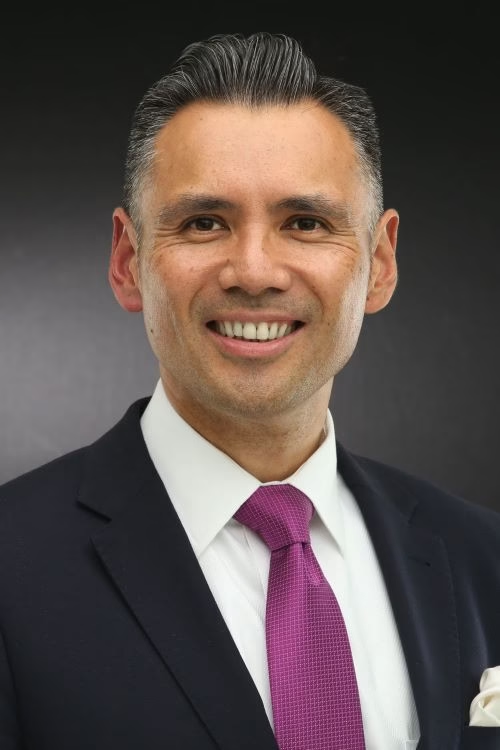
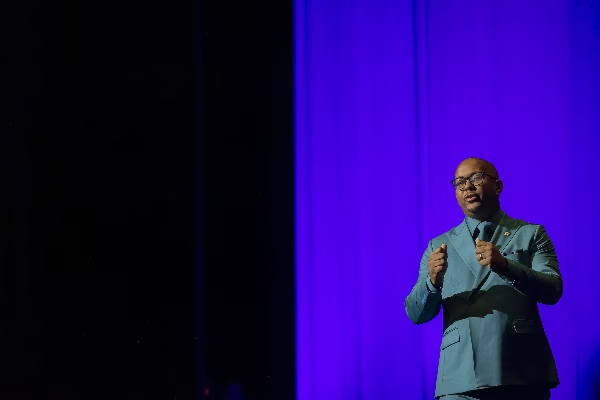
The Port of Long Beach is defining what’s possible as the Port of the Future by spurring innovation and building the infrastructure needed to double its cargo throughput by 2050, Port CEO Dr. Noel Hacegaba said Thursday during his first State of the Port address.

While announcing a record-setting 2025 with nearly 9.9 million cargo containers moved with no backlogs or delays, Hacegaba said a newly released forecast shows the Port of Long Beach is projected to move 20 million containers annually by 2050.

“We have 24 years to prepare to double our container throughput and figure out how we’re going to handle all that additional cargo quickly, safely, efficiently and sustainably,” Hacegaba told 1,300 industry partners, community members and civic and labor leaders gathered at the Long Beach Arena for the State of the Port address.

Details: View Hacegaba’s address at www.polb.com/stateoftheport.

How New Venezuela President Will Save Us from Trump’s Crazy

The Radical Pragmatist versus Rubio’s Vulture

by Greg Palast Jan. 14

Trump aims to drop oil to $50 a barrel; Chavez offered that years ago.

The US press is confused. Nothing new there. They are confused about the Acting President of Venezuela, Delcy Rodriguez.

The New York Times says Rodriguez “Went From Revolutionary to Trump’s Orbit”

Oh no, she didn’t.

Rodriguez still attacks Trump as an outlaw kidnapper and imperialist invader. But, at the same time, she says she’s seeking the restoration of diplomatic relations with the US and offers tens of millions of barrels of oil to Trump.

I’ve known Rodriguez for years. Is she a militant Leftist or a moderate pragmatist?

The answer is, “Yes.” I’d call Rodriguez a “radical pragmatist.”

Trump is wise to keep Rodriguez in the Presidential office. Did I just associate “Trump” and “wise”? Yes, but it seems Trump’s wisdom may be accidental. He is reported to be furious at the leader of the Venezuelan opposition, Maria Corina Machado, for accepting the Nobel Peace Prize instead of leaving it to Trump. And the result is that he has vetoed installing her in power.

Notably, oil and finance interests want the “Leftist” Rodriguez to stay — even the CIA wants her to stay. But Sec. of State Marco Rubio and an outlaw US billionaire want her out. Who wins? I’ll handicap the race below.

Trump wants Venezuelan oil — that we already had

Rodriguez and Trump desire the same thing: to send Venezuelan oil to the US. But Donald, we already had Venezuelan oil…until YOU embargoed imports of their crude.

Venezuela’s socialist President Hugo Chavez enjoyed taunting George W. Bush. I remember when Chavez spoke at the UN General Assembly right after Bush left the podium. Chavez began, “There is a distinct smell of sulfur here.” Bush went after Chavez. It was a bit less subtle than Chavez’ comment. Bush backed the kidnapping of Chavez in 2002. Unlike Trump, Bush’s scheme face-planted and Chavez was returned by his kidnappers, more popular than ever.

But despite the barbs and kidnapping, Bush, with Chavez’ encouragement, kept Venezuelan oil flowing to the US, more than a million barrels a day.

Trump is crowing that, “we’re going to be taking oil” from Venezuela. Mr. President, we were taking Venezuela’s oil until you stopped the flow with an embargo.

Now, it will be nearly impossible, and cost a prohibitive amount, to crank up Venezuela’s production to get back up to the flow quantities we had before Trump’s embargo. Because, when the extraction of super-heavy oil of Venezuela stopped, it congealed into tar and then into asphalt. Refineries and pipes are choked and destroyed, a destruction Trump engineered through blocking Venezuela from paying for equipment to maintain the lines. Now, Trump is trying to bully US oil companies to invest as much as $100 billion to restore the oil infrastructure that Trump himself destroyed.

Trump wants praise for (expensively) rebuilding what he demolished. He’s like an arsonist who wants praise for calling the fire department.

youtube.com/watch?v=syExbfVPDnU&mc_cid=10622a2735&mc_eid=20f826c8b2

Chavez offered to cap oil at $50 a barrel during a Palast interview for BBC Newsnight. Photo: Richard

Chavez’ $50/barrel offer

US voters have decided that price inflation is a real bummer. So, Trump has decided, correctly, that unleashing Venezuela’s oil is the way to go. Trump states bluntly that he wants to open Venezuela’s oil spigots to bring down the price of crude to $50 a barrel. Today, crude sells for just under $60/bbl.

But Venezuela already offered to cap the price of its oil at $50/bbl years ago. In one of my interviews with Chavez for BBC Television, he said he would agree to cap oil at $50 if the US would guarantee that oil would not slip below $30/bbl. Venezuela, unlike Saudi Arabia, could not afford another crash to $10 a barrel, as happened in 1998, which bankrupted South American OPEC members. So, Chavez enthusiastically endorsed this idea of a “band” — you give us a bottom and we’ll give you a top — which was first suggested, notably, by industry consultant Henry Kissinger.

Chavez told me he got along well with Kissinger and George Bush Sr., a fellow oil man. And, as Chavez noted, he was “a good chess player,” a pro at realpolitik, a skill he passed to his protégé Rodriguez.

In other words, Trump killed a hundred people in his coup (and thousands may yet die) to get something by force that he could have gotten by contract.

OPEC: “no brainer” or “no brains”?

The first strike against right-wing fave Machado is her avowed desire to sell off Venezuela’s state oil company, Petroleos de Venezuela, S.A. (PdVSA, pronounced, Pay-day-VAY-sah). What Machado, a neophyte to petroleum economics, does not understand is that full privatization is a direct threat to the oil majors and OPEC.

I’ve seen this movie before. Leading up to the invasion of Iraq, neo-cons within the Bush Administration wanted to privatize Iraq’s state oil companies, selling the fields to American and European majors who would then, the neo-con plan went, compete to maximize output, crash the price of crude and bring OPEC to its knees. Ari Cohen of the Heritage Foundation told me this scheme was a “no-brainer.”

But then I spoke with Philip Carrol, past President of Royal Dutch Shell USA who said, “Anyone who thinks pulling out of OPEC is a ‘no brainer’ has no brains.” Oil companies are not in the business of getting oil; they are in the business of making money. A crash in the price of crude could indeed end OPEC’s price-setting power and no US oil company wants to see their revenues collapse.

There’s also a legal issue. There is no way for Venezuela to stay in OPEC if its state oil company is sold to US interests because US law makes it a crime to participate in a price-fixing cartel. But our government has carved out a convenient exception for state-owned oil companies allowing Exxon and Chevron and their buds to surf on the high prices set by the OPEC monopoly.

Rodriguez is not only Acting President, she remains the Minister of Petroleum and Hydrocarbons. She has a detailed knowledge of the hard realities of oil production. But, she’s a patriot, too. She will not allow the theft or seizure of Venezuela’s oil, but she sure as hell wants to sell us oil again. Chevron, which has worked closely with Rodriguez, couldn’t be happier. Oil companies don’t want to own oil fields. That’s not how the industry operates. They don’t want the real estate; they want profit. They work with OPEC nations through PSA’s, Profit Sharing Agreements. The issue is always the split of the revenues, not ownership; with the state’s share paid as a “royalty” for US tax purposes.

The last thing the oil companies need is Machado, a free-market fanatic, creating a civil war over ownership of fields that the majors want to drill, not own.

And there’s a practical problem. At $50/bbl, no one is going to drill in the Orinoco Basin, where most of the oil is, because it’s just not profitable to try and pull up the sulfureous gunk there. As petroleum engineer Beck would say, “It’s a loser, baby.” That’s why Trump was so frustrated with the oil big wigs who just met with him at the White House. He’s telling them to dump tens of billions into a money pit, rebuilding what Trump destroyed.

Rodriguez well understands the practical limits of control. Chavez was known for hiking oil royalties on Exxon, Chevron and France’s Total but his then-minister for oil told me, quietly, “That if they invest in our country, then we forgive the new royalty.”

Palast’s been tracking Paul “The Vulture” Singer for nearly two decades

“The Vulture” swoops in

So who would want to privatize PdVSA? The Vulture, that’s who. I’ve been tracking this bird, Paul Elliott Singer, for nearly two decades, first for the BBC. Bloomberg low-balls his net worth at $6.7 billion. (He’s been known as The Vulture since this reporter gave him the name. You could say he’s no fan and tried to get the network to fire me.)

Singer is an international re-po man, buying up the debts of nations busted by wars, famines and cholera. An Obama official called him an “extortionist” after Singer got away with ripping off the US taxpayer for billions.

Singer’s trick is to buy up defaulted debts of desperate nations and distressed companies. Then he’ll sue for ten times, or even a hundred times, what he paid for these debt securities, a brutal business outlawed in several nations. You may remember the signs from Argentine fans at the 2014 World Cup , “¡Fuera Buitres!” (“Vultures Out!”), referring to a Singer-led re-po attack that brought Argentina to its knees.

In 2018, a Maryland court tentatively approved Singer’s Elliott Management’s purchase of PdVSA’s US subsidiary, CITGO. Singer plans to pay peanuts — just $5.9 billion for Venezuela’s US property which is valued at $11 billion to $18 billion. As you can imagine, Venezuela objects.

The low price for CITGO is based on its devaluation because of the Trump embargo. But since Maduro’s kidnapping, it’s all but certain that the embargo will end. If Singer can close the sale, he could cash in and quickly flip these assets for an easy $6+ billion profit.

But, Rodriguez wants CITGO back. Her nation paid for those refineries and gas stations and it’s hard to see how she’d let Singer waltz off with her peoples’ property.

The judge understands that CITGO’s valuation is changing, probably tripling in value because the US is negotiating the restoration of diplomatic ties. So, the judge asked the US State Department to file a statement with the court on how the change of government in Venezuela changes the commercial value of CITGO. The comment was due from the State Department on January 8. But the court got nothing — nada, zero.

How come the State Department didn’t respond to the court, leaving Singer’s windfall uncontested? How could Singer get away with this? It should be “who” is letting Singer get away with this?

Singer was the overwhelming Number One donor to the Presidential campaign of Marco Rubio, now our Secretary of State and National Security Advisor. Trump used to attack the “Never-Trump” Singer — until Singer made a million-dollar donation to Trump’s inaugural committee. Singer is also funding a primary against Rep. Thomas Massie, the Republican Congressman who demanded the release of the Epstein files.

Rubio was huffing-and-puffing to get Trump to install Machado whose affection for privatization would have helped Singer to cash in. Whether Singer’s creepy greed, Rubio’s silence, and Machado’s willingness to give up her nation’s crown jewels are related, “¿Quién sabe?” Unlike Pete Hegseth, Rubio doesn’t invite journalists on his conference calls.

But while the State Department did not respond to the judge, Trump went over Rubio’s head and issued an Executive Order over this past weekend using his power under the Constitution to stop any court action that impedes the Executive Branch’s sole authority to conduct foreign affairs. In a stunning move, Trump barred US oil majors and other creditors from grabbing Venezuela’s cash reserves still held in US banks. Trump’s order is a bit of a mess (no news there), but it is a clear and present danger to The Vulture’s smash and grab of CITGO.

Indeed, Trump told oil companies to stick it. In their confab with Trump, ConocoPhillips bitched that it was owed $12 billion and Trump blamed the company for its loss, “We’re not going to look at what people lost in the past because that was their fault.” (Which it was.)

Trump’s even suggesting he’ll bar ExxonMobil from returning to Venezuela because they are demanding compensation for properties the company abandoned. (When Exxon left Venezuela it was an attempt to pressure Chavez into dropping his royalty demands. That failed. Now, I suspect, Exxon is miffed that Chevron will cash in big-time under Rodriguez. Exxon is like the guy who gives up girlfriend then gets jealous when she cuddles up to a rival.)

“Call of Duty,” the CIA and “good” vultures

A week after the attack on Venezuela, Pope Leo went full Pontiff-for-Peace on Trump, decrying “diplomacy based on force.” Take that, Stephen Miller!

Singer is not normal. Not every financier wants to chew on Venezuela’s corpse. Hans Humes of Greylock Capital Management, whom one of my colleagues calls, “the ‘good’ vulture,” likes to cut deals with foreign governments that won’t bankrupt their nations nor cart off their resources. I know Humes. He fears civil war in Venezuela or “any kind of breakdown of social order” which would make his bonds worthless.

I can tell you that both sides in Venezuela are armed to the teeth. If Rubio succeeds in getting Trump to reverse his position and shove Machado down Venezuelans’ throat, it will be Iraq 2.0. Then no one gets the oil, no debts get paid. The Wall Street Journal quotes Eric Fine, whose firm also owns Venezuelan bonds, “The last thing you want to see is a ‘Call of Duty’ scenario with a bunch of soldiers in the streets.”

Trump has been down this dark alley before. In 2019, he went along with then-Senator Marco Rubio’s hare-brained scheme to declare Juan Guaido as President of Venezuela. Guaido is a white guy who lived in Washington, not Venezuela, and never even ran for President. Trump has made clear he’d been burned with Guaido, and dismissed him as a loser. Trump has said he thinks of Machado as another Guiado. He said, “She doesn’t have the support within, or the respect within, the country. She’s a very nice woman, but she doesn’t have the respect.” Ouch!

That’s also the position of CIA. In a leaked memo, the Agency said that Rodriguez was more likely to hold the country together during a transition. Also, while she he gave a thundering speech against Trump’s gunboat diplomacy — “Never again will we be slaves, never again will we be a colony of any empire” — she also said, “We are open to energy relationships where all parties benefit, where cooperation is clearly defined in a commercial agreement.”

That had to be music to Trump’s ears, though not Rubio’s. Rodriguez, the 56-year-old Sorbonne-trained lawyer and former diplomat in London, is expert at the Art of the Deal. And, unlike the former bus-driver Maduro, she can make her case convincingly in flawless English, French and erudite Castilian.

Acting President Rodriguez knows, it’s about the oil. Always the oil. She said, “All the lies about ‘drug trafficking’, ‘democracy’, ‘human rights’. They were the excuses. It was always about the oil.” And Minister for Petroleum Rodriguez, the radical pragmatist, knows that is how she will artfully cut her deal.

Because she knows that Venezuelan’s can’t drink their oil; that her nation needs American majors to buy her nation’s output and for the industry to rebuild their former production lines. Darren Woods, the cranky CEO of ExxonMobil told Trump that Venezuela would be “uninvestible” unless there is political stability. Rodriguez can provide that.

But while the oil boys were talking about the need for stability in Venezuela, there was a sly message directed at Trump. Given our president’s quixotic policies — from tariffs to taxes to military adventures — that the majors don’t want to gamble billions unless there is a stable government in the USA.


Kings or Slaves?


By Greg Palast, Jan. 19

There are a million Iranians in the streets facing bullets and torture who don’t agree that Ayatollah Ali Khamenei is a poor victim of US and “Zionist” imperialism.

We should take their cue. Don’t let Trump pick our heroes for us. Trump ain’t gonna do a damn thing for the Iranian people. He’s letting them sell oil illegally because he wants the world price to come down. The Iranian people, in his view, despite his saber rattling, don’t mean a damn thing to him.

But they mean a lot to me.

The right to choose our own leaders is not an American right. Freedom is one of the “unalienable Rights” of Americans “endowed by their Creator” — and neither Trump nor Khamenei, as Destroyers, qualify.

Those who cannot choose their own leaders, who are forced by violence to bend to authority, are slaves. In America, we still have, for a moment, a choice: We can be Kings or we will be Slaves. Choose today.

For MLK Day, I will pray that Iran, Ukraine and Minnesota will be Free at Last.

And for Yolanda Renee King, MLK’s granddaughter, playing the piano for me. She is our future. If we dare to dream it.

How JFK Saved MLK’s Life And So Won The Presidency

It was a Republican, Martin Luther King Sr., who made John Kennedy president of the United States — for JFK’s saving Daddy King’s son, Martin Jr., from lynching.

This harrowing and little known drama of terror and courage, confirmed for me by Martin Luther King III, changed American politics — and America — forever.

On October 19, 1960, Martin Luther King Jr. was arrested in Georgia for driving with an Alabama driver’s license and sentenced to six months hard labor. No one expected King to survive the sentence — he’d be lynched at the outset.

His father, Martin King Sr., had one desperate chance to save his son. Daddy King had endorsed Richard Nixon, a family friend, for the presidency. Nixon could count on King, a Republican like many African-Americans, who chose the party of Lincoln over the racist Democratic party of Jim Crow segregation.

A desperate King called Vice-President Nixon — who refused to answer. But MLK’s wife, Coretta, had a single hope. She called a friend, pacifist activist Harris (later Senator) Wofford who called Bobby Kennedy.

RFK didn’t hesitate, calling from a pay phone on Long Island to his brother, demanding John save MLK Jr.

Palast at King’s Atlanta Church on assignment for Al Jazeera. Photo by Zach D. Roberts.


It was just three weeks before the presidential election, a race too close to call. This was a crisis. Three Southern governors warned the Kennedys that any help for Dr. King and JFK would lose three Deep South states.

John Kennedy, who’d just won the Pulitzer Prize for Profiles in Courage, knew this was his test. He gave Bobby the go-ahead to save King.

Bobby called Atlanta and told the judge he’d post King’s bond — though the judge had never offered bond. But this Democratic judge knew that with his party, the Kennedys could employ and destroy.

Meanwhile, according to Martin King III, his father was pulled from his Atlanta jail at 2am and told he would be transferred to Reidsville Prison hours from the city. King was certain he would not live to see the dawn.

But the judge had let it be known that King now was now under the protective gaze of the Kennedys. And MLK, said his son, was “the first prisoner ever to be thrilled and thankful to enter the gates of Reidsville Prison.”

But the warning came true. Word of Kennedy saving King cost JFK the electoral votes of Louisiana, Mississippi and Georgia. But then there was the miracle. Daddy King had written a pamphlet beginning, in block letters:

“No Comment” Nixon
versus
A Candidate with a Heart,
Senator Kennedy
*
THE CASE OF
MARTIN LUTHER KING


The pamphlet, on blue paper, was carried to the churches of half a million African-Americans.

Daddy King said, “I have a suitcase full of votes for the Senator that I’m carrying to Chicago.”

The mass outpouring of sermon-inspired African-Americans won Kennedy razor-close victories in Illinois, Michigan and New Jersey.

Even historian Ted White cites the King family’s powerful campaign of gratitude, and the pamphlet now known as “The Blue Bomb,” as the deciding factor in John F. Kennedy’s victory over Nixon.

The Democrats’ once-solid hold on the South was no longer solid — but a new voting block, would hold hard as a hammer for the Democratic Party for the next half century to today.

It was this profile in courage — the Kings and the Kennedys — that truly made America great and morally mighty.

Those mighty Kings and Kennedys are gone.

So it’s left to us to stand up to the gelatinous orange pustule of bloviating bigotry that has, against the democratic will, seized this White House and Congress.

Today, we honor a man whose courage must now be ours; and then we can make America truly great again.

Darrow Palast contributed research for this article. Photo of Palast at King’s church by Zach D Roberts for Al Jazeera.

Order or Oppression?


The Debate Over Fascism in the Minnesota Crackdown

Nolan Higdon, Jan. 19

“For the last decade, there’s been a debate among people who don’t like Donald Trump about whether he’s a fascist,” writes Michelle Goldberg in a January 2026 New York Times article. This rhetoric, which began during his first term, reached a fever pitch during the 2024 campaign when Hillary Clinton compared his Madison Square Garden rally to the infamous Nazi gathering held there in the 1930s. In 2024, Vice President Kamala Harris and half of the American public, according to ABC News/Ipsos polling, embraced the label for Trump, while many others dismissed it as hyperbolic. A year into Trump’s second term, Goldberg suggests that those who sounded the alarms are being vindicated.

The debate over fascism has become more pervasive following the killing of Renee Good by Immigration and Customs Enforcement (ICE) agent Jonathan Ross in Minnesota. The video of Good’s death was seen by 80% of Americans, and polls from Data for Progress, Quinnipiac, CNN, and YouGov/Economist reveal that the majority of Americans do not think the killing was justified.

Nonetheless, the Trump Administration has ramped up the assault in Minnesota. The internet is flooded with viral videos of ICE agents violently detaining a U.S. citizen child at a Target and warning peaceful bystanders that they will end up like Good. Other footage shows agents punching citizens for legally recording them, assaulting a woman whose disability prevented her from exiting her car, and using flash bangs and pepper-spraying peaceful protesters. As they were driving, a Minneapolis couple and their six children were reportedly caught in a chaotic clash between federal agents and protesters. According to the parents, officers deployed flash-bang munitions and tear gas that filled their vehicle, causing their 6-month-old baby to stop breathing and lose consciousness before emergency responders arrived.

These violent acts are not just limited to Minnesota. Since 2025, ICE has been responsible for nine fatal shootings and about 40 deaths in custody, including one ruled a homicide. The agency has also detained nearly 200 U.S. citizens, including Native Americans.

It is no wonder that the concept of abolishing ICE is more popular than ever. Social media is increasingly filled with videos of everyday citizens who emphasize that they are not overtly political and rarely, if ever, protest, yet feel compelled to speak out because they believe the President’s version of events is demonstrably false.


https://youtu.be/N2j6AlufgsI


Even traditionally sympathetic voices like Tim Dillon and Joe Rogan have raised concerns, specifically comparing the administration’s use of federal agents to the “Gestapo”: the secret police of Nazi Germany known for their brutal suppression of dissent and lack of judicial oversight. Rogan further leaned into this comparison by arguing that forcing residents to prove their citizenship status on the street is tantamount to the infamous Nazi practice of demanding “your papers,” to identify and disappear undesirables. Relatedly, in the understatement of the year, former ICE Director Sarah Saldana recently warned on CNN that the situation has reached a breaking point, noting that it is “way past time for de-escalation.”

As his first year comes to a close, much of what has occurred in Minnesota and elsewhere has led critics to label Trump a fascist. They point to the fact that he lied to the public about Good’s death. After the incident, Trump immediately made the false claim that Good “viciously ran over” an agent, forcing the officer to be hospitalized. In reality, Good’s car did not run over anyone, and Ross walked away from the scene unassisted. New York Times reporting casts doubt on the idea that Ross even visited a hospital after Good’s death.

Critics argue that Trump warrants the fascist label due to his efforts to direct the U.S. military against American citizens. Trump and his Administration have threatened to invoke the Insurrection Act in Minnesota, which, unlike in Trump’s National Guard deployments would allow armed forces to carry out law enforcement functions, such as making arrests and conducting searches. According to military intelligence sources, the Minnesota crackdown serves as more than an immigration initiative; it is allegedly part of a broader campaign targeting “anti-American’ elements,” such as Antifa and the radical left. Reports indicate that 1,500 Alaska-based troops are prepared to deploy to Minnesota at Trump’s command. This escalation coincides with a federal court ruling this week that significantly restricted the tactics ICE may employ against peaceful protesters. Meanwhile, Minnesota Governor Tim Walz mobilized the state’s National Guard this weekend to maintain order. The deployment occurs against the backdrop of a criminal probe by the Justice Department into both Walz and Mayor Jacob Frey for allegedly impeding federal immigration operations.

Critics contend that the Trump administration has effectively weaponized ICE, transforming it into a tool of executive power rather than a public service agency. They cite a convergence of aggressive incentives and diminished oversight as evidence of this shift. In mid-2025, the administration introduced substantial financial inducements, including $50,000 signing bonuses and $60,000 in debt forgiveness, to attract recruits whose primary motivations may be economic rather than civic. This, coupled with policies allowing agents to remain masked, withhold identification, and conduct stops based on subjective criteria like “accents,” has largely insulated the agency from accountability. Moreover, the imposition of strict arrest quotas to meet a target of 11 million deportations has escalated routine daily activities into high-stakes confrontations for many residents.

Despite claims that professional standards prevent abuse, an undercover report from Slate describes ICE training as “sloppy” and lacking substantive background checks. Trainees reportedly expressed more interest in physical assault and making arrests than in mastering the legal requirements of the job.

As the line between law enforcement and political weaponry continues to blur, the American public is left to determine whether these actions represent a temporary crisis or a permanent systemic shift toward something like fascism. To navigate this uncertainty, one must look past the headlines and evaluate the administration’s trajectory against the historical markers.


Is the American System Immune to Fascism?

Last Word Press

Fascism has always had supporters in the U.S. In 1939, 26% of Americans preferred fascism, in October 2024, it was 17%. However, some such as Tyler Cowen, a Professor of economics at George Mason University wrote in 2018 that “American fascism cannot happen anymore because the American government is so large and unwieldy.” Four years later, Political scientist Anthony DiMaggio disagreed, arguing that it was already happening in the U.S.

Before the U.S. entered World War II, scholars not only believed the emergence of fascism was possible in the U.S., they predicted the exact mechanics of how it would occur. In 1935, the scholar and former U.S. Marine Arthur H. Steiner warned that American fascism would materialize once six specific components were realized: the rejection of democracy, adoption of dictatorial techniques, repression of individual freedoms, suppression of organized labor, stoking of intense nationalism, and mobilization of a popular reactionary perspective.

Steiner’s academic warnings were grounded in the volatile political climate of the 1930s, most notably the “Business Plot,” which involved a fellow Marine and two-time Medal of Honor recipient, Major General Smedley Butler. The conspirators, a group of financial elites, believed they could leverage Butler’s immense influence over veterans to lead a military coup against President Franklin Delano Roosevelt. However, Butler remained loyal to the Constitution; he exposed the plot and forced a Congressional investigation that effectively quelled the coup. This historical episode, recently dramatized in the 2022 film Amsterdam, served as the catalyst for Butler to document the corrupt intersection of corporate interests and military power in his seminal pamphlet, War is a Racket.

While scholars were still debating whether fascism could ever take root in the United States, poet Langston Hughes argued that Black Americans were already living through its domestic equivalent. Addressing the Second International Writers’ Congress in 1937, Hughes contended that the traits now labeled as “fascist” were the founding realities of the Jim Crow South. “We Negroes in America do not have to be told what Fascism is in action. We know,” Hughes declared, noting that “theories of Nordic supremacy and economic suppression” had long been a lived reality.

After World War II, Americans largely viewed fascism as an “Old World” relic, a theme explored in the new film Nuremberg. The film rightly tells the story of how psychologist Dr. Douglas Kelley was dismissed by American audiences for suggesting that his work with Nazis revealed that fascism could take root in the U.S. Still, in the decades ahead, scholars like Theodor W. Adorno as well as artists such as Pier Paolo Pasolini warned that nations like the U.S. that privileged capitalist consumerism had the potential to resuscitate fascism.

Is the “Fascist” Label Historically Accurate or Just Partisan Rhetoric?

POEM] First They Came for the Jews by Pastor Niemöller : r ...

“It’s striking how much the arguments that Trump is not a fascist have suffered in just the first few days of this year,” Goldberg noted. This observation highlights a deepening divide: while some commentators dismiss the fascist label as mere partisan hyperbole, others contend it accurately captures the current trajectory of the United States. To understand this debate, one must look at the origin and evolution of the term itself.

The term “Fascism” was coined in 1919 in reference to Benito Mussolini’s regime in Italy, and later used to describe the regimes of Germany and Spain. In the decades following World War II, scholars agreed that fascist regimes dominated Europe during the 1920s and 1930s, but they found little consensus on a generic definition of the term. Ernst Nolte, a premier scholar on the subject, rejected efforts at defining fascism because he believed the political ideologies of the researchers made the practice futile.

In the post-World War II U.S., efforts at defining fascism were overshadowed by the Cold War (1945-1991). While Marxists and conservatives debated whether capitalism was responsible for the rise of fascism, liberals continued to blame “totalitarianism.” Marxists rejected this as a politically charged attempt to marginalize progressives by conflating fascism with the leftist, Communist Soviet Union. Nonetheless, by the late 1970s, the lack of a unified concept led many to believe that fascism was a unique set of historical circumstances that would not recur. Still, for those who want a dictionary definition, the Merriam-Webster definition is:

“Fascism : a populist political philosophy, movement, or regime that exalts nation and often race above the individual, that is associated with a centralized autocratic government headed by a dictatorial leader, and that is characterized by severe economic and social regimentation and by forcible suppression of opposition.”

What Are the Defining Characteristics of a Fascist Government?

Rather than focusing on a dry dictionary definition, the debate concerning the appropriateness of the fascist label centers on the specific behaviors and attitudes of the Trump presidency. Goldberg noted that those who contend Trump is a fascist point to his territorial aggrandizement in Greenland and Venezuela, the utilization of state violence via ICE, his appeals to nationalism, and an emphasis on hyper-masculinity. They further cite his pardoning of January 6th participants and a “fetish for technology” as evidence of this shift. Meanwhile, other commentators highlight Trump’s strategic alliance with corporate power and his systematic dismantling of institutional independence, including efforts to curb autonomy in higher education, co-opting legal processes, and intimidating the press.

To provide a framework for these observations, scholars have sought to categorize the underlying traits that allow such movements to take root. In 1995, Umberto Eco introduced a framework for ‘eternal’ fascism. He posited that fascism functions as a ‘coagulation’ of contradictory elements rather than a single, cohesive system, categorized by fourteen primary characteristics:

  1. The cult of tradition. “One has only to look at the syllabus of every fascist movement to find the major traditionalist thinkers. The Nazi gnosis was nourished by traditionalist, syncretistic, occult elements.”
  2. The rejection of modernism. “The Enlightenment, the Age of Reason, is seen as the beginning of modern depravity. In this sense Ur-Fascism can be defined as irrationalism.”
  3. The cult of action for action’s sake. “Action being beautiful in itself, it must be taken before, or without, any previous reflection. Thinking is a form of emasculation.”
  4. Disagreement is treason. “The critical spirit makes distinctions, and to distinguish is a sign of modernism. In modern culture the scientific community praises disagreement as a way to improve knowledge.”
  5. Fear of difference. “The first appeal of a fascist or prematurely fascist movement is an appeal against the intruders. Thus Ur-Fascism is racist by definition.”
  6. Appeal to social frustration. “One of the most typical features of the historical fascism was the appeal to a frustrated middle class, a class suffering from an economic crisis or feelings of political humiliation, and frightened by the pressure of lower social groups.”
  7. The obsession with a plot. “The followers must feel besieged. The easiest way to solve the plot is the appeal to xenophobia.”
  8. The enemy is both strong and weak. “By a continuous shifting of rhetorical focus, the enemies are at the same time too strong and too weak.”
  9. Pacifism is trafficking with the enemy. “For Ur-Fascism there is no struggle for life but, rather, life is lived for struggle.”
  10. Contempt for the weak. “Elitism is a typical aspect of any reactionary ideology.”
  11. Everybody is educated to become a hero. “In Ur-Fascist ideology, heroism is the norm. This cult of heroism is strictly linked with the cult of death.”
  12. Machismo and weaponry. “Machismo implies both disdain for women and intolerance and condemnation of nonstandard sexual habits, from chastity to homosexuality.”
  13. Selective populism. “There is in our future a TV or Internet populism, in which the emotional response of a selected group of citizens can be presented and accepted as the Voice of the People.”
  14. Ur-Fascism speaks Newspeak. “All the Nazi or Fascist schoolbooks made use of an impoverished vocabulary, and an elementary syntax, in order to limit the instruments for complex and critical reasoning.”

He famously noted that “it is enough that one of them be present to allow fascism to coagulate around it.” Eco’s framework shifted the focus from specific government structures to a set of psychological and rhetorical traits.

Eco’s list was later emulated by Lawrence Britt in 2003, who identified fourteen characteristics of fascist regimes:

  1. Powerful and Continuing Nationalism
  2. Disdain for the Recognition of Human Rights
  3. Identification of Enemies/Scapegoats as a Unifying Cause
  4. Supremacy of the Military
  5. Rampant Sexism
  6. Controlled Mass Media
  7. Obsession with National Security
  8. Religion and Government are Intertwined
  9. Corporate Power is Protected
  10. Labor Power is Suppressed
  11. Disdain for Intellectuals and the Arts
  12. Obsession with Crime and Punishment
  13. Rampant Cronyism and Corruption
  14. Fraudulent Elections

The examination of features of fascism accompanied the research on how fascism was not a European phenomenon because these features are universal. As a result, in the late 20th century, scholars moved the research beyond Europe, arguing that fascist regimes operated across the globe in Argentina, Chile, and Japan. However, as the digital age and globalized economy reshape the ways power is seized and maintained, many wonder if these classic markers are being updated for a new era.

How Has the Fascist Playbook Evolved for the 21st Century?

Jason Stanley In Conversation with Timothy Snyder about HOW FACISM WORKS via Crowdcast (5/29) | Penguin Random House

While the classic markers of the 1930s provide a baseline, many experts argue that modern movements require a new vocabulary. In November 2025, Stefanie Prezioso warned that traditional fascism analogies may not be entirely helpful today because Trump’s actions, “while echoing the darkest chapters of the twentieth century, remain in many ways radically new.” Prezioso cites historian Eric Hobsbawm, who observed, “When people face what nothing in their past has prepared them for, they grope for words to name the unknown, even when they can neither define nor understand it.” Indeed, when fascism first emerged in the early 20th century, thinkers like Antonio Gramsci drew upon history to name the phenomenon, initially referring to it as “Caesarism.” This 19th-century concept described autocrats who, like Julius Caesar or Napoleon III, claimed to embody the “popular will” while systematically dismantling the institutions that protected it.

Still, scholars have sought to bridge the gap between 20th-century history and today’s political shifts through the term “neofascism.” Galadriel Ravelli and Anna Cento Bull define neofascism as a revival of activism by groups striving to keep fascist ideals alive in the post-war international context.

Jason Stanley argues in How Fascism Works (2018), that 21st-century fascists share tactics with their 1930s predecessors: the construction of a mythic past, reliance on propaganda over reason, and the exploitation of sexual anxiety. However, crucial differences remain. Modern neofascism is fueled by globalization rather than total war, and its rhetoric has shifted from old-world antisemitism toward xenophobia aimed at immigrants.

Neofascism’s appeal is rooted in its ability to reframe political contests. Where the Marxist left struggled to build intersectional coalitions, the radical right has succeeded in reframing the struggle of good versus evil. They pit a deindustrialized working class against a collection of bad actors: immigrants, racial minorities, religious minorities, sexual minorities, feminists, leftists, journalists, and the intelligentsia. In this framework, the good people are defined as anti-feminist, uneducated, xenophobic nationalists who aggressively oppose the emancipatory promise of the Enlightenment in favor of a world governed by hierarchy and hyper-masculine violence.

Is the American Crisis a Temporary Setback or a Final Stage of Fascism?

The contemporary debate over Trump is less about his personality and more about the specific timeline of American decline. Analysts like Monika Bauerlein of Mother Jones contend that the transition to fascism is “not over” because citizens still possess rights worth using. Similarly, contributors to The Nation argue that a window remains to prevent total consolidation, provided the public aggressively defends those currently targeted by state violence. Goldberg describes the United States as being trapped in a liminal space: “the space between the liberal democracy most Americans grew up in and the dark, belligerent authoritarian state that our government seeks to impose.”

This belief that the U.S. is “transitioning” suggests that fascism is a process rather than a single event. Researchers such as historian and philosopher Hannah Arendt argue that fascism emerges from specific societal conditions. It often begins with what Arendt calls the “politics of inevitability,” the naïve belief that democracy is guaranteed to endure, leaving citizens unreflective and vulnerable to creeping authoritarianism.

This complacency often coincides with a deadlocked democracy, where traditional liberal and conservative parties become unable to govern effectively or solve national crises. This leads to a “paralysis” of the state that a fascist movement exploits by stoking a sense of overwhelming victimhood and a need for “purity” to prevent national decline. In these moments, when the future seems bleak, leaders point toward a mythical, “pure” past, a “Golden Age,” and frame the present as a constant cycle where “innocent” people are under attack by outsiders.

Fascism also gains momentum when there is no viable left-wing alternative to champion the needs of poor and working people. As Professor of Economics at The New School for Social Research, Clara Mattei notes, fascists rarely seize power in a vacuum; instead, conservative elites often decide to invite fascists into power specifically to help crush the Left. Mattei argues that austerity, which refers to policies like wage cuts and social service reductions, is a deliberate tool used by elites to break the power of the working class. When the status quo fails and the left is marginalized, the public often turns toward fascist rhetoric out of desperation.

When democracy fails to solve a national crisis, elites may view fascism as a technocratic solution that can enforce economic discipline by force where democratic processes have failed. Fascism thus emerges to “tame” the public and ensure that the logic of profit remains unquestioned, often presenting brutal economic choices as scientific necessity. This transition is made easier by the death of truth. As University of Toronto’s Timothy Snyder emphasizes, fascism begins with the abandonment of facts; if nothing is true, no one can criticize power, and citizens eventually trade their freedom for the “sensual experience” of belonging to a tribe or following a leader.

Once a movement emerges, it follows a trajectory that Robert Paxton delineated in his 2004 seminal work, The Anatomy of Fascism. Paxton contends that fascist regimes evolve through five distinct stages:

  1. The emergence of a populist movement.
  2. Successful rooting in the political system.
  3. The achievement of power.
  4. The exercise of power.
  5. Radicalization or eventual failure.

While Paxton observes that several movements have emerged throughout history, only Italy and Germany reached the third stage of achieving power, and only Germany successfully expanded through its full exercise. He contends that fascist regimes carry the seeds of their own “inherent self-destruction” because they are built on fundamental contradictions. They position themselves as movements for the people while simultaneously legitimizing the deep inequalities of modern capitalism. Ultimately, fascism is a self-terminating system, yet it collapses only after a period of profound violence, suffering, and systemic instability.

Leading global voices in the study of fascism, such as Jason Stanley, Marci Shore, and Timothy Snyder, recently left their positions at Yale University for academic appointments in other nations. They characterized this move not as a mere career transition, but as a calculated survival strategy. Drawing on their own research, they suggested that the safest course of action is to exit a country at the earliest stage, before a fascist regime fully consolidates its power and closes its borders.

Conclusion

The escalating violence in Minnesota and the administration’s shift toward military intervention have transformed the debate over fascism from a theoretical academic exercise into an urgent national crisis. While critics point to the crackdown as proof that the country has entered the later stages of authoritarian consolidation, others maintain that these actions are necessary measures to maintain order within a polarized democracy. This divide suggests that the “fascist” label remains as contested as it is consequential, leaving the public to reconcile the disturbing events in the streets with the historical frameworks provided by scholars. While the debate persists, the nation waits to see if its institutions will bend or break under the current pressure.

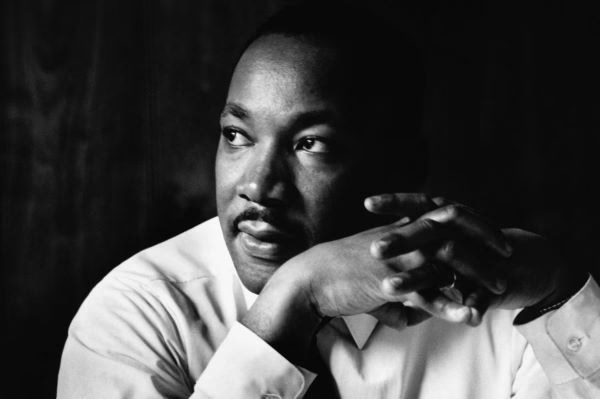
“We cannot stand two more summers like last summer without leading inevitably to a right-wing takeover and a fascist state that will destroy the soul of the nation.” – Dr. Martin Luther King Jr.


Port of Long Beach CEO Brings Global Trade Perspective to World Economic Forum


Port of Long Beach CEO Dr. Noel Hacegaba will speak this week at the World Economic Forum. The annual gathering brings together world leaders from government, business and academia in Davos, Switzerland to engage in forward-looking discussions to address global issues and set priorities. Hacegaba will be the only top executive of a U.S. port authority at the summit that is expected to include 850 executives and national leaders from 130 countries.

Hacegaba – who was invited to attend the forum – said he will use the opportunity to ensure that customers and stakeholders from the global shipping community understand the Port of Long Beach’s position as a top international seaport and its visionary plans for the future.

“The Port of Long Beach is a global port and in a time of dynamic trade policies and priorities, we can’t afford not to be at the table when the world’s top economic leaders are discussing the future,” said Hacegaba. “Our new long-term cargo forecast predicts we will double our annual container volume at Long Beach by 2050. Achieving that will require visionary innovation, advances in workforce development and international cooperation as never before.”

On Jan. 15, Hacegaba delivered his first “State of the Port” address, laying out a bold new vision for the Port reaching the future as a zero-emissions, job-creating, community-benefiting global trade leader. He also announced that the Port achieved its highest cargo volume ever, despite the specter of new tariffs.

Details: https://tinyurl.com/LB-Port-address

Optimism, as usual: Mayor touts progress, opportunity in Long Beach State of the City address

0

“You can win, so long as you keep your head to the sky,” sang the youth chorus / drum line that opened Mayor Rex Richardson’s annual State of the City address Tuesday night. “Be optimistic!”

You couldn’t ask for a more apt opener, as Richardson unfailingly touts the LBC as strong and getting stronger, regardless of how much more nuanced the reality is.

In case you missed it, here are a few highlights…and lowlights:

New Kids in Town

  • The State of the City was held on the eve of the groundbreaking ceremony for construction of the Long Beach Bowl, a waterfront amphitheater that will hold around 11,000 people. Scheduled for completion in June, Richardson noted that the Bowl is slated for 25 events in its first year of operation, after which it will host upwards of 40 per year.
  • Iconic swimwear brand Speedo will relocate its North American headquarters to Long Beach, a choice informed by the fact that Long Beach will play host to 11 events during the 2028 Summer Olympics, the majority of which are aquatic.
  • Joining Greece and Denmark in selecting Long Beach for the location of their respective Olympic National Hospitality Houses is Ireland, which promises a wide variety of cultural programming, events, and live entertainment right on Pine Ave.
  • Much ado was made about Marathon Burger opening a Pine Ave. location come March. But even for those who do eat red meat, no doubt some want nothing to do with anything related to Snoop Dogg since he chose to perform at an event celebrating Trump’s inauguration last year.
  • This summer will see the debut of a Long Beach pro baseball team — though not one associated with Major League Baseball; instead, the team will play in the independent, 11-team Pioneer Baseball League. The name, though, has been a cause of confusion. First Richardson teased the audience with three choices on which the public voted last year: the Parrots, the Regulators, and the Coast. The audience’s clear favorite was the Regulators (a reference to team co-owner and Long Beach native Warren G’s song “Regulate”), while the least favorite was the Coast. The video segment that followed revealed that fans chose “the Coast,” but then Warren G said something to the effect that the team would be called both the Coast and the Regulators. After the video, Richardson said the same thing: “It’s the Long Beach Coast, and the Long Beach Regulators.” The first question I was asked after the event was, “Did you understand what he meant about the team name?” Everyone I queried was similarly confused — including a member of the mayor’s own staff, who had been asked the same question by others. The Long Beach Post got clarification from a team spokesperson: “the Regulators name ‘will appear through select in-ballpark experiences, special activations, creative storytelling and limited merchandise drops.”’ Really? If y’all wanted to call the team “the Regulators,” why have a fan vote? It’s a way better name than “the Coast,” for fuck’s sake.

Most Unrealistically Optimistic Goal
Well, nothing could compete with the ludicrous wish Richardson made last year: “to position Long Beach as the coastal live music capital of the world.” Uh-huh. But this year’s winner has almost as little chance of coming true: “to achieve our goal of ending homelessness [by] 2030.” A “critical step” down this path, he said, is the Youth Shelter and Navigation Center, which provides not only temporary housing but mental-health and vocational support. That’s great (even if it has only 12 beds), and it’s not the only way in which the City is trying to reduce homelessness, but real talk can only be helpful. No homelessness in Long Beach in four years is not real talk.

Lies, Damn Lies, and Statistics
“Long Beach has now seen consecutive years of declining years of street homelessness,” Richardson claimed. That’s true — just don’t skip over the word street, because it’s also true that last year, overall homelessness rose 6.5%. That truth he left out.

Richardson strongly tied homelessness to housing affordability and praised Long Beach on that front, too, saying that “among the 14 largest cities in the state, Long Beach has had the third-lowest rent increase over the last three years.” I have no idea whether that’s accurate: we were told someone from the Mayor’s Office would get back to us with supporting data and followed up when they didn’t, but no dice. Whatever the case, something tells me things sound less rosy if we make it a round number like 15 or 20, rather than 14. Who makes a list of the top 14 anything?

Chased Off the Stage, Again
Last year was the first time in the 15+ years I’ve attended State of the City events that protestors disrupted the proceedings. But this year Richardson was chased off not once, but twice. The first came 10 minutes into his speech, when a pair of men stood up and yelled, “Rex, when are you going to protect Black workers?” Twenty minutes later, a group of about 10 people began chants of “ICE out of Long Beach!” Richardson again departed as the group was ushered out. Near the end of his speech more protestors took up the same chant, this time also exhorting Long Beach officials to “do more” to resist, but Richardson refused to depart for a third time. (Prediction for 2027: From now on, people will always see the State of the City as an opportunity to voice their grievances in front of a captive audience. This is the new normal.)

Solidarity
While I don’t know whether Rex is somehow not properly protecting Black workers, interrupting his speech to protest ICE seemed inapt, as both he and the city council have been unequivocal in their denunciation of ICE under the Trump administration. And once he returned to the stage, Richardson passionately reiterated that position:

These are serious times we’re living through, and we get it. What we shouldn’t be doing is [the Trump administration’s] job for them by dividing ourselves: we should be sticking together, [and] that’s what we should be doing this minute. That’s how Long Beach makes it through. […] Let me say this directly and unequivocally clear: ICE does not belong in our city, ICE does not belong in our hotels, ICE does not belong in our schools, not in our places of worship, not in our places of work, not…in…Long…Beach…period!”

He noted that in 2018 the city council approved the Long Beach Values Act, which codified various ways in which the City would resist onerous enforcement of federal immigration law; and that the Act was strengthened last year, “ensuring that no City resources are used to aid ICE, and holding all City departments and contractors to the very same standard [so that] residents can trust and access City services, send their children to school and [go to] work, making sure they can engage their [local] government without fear.”

Hot Air?
In acknowledging the fact that for generations certain areas of Long Beach have been disproportionately affected by Port of Long Beach emissions (“For families in West Long Beach, air quality isn’t an abstract issue: it’s asthma inhalers, it’s missed school days”), he touted last year’s “historic partnership, a new standard and enforceable agreement between the Ports of Long Beach and Los Angeles and the South Coast Air Quality Management District” as a pathway to “faster zero-emission infrastructure [and] cleaner air for surrounding frontline communities.” But nonprofit, nonpartisan news org CalMatters urged the SCAQMD to vote against “the so-called cooperative agreement” on the grounds that “impacted community members were not meaningfully included” in the process of crafting the agreement, which “weakens the [D]istrict’s ability to reduce emissions and it creates a dangerous precedent.” CalMatters noted that the agreement “includes a five-year ban on rulemaking. That handcuffs South Coast Air Quality Management District, effectively blocking the agency’s authority to address port pollution when the South Coast Air Basin can least afford a delay.”

Most Unsurprising Omission
Regarding the LBPD, Richardson declared that “professionalism and respect for human life […] should not be the exception: this should be our standard.” Asserting that this is the standard, he cited declining crime rates and the fact that 2025 was the first year ever without a single officer-involved shooting. Something he didn’t say was that going into 2025, complaints of officer misconduct had risen by over 10% each year since 2021. (Stats on 2025 will be released this spring.) It’s a subject he and the city council have consistently refused to comment on or (according to City records) ask questions about, just as they refused to comment on a 29% jump in use-of-force incidents between 2023 and 2024. So much for what he said next: “We’re also committed to transparency.”


Padilla, Merkley Lead Fight to Protect Vote-By-Mail Access for Voters


WASHINGTON, D.C. — Today, U.S. Senators Alex Padilla (D-Calif.), Ranking Member of the Senate Committee on Rules and Administration and California’s former Secretary of State, and Jeff Merkley (D-Ore.) Jan. 15 led 14 Senators in condemning a recent announcement from the United States Postal Service or USPS regarding postmarking practices that will make it harder for Americans to vote by mail, especially those living in rural communities.

Right before the holiday season, USPS clarified its recent practices in a rule stating, “the postmark date does not inherently or necessarily align with the date on which the Postal Service first accepted possession of the mailpiece.” Due to recent Postal Service consolidations, this policy would have significant negative impacts on election administration in vote-by-mail states like California that rely on postmarks to decipher ballot eligibility, while hampering access to basic services like prescription drug deliveries, tax returns, and bill payments.

The Senators emphasized that many states determine mail-in ballot eligibility using the postmark date, and this change could lead to more ballots being rejected. Experts estimate at least a one-day delay for postmarks and mail delivery in rural areas.

They also highlighted that recent cost-cutting measures at USPS have led to facility closures and consolidations that acutely impact seniors, rural residents, and small businesses who rely on USPS for important personal and financial correspondence. Along with voting and tax issues, delayed postmarks will lead to application denials, late fees, missed deadlines for legal document submissions, overdue notices, and other challenges.

Before coming to the Senate, Padilla established automatic and same-day voter registration, upgraded California’s voting systems to meet higher security standards, and expanded mail-in and in-person early voting as California’s Secretary of State.

Read RLN’s story USPS Postmark Clarification Raises Concerns For Voting, Health Care Deadlines here.

Details: Read the full letter here

Solis Leads Legal Effort to Defend Affordable Care Act

LOS ANGELES — The Los Angeles County Board of Supervisors Jan, 13 approved a motion reaffirming support for the Affordable Care Act and authorizing participation in a legal effort to protect access to affordable health coverage.

Since its implementation, the Affordable Care Act has played a critical role in expanding health insurance coverage, lowering uninsured rates and strengthening public health systems. In Los Angeles County, the law has helped residents gain access to preventive care, mental health services and essential medical treatment, while also reducing uncompensated care costs for hospitals and clinics.

Recent federal changes under the Trump administration would create new barriers to coverage, including shorter enrollment periods, additional administrative requirements and policies that may limit eligibility for low-income individuals and families. These changes could result in millions of people nationwide losing health coverage and place added pressure on local health systems and safety net providers.

The motion directs county counsel to join an amicus curiae brief in the case Columbus v. Kennedy, currently pending in federal court, in support of efforts challenging the federal rule changes. The action is intended to protect coverage gains achieved under the Affordable Care Act and ensure healthcare policies do not undermine access to care.

Details: View the motion here.

Awareness Campaign Aims to Help Residents Recognize and Prevent Human Trafficking


LOS ANGELES In recognition of National Human Trafficking Prevention Month, the Los Angeles County Department of Consumer and Business Affairs’ Office of Labor Equity or OLE launched a public awareness campaign to highlight the often-hidden realities of human trafficking and labor exploitation. The campaign includes the release of a new video, ‘After the Disaster: Know the Signs of Human Trafficking,’ which examines how moments of crisis can create dangerous opportunities for trafficking.

Human trafficking is a crime involving the use of force, fraud, or coercion to exploit a person for labor or services. It does not require crossing borders or violence and can occur in any community. In many cases, trafficking does not look like what people expect. It may appear as a job offer, temporary work, or help during a difficult time. Immigrants and workers in certain industries, including domestic workers, construction workers and day laborers, hospitality workers and others, are particularly vulnerable.

Risk of trafficking often increases after disasters. When people are displaced, seeking work or trying to rebuild, they become more vulnerable to exploitation.

‘After the Disaster: Know the Signs of Human Trafficking’ features survivor and advocate Miranda, who was trafficked after the 2018 Camp Wildfire in Butte County, along with expert insight from Rose Basmadzhyan, OLE deputy director. The video helps viewers understand how trafficking and labor exploitation can take different forms, how to recognize the warning signs and how to get help or report concerns.

As part of its monthlong public awareness campaign in January, DCBA will share tips and resources on preventing human trafficking at dcba.lacounty.gov and on social media @LACountyDCBA.

As Los Angeles County prepares for large events like the 2026 FIFA World Cup and the 2028 Summer Olympics, demand for temporary labor in industries already vulnerable to exploitation will increase.

Five common warning signs of labor exploitation and human trafficking include:

  • Personal Identification: A person’s passport, ID or documents are taken away and held by someone else
  • Constant Surveillance: Being closely monitored or controlled by another person
  • Pay and Threats: Not being paid what was promised or being threatened with deportation or harm
  • Unsafe Work Conditions: Working in dangerous conditions without proper gear, training or breaks
  • Loss of Financial Control: Not having control over your income or being afraid to talk about work with others

If you or anyone you know is being coerced or forced into any activity – whether it is commercial sex, housework, farm work, construction, factory, retail, restaurant work or any other activity – call the National Human Trafficking Hotline at 888-373-7888 or text “HELP” to 233733. The hotline is free and confidential. Anonymous calls are welcome, and services are provided in more than 200 languages.

Reports can also be made to the DCBA Office of Labor Equity: