Home Blog Page 19

Rancho Palos Verdes City Council Places Public Safety/City Services Measure on Nov. 3, 2026 Ballot


July 22, 2026 (RANCHO PALOS VERDES — The RPV City Council voted unanimously July 21 to place the Public Safety/City Services measure on the Nov. 3, 2026 Municipal Election ballot, giving local voters the opportunity to consider an approach intended to properly prepare for future landslides and other natural disasters, while maintaining essential city services such as public safety patrols, emergency preparedness, and street maintenance.

If approved by voters, the measure would provide an additional locally controlled source of funding with revenue that can’t be taken by Los Angeles County or the State.

“The City seeks to keep our RPV residents safe and ready for any emergency. This measure is a fiscally responsible approach that generates local funding in the least burdensome way possible to our residents and property owners, while preserving competitive advantages for our local businesses,” said city manager Ara Mihranian.

The Public Safety/City Services Measure is a transient occupancy tax (TOT) paid only by hotel and motel guests, increasing the TOT by 3%. The city council’s action occurs amid ongoing challenges facing cities across California. The state has increasingly imposed expensive regulations and requirements on local governments and Los Angeles County has continued attempts to seize control over available revenue sources. Funds generated by the measure are required by law to be spent for the benefit of RPV residents. The measure is subject to include strict accountability requirements including public disclosure of all spending and annual, independent financial and performance audits.

No funds from the measure could be taken by Los Angeles County, the State of California, or the federal government. All funds would be dedicated to essential city services such as mitigating continued risk of wildfires, land movement, and landslides; public safety and other general fund services.

Letters to the Editor: As the Earth Warms, Carson Reflections Mini Park, and California’s 911 calls from ICE Detention Centers


As the Earth Warms

Those who continue to deny our assault on the climate are complicit in the rising death toll. For Trump and his minions, add it to genocide in Gaza, loss of USAID funding to desperate areas, war in Iran, war in general, and Gestapo tactics in our streets. Trump himself is a crime against humanity.

Global study reveals how heat stress is intensifying worldwide, Copernicus

https://tinyurl.com/Heat-Stress-Intensifying

John Barbieri

San Francisco


Re: Opposing Consent Item 20, Resolution 26-067, Declaring Reflections Mini

Park Surplus Land.

Dear Mayor Davis-Holmes and Councilmembers,

On behalf of the Palos Verdes-South Bay Regional Group of the Sierra Club, we

write to oppose, in no uncertain terms, consent item 20, which will declare

Reflections Mini Park surplus land.

There are myriad reasons this item should be voted down. And frankly it

is shocking the way this item is being proposed in the first place. Some of the

issues we have identified with this item include, but are not limited to:

The precedent of turning public open space into land for private residential

development, without thorough public discussion of infrastructure impacts,

fiscal impacts, environmental impacts, and quality of life impacts to

adjacent and nearby residents. To our knowledge, none of this has

happened.

We also find it concerning that the city staff’s report fails to identify the

other mini park that will supposedly be expanded to make up for the open

space that will be lost by the development of Reflections Mini Park. And why

is there no concurrent resolution committing the city to the other park’s

expansion?

It is also very concerning that the city is working on this issue with the

adjacent property owner. The mere fact that a property owner wishes to

develop an adjacent lot is not an adequate reason to dispose of a city

park. The private property owner should not expect special treatment.

Although California’s Surplus Land Act and Carson’s Municipal Code

apparently do not require a second City Council reading of this resolution, a

second reading should be called for by the Council so that community

members will have time to be informed what is being proposed and have

the opportunity to state their positions on the issue.

With nearly 3,000 members in our region, the Palos Verdes-South Bay Regional

Group of the Sierra Club is committed to protecting parks and open spaces for

everyone to enjoy, especially communities living on the frontlines of refinery

pollution and risk. We have advocated for over a century for the creation and

expansion of parks. And we unequivocally urge you to vote against this agenda

item.

Environmentally Yours,

Joseph Luis Piñoni

Carson


Californians have a right to know about 911 calls from ICE detention centers

The number of people held in privately-run immigration detention centers in California has more than doubled since last year, leading to widespread reports of unsafe and overcrowded conditions.

Since September, six people have died at the Adelanto ICE Processing Center and the Imperial Regional Detention Facility, both in Southern California. Given the stakes, Californians have a vital interest in knowing what is happening in these facilities, which are run by private, for-profit companies.

Instead, the centers are shrouded in secrecy, leading detainees to stage hunger strikes and sit-ins and to throw notes over barbed-wire fences to draw attention to their treatment. It’s unlikely the federal government will increase transparency at the centers anytime soon.

But California could shed light on what is happening inside by making a targeted change to its open records law to require local agencies to disclose any 911 calls and related records about the detention centers.

Earlier this year, CalMatters reported that in 2025 the San Diego County sheriff received reports of several alleged sexual assaults at the Otay Mesa immigration detention center.

The sheriff’s department didn’t investigate the allegations. Rather, it has an agreement with the center that gives the warden the power to decide if an investigation should be conducted.

Paloma Esquivel

A journalist and press education specialist at the First Amendment Coalition.

Long Beach

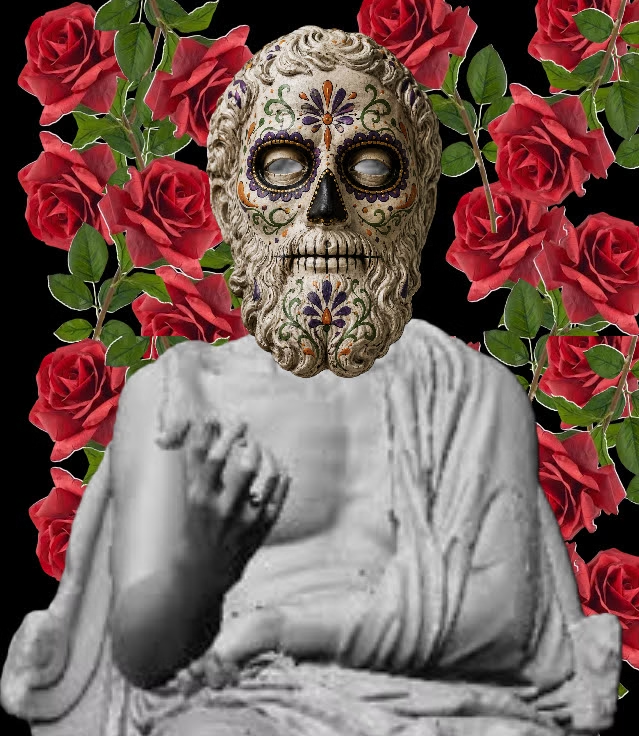
Theatre of Death


By Sophie Daushvili

I was asked to write an article about death.

As I sat with the assignment, it occurred to me that I had absolutely nothing to say about death because I had never died before. What an absurd thing to ask someone to write about. Death is perhaps the only human experience that cannot be narrated by the one experiencing it. It is the place where language collapses in the face of cosmic silence. Perhaps this is why every conversation about death eventually becomes a conversation about life.

The philosopher Epicurus famously observed that death is nothing to us, for when we are, death is not, and when death is, we are no longer here. It is a strangely comforting thought and yet one that solves very little. Death remains the great organizing principle of human existence precisely because it cannot be known. It is the silent horizon against which every decision, every love affair, every work of art, every civilization unfolds.

While contemplating the subject, I realized that the only thing I can speak about when it comes to death is the reaction to it. The familiar language quickly arrives. We are told grief comes in stages: shock, denial, anger, bargaining, depression, acceptance. The list has become so culturally embedded that many of us measure our own grief against it, wondering whether we are mourning correctly, whether we have skipped a step or lingered too long in another. As if defining it within this narrow framework shrinks the experience to something knowable, manageable, finite.

What is it about human beings that compels us to name every emotional landscape we encounter? Perhaps we believe that by classifying an experience, we become the masters of its dominion. Yet some experiences forever remain unnamed; they overflow the borders determined by language. They exist beyond the realm of symbols. Death is one of those concepts and grief in reaction sometimes refuses to follow its assigned script.

I grew up in the Republic of Georgia during the collapse of the Soviet Union. Death was not an abstract philosophical idea; death was a daily occurrence in the midst of a country at war. Funerals became ordinary weekly events. Mourning became so routine that it seemed the entire country simply collapsed into a perpetual state of grief.

As a fourteen-year-old witnessing the deaths of multiple peers, I was certainly terrified, but it was my inability to process their magnitude that disturbed me even more. I felt myself becoming numb, and perhaps this numbness was the closest experience to death itself. For one cannot truly claim to be alive if one feels nothing. I even remember fighting an urge for compulsive laughter at certain funerals. I was clearly not amused—my mind was simply short-circuiting. I horrified myself. I believed something must be fundamentally wrong with me because my mind refused to comply with the emotional choreography around death that culture expected of me.

Only years later did I begin to wonder whether perhaps laughter, silence, numbness, rage, absurdity, tenderness, and even indifference belong equally to grief. Perhaps the psyche refuses neat categories because death itself cannot be contained within them.

Where language fails, we perform.

The British psychoanalyst D. W. Winnicott believed that we could not affectively symbolize experiences without first playing with them. In his theory of infant development, he believed that play is the psychic space where realities that cannot be articulated can nevertheless be experienced through enactment. And what are we but infants in the face of mortality? That which can never be experienced must forever be played with; hence human beings have always responded to death not with explanations but with theatre. We enact death, we are ceremonial and performative around it. I don’t mean theatre in the sense of pretending, but theatre in its oldest anthropological meaning: ritualized performance that allows us to approach what cannot be approached directly. If death cannot be experienced or spoken, it can at least be enacted, symbolized, rehearsed.

Long before theatre became entertainment, it emerged from ritual. Greek tragedy grew out of festivals dedicated to Dionysus, god of life, death, and ecstatic transformation. Entire communities gathered not merely to watch a story unfold, but to participate in collective encounters with mortality. Aristotle would later describe tragedy as producing catharsis—a purification of emotion. Perhaps what audiences were really rehearsing was not simply pity or fear, but their own inevitable disappearance.

Shakespeare understood this intuitively. Hamlet begins not with action but with a ghost, a dead father refusing silence. The entire play revolves around an impossible question: what is death, and how should the living respond to it? Macbeth offers perhaps an even more devastating reflection when he describes life itself as “a poor player that struts and frets his hour upon the stage.” Notice the reversal. It is not death that becomes theatre. It is life. Mortality transforms existence into performance. Every entrance is temporary. Every exit is inevitable.

Perhaps this is why no civilization has invested more imagination into anything than into death.

Ancient Egyptians constructed pyramids as elaborate architectures for the afterlife. Mummification, the weighing of the heart, the journey through the underworld—an entire cosmology devoted to crossing from being into not-being.

Across the ancient Mediterranean, souls crossed rivers ferried by Charon into Hades. Christianity imagined heaven, hell, resurrection, purgatory. Tibetan Buddhists developed sky burials in which the body is offered back to nature. Mexican Día de los Muertos welcomes the dead home with music, food, candles, and laughter, dissolving the boundary between the living and the departed. Among the Inca, indigenous death rituals survived colonialism by hiding ancestral deities inside Catholic processions, preserving older cosmologies beneath newer symbols.

These practices differ radically, yet they all perform the same psychological task.

They give shape to silence.

Freud believed that no one truly believes in their own death. Somewhere in the unconscious we continue to imagine ourselves as immortal because genuine nonexistence exceeds what the mind can represent. Ernest Becker later argued that civilization itself is built upon this impossibility. Our religions, monuments, achievements, families, nations, and works of art become elaborate strategies for negotiating mortality. We build not only houses but legacies. Not only memories but myths.

Perhaps every culture is, in some sense, staging a response to the same unspeakable mystery.

Seen this way, grief itself is only one scene in a much larger production.

We compose requiems. We bury our dead beneath stone engraved with names that outlive voices. We light candles, scatter ashes into oceans, preserve photographs, tell stories, create anniversaries, wear black, build mausoleums, speak to those who can no longer answer us. None of these rituals changes death. But they give form to an unbearable unknowing.

Death itself remains perfectly silent. It is we who cannot stop relating to it. And perhaps that is the real theatre of death, our endless performances in the face of what can never be known. We create ceremonies like mute children playing with dolls. We invent mythologies that allow us to imagine the full range of human experience as a final act. We write eulogies because death offers no final dialogue.

Perhaps that is what makes life tragic—not simply that it ends, but that everything beautiful unfolds in the shadow of its ending. Love matters because it is temporary. Memory matters because it fades. Beauty matters because it disappears.

Death may forever remain beyond language.

Yet in trying to answer its silence, humanity has produced some of its greatest achievements: philosophy, religion, ritual, theatre, art, poetry, and culture itself.

Perhaps civilization itself is humanity’s standing ovation before the curtain finally falls.

Obsession: New Arising Gen-Z Filmmakers


By: Emily Parsons, Editorial Intern

Spoilers from “Obsession”

Imagine, suddenly, you become separated from your body, and your will is under someone else’s control. What do you think will happen? Apparently, nothing good.

“Obsession” follows Bear (Michael Johnston), a loser obsessed with his close childhood friend Nikki (Inde Navarrete). Bear is a depressed coward unable to express his true feelings due to his deep fear of rejection, while Nikki is a bright, creative writer eager to move forward with her life. Bear’s character is an accurate representation of insecure males who are unable to accept rejection from women and a terrifying twist of what happens when you wish for someone to center their entire life around you. Bear was never in love with Nikki, but was in love with the idea of being with her – relating to how many people experience limerent-driven attractions. Many relationships now are similar to this trope, especially with the presence of internet platforms and people’s lack of face-to-face connection.

This concept that Curry Barker tackles is a clear metaphor for the widespread issue of dysfunctional relationships and lack of genuine bonds in the modern age.

At only 26 years old, Curry Barker created Obsession, an indie horror movie now recognized as the highest-grossing film ever made with under one million dollars. His self-taught filmmaking skills may be proof that you don’t always need millions of dollars or film school to create a Hollywood masterpiece.

Barker dropped out of the New York Film Academy campus in Los Angeles after meeting Cooper Tomlinson (who plays Ian in Obsession). They created a comedy-horror YouTube channel called That’s a Bad Idea, where Barker began experimenting with his individual, unique film style. Their YouTube channel has collected a large audience over time, now with 1.5 million subscribers, contributing to the popularity of Barker’s first film release.

Other filmmakers like Issa Rae, who created a YouTube comedy series in 2011 called The Misadventures of Awkward Black Girl, and Quinta Brunson, who made an Instagram series in 2014 called The Girl Who Has Never Been on a Nice Date, followed a similar route in pursuing film as a career — using the internet to share their creations and gain a following. Curry Barker, Kane Parsons and Markiplier are all recent examples of online content creators who used their platforms to pursue their aspirations in film.

Film directors like Barker will keep theater alive in this generation if their future releases have as much praise and attention as Obsession. The popularity of this movie poses a question: What else will Gen-Z filmmakers bring to the table in the upcoming years, and how will Hollywood change?

Tuning Out the Algorithm

Gen Z Pushes Back Against Digital Overload

Hannah G. Morris, Editorial Intern

Rage bait, doomscrolling, thirst trap: The internet has developed a vocabulary to describe how technology and social media capture, manipulate and monetize the human gaze. And participants in this digital environment, which heavily consist of young people, are often left exhausted and worse for wear because of it.

As the first generation to grow up entirely in the digital age, many Gen-Zers have had enough of this corporate manipulation. Instead, they’ve come to desire what they can’t find online: face-to-face conversations, hands-on activities and a break from constant distraction. In response, some Gen-Zers are choosing to unplug this season and have an ‘Analog Summer.’

The Analog Summer essentially involves spending time away from technology to pursue creative projects and engage in offline experiences such as reading, hiking and more. Amid increasing concerns over screentime, as well as an influx of Instagram posts promoting anti-scroll apps, the conversation about unplugging has emerged among the South Bay and Los Angeles Harbor Area youth as well.

Whereas online influencers have taken to posting their ‘analog bags,’ which are filled with non-technology entertainment options, local youth are taking a more organic approach.

San Pedro local Noel Marin emphasized “just how much time” social media takes away from other activities people could be doing. Instead, he chooses to spend time offline engaged in physical and social activities, including going to the gym, playing basketball and spending time with friends, as well as artistic endeavors such as improving his guitar skills.

“I’ve seen how (for) younger kids these days, being on the phone really affects them growing up and their social skills,” Marin said. “So I think knowing how messed up the youth is, I feel like that opens up my eyes to how bad being on the phone and on social media a lot can be.”

Allison Perlman, an associate professor in the University of California, Irvine’s film and media studies and history departments, says this shift to analog by Gen-Zers “follows in a long tradition of youth seeking more authentic ways of living and communicating and understanding their relationship with technologies.”

AllisonPerlman

Allison Perlman, an associate professor in the University of California, Irvine’s film and media studies and history departments. Courtesy of University of California, Irvine

Perlman identified the commune movement of the 1960s-70s, which she described as a reaction to feelings of alienation in a corporation-dominated “mass society,” and the DIY culture of the 1990s.

“It is possible that today’s youth are similarly cynical about how a few very large — and largely unregulated — multinational corporations have structured their communicative experiences and have sought to capture and monetize their attention and are looking for more authentic modes of expression and engagement,” Perlman said in an email.

Local Gen-Z members echoed this sentiment, though the authenticity they sought looked different from person to person.

For aspiring local artist Liam Messer, unplugging is about creating more than he consumes on social media. Messer often spends his time offline developing his creative talents, exploring fine arts such as painting, sculpture and textile art.

“What’s pushed me to spend time off of my phone would probably be personal career goals with my art,” Messer said. “I often get caught in cycles of consuming on Instagram and YouTube and as an artist, you have to be the best or else you’re not going to make it.”

San Pedro resident Camilo Visessiri-Petite is using his time spent offline to rediscover his passion for old hobbies. He noted that putting his phone down this summer could allow him to get back into surfing.

“Summer is a rare time of the year where, as a student, it’s one of my only times off,” Visessiri-Petite said. “So by being able to spend it not on my phone, I get to do more things [that] I love doing.”

Beyond time management, some local Gen-Z members also expressed the harmful effects of social media on mental health. For Manhattan Beach resident Sufi, her time spent offline — engaged in activities such as reading, baking and learning more about topics of interest — has been an exercise to improve her focus and mental clarity.

“I think it is really grounding to be able to spend time offline,” Sufi said in a survey response. “When life gets stressful, it’s super important to be able to have activities that bring you peace and allow you a healthy outlet.”

Similarly, for San Pedro resident Faris Ibrahim, his time spent offline offers him “a chance to recharge and focus on what matters most in [his] life” — friends and family. He noted that unplugging allows him to step away from the overwhelm of social media and connect with the people he cares about.

“[Being offline has] a positive impact on my mental health as it gives me a break from the constant distractions and pressures of being online,” Ibrahim said in a survey response. “It helps me reduce my stress, feel calmer and lets me focus on the present moment.”

Julian Mejia, a 2026 San Pedro High School graduate, painted the difference between social connections found online and those found in person.

According to Mejia, people on social media may feel confident to speak and act in ways that they wouldn’t otherwise, which can make genuine interactions more elusive. However, with locals at the park, Mejia has found it easier to spark up simple but meaningful conversations.

“I feel like it’s easier to talk to people in person than it is online because, one, you don’t have to wait for a response,” Mejia said. “And it’s easier to make conversation, like you can talk about something [that] you guys are both doing.”

Marin called the smartphone “the biggest distraction in our lives” — a sentiment that Messer, Visessiri-Petite, Mejia and Ibrahim echoed.

And for the Gen-Z locals interviewed, it appears that spending time offline has been a conscientious choice in an era saturated with technology.

Two New ICE Murders Highlight Ongoing Systemic Violence


Lorenzo Salgado Araujo was murdered on his way to work in Houston, Texas on July 7. Joan Sebastian Guerrero was murdered with his pajama-clad 3-year-old daughter in his car in Biddeford, Maine on July 13. Both men were mistakenly murdered by ICE agents looking for someone else. Both were initially accused of threatening ICE agents’ lives with their vehicles. In both cases, ICE lied repeatedly.

ICE claims to be going after “the worst of the worst.” But these two men were anything but that.

Araujo, 52, was a father of three who’d been in the U.S. for more than three decades, owned his own construction company, and was trying to obtain legal residency. “He prided himself in his work,” his son Ronaldo said. “He built the homes that people bought for their families to put over their heads, and he saved up so much money to be able to build the house of his dreams.”

Guerrero, 26, worked two jobs, was authorized to work in the United States — and had been issued a Social Security number according to Presente! Maine.

“He was a member of our community, a neighbor and a human being whose life was cut tragically short,” the organization said in a statement.

The two murders put ICE violence back at the top of national awareness, following a period in which the Trump administration sought to lower the public profile of its mass deportation efforts. Both occurred in Senate battleground states, and protesters chanting, “Vote her out!” marched to Sen. Susan Collins’ office in the aftermath of Guerrero’s murder, in part due to her role as the deciding vote in the most recent $70 billion appropriation for ICE.

The murders were followed by the release of report on the widespread misuse of force against ICE protesters, journalists, bystanders and children, underscoring the fact that these murders are just the tip of the iceberg of much broader lawlessness on the part of ICE and the Department of Homeland Security, as well as state and local law enforcement that sometimes joined them. The report, “Charting the Crackdown,” from Physicians for Human Rights and the Human Rights Center at the University of California, Berkeley, documented 412 verified incidents of the “misuse” of these crowd control weapons, also known as “less-lethal weapons,” across 16 cities in 13 states from June 2025 through May 2026.

It documented 203 injuries — including blindings, traumatic brain injuries, lacerations, fractures and contusions — with the caveat that “our methods likely systematically undercount such injuries. The true number of injuries is likely far greater.”

Five cities accounted for the majority of incidents, led by Los Angeles, (169 incidents, more than 40% of the total), followed by Minneapolis (94 incidents, nearly a quarter of the total), then Chicago (56 incidents, 13.6%), Portland, Oregon, (37 incidents 9.0%), and Newark, New Jersey (21 incidents 5.1%). In LA, both the Los Angeles Police Department and the LA County Sheriff’s Department were involved in some of the incidents. As Random Lengths News has noted before, the LA City Council passed 22 policy recommendations in the wake of these demonstrations, none of which were implemented by the Police Commission overseeing the LAPD. (A charter reform proposal to give city council the power to set policy directly was removed from consideration on a motion by Councilman Tim McOsker.)

“The high number of head injuries (19 brain, 10 eye, 1 hearing loss) suggests a pattern of force directed towards the head,” the report noted. “Whether intentionally or recklessly, this violates virtually all use-of-force guidelines and results in significant harm.” Elsewhere it notes, “Shots to the head (97 incidents, 24%) and shots to the groin (7.2%) directly violated prohibitions in every applicable agency policy reviewed.”

The report follows a report in June, “Dying in Detention: Rising Deaths in an Expanding US Immigration Detention System,” from Human Rights Watch and Physicians for Human Rights, which analyzed deaths in ICE custody from Oct. 1, 2015, through June 4, 2026.

The report found that 52 people died in custody during the first 500 days of President Trump’s second term, with a mortality rate, “nearly three times the rate during the entire Biden administration and about twice as high as that of the first Trump administration, which included the first 10 months of the Covid-19 pandemic.”

Together, these two reports paint a picture of systemic lawlessness and violence by ICE, its sister agencies and law enforcement agencies that aid them. Just as those being hunted down and deported — people like Lorenzo Salgado Araujo and Joan Sebastian Guerrero — are mostly the opposite of “the worst of the worst,” so, too, those doing the hunting and deporting are producing the opposite of law and order.

From FIFA Fan Zone to Waterfront Destination, The Long Road to West Harbor


By Devonte Barr, Columnist

By now, most of San Pedro is aware of West Harbor, the replacement for Ports O’ Call Village which was torn down five years ago to make way for this new development. What few may know is that 14 years ago, Eric Johnson and Jerico Development submitted their FIFA Fan Zone application—a move that set the entire timeline in motion. A few days before the opening, I decided to head down to see for myself what was becoming West Harbor.

One of the first people I saw when I strolled through the construction site was Eric Johnson—President of Jerico Development. I quickly found myself in a very unplanned conversation with him, and I learned even quicker that the Fan Zone represents something much larger than a World Cup celebration: proof that San Pedro’s waterfront can become a place where people choose to spend an entire day.

For decades, San Pedro has wrestled with its identity—beach town, working port, arts district, commuter city. Johnson sees the problem differently than most: the waterfront has been held back not by what it is, but by the belief that it needed to choose one answer. That layered identity is not a liability but an advantage.

“San Pedro is much more than just a beach city,” he said.

The harbor’s advantage, in his view, is not that it competes with Huntington Beach or Newport Beach, but that it offers something those cities cannot: a working waterfront, international culture, historic neighborhoods and access to downtown Los Angeles. That layered identity—port and community, working and recreational, local and connected—is what West Harbor is designed to activate rather than erase.

Jerico Development was founded in 1984 by a family with business interests in San Pedro since the early 20th century and who plan to remain part of the community they’re building in.

For years, proposals circulated for the former Ports O’ Call site—hotels, casinos, traditional destination projects. Jerico rejected that approach entirely. Those developments promised economic activity but failed to capture local imagination, and Johnson wasn’t willing to repeat that mistake in a community where he planned to stay.

The goal, Johnson explained, was never simply to construct buildings. It was to create what he repeatedly described as a “multi-day area” — a destination where visitors arrive in the morning, stay into the evening, return the following day and become participants in the local economy rather than simply passing through it.

This summer’s FIFA Fan Zone served as a preview. Tenants are expected to move into West Harbor by the end of the year.

The Fish Market, one of the nation’s top-performing fish restaurants, is currently in planning and design stages for its permanent space—a build-out expected to take approximately two years. Following that completion, a hotel will anchor the waterfront’s northern edge, the final major component of the West Harbor vision.

Johnson designs West Harbor with younger demographics in mind—people in their twenties and thirties. He believes they’re the demographic most likely to shape repeat visitation and weekend destination choices, the people who decide where to spend leisure time and which waterfront becomes a habit.

Throughout the interview, Johnson never mentioned square footage or profit margins. Instead, he spoke about bringing something unique, authentic, and fun to the waterfront.

He described the waterfront not as real estate to be developed into just anything, but a public place people would actually use—a place where routines form, where people belong. When he talked about the multi-day area, he wasn’t calculating visitor spending; he was imagining someone arriving in the morning, staying into the evening, then deciding to come back.

That shift from extraction to participation seemed to be the entire point. For Johnson, West Harbor’s success would be measured in whether San Pedro became a place people chose to return to—not as a one-time event, but as a habit, a destination worth the drive, a weekend ritual.

The Fan Zone proved the concept works—it showed for the first time in years that San Pedro’s waterfront could be real and alive, not just theoretical. West Harbor now stands in its final stages with buildouts, tenant finalization (which hasn’t been confirmed), and space activation. The concept is proven once but can it continue? What remains is execution.

The Corner Store’s 79th Birthday


By Gretchen Williams, Columnist

Happy Birthday to the Corner Store! For 79 years, the Corner Store has anchored the Palisades neighborhood, serving treats to White Point Elementary School students, snacks and drinks for their parents, and providing a gathering place that showcases San Pedro artists and musicians.

The Corner Store recently celebrated its 79th birthday with a neighborhood party hosted by David and Julieth DeAnda. James Preston Allen and The Report provided the musical entertainment, San Pedro Pet Pals brought puppies and kittens, and the aroma of carne asada filled the air from the grill. Neighbors gathered to sing “Happy Birthday,” share cake, and celebrate the Corner Store’s enduring role as the heart of the community.

Among the Corner Store’s best-kept secrets are its tres leches cake sold by the slice, an inventive coffee and specialty drinks menu, and the Del Mar breakfast sandwich. Served on bread or a bagel, the Del Mar is topped with cream cheese, ham, capers, tomato, red onion, and arugula. The cinnamon rolls are fragrant and delightful.

Located at the corner of Barbara and 37th streets, the Corner Store remains one of San Pedro’s most beloved neighborhood destinations. David and Julieth DeAnda have brought nostalgia back to the historic market. Old-fashioned screen doors, rows of colorful candies and sodas, and a welcoming atmosphere greet visitors. The scent of freshly brewed coffee fills the air while fruit turnovers and rich brownies tempt customers from the display case.

The breakfast sandwiches and burritos are perfect for enjoying on the pet-friendly terrace. The Italian Stallion sandwich features grilled chicken breast, provolone cheese and mayonnaise on a ciabatta roll for $14.95. The Beachcomber BLT is an ideal choice after a stroll along Paseo del Mar and is also priced at $14.95.

Burger lovers will find plenty to enjoy. The cheeseburger is $12.99, while the Frisco Burger adds grilled onions and Thousand Island dressing. Both are served with lettuce, tomato and onion, with bacon or avocado available for an additional charge.

The children’s menu includes bean-and-cheese burritos, quesadillas, cheeseburgers and grilled cheese sandwiches.

The Corner Store is located at 1118 W. 37th St. in San Pedro. For more information, call 310-832-2424.

Built on Water: The Environmental and Historical Wake of Global Trade


The Ports of Los Angeles and Long Beach make up the largest port complex in the United States; they are also the busiest ports in North and South America. Each year, they handle more than 15 million cargo containers, representing over $400 billion worth of goods.

When one considers what that means for the San Pedro Bay, it can be overwhelming. The spectacle of these daily operations is both fascinating and troubling. On one hand, the scale of commerce, the efficiency of logistics and the technological systems that enable the movement of goods are captivating. On the other hand, the environmental and social-economic consequences of the globalized supply chains these ports sustain are troubling.

A new contemporary exhibition, Built on Water, showing at Angels Gate Cultural Center or AGCC through Aug. 22, maps the human forces that have shaped — and continue to reshape — the economy and ecology of the ports of Los Angeles and Long Beach.

Built on Water presents past, present and future visions of the ports of Los Angeles and Long Beach, featuring Los Angeles-based artists Flora Kao, Kaya & Blank, Jennifer Gunlock, Hilary Norcliffe and Katie E. Stubblefield. Built on Water is curated by AGCC’s director of exhibitions, Cecelia Caro.

Angels Gate Cultural Center is a resonant vantage point, on a hill overlooking the bay, from which to examine the ports’ industrial present and layered histories beneath. The campus was originally established as Fort MacArthur in the early 20th century, serving as a coastal defense installation for the Los Angeles Harbor. Living in the Harbor Area and looking out to the bay, one registers — even internalizes — a canvas of muscular port infrastructure. Monumental stacks of containers, towering cranes, and endless lines of cargo ships compress a dense network of global commerce into an abstract grid of steel, color and mechanized movement.

Conversely, the region’s industrial present and layered histories hold present-day parallels. The forced internment of Japanese Americans from the Terminal Island fishing village echoes the erasure of the original Gabrieleño Tongva peoples. The ports are machines for transpacific exchange, yet their industrial reach has permanently altered the ecology of the natural coastline and the marine life once sustained.

A surprising feature of this exhibition is that it offers viewers an answer to the unforeseen inquiry of how to comprehend all of this — panorama, history, industry, absorption and ecology. Built on Water examines the ports’ layered industrial landscape to postulate a visionary future — where memories surface, nature reclaims and humanity progresses in harmony with the natural world.

Flora Kao’s work in Built on Water excavates layered histories beneath the port, exploring meaning through place and memory. Kao’s evocative installation of cyanotype and rubbing, 100 Views of Fish Harbor, Terminal Island, investigates the historic significance of San Pedro for Southern California’s Japanese-American community. More than 100 Prussian blue images mark the historical context of a thriving Terminal Island fishing village; its inhabitants, culture, and dress fill the walls of the lower gallery. A fine netting pattern on the surface of each blueprint reflects fish netting, Japanese embroidery designs and textile patterns. Residents in their best clothes pose in front of businesses that fortified the region; cyanotype prints of the day’s fresh catch, fishermen working, and family and school photograms populate the gallery walls, recalling an abundant life.

Artist duo Kaya & Blank focus on the intersections between infrastructure, ecology and systems of power. In their body of work, Intermodal, the monumental scale of port operations loops and distorts global commerce into an abstract environment of steel and color, underscoring the enmeshed relationship we have to global exchange. The extended video triggers hypnotic focus, providing a bird’s-eye view of intermodal mechanisms. It’s a bit like watching toy Tonka trucks moving about, juxtaposed with the aid of automated stacking machinery and other mechanisms, amidst ambient sounds of machinery constantly, rhythmically pushing forward, as it audio-hypnotizes.

Inermodal
Kaya & Blank, “Intermodal” still. Photo courtesy of AGCC.

Accompanying the video is a series of gold-toned salted paper prints, containing saltwater from the ports of LA and Long Beach. This printing process, developed in the 19th century, is used to sensitize the paper. The seawater is brushed onto the paper surface and coated with silver nitrate, forming light-sensitive silver salts. After exposure, the prints undergo a developing and washing sequence that incorporates additional seawater collected from the site, resulting in the material conditions of the ports becoming physically embedded within each image. Presented in bare wooden frames, five striking images each present a quiet horizon around the port. Three display vessels in the distance, almost like whales skimming the waters’ surface. A beautiful, vertical triptych depicts a full moon over water in the first frame, bordered by a thin veil of clouds. Lunar light is framed by a darkened sky at the top that precedes the satellite, replicating the shadowiness of still waters in the successive frames below. Each of the print’s archival aesthetic depicts peaceful scenes amid foregrounded natural elements, such as waves crashing at Cabrillo Beach and birds in flight above the waters and mountains in view.

Birds Png
Kaya & Blank, “Intermodal” KBL S Photo courtesy of AGCC.

Looking toward a visionary future, Future Port is a collaboration between Jennifer Gunlock, Katie Stubblefield and Hilary Norcliffe, who create an immersive installation that imagines a reclaimed coastal marine environment. Stubblefield has created an ocean floor landscape in Live Through This, created from second-hand wedding dresses and pearl-producing mollusks. The exhibition text notes, “Mother Nature creates a hybrid filtration system that regenerates despite environmental upheaval.” The installation is contrasted with an overlaid video titled Gone Fishing by Gunlock, whose projected video works convey the collision between the coastline and built infrastructure. Human detritus flow through crashing tides, emphasizing the anthropogenic time humans reside in. Heavily rusted mooring chains are visible underwater while cranes sit at the top of the projection, populating a bright blue, cloud-filled sky. At the horizon, the ocean surface shines, mirage-like, above murky waters. Norcliffe’s Alpha Frequency installation envisions a radically optimistic future of ocean-attuned shipping and port systems. Shimmering, dynamic, fish-like forms swim disarmingly with an invisible tide, transporting goods from upcycled port to upcycled port, channeling the alpha frequency — the brain’s state of calm, grounded consciousness. A small video “billboard” of Going Fishing is embedded into one of these ports, reminding future folk of how past humans disrespected their precious waters.

Together, Future Port imagines the conditions under which regeneration is possible and global exchange operates in harmony with the natural world.

Built on Water is made possible with support from the Department of Cultural Affairs, City of Los Angeles, the Port of Los Angeles, the Port of Long Beach and the Los Angeles County Department of Art and Culture.

~ In conjunction with Built on Water, join a paint & sip cyanotype printing, hands-on sun print workshop. The free event includes a social and an artist talk with artist Flora Kao, from 2 to 4 p.m., Aug. 1.

Details: https://tinyurl.com/Cyanotype-printing-workshop

Built on Water

Time: 10 a.m. to 5 p.m. Thursdays, Fridays, and Saturdays, through Aug. 15

Cost: Free

Details: https://angelsgateart.org

Venue: Angels Gate Cultural Center, 3601 S. Gaffey St., San Pedro

California Sent Investigators to ICE Facilities


They found more detainees and health care gaps

By Wendy Fry

When reporters asked for records about the cases, citing the California Public Records Act, the sheriff’s department denied their request. It said it did not have to disclose the records because they fall under a carveout in the public records law that protects investigative records — even though the sheriff was not investigating the cases.

I’ve experienced this lack of transparency firsthand. In 2017, I began reporting for the Los Angeles Times about a rash of deaths and attempted suicides at Adelanto. Detainees I spoke with described harrowing conditions that echo what others are saying today.

One man told me he saw a fellow detainee hanging from the second floor with a bedsheet around his neck. What I remember most is he was horrified but not surprised.

“I think doing something like that is something that has crossed the mind of all of us who are locked up here,” he said.

A colleague and I requested official records to learn about complaints from detention centers across the state and explain what was being done about them. When the federal government delayed or denied our requests, we asked local police for 911 call logs showing reported incidents at the facilities.

The logs revealed hundreds of calls about violence or abuse at the centers.

But most of those listings offered almost no details about what had been reported or what had come of the reports, because local agencies chose to withhold additional records. Over two years, we pushed law enforcement to release enough information to allow us to assess those reports.

Getting information on a system that affects the lives of thousands of people in our state should not be this difficult.

Recent stories based on 911 calls in other states make it clear why California should act. In Arizona, reporters obtained audio of a 911 call from an ICE facility revealing that officers had pepper sprayed 47 detainees in an enclosed room.

In Florida, reporters analyzed 911 calls about Alligator Alcatraz from staff and detainees’ loved ones, revealing confusion and desperation. And at the South Texas Family Residential Center, 911 calls exposed medical emergencies involving young children and pregnant women.

A law requiring disclosure of 911 calls and related records from privately-run detention centers in California would make a meaningful difference.

The good news is state Sen. Lena Gonzalez, a Democrat from Long Beach, has introduced Senate Bill 423 to do that. The bill includes safeguards to protect legitimate investigative needs and victim privacy, while ensuring the right to know is not limited by local practices or agency discretion.

The First Amendment Coalition, where I work training journalists on access to public records, co-sponsored the bill, along with the policy advocacy organization Immigrant Defense Advocates.

For California legislators, this should be an easy call. Detainees should not have to resort to throwing notes over barbed-wire fences, just so the public knows what they are experiencing in our state.