
By Sophie Daushvili
I was asked to write an article about death.
As I sat with the assignment, it occurred to me that I had absolutely nothing to say about death because I had never died before. What an absurd thing to ask someone to write about. Death is perhaps the only human experience that cannot be narrated by the one experiencing it. It is the place where language collapses in the face of cosmic silence. Perhaps this is why every conversation about death eventually becomes a conversation about life.
The philosopher Epicurus famously observed that death is nothing to us, for when we are, death is not, and when death is, we are no longer here. It is a strangely comforting thought and yet one that solves very little. Death remains the great organizing principle of human existence precisely because it cannot be known. It is the silent horizon against which every decision, every love affair, every work of art, every civilization unfolds.
While contemplating the subject, I realized that the only thing I can speak about when it comes to death is the reaction to it. The familiar language quickly arrives. We are told grief comes in stages: shock, denial, anger, bargaining, depression, acceptance. The list has become so culturally embedded that many of us measure our own grief against it, wondering whether we are mourning correctly, whether we have skipped a step or lingered too long in another. As if defining it within this narrow framework shrinks the experience to something knowable, manageable, finite.
What is it about human beings that compels us to name every emotional landscape we encounter? Perhaps we believe that by classifying an experience, we become the masters of its dominion. Yet some experiences forever remain unnamed; they overflow the borders determined by language. They exist beyond the realm of symbols. Death is one of those concepts and grief in reaction sometimes refuses to follow its assigned script.
I grew up in the Republic of Georgia during the collapse of the Soviet Union. Death was not an abstract philosophical idea; death was a daily occurrence in the midst of a country at war. Funerals became ordinary weekly events. Mourning became so routine that it seemed the entire country simply collapsed into a perpetual state of grief.
As a fourteen-year-old witnessing the deaths of multiple peers, I was certainly terrified, but it was my inability to process their magnitude that disturbed me even more. I felt myself becoming numb, and perhaps this numbness was the closest experience to death itself. For one cannot truly claim to be alive if one feels nothing. I even remember fighting an urge for compulsive laughter at certain funerals. I was clearly not amused—my mind was simply short-circuiting. I horrified myself. I believed something must be fundamentally wrong with me because my mind refused to comply with the emotional choreography around death that culture expected of me.
Only years later did I begin to wonder whether perhaps laughter, silence, numbness, rage, absurdity, tenderness, and even indifference belong equally to grief. Perhaps the psyche refuses neat categories because death itself cannot be contained within them.
Where language fails, we perform.
The British psychoanalyst D. W. Winnicott believed that we could not affectively symbolize experiences without first playing with them. In his theory of infant development, he believed that play is the psychic space where realities that cannot be articulated can nevertheless be experienced through enactment. And what are we but infants in the face of mortality? That which can never be experienced must forever be played with; hence human beings have always responded to death not with explanations but with theatre. We enact death, we are ceremonial and performative around it. I don’t mean theatre in the sense of pretending, but theatre in its oldest anthropological meaning: ritualized performance that allows us to approach what cannot be approached directly. If death cannot be experienced or spoken, it can at least be enacted, symbolized, rehearsed.
Long before theatre became entertainment, it emerged from ritual. Greek tragedy grew out of festivals dedicated to Dionysus, god of life, death, and ecstatic transformation. Entire communities gathered not merely to watch a story unfold, but to participate in collective encounters with mortality. Aristotle would later describe tragedy as producing catharsis—a purification of emotion. Perhaps what audiences were really rehearsing was not simply pity or fear, but their own inevitable disappearance.
Shakespeare understood this intuitively. Hamlet begins not with action but with a ghost, a dead father refusing silence. The entire play revolves around an impossible question: what is death, and how should the living respond to it? Macbeth offers perhaps an even more devastating reflection when he describes life itself as “a poor player that struts and frets his hour upon the stage.” Notice the reversal. It is not death that becomes theatre. It is life. Mortality transforms existence into performance. Every entrance is temporary. Every exit is inevitable.
Perhaps this is why no civilization has invested more imagination into anything than into death.
Ancient Egyptians constructed pyramids as elaborate architectures for the afterlife. Mummification, the weighing of the heart, the journey through the underworld—an entire cosmology devoted to crossing from being into not-being.
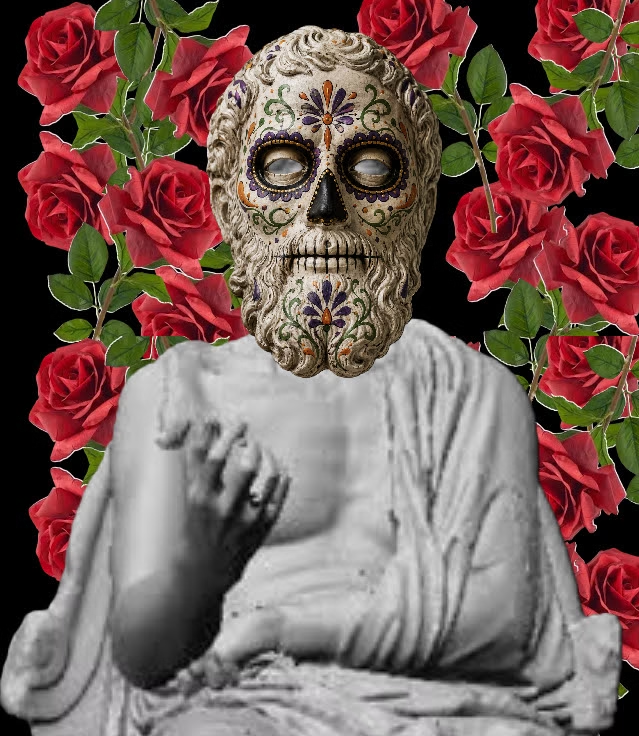
Across the ancient Mediterranean, souls crossed rivers ferried by Charon into Hades. Christianity imagined heaven, hell, resurrection, purgatory. Tibetan Buddhists developed sky burials in which the body is offered back to nature. Mexican Día de los Muertos welcomes the dead home with music, food, candles, and laughter, dissolving the boundary between the living and the departed. Among the Inca, indigenous death rituals survived colonialism by hiding ancestral deities inside Catholic processions, preserving older cosmologies beneath newer symbols.
These practices differ radically, yet they all perform the same psychological task.
They give shape to silence.
Freud believed that no one truly believes in their own death. Somewhere in the unconscious we continue to imagine ourselves as immortal because genuine nonexistence exceeds what the mind can represent. Ernest Becker later argued that civilization itself is built upon this impossibility. Our religions, monuments, achievements, families, nations, and works of art become elaborate strategies for negotiating mortality. We build not only houses but legacies. Not only memories but myths.
Perhaps every culture is, in some sense, staging a response to the same unspeakable mystery.
Seen this way, grief itself is only one scene in a much larger production.
We compose requiems. We bury our dead beneath stone engraved with names that outlive voices. We light candles, scatter ashes into oceans, preserve photographs, tell stories, create anniversaries, wear black, build mausoleums, speak to those who can no longer answer us. None of these rituals changes death. But they give form to an unbearable unknowing.
Death itself remains perfectly silent. It is we who cannot stop relating to it. And perhaps that is the real theatre of death, our endless performances in the face of what can never be known. We create ceremonies like mute children playing with dolls. We invent mythologies that allow us to imagine the full range of human experience as a final act. We write eulogies because death offers no final dialogue.
Perhaps that is what makes life tragic—not simply that it ends, but that everything beautiful unfolds in the shadow of its ending. Love matters because it is temporary. Memory matters because it fades. Beauty matters because it disappears.
Death may forever remain beyond language.
Yet in trying to answer its silence, humanity has produced some of its greatest achievements: philosophy, religion, ritual, theatre, art, poetry, and culture itself.
Perhaps civilization itself is humanity’s standing ovation before the curtain finally falls.