Home Blog Page 103

We 12 Kings CD Listening Party Lights Up December’s First Thursday ArtWalk


San Pedro! December’s First Thursday ArtWalk will kick off the Christmas spirit with a very special event.

P.M. Sounds Record Store in downtown San Pedro will present acclaimed LA-based arranger, producer, composer, and DJ, Terence Toy at First Thursday ArtWalk on Dec. 4. Join for a CD listening party of Toy’s latest release, We 12 Kings along with resident DJ’s Electric1uan and $ammy $am.

Toy’s We 12 Kings is a Christmas album like you’ve never heard before. The record became a deeply spiritual collaboration among 12 male artists. From deep house revivals of gospel hymns to hip-hop and drum-and-bass transformations, We 12 Kings bridges secular and spiritual worlds. Spoken word, rap and lush instrumentation create joy that radiates through every track. The album’s original compositions and reinterpretations invite listeners to rediscover familiar melodies in new, soulful ways.

Join the listening party for this sublime Christmas album with a different spin. The eclectic We 12 Kings phenomenal arrangements and masterful musicians will have you recalling Christmases past in your mind’s eye but with beautiful new sounds.

Read about We 12 Kings here:https://tinyurl.com/twelve-kings-one-vision

Time: 5:30 to 9:30 p.m., or later, Dec. 4

Cost: Free

Details: www.terencetoy.com, 323-333-8679 and www.instagram.com/p.m.sounds

Venue: P.M. Sounds, 421 W 6th St., San Pedro

Gov. Newsom Announces Judicial Appointments

0


SACRAMENTO – Gov. Gavin Newsom Nov. 24 announced his appointment of six Superior Court Judges, with one in Los Angeles County

Los Angeles Superior Court


Unnamed 2025 11 24T134408.496
Judge Karine Mkrtchyan


Karine Mkrtchyan, of Los Angeles County, has been appointed to serve as a judge in the Los Angeles County Superior Court. Mkrtchyan has served as a court commissioner at the Los Angeles Superior Court since 2023. She worked as a partner at Fraser, Watson & Croutch from 2018 to 2023 and as an associate from 2011 to 2018. She was an associate at Lynberg & Watkins in 2010 and an associate at Maranga & Morgenstern from 2009 to 2010. Mkrtchyan received a Juris Doctor degree from Southwestern Law School. She fills the vacancy created by the retirement of Judge Fumiko H. Wasserman. Mkrtchyan is a Democrat.

LACDMH Launches Office of Transition Age Youth to Support Wellbeing of Teens and Young Adults


LOS ANGELES — The Los Angeles County Department of Mental Health or LACDMH today launched the Office of Transition Age Youth (TAY) to promote the mental health and wellbeing of young people, between ages 16 and 25, transitioning to adulthood. The program specifically focuses on connecting and engaging with youth, including those experiencing homelessness, through various human services systems by linking them to mental health, housing and other essential services.

The Office of TAY launched alongside a screening of the short film “Cope Safely” at LACDMH Headquarters. The film amplifies the voices of three youths and explores the realities of coping with mental health and substance use challenges. The film was made in partnership with UCLA’s Center of Excellence and Kids in the Spotlight, an organization that helps foster youth heal and grow from trauma through the power of storytelling and filmmaking.

The Office of TAY’s core services are provided through field-based teams; however, many other vital services are offered, including youth drop-in centers, substance use disorder support, workforce and job development, and the Enhanced Emergency Shelter Program (EESP). The Office of TAY field-based teams can be reached by phone, Monday through Friday from 8 a.m. to 5 p.m. at 213-738-6194; by email at AskTAY@dmh.lacounty.gov; or through the LACDMH 24/7 Help Line at 800-854-7771.

Once contacted, the TAY intake specialist will connect with the youth to find their eligibility for EESP and additional services. The shelter program provides a 60-day temporary shelter, a warm, clean and safe place to sleep, hygiene facilities, hot meals, and case management services. Additionally, the TAY field-based teams can provide ongoing mental health services while the youth reside at the EESP. They can also connect youth to ongoing mental health care, substance use counseling, other program referrals, and employment support, as needed.

UPDATE 2: Unified Command Continued Response to Cargo Container Ship Fire at Port of Los Angeles

U.S. Coast Guard Southwest District

SAN PEDRO – The Unified Command continued response operations Nov. 24 after a fire aboard the container ship One Henry Hudson occurred Nov. 21 while it was moored at Berth 218 in the Port of Los Angeles.

Community Safety Remains Top Priority

“Safety is our top priority in addressing this incident,” said Capt. Stacey Crecy, Coast Guard incident commander. “We are closely monitoring air quality, maintaining safety zones, and coordinating with all agencies to ensure this incident remains isolated and the public remains protected.”

Air Quality Monitoring

Air quality is being monitored 24/7 to assess any impact on surrounding communities.

“The Port Police Hazmat team is providing live air monitoring from four strategic locations throughout the port using air mobile with a live feed into the Department Operations Center,” said Chief Greg McManus, Los Angeles Port Police Deputy Chief. “Air quality has remained at or below federal and state safety thresholds. We’ll continue to track these levels as work on the vessel moves forward.”

No impacts have been detected outside of the established safety zone. Real-time air quality updates can be found on the Port’s air quality monitoring site.

Fire Suppression and Salvage Operations

Fire suppression and salvage operations continue for the One Henry Hudson ship, which has been anchored outside the breakwater at the Port of Los Angeles since the morning of Nov. 22

Vessel crew and a contracted salvage team are monitoring for hot spots in containers. A fire lance is being used to extinguish and cool any affected containers.

Contracted tugs are continuously spraying water to conduct boundary cooling and preserve the integrity of the hull. Water remains the extinguishing agent.

The vessel’s stability is not currently a concern. The salvage team is prioritizing operations on cargo hold number 03, which is estimated to be 80% full of water from initial firefighting efforts.

A formal salvage plan is under development. Monitoring for oil discharge and hazardous substance release continues.

A half-mile safety zone is being maintained around the container ship by the U.S. Coast Guard and Los Angeles Port Police. The temporary flight restrictions are maintained by the U.S. Coast Guard.

The Unified Command consists of the U.S. Coast Guard, Port of Los Angeles Port Police Department, and a representative of the container ship (the vessel’s Qualified Individual).

The Los Angeles Fire Department (LAFD) has shifted to a supporting role and is standing by to assist as needed.

Link for the first update: https://www.news.uscg.mil/Press-Releases/Article/4340795/update-unified-command-responds-to-cargo-container-ship-fire-at-port-of-los-ang/

Contact Information

  • A Joint Information Center has been established and can be reached at 310-732-6479 or OneHenryHudsonFire@gmail.com.

For more updates go to X @USCGSoCal here

Gaslight Gazette: Synthetic Reality Big Tech’s Propaganda and the Politics of “Fake News”

By Nolan Higdon, Nov. 25

Democracy in the Machine

Tracking the collision of democracy and technology—how AI and digital power reshape elections, civic life, and the fragile trust that holds society together.

The AI Trap: How Silicon Valley Controls Truth, Power, and Minds

On November 12, 2025, Common Dreams ran a headline that captured a growing panic: “Watchdog Warns of Increased AI [Artificial Intelligence] Propaganda, Deepfakes, and Harassment.” The accompanying article detailed concerns from Public Citizen, a consumer advocacy organization, about the release of Sora 2, OpenAI’s powerful new video-generation tool. Public Citizen warned that the technology was released “without putting in proper guardrails” to prevent abuse. The group’s assessment was stark: Sora 2 offered “a scalable, frictionless tool for creating and disseminating deepfake propaganda” capable of distorting elections and damaging democratic decision-making. Their alarm proved justified almost immediately.

Just a week later, reports surfaced that Congressman Mike Collins, a Republican running to unseat U.S. Senator Jon Ossoff in Georgia, had circulated an AI-generated ad featuring a synthetic Ossoff look-alike. The fake Ossoff stared into the camera and declared, “I just voted to keep the government shutdown. They say it’ll hurt farmers, but I wouldn’t know. I’ve only seen a farm on Instagram.” Ossoff had never said any such thing. The episode was a flashing warning sign: as AI-generated political content proliferates, citizens are increasingly forced to navigate a polluted information ecosystem where discerning truth from fabrication becomes very difficult.

The political deepfake scandal surrounding the synthetic Ossoff was not an isolated stunt; it was a preview of the information crisis AI is ushering in. Just a few years ago, public anxieties about digital truth revolved around something as comparatively banal as Wikipedia. Educators worried that students would treat the encyclopedia, written by anonymous editors, influenced by elite institutions, and vulnerable to manipulation, as if it were an unquestionable oracle. Those concerns now feel almost quaint. In November 2025, historian Sam Wineburg and researcher Nadav Ziv warned in the Chicago Tribune that AI systems now “exploit” Wikipedia’s openly accessible data, “siphon off its traffic,” and “threaten its future.” Wikipedia may reflect establishment bias, as the Manhattan Institute and University of California, Berkeley show, and be shaped by powerful actors like the FBI and Central Intelligence Agency (CIA), but at least it offers citations, a revision history, and identifiable contributors. It forces users to examine claims, trace sources, and confront the social dynamics of knowledge.

AI does the opposite. Instead of functioning as a starting point for inquiry, AI replaces inquiry. It confidently outputs statements with no author, no citations, and no institutional trail of accountability. Worse, today’s AI systems rely on large language models (LLMs), which do not think, reason, or understand; they predict text. As economist and AI researcher Gary Smith notes, their statistical mimicry “creates an illusion of intelligence.” They do not merely mislead; they persuade. Smith warns that these AI systems, which are “prone to making logical and factual errors,” are being deployed everywhere, “even when the costs of mistakes are substantial.” This extends to military applications, despite researchers’ warnings that every laboratory test of AI used in this context has ended in human destruction. Instead of treating AI tools as imperfect aids, the public is being trained, through euphoric advertising, seamless interfaces, and institutional adoption, to treat them as replacements for human judgment.

This is no accident. The unchecked rise of so-called AI, driven by profit-hungry Big Tech corporations, threatens democracy by destabilizing truth, undermining informed consent, and concentrating political and economic power in the hands of a few. This crisis is deepened by industry-controlled public relations campaigns that manipulate public perception and corporate-led AI education initiatives that normalize harmful technologies while obscuring their structural risks. Without democratic oversight and critical public engagement, AI’s growing influence endangers the foundations of democratic society. In a democracy where informed consent is foundational, this constitutes not merely a technological disruption, but the erosion of a shared reality itself, one with potentially catastrophic consequences.

Corporate Giants at the Helm: Big Tech’s Indifference to Democracy’s Collapse

Industry appears indifferent to the potential catastrophic consequences of pervasive deployment of unregulated AI. Sam Altman, CEO of OpenAI, once quipped that “AI will probably most likely lead to the end of the world, but in the meantime, there’ll be great companies.” Altman is hardly alone in his indifference to AI’s collateral damage.

The reality is that the industry recognizes outcomes of AI use. Elon Musk once claimed that there is ‘only a 20% chance of annihilation’ with AI. The reality is that AI systems and the falsehoods they produce are too lucrative for industry to avoid. For example, Meta’s internal documents allegedly project that 10% of the company’s 2024 earnings, roughly $16 billion, came from scams and fraud hosted on its platform. Worse, these documents reportedly show that Meta, the parent company of Facebook and Instagram, moved slowly to address such issues, presumably because doing so would diminish profits. This is consistent with past patterns: Meta has long been accused of ignoring its own research into the platform’s harmful effects on democracy and on the mental health of young girls. More recently, they have faced accusations of overlooking mounting evidence that their chatbots were negatively impacting teenagers. Time and again, like much of Big Tech, Meta’s decisions seem to prioritize shareholders over the public.

This ruthless calculus now shapes the AI economy. Meta recently announced it would analyze or extract data from users’ private messages to feed its AI. The shift reveals an industry that increasingly views the entire public as raw material. And because tech companies have become the backbone of the global economy, this power is largely unchecked. The point was driven home in 2025, when major outages at AWS and Cloudflare brought businesses, schools, communications, and public services to a standstill, underscoring society’s deep dependence on a small number of corporate platforms and the lack of any viable alternatives or accountability. By October 2025, AI firms accounted for 80% of all stock market gains, and an estimated 40% of U.S. GDP relies on AI. Nvidia, the chipmaker fueling the boom, was forecasted as being the world’s first $5 trillion company.

For many observers, the parallels to the dot-com bubble, which burst in 2000, are impossible to ignore. A key concern is vendor financing, where companies prop up one another through speculative purchasing rather than real economic demand. For example, in September, Nvidia announced a $100 billion investment in OpenAI. Just two weeks later, OpenAI revealed plans to purchase 6 gigawatts worth of chips from Advanced Micro Devices (AMD), with an option to acquire up to a 10% stake in the chipmaker. Is this genuine growth, or an elaborate circular economy built on speculation?

The AI Gold Rush: Profits Over People and the Looming Market Crash

Many argue that there are now unmistakable signs that the AI bubble is on the verge of bursting. This year, tech companies such as Genentech have carried out massive layoffs. For example, Chegg laid off 45 percent of its workforce in October. These “imminent” job losses are routinely dismissed as an inevitable byproduct of AI’s rise. Yet as critics Jeffrey Funk and Gary Smith recently asked, if layoffs from AI are saving industry money and maximizing profits, “Where’s the profit?” They note that Big Tech companies, including OpenAI, “can’t really say.”

Meanwhile, signs of profit decline are everywhere. An MIT study spooked investors when it found that 95% of AI pilots fail because of an overestimation of AI capabilities, poor data quality, a lack of clear goals, insufficient infrastructure, and cultural resistance. At the same time, entrepreneur and venture capitalist Peter Thiel’s fund made headlines for offloading its Nvidia stake in the third quarter of this year, a move widely interpreted as a vote of no confidence in the industry’s long-term strength. And even Sam Altman looked visibly uncomfortable when the prospect of an AI bubble was raised in a recent interview. This leads many to believe that even major investors suspect the bubble will burst soon.

Historically, when industries prioritized profits over people, government regulation served as a necessary counterweight to protect the public from the economic pain of a bubble bursting. Today, however, the U.S. government seems committed to enabling Big Tech’s takeover of both the economy and the public sphere. President Donald Trump, who has become a darling of Big Tech oligarchs, has even proposed preventing states from enacting AI regulations, arguing that local oversight threatens Big Tech’s economic interests. It is not only Republicans; leaders within the Democratic Party, such as California Governor Gavin Newsom, and so-called populists like Representative Ro Khanna also maintain cozy relationships with Big Tech. Indeed, liberals like Sarah Hurwitz, a former speechwriter for Barack and Michelle Obama as well as Hillary Clinton, lament Big Tech not for its economic or political power, but because it has chipped away at their ability to weaponize legacy news media to shape public opinion on issues such as Israel. The irony is striking: rather than defending democratic discourse, elites across the political spectrum either complain about losing influence or work to maintain favor with industry.

Spin Before Safety: How AI Industry PR Masks Real Harms

The economic and political power of Big Tech is built through public relations propaganda that persuades audiences with dubious claims about AI’s benefits. It would be hard to avoid the billboards, commercials, and news media appearances by AI leaders, all touting the transformative impact of AI. Earlier this year, a series of billboards urging businesses to “stop hiring humans” and instead use AI attracted significant media attention.

Beneath all the optimistic advertising lies research that the industry would prefer to avoid. Research increasingly suggests that AI tools exert deleterious effects on the human mind. A recent study comparing “brain-only” writers, search-engine users, and LLM users found that those who used AI displayed weaker neural connectivity, reduced memory recall, diminished ownership over their work, and persistent cognitive laziness even after switching back to non-AI tasks. Although AI-assisted essays scored reasonably well, they lacked originality and depth, predictable outcomes for systems that replicate patterns rather than generate genuine insight.

The psychological consequences extend further. Nearly one million people with suicidal intent reportedly use ChatGPT to discuss their ideation: an extraordinary concentration of vulnerability in the hands of a private corporation. Some companies, like Talkspace, have capitalized on the mental-health crisis by marketing AI-infused therapy as a convenient solution, but the dangers are unmistakable. Lawsuits reveal that OpenAI, which recently completed its transition from a non-profit to private company, once relaxed guardrails designed to prevent teen suicide after discovering that such restrictions reduced user engagement. In one tragic case, their product ChatGPT allegedly guided a child through suicidal ideation, even advising the teen, who was seemingly reaching out for help, not to tell his parents about their plan to commit suicide. The child later died by suicide. The lawsuit claims that OpenAI prioritized engagement over safety, a charge that resonates deeply with critics who have long warned that corporate incentives are fundamentally misaligned with public well-being.

Industry responses often consist of public-relations theater rather than meaningful change. Even self-described leaders in “ethical AI,” such as Alex Issakova, concede that the term has become “a marketing label.” Steven Adler, former head of safety at OpenAI, recently warned the public not to trust corporate claims about protecting users since companies rarely release data demonstrating that their interventions have reduced harm. Adler focused particularly on erotica and sexual content generated by AI, noting a disturbing trend: some users fall in love with AI chatbots, and in many cases the erotica escalates into child-related sexual fantasies. This aligns with long-standing research showing that digital-age pornography can escalate users’ appetites, leading some, half of users in one survey, who previously had no interest in child pornography to seek it out. Alarmingly, over 40% of people who consume child sexual abuse material reportedly act on it offline. Instead of government action, companies like Roblox, a platform repeatedly criticized for failing to protect minors, are left to implement their own safety protocols, an arrangement that places children’s well-being in the hands of profit-driven corporations.

Critical Media Literacy or Corporate Propaganda? The Battle for AI’s Narrative

Despite these grave concerns, AI adoption continues to spread into every corner of society. Education is often touted as part of the solution, but not all education is equal. Critical media literacy advocates argue that effective AI education must demystify the technology by examining its ownership, political implications, environmental costs, biases, hallucinations, and the reality that even many AI evangelists do not fully understand how these systems work. This approach is precisely what industry does not want. Instead, tech companies promote AI education designed to normalize acceptance of the tools while obscuring their structural harms.

This corporate approach to media literacy education is spreading as quickly as the AI tools themselves. Google has launched aggressive campaigns to insert its AI products into schools. San Jose, California recently announced a city-wide AI education initiative led by major AI companies. Universities are also aligning themselves with AI companies. Tina Austin reported that the Dean of the Marshall School of Business at University of Southern California (USC) Geoffrey Garrett and OpenAI‘s Head of Education, Leah Belsky, recently announced an institutional partnership that Garrett described as “USC-now brought to you by OpenAI.” Even labor unions such as the American Federation of Teachers have partnered with Big Tech to help shape AI curricula. Meanwhile, teachers are left facing the challenges to learning that AI has wrought: students who are caught cheating with AI and then submit AI-written apologies; classrooms where nearly every assignment is AI-generated have led to brain decay as students cannot recall basic facts of information from the assignment they just submitted; and students who turn in essays on topics such as Marxism, that they do not even remotely understand, are further confused by AI systems fail to explain Marxism.

This dynamic is exacerbated by a harmful divide within public discourse. On one side are techno-protectionists who believe they can simply reject AI altogether. Their refusal to understand the tools leaves them ill-equipped to communicate meaningfully with students and users who encounter AI everywhere. Young people dismiss such critics as out of touch. On the other side are techno-utopians who tout AI as a universal solution, ignoring its structural harms. They read the work of AI boosters like New Yorker writer James Somers, who promotes the illusion of AI’s “intelligence.” Or they listen to tech evangelists such as Joe Rogan who hosts influential tech-titans like Peter Thiel, Elon Musk, and Marc Andreessen on his podcast so they can celebrate the notion that flawed humans should be replaced by algorithmic governance.

Meanwhile, scholars grounded in rigorous research, such as Gary Smith, who repeatedly demonstrate that AI is not truly intelligent, have their warnings ignored by boosters. Critical scholars key message that the real danger is not that computers are smarter than humans, but that humans believe they are, goes unheeded. Nuanced perspectives such as AI having limited but legitimate utility are sidelined by utopians and pessimists alike.

Conclusion

The AI revolution is not merely a technological shift; it is a political one. The uncritical integration of AI systems into every facet of life poses an existential threat because they are controlled by a handful of rapacious corporations, led by people who openly believe that humans are fundamentally flawed and must be fixed by technology. Indeed, the Big Tech oligarchs increasingly argue that human judgment is so defective that democracy should be supplanted by a technocratic, CEO-style authoritarian regime.

The AI revolution is a political crossroads. Left unchecked, AI is accelerating the erosion of democratic values by destabilizing shared truth, undermining cognitive autonomy, and consolidating power within a handful of unaccountable corporations. The illusion of AI intelligence masks a deeper crisis: humans are ceding critical judgment to machines controlled by profit-driven entities that prioritize engagement and control over public well-being. Democracy depends on an informed and empowered citizenry, transparent governance, and collective accountability; pillars currently threatened by the unchecked deployment of AI. To safeguard democracy, we must demystify AI, demand rigorous regulation, and reclaim public control over the technologies shaping our societies. Ultimately, the greatest danger is not AI itself but the concentration of power behind it that endangers the very foundation of democratic life.


Nearly 5.5 Billion Gallons of Water Captured During Recent LA Storms

LOS ANGELES – Following one of the rainiest Novembers in recent memory, Mayor Karen Bass Nov. 25 announced that the Los Angeles Department of Water and Power or LADWP estimates the cumulative amount of stormwater captured since Oct.1, is nearly 5.5 billion gallons of water, enough to meet the annual water needs of almost 68,000 L.A. households.

Stormwater capture is an important element of LADWP’s overall plan to enhance Los Angeles’ water supply. LADWP uses various methods for capturing rainwater, including neighborhood green stormwater infrastructure, residential rain barrels and cisterns, and large spreading grounds – like the Tujunga Spreading Grounds – that help recharge underwater aquifers that serve as “groundwater banks.” This groundwater can be pumped and treated to water quality standards for residential use.

LADWP’s stormwater capture facilities have the capacity to capture more than 83,000 acre-feet per year (more than 27 billion gallons) under average conditions. Stormwater runoff that cannot be contained at these facilities is discharged to the Pacific Ocean via streams, rivers, and storm drains. LADWP will continue implementing stormwater capture projects that decrease the amount of runoff lost to the Pacific Ocean, including through large-scale spreading ground enhancements and smaller-scale strategies that leverage green streets, rain gardens, and rain barrels.

How Angelenos Can Help Capture Stormwater

LADWP customers can also capture stormwater and use it for watering landscapes instead of drinking water. LADWP provides rebates that range from $50 for rain barrels that hold at least 50 gallons of water, to $300 to $500 for cisterns ranging in size from 200 to over 1,000 gallons.

Details: Learn more about LADWP’s stormwater capture efforts and projects here.

California Issues Update Reaffirming Vaccines Are Not Linked to Autism

SACRAMENTO – Gov. Gavin Newsom Nov. 25 announced the West Coast Health Alliance or WCHA issued information to the public and public health professionals after the Centers for Disease Control and Prevention or CDC – headed by vaccine-skeptic Robert F. Kennedy Jr. – incorrectly updated its website to suggest, without scientific evidence, a causal link between vaccines and autism.

West Coast Health Alliance statement

The West Coast Health Alliance continues to strongly recommend vaccines to protect our children, noting that rigorous research of millions of people in multiple countries over decades provides evidence that vaccines are not linked to autism. The Alliance is deeply concerned about inaccurate claims to the contrary recently posted on the federal Centers for Disease Control and Prevention website.

Autism is a complex neurodevelopmental condition with multiple contributing genetic and environmental factors. Suggesting it stems from any single cause, such as vaccination, misleads families who deserve accurate guidance. It is not only a disservice to families seeking clarity about vaccines but also potentially harmful to autistic individuals and their families.

Vaccines are thoroughly tested and remain one of the most important tools for preventing infectious diseases. Public health guidance on immunization must be grounded in credible, evidence-based science to help parents and caregivers who may be receiving conflicting or inaccurate messages about immunization.

The Alliance encourages families to seek information from trusted health care providers and reputable medical organizations, including the American Academy of Pediatrics.

To protect the health of our communities, the Alliance will continue to ensure that our public health strategies are based on the best available science.

Barragán Briefs: Food Security Bill Introduced, DOJ Pulls Extremism Study

Reps. Barragán and Bell Introduce the Food Assurance and Security Act

Washington, D.C.— Representatives Nanette Barragán (D-Calif.) and Wesley Bell (D-Mo.) Nov. 21 introduced the Food Assurance and Security Act, legislation that reinstates and protects the federal government’s annual reporting on hunger and food insecurity in the United States. The bill requires the U.S. Department of Agriculture (USDA), in coordination with the Census Bureau, to maintain an interagency food security measurement program and publish comprehensive yearly data on household food insecurity—data that was halted under the Trump Administration after its historic cuts to SNAP.

Last month, Rep. Barragán also sent a letter, joined by 21 other House Democrats, to USDA that urged the continuation of the food security report when the agency first announced its discontinuation. The letter also urged for immediate reinstatement of the agency researchers who were placed on non-disciplinary administrative leave who worked on the survey.

“I am proud to co-lead this bill, which reinstates the annual food access report published by the USDA. The Trump administration ended this report right after they made the largest cuts to SNAP in history. This cannot be coincidence,” said Rep. Barragán. “Kicking hardworking Americans off SNAP means more people will be forced to go to food banks or shelters because basic groceries are too expensive. We cannot stand by and watch as the Trump Administration tries to hide the real harm of their cuts to food assistance by cancelling this report.”

SNAP has proven to reduce food insecurity and strengthen financial stability for young people building their futures. Under the One Big Beautiful Bill Act, according to the Urban Institute, nearly three million young adults ages 18 to 24 are at risk of losing these benefits, as the law includes $186 billion in cuts to SNAP.

Details: Read the full bill text here. Read the full letter text here.


Dem. Senators Lead Letter to Call Out DOJ’s Quiet Removal of Study on Violent Right-Wing Domestic Terrorism

WASHINGTON, D.C. — Last month, U.S. Representatives Nanette Barragán (CA-44) and Sydney Kamlager-Dove (CA-37) led a letter to Attorney General Pam Bondi to express their strong concern over the Department of Justice’s or DOJ removal of the National Institute of Justice or NIJ study “What NIJ Research Tells Us About Domestic Terrorism” from the DOJ website.

The letter urged the DOJ to provide an explanation for the removal of the study, disclose whether there was White House involvement, and clarify the Executive Orders used as the basis for DOJ’s review of websites and research materials.

The NIJ study concluded that violent acts committed by far-right extremists have outpaced those committed by far-left extremists or other groups. Yet, despite these findings, the Administration has publicly advanced false claims that “the Radical Left” is the primary driver of political violence.

The removal of the NIJ study, paired with misleading public claims, raises serious questions about whether DOJ is suppressing research in favor of partisan narratives. This comes as President Trump’s memorandum on domestic terrorism pledges to focus federal resources on “left-wing terrorism,” while dismissing experts who present contrary evidence.

Details: To view the full letter, click HERE.

LB’s My Utility Portal Officially Launched

LONG BEACH The City of Long Beach has officially launched its new MyUtilityPortal, providing residents with a more convenient and modern way to manage their water, sewer, gas, and refuse services. Over the past several weeks, outreach has been shared through social media, printed bill messages for paper bill recipients, and direct emails to all customers enrolled in paperless billing to support a smooth transition.

The new portal offers a range of helpful features, including 24/7 account access, real-time usage information, projected bill estimates, online service scheduling, and customizable alerts to keep customers informed about account activity and service updates. This upgrade is designed to make managing utilities easier and more accessible for all Long Beach residents.

Customers who prefer to pay in person or by phone can continue doing so at City Hall or participating retail locations, and all current customer service phone options remain available.

Details: For utility bill assistance, residents can visit here or call 562-570-5700.

Hahn Testifies at Congressional Hearing on ICE Misconduct


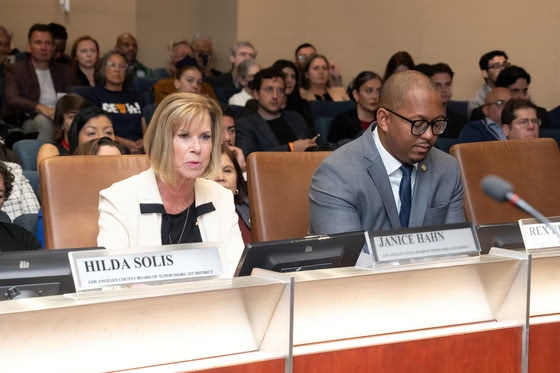
LOS ANGELES — Los Angeles County Supervisor Janice Hahn Nov. 24 testified at a House Oversight Committee Field Hearing held in Downtown Los Angeles on ongoing ICE raids in Los Angeles County. The hearing was organized by the committee’s Ranking Member Congressman Robert Garcia and Mayor Karen Bass. Hahn focused on the ways ICE has violated the rights of her residents, the targeting of law abiding workers, and her efforts at the county to ban ICE from wearing masks.

Watch Video of Hahn Testimony

Hahn delivered the following testimony:

Good morning. Thank you to my friend, Ranking Member of the House Oversight Committee Congressman Robert Garcia, for holding this important hearing. And thank you to all the members who took the time to be here to hear the stories of what our residents have been going through.


The communities I represent have been being terrorized by ICE since June. They hit Long Beach hard this past week – chasing down and tackling a gardener working at Polly’s Pies – a Long Beach institution. They raided a church. They questioned terrified parents waiting for their children outside an elementary school.


They are not communicating with local law enforcement, and we know they are not targeting violent criminals. They are targeting people based on the color of their skin, or their accent, or the place that they work – and they are violating our residents’ rights every day they are on our streets.


They raided a Swap Meet in Santa Fe Springs and multiple witnesses said, “if you looked Hispanic in any way, they just took you.”


In Whittier, ICE arrested a man walking on the sidewalk – only to be forced to release him hours later, because even though he was a Mexican national, he was here completely legally on a tourist visa.


In October, they grabbed three men just out for a walk in LA County’s Friendship Park in my neighborhood in San Pedro. When our LA County Parks and Recreation employees asked for identification—the ICE agents threatened to arrest them.


These agents are behaving as if they are above the law. A community led organization who is monitoring ICE’s work called the Harbor Area Peace Patrol has documented ICE agents swapping license plates between vehicles – or taking plates off all together.


They cover their faces and refuse to wear badges or identify themselves. They pull people into unmarked vans at gunpoint and wonder why people resist arrest.


This is how an authoritarian’s secret police operate – not legitimate law enforcement in a democracy.


I want this committee to know the pain ICE is causing in Los Angeles County – the children who may never see their parents again, the families who are going hungry without breadwinners, the longtime residents deported to countries they barely know.


Our LA County Board of Supervisors has taken what steps we can to protect our residents. We declared a State of Emergency so that we can better respond to the devastating impact ICE raids have had. And next week, I will ask the Board to vote on an ordinance to ban all law enforcement from wearing masks.


But we need your help. That is why this hearing is so important. We cannot allow ICE to continue to operate above the law. We need Congress to be a check on the Trump Administration’s unlawful abuse of power.


Thank you.