

Home Blog Page 104

Larry Summers, Epstein and the “End Game” Memo


By Greg Palast for Thom Hartmann Nov. 24

Forgive me, but I have to send a little thank you to Jeffrey Epstein. The latest cache of the predator’s memos have finally brought down Lawrence Summers, once President of Harvard University, once US Secretary of the Treasury and the dark eminence behind banking deregulation and mass home foreclosures. And worse.

The newly released emails revealed that Epstein agreed to be Summers’ “wing man,” advising Summers on how to use coercive power to maneuver his female protégé into the sack.

I should write, “The Honorable” Larry Summers. He keeps his “Hon.” honorific as a former Cabinet member, though I wonder how honored Larry’s wife feels having to read the icky Epstein emails in the New York Times.

Summers was also a frequent flyer on Air Epstein.

But let’s set aside Larry the Lecher (I’ll leave that to The Times.) This is the moment to reveal how Summers has used his power not just to abuse women but to abuse the planet. His victims number in the millions. No kidding. Stay with me on this. We begin with the “end game.”

The End Game Memo

In 2013, a little birdy dropped a highly confidential note written to Summers from his flunky, Timothy Geithner, then Ambassador to the World Trade Organization. Its content was so explosive, so sick and plain evil, I just could barely believe it.

The scheme revealed in the note was breathtaking: complete deregulation of the WORLDWIDE banking system.

The End Game Memo confirmed every conspiracy freak’s fantasy that top US Treasury officials secretly joined up with a cabal of banker big-shots to rip apart financial regulation across the planet.

Geithner wrote to then-Deputy Secretary Summers,

“As we enter the end-game of the WTO financial services negotiations, I believe it would be a good idea for you to touch base with the CEOs.”

To avoid Summers having to call Geithner to get the phone numbers (which, under US law, would have to appear on public logs), Geithner listed their private lines. And here they are:

Goldman Sachs: John Corzine (212)902-8281

Merrill Lynch: David Kamanski (212)449-6868

Bank of America, David Coulter (415)622-2255

Citibank: John Reed (212)559-XXXX

Chase Manhattan: Walter Shipley (212)270-1380

CEO Reed at Citigroup picked up our call, but when it wasn’t Larry on the line, he hung up. Other numbers were changed.

Most important, the banker-Treasury lock-up succeeded beyond imagination. How? We’ll get there.

Going to “Vegas.”

A nibble of history is needed here.

Summers’ boss as Treasury Secretary Robert Rubin, was appointed by Bill Clinton after Rubin’s stint as Co-chairman of Goldman Sachs. Summers and Rubin had seduced the President into a radical de-regulation of the banking system.

The Summers’ plan would allow banks to speculate in in the new “derivatives” market with your government-guaranteed savings accounts. What had once been a crime was now government policy.

The banks ran straight to Vegas and gambled it away. All of it. But they didn’t go home empty handed. Banks and insurance companies got a half-trillion-dollar taxpayer bail-out AND a $7.77 trillion back-up from the Federal Reserve.

But before the markets imploded, Rubin left the Treasury to Chair CitiGroup, a Frankenstein of de-regulation created by eliminating the Glass-Steagall Act, FDR’s precious gift to us to prevent stock market swindles. Rubin’s starting salary: $126 million.

Most important, Rubin made sure Clinton would pick a replacement — Larry Summers — who wouldn’t stop the de-regulation grift.

“What Would Goldman Think?”

To get that confirmation of the memo’s authenticity, first I would have to fly to Geneva and, as a BBC reporter, wangle a meeting with the General of Globalization himself, Pascal Lamy, Secretary-General of the World Trade Organization.

Lamy told my audience, “The WTO was not created as some dark cabal of multinationals secretly cooking plots against the people… We don’t have cigar-smoking, rich, crazy bankers negotiating.”

Then I showed him the End Game Memo. He disavowed knowing about the Summers confabs in the memos nor the extortion that would turn the WTO into the enforcer of bank deregulation.

Then I remembered something Nobel laureate Joe Stiglitz told me. We happened to be giving lectures on the same night at London School of Economics (I was once a bit of an academic). The next day we spent hours talking about globalization — and Larry Summers.

I did not have the End Game memo yet. But Stiglitz told me that secretly sharing Treasury plans to get approval from Big Finance was apparently Standard Summers Operating Practice.

Stiglitz was Chairman of Clinton’s Council of Economic Advisors. He’d meet the President weekly, joined by Summers and Rubin. When Clinton was out of the room Stiglitz said that Summers would ask Rubin, “How would Goldman feel about that? How would Goldman feel about that?”

Finally, the disgusted Stiglitz asked Summers, “Why do we care what Goldman Sachs thinks; isn’t it about what’s good for the public?” He said Summers and Rubin looked at him as if he were a silly naïve child.

The “IMF riots”

But I still haven’t gotten to the worst part: When Summer was Chief Economist of the World Bank from 1991-1993, he literally imposed a policy of starvation on citizens of the Third World.

Summers didn’t call it “The World Bank Plan to Starve You.” he called it, “Structural Adjustment.” From Ecuador to Bosnia to Ivory Coast, the World Bank and its partner, the International Monetary Fund, ordered nations to raise prices on food and cooking fuel, sell off their water systems to Enron (really!) and crucially, open their banking systems to Citigroup, Goldman, JP Morgan and all of Larry’s buds.

What set me on Summers was a whole stack of confidential documents passed to me by brilliant investigators Mary Bottari of the Center for Media and Democracy and Lori Wallach of Public Citizen. They had gotten hands on hundreds of secret directives from the World Bank

I put thick, confidential plans for several nations in front of Stiglitz. Notably, he had taken Summers’ post at the World Bank. He authenticated them — though I must emphasize he did not provide them.

He was horrified but not shocked. Stiglitz knows all about Summers fronting for banks’ demand for finance deregulation, the sell-off of government industries to well-connected cronies, the radical free-trade agenda and the end of food and fuel support for the poorest of the poor.

Structural Adjustment led quite directly to rural starvation worldwide and what Stiglitz called, “The IMF riot.” The World Bank and IMF knew that mass suffering would provoke rioting which would lead to tanks in the street, martial law and the imposition of the Structural plans.

Stiglitz noted that In Russia, the privatization plan — Stiglitz called it “briberization” made billions for oligarchs (and millions for Harvard “consultants”) while Russia’s life expectancy plummeted.

Bankers Go Bananas

But turning American banks into derivatives casinos was not enough. The planet was ripe with juicy gobs of capital from resource revenue.

How could they pluck the planet? The answer conceived by the Big Bank Five: eliminate controls on banks in every nation on Earth in one single move. It was as brilliant as it was insanely reckless.

How could they pull off this mad caper? The bankers and Summers would use the Financial Services Agreement (FSA), an abstruse and benign addendum to WTO trade agreements.

Until the bankers began their play, the WTO agreements dealt simply with trade in goods — that is, I sell you cars and you sell me coffee. The new rules ginned-up by Summers would force all nations to accept trade in “bads” — toxic assets like financial derivatives.

Until the bankers’ re-draft of the FSA, nations regulated the banks within their own borders. The new rules of the game would force every nation to open their markets to Citigroup, JP Morgan and their derivatives “products.”

Fun fact: JP Morgan alone would soon carry $88 trillion of these pseudo-securities on its books as “assets.”

All 156 nations in the WTO would have to smash down their own Glass-Steagall “fire-walls” between commercial savings banks and the investment banks that play with risky derivatives.

The job of turning the FSA into the bankers’ battering ram was given to Geithner, who was named Ambassador to the World Trade Organization for this purpose.

Bankers Go Bananas II

Why in the world would any nation agree to let its banking system be boarded and seized by financial pirates like JP Morgan?

The answer, in the case of Ecuador, was bananas. Ecuador was truly a banana republic. The yellow fruit was that nation’s life-and-death source of hard currency. If it refused to sign the new FSA, Ecuador would have to feed its bananas to the monkeys and go into bankruptcy. Ecuador signed.

And so on, with every single nation bullied into signing.

Every nation but one, I should say. Brazil’s new President, Inacio Lula da Silva, refused. In retaliation, Brazil was threatened with a virtual embargo of its products by then European Union Trade Commissioner, Peter Mandelson, according to another confidential memo I got my hands on.

NB: Mandelson was fired this September as Britain’s Ambassador to the US after he too was found deeply entangled with Epstein.

Ecuador, once its bank sector was de-regulated and its economy “structurally adjusted,’ exploded into riots. Stiglitz told me that inside the World Bank, these were called, “IMF riots,” which were not only predicted but planned into the re-structuring agreements. The crackdown was also predicted. Tanks in the street and marshal law would allow the implementation of the full structural smash and grab.

My Argentine friends told me Structural Adjustment led to school teachers hunting in garbage cans for food. Ensuing protests and riots did not stop the sell-off of the nation’s oil company to Spain and the Buenos Aires water system to Enron.

Then, Bankers Gone Wild in the Eurozone dove head-first into derivatives pools without knowing how to swim; Goldman and others drowned Europe in near-worthless derivatives.

Does all this evil and pain flow from the single End Game memo? Of course not: the evil was The Game itself, as played by the banker clique. The memo only revealed their game-plan for checkmate.

Summers Killed off Foreclosure Relief

It didn’t take long for the frozen imported chickens to come home to roost. The 2008 implosion of the mortgage market, caused by the creatures of deregulation — subprime mortgages and derivatives gambling — led to a bail-out. Rubin’s Citigroup got a $45 billon gift plus $306 billion in loan guarantees, while Goldman got $10 billion plus $37 billion in various guarantees.

But the 12 to 15 million people who lost their homes to foreclosure (HUD calculation) got bupkis, nothing but marshalls breaking in their doors. Franklin Roosevelt saved Americans from mass homelessness during the Depression with a successful moratorium. So, newly-inaugurated Barack Obama sent his new Economics Tsar, Larry Summers to Congress to testify that he would endorse a bill that would block millions of foreclosures.

But in private, Summers convinced Obama not to invoke a moratorium. Summers craftily made sure Sen. Elizabeth Warren was cut out of the Obama meeting. “Tzar” Summers was backed by his Tsarina, US Treasury Secretary Tim Geitner.

Revenge of the Women Economists

I could go on: Summers cashed in on one of the bastard spawn of bank de-regulation: so-called peer-to-peer lending schemes. It’s basically loan-sharking in cyberspace.

That scam, along with fees for consulting work with Citigroup, boosted Summers net worth now estimated at $39 million. Not bad for a professor.

It’s no surprise that a man who held literal life and death power over Ecuador would use his life and death power over a young woman’s career to get into her pants. Privilege = Power. And to the Epsteins and Summers of this world, what’s the use of power if you can’t abuse the power.

I don’t think Larry likes me. Not since I sent the End Game Memo to Sen. Sherrod Brown, in 2013, the Chairman of the Subcommittee on Financial Institutions and Consumer Protection. The senator blocked Summers from being appointed Chairman of the Federal Reserve Board.

Summers once said that the reason few females get professorships in economics and quantitative fields is that women “lack an intrinsic aptitude at the high end.” In other words, ladies, you’re too stupid to be economists. So, I was thrilled that, after President Obama dumped Summers’ nomination as Federal Reserve Chairman, the President replaced Larry with another one-time Harvard Professor, Janet Yellen!
Long Beach Announcements: Youth Power Budgeting Launches 4th Year; MEHKO Draft Ordinance Released for Public Review

Office of Youth Development Announces Fourth Year of Youth Power Participatory Budgeting Long Beach

The City of Long Beach Department of Health and Human Services Office of Youth Development, in partnership with The Nonprofit Partnership and Invest in Youth Coalition anchored by Khmer Girls in Action, has announced the fourth year of Youth Power Participatory Budgeting or PB Long Beach, a participatory budgeting process where youth vote on how to spend public dollars on youth summer projects.

A total of $500,000 will be allocated through this process for projects ranging from $10,000 to $50,000, which will be voted on by youth who live, work, or play in Long Beach. The winning proposals will be funded in summer 2026 through Measure US dollars and one-time General Fund support.

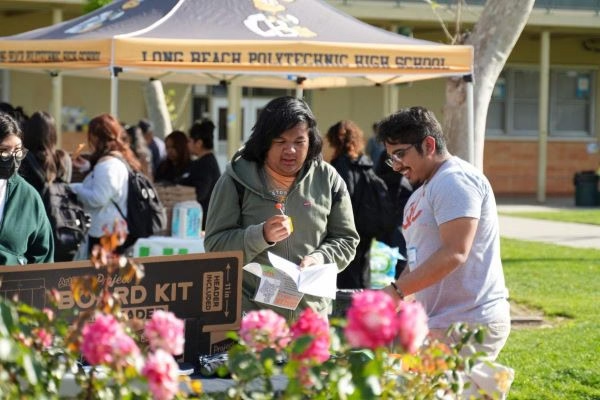
The fourth cycle of Youth Power PB will kick off with four in-person idea collection sessions held across Long Beach, designed to ensure that youth from all neighborhoods have an opportunity to participate. Youth need only to attend one session to submit their ideas for youth summer projects.

The dates and locations for the sessions are as follows:

  • Thursday, Dec. 4 from 4:30 to 6:30 p.m. at the Doris Topsy-Elvord Community Center at Houghton Park (6301 Myrtle Ave.)
  • Saturday, Dec. 6 from 10:30 a.m. to 12:30 p.m. at the Youth Movement and Education Center (2217 E. 6th St.)
  • Thursday, Dec. 11 from 4:30 to 6:30 p.m. at the Juanita Millender-McDonald Community Center at Admiral Kidd Park (2125 Santa Fe Ave.)
  • Tuesday, Dec. 16 from 4:30 to 6:30 p.m. at Whaley Park Community Center (5620 E. Atherton St.)


LB Microenterprise Home Kitchen Operation Draft Ordinance Review Available Now

The Microenterprise Home Kitchen Operation or MEHKO public review draft ordinance is now available for review. The ordinance builds upon the Health and Human Services Department’s feasibility analysis and outreach throughout 2025. On June 10, the city council directed the city attorney’s office to draft a MEHKO ordinance. More information on this work can be found on the Health and Human Services Department MEHKO webpage.

The Zoning Code Amendment has been drafted to establish new definitions and zoning regulations for MEHKO businesses. To review the draft ordinance, visit the Planning Bureau MEHKO webpage. To provide feedback/comments on the draft ordinance, email Maryanne.Cronin@longbeach.gov.

Time: 5 p.m. Dec. 18, in the

Details: To participate in the hearing, visit www.longbeach.gov/lbcd/planning/current/commission

Venue: Long Beach City Hall Civic Chambers, 411 W. Ocean Blvd., Long Beach

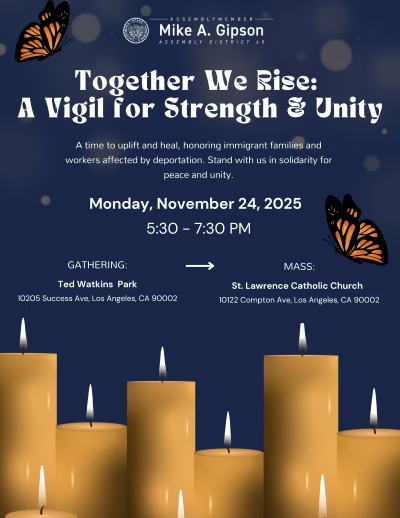
Together We Rise: 65th Assembly District Residents Join Asm. Mike Gipson in Pro-Immigrant Vigil to Heal the South L.A. Community

WILMINGTON – Assemblymember Mike A. Gipson (D-Carson) will join assembled community members and leaders uniting to create a healing space for Angelenos who are impacted by months of activity during the federal government’s immigration enforcement push. On Nov. 24 in Watts, participants plan to meet up in public and convene in a prayer for South Los Angeles families. After remarks that uplift local voices and organizational partners, participants will march less than a mile on 103rd Street, peacefully relocating from the county park at Ted Watkins Memorial Park to St. Lawrence Catholic Church on Compton Avenue. Mass will be held in the Church. This multiracial and multiethnic event is planned in partnership with residents of the Watts neighborhood. A food giveaway will take place for needy families affected by recent detainments.

The opening prayer of “Together We Rise: A Vigil for Strength & Unity” begins at 5:30 p.m. sharp.

‘A Direct Attack on the Freedom of Speech’: Trump Takes On Higher Ed

By James Libresco

https://www.projectcensored.org/attack-freedom-of-speech-trump-higher-ed

And then came the universities.

After waging war on public broadcasting and the arts, the Trump administration threatened last month to cut federal funding to nine prominent colleges unless they restricted campus speech that opposed conservatives.

“Academic freedom is not absolute,” read part of a Compact for Excellence in Higher Education that offered the schools preferential research funding if they obliged with a laundry list of demands that would restrict expression. If any school refused the demands, it “elects to forego federal benefits,” the compact read.

While the corporate media chose to gloss over the full extent to which the proposal undermined free expression, thousands of students across the country read it for themselves and took to the streets, demanding that their schools not capitulate.

And although none of the initial nine universities have signed on thus far, President Trump has now offered the agreement to every college in the country.

What does the compact say?

The compact was sent on Oct. 2 to the University of Arizona, Brown University, Dartmouth College, Massachusetts Institute of Technology, the University of Pennsylvania, the University of Southern California, the University of Texas at Austin, Vanderbilt University, and the University of Virginia.

Nine pages long, it listed almost two dozen demands. Among the most controversial was one requiring schools to abolish “institutional units that purposefully punish, belittle, and even spark violence against conservative ideas.” Students noted these terms were vague, perhaps intentionally.

“What does that mean?” said Raya Gupta, a freshman at Brown who protested the compact. “We can be pretty sure that the Trump administration is going to use that to shut down programs like the Center for Students of Color and our LGBTQ+ center.”

The compact also demanded professors, when acting “as university representatives,” refrain from speaking on “societal and political events.”

Timmons Roberts, a professor of environment and society at Brown, said his courses on climate change fall into those categories.

“How am I going to teach what I need to teach?” he said. “That is a direct attack on the freedom of speech.”

In another clause, the compact demanded that universities “screen out” international students who “demonstrate hostility” to US values and allies, and share “all available information” with the State Department.

Universities risk “saturating the campus with noxious values, such as anti-Semitism,” the compact read.

Notably, the State Department this year has revoked the visas of hundreds of students it accuses without evidence of supporting antisemitic terrorism.

Students and faculty claimed other demands—a limit on international students to 15% of the school population, sex-based definitions of gender, and an SAT requirement—eroded institutional independence.

“We are not a dog,” said Clay Dickerson, the student council president at UVA, at a protest. “We are not to be leashed up by the federal government and dragged around.”

Demonstrators at Brown University taped their mouths shut to emphasize how they believe the compact would have a chilling effect on free speech. Students and faculty at all nine institutions that initially received the compact have protested it, as have thousands of other students across the country. | Photo by Jake Parker


How did universities respond?

Although federal officials set a final deadline of Nov. 21 to respond to the compact, seven of the original nine schools have already rejected it. Vanderbilt and UT Austin have not indicated whether they will sign on.

But, in a social media post, Trump expanded the compact’s scope to all universities, claiming it will “bring about the Golden Age” of higher education.

While only two universities—the New College of Florida and Valley Forge Military College—have officially agreed to the compact, many of the schools that rejected it appeared more concerned with preserving merit-based research funding than protecting free expression.

In his response to the federal government, Arizona President Suresh Garimella wrote that his school has “much common ground” with the compact’s ideas, but does not agree with “a federal research funding system based on anything other than merit.”

UVA Interim President Paul Mahoney’s response was almost identical. Penn President Larry Jameson’s only justification was that he is “committed to merit-based achievement.” MIT President Sally Kornbluth wrote that the compact would “restrict” her school’s independence. But “fundamentally, the premise of the document is inconsistent with our core belief that scientific funding should be based on scientific merit alone,” she wrote.

Only three schools—Brown, Dartmouth, and USC—heavily emphasized academic freedom in their responses.

“It’s disappointing,” said Jade Personna, a senior at MIT who protested against the compact, “that the school, which has a lot more power and leverage than I do, is not willing to stand up for us in that way.”

Personna said she believed MIT treaded lightly to prevent a brash response from Trump. But she would have preferred “stronger language,” she said.

It remains unclear what will happen to the schools that did not sign. In early November, Project Censored requested comment from the Education Department, but received an automated response: “Unfortunately, Democrat Senators are blocking passage of [a spending bill]. … We will respond to emails once government functions resume.”

What did the media cover?

The Wall Street Journal reported first on the compact, but its main and deck headlines included no mention of free speech. Six paragraphs in, after referencing the SAT requirement, the story mentioned the clause banning “institutional units” that “belittle” conservative values.

The article included no reference to clauses prohibiting professors from discussing “societal and political events” and mandating that schools screen foreign students who “demonstrate hostility” to US allies. Neither did stories by the New York Times, CNN, and USA Today.

The Washington Post’s story does mention the “societal and political events” clause—thirty paragraphs in. But, like the others, it doesn’t say international students would be screened for their values.

In its framing, CNN initially downplayed free speech implications, describing the effective ban on anti-conservative speech as a policy “to foster ‘a vibrant marketplace of ideas on campus,’” before quoting the rest of the clause seven paragraphs in.

Personna, the MIT student, said it was “concerning” to see that the establishment press did not cover all of the compact’s free-speech implications. Although she read the compact in full, individuals who relied on media summaries may have lacked critical information. “We all need to look at the things that are most alarming,” she said in reference to the compact’s free-speech clauses, because they can become a “stepping stone for the Trump administration to expand its power further.”

But even with the selective coverage, student groups on campus publicized the unfiltered truth, Personna said.

“The Trump administration very much miscalculated … how easy it would be to coerce people into signing something like this,” she said.

James Libresco is a first-year student at Brown University studying political science.

Los Padrinos Juvenile Hall Hosts Meaningful Pre-Holiday Thanksgiving Meal with Supervisor Hahn and Community Partners


LOS ANGELES — County Probation hosted Supervisor Janice Hahn and other county officials for a Thanksgiving event for youth housed at Los Padrinos Juvenile Hall. Supervisor Janice Hahn visited Los Padrinos Juvenile Hall on Nov. 20, joined by Hoops 4 Justice, Department of Youth Development director Carroll, public defender Garcia, and members of the probation oversight commission. Together, they spent time with the youth and staff in units R1 and R2 during a heartfelt Thanksgiving gathering.

Supervisor Hahn generously provided a full Thanksgiving meal with all the traditional fixings. The evening began with youth and guests sharing what they were thankful for, followed by a youth led prayer. Laughter, conversation, and warm connection filled the room as everyone shared dinner and stories.

“Moments like these remind our youth and staff that they are seen, supported, and valued. The sense of care shown tonight will stay with them long after the holiday season,” said Probation deputy director Roman. “This gesture from Supervisor Hahn means more than words can express.”

“For the young people in our care, I can imagine that the holiday season is the hardest time to be away from their families and their homes. So, I was thankful for this opportunity to bring them a bit of that warmth that they’re missing, and to share the evening with them,” said Supervisor Janice Hahn. “We have an incredible responsibility to create as nurturing and supportive an environment as possible for them.”

Public Health Statement on Updates to CDC Website on Vaccines and Autism

0

LOS ANGELES — The Los Angeles County Department of Public Health is bringing attention to its awareness of recent changes to the CDC’s “Autism and Vaccines” webpage.

The department has released this statement below on the subject.

The updated statement, “Scientific studies have not ruled out the possibility that infant vaccines contribute to the development of autism,” may give people the impression that there is meaningful scientific uncertainty on this topic. There is no new evidence to support those claims and the statement is not accurate. Here’s why.

For more than 25 years, researchers around the world have rigorously examined whether vaccines cause autism. Over 40 high-quality studies involving more than 5.6 million children have found no link between any routine childhood vaccine and autism. This conclusion is supported by leading health authorities, including the American Academy of Pediatrics, the California Department of Public Health, the World Health Organization, and leading research institutions.

The increase in autism diagnoses reflects improved screening, broader diagnostic criteria, and greater awareness, not a link to vaccines. The spread of this harmful myth stigmatizes members of the autism community and their families. For more information visit the American Academy of Pediatrics’ s website.

We understand how confusing misleading statements can be, especially for parents making decisions about their children’s health. We encourage families to talk with their child’s healthcare provider and rely on trusted, evidence-based sources such as the American Academy of Pediatrics and the California Department of Public Health.

Vaccines remain safe, effective, and a vital tool for protecting children’s health. Parents should continue following the recommended vaccine schedule and consult their child’s healthcare provider with any questions.

Details: ph.lacounty.gov/vaccines


LA Environmental Briefs: Harbor Commission Approves AQMD Cooperative Agreement and EPA Fines Sherwin-Williams


LA Harbor Commission Approves Cooperative Agreement with South Coast AQMD

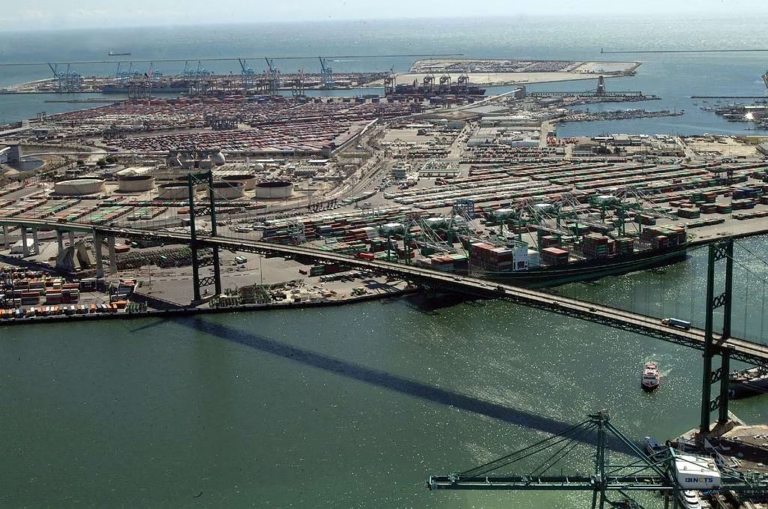
LOS ANGELES The Los Angeles Board of Harbor Commissioners has approved an agreement with the South Coast Air Quality Management District or South Coast AQMD, Port of Los Angeles and Port of Long Beach to accelerate development and implementation of zero-emission technology and infrastructure at both ports. The cooperative agreement covers all major port emission source categories, including cargo handling equipment, harbor craft, trucks, trains and ocean-going vessels.

Approved by the South Coast AQMD and the Port of Long Beach earlier in November, the agreement calls on both ports to develop comprehensive zero-emission infrastructure plans in three phases, starting with a draft plan in May 2027. Approved plans for all emission categories are required under the agreement by the end of 2029.

The South Coast AQMD will verify progress on both ports’ infrastructure plans through annual reports and regular reporting to its governing board. Penalties for noncompliance by the two ports range from $50,000 to $200,000 per default, with penalty fees going toward projects benefiting near-port communities.

Details:here.

EPA Fines Southern California Facility for Hazardous Waste Violations

LOS ANGELES — The U.S. Environmental Protection Agency or EPA Nov. 20 announced a settlement with the Sherwin-Williams Company (doing business as Engineered Polymer Solutions) to resolve claims of violations of the Resource Conservation and Recovery Act (RCRA) at the company’s manufacturing facility in Commerce, California. The settlement requires the facility to pay a civil penalty of $306,436 and return to compliance.

The facility produces resins used as base materials for paints. During a routine inspection, EPA determined that the company had failed to properly identify hazardous waste it was generating, including chemicals like xylene, toluene, and butanol.

“The improper disposal of hazardous waste poses a clear risk to human health and the environment,” said EPA Pacific Southwest Region Enforcement and Compliance Assurance Director Amy Miller. “EPA is holding companies accountable for managing dangerous waste properly, and we’re ensuring communities in Commerce and the surrounding areas are protected.”

EPA also found that the facility failed to meet air emission standards for equipment and hazardous waste storage tanks, maintain proper containment systems, conduct required daily inspections, and determine whether waste must be treated before it can be disposed.

Under the settlement, the company will complete return to compliance tasks, including submitting documentation to EPA that shows whether certain wastes are RCRA hazardous waste or non-RCRA hazardous waste and that demonstrates whether air emissions standards apply to certain equipment and tanks at the facility.

LA Briefs: LA General Hospital Stays Reduced for Uninsured Hemodialysis Patients and County Expands Protections for Janitorial and Security Workers


LA General Medical Center Program Reduces Hospital Stay for Uninsured Hemodialysis Patients

LOS ANGELES — Los Angeles General Medical Center has launched a groundbreaking hemodialysis program that has reduced the average hospital stay for uninsured patients by more than five days, marking a first-of-its-kind initiative authorized by the California Department of Public Health or CDPH.

Launched in February 2020, the program allows uninsured patients beginning hemodialysis or HD to temporarily receive outpatient-level dialysis in the hospital’s inpatient HD unit while their insurance applications are processed. Previously, uninsured patients faced prolonged hospitalizations because outpatient HD centers could not accept them until coverage was secured.

“Nearly one in five patients admitted to LA General arrive without insurance,” said Jorge Orozco, CEO of LA General. “CDPH’s authorization allowed us to safely provide transitional dialysis, reducing hospital stays and helping patients return home faster, with dignity and support.”

Study Findings

  • The average length of stay at LA General dropped from 13.0 days to 7.6 days—a reduction of 5.4 days (p < 0.001).
  • Control hospitals within the Los Angeles County Department of Health Services network saw smaller reductions of less than three days using emergency department–based transitional dialysis.
  • No increase in 30-day readmissions or mortality was observed, confirming the program’s safety.


Los Angeles County to Strengthen Labor Protections for Janitorial and Security Workers

LOS ANGELES — The Los Angeles County Board of Supervisors Nov. 20 approved a motion directing the development of a formal labor peace agreement and worker retention policy for janitorial and security staff at county-operated facilities.

Labor peace agreements help ensure continuity of services, reduce the risk of labor disputes, and foster cooperative labor-management relationships. As the county expands its use of Proposition A contracts, which allow outsourcing of janitorial, food, and security services when more cost-effective than county staff, it is essential to consistently apply labor peace protections to safeguard service quality and workers’ rights.

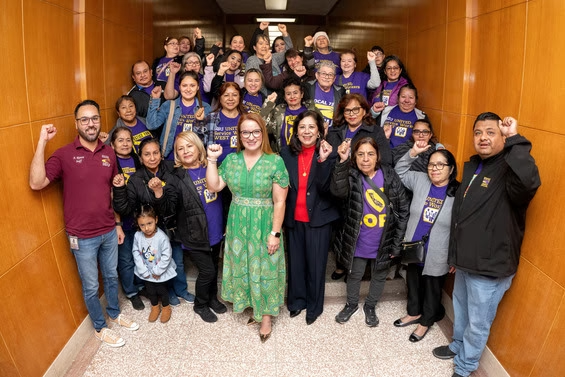
“I applaud the Los Angeles Board of Supervisors for taking a big step toward protecting the workers who keep our public spaces running. County contracted Janitors and Security Officers have been sounding the alarm for years about dangerous workloads, poverty wages, and employers who cut corners at the expense of worker safety and community well-being. This proposal is a clear message that our leaders are listening. Our union is proud to support this effort, and we’re ready to continue fighting for a county where every worker is treated with dignity, respect, and fairness,” David Huerta, President of the Service Employees International Union-United Service Workers West (SEIU-USWW).

The motion directs the chief executive officer, in consultation with county departments, to develop a labor peace agreement and worker retention policy for all Proposition A contracts involving janitorial and security services at county-owned or managed facilities. Contractors will be required to provide evidence of a labor peace agreement before starting new work or extending existing contracts.

The CEO will report back within 90 days with a draft policy that includes definitions, applicability criteria, enforcement mechanisms, and an implementation plan showing how the policy will integrate into county procurement processes. The report will also analyze potential fiscal and operational impacts and reflect input from labor organizations, including SEIU-USWW.

The motion aims to maintain uninterrupted public services while ensuring that janitorial and security workers, many of whom are women, immigrants, and people of color, receive fair treatment, job security, and a voice in their workplaces.

 Long Beach Briefs: Percival to Lead New Baseball Club; Airport Cuts Greenhouse Emissions

Angels World Series Champion Troy Percival Named First Manager of the Long Beach Baseball Club

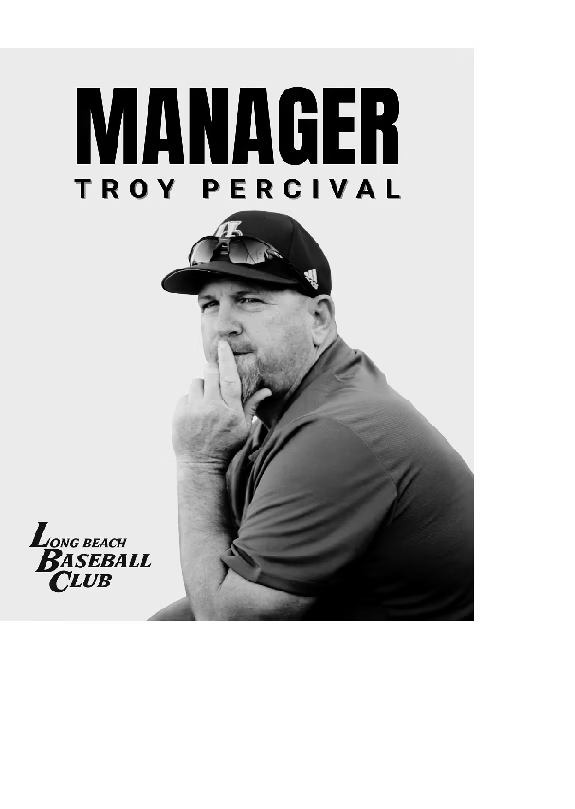
Long Beach —The Long Beach Baseball Club or LBCC Nov. 20 announced that Troy Percival, the four-time MLB All-Star and World Series champion who relieved and closed games for the Anaheim Angels during their historic 2002 championship season, has been named the team’s first manager.

Percival, a Southern California native and one of baseball’s most respected competitors, becomes the inaugural hire for the new professional franchise that will bring high-level baseball back to Long Beach. The announcement marks the first major milestone in shaping the club’s on-field identity.

“Troy Percival represents everything we want this team to stand for — leadership, integrity, and an unrelenting competitive spirit,” said Ena Patel, President of LBBC. “He has won at the highest level, developed young players, and built strong communities through the game. We’re thrilled he’s leading us from day one.”

Percival spent 14 seasons in Major League Baseball (1995–2009), pitching for the California/Anaheim Angels, Detroit Tigers, St. Louis Cardinals, and Tampa Bay Rays. As one of the premier closers of his era, he recorded 358 career saves, ranking among MLB’s top 15 all-time when he retired. His fiery competitiveness and signature fastball made him a fan favorite throughout Southern California.

Since retiring, Percival has focused on coaching and player development. He was previously the manager of the Idaho Falls Chukars in the Pioneer League, where he earned respect for his mentorship of young professional players.

“Southern California is home, and Long Beach has an incredible baseball history and community,” Percival said. “This opportunity to build a team from the ground up, to establish a culture that values hard work, teamwork, and pride in representing this city, is something truly special.”

The club also announced that former Major League All-Star Troy Glaus will join Percival’s staff as an assistant coach. Well known to Southern California baseball fans, Glaus starred at UCLA and with the Anaheim Angels before continuing his MLB career with the Arizona Diamondbacks, Toronto Blue Jays and St. Louis Cardinals. His championship pedigree, offensive firepower and deep local roots will be vital assets as LBBC builds its inaugural roster and culture.

Percival will now begin assembling his full coaching staff, with further announcements expected in the coming months.

The Long Beach Baseball Club is preparing for its inaugural season as part of a growing movement to bring independent professional baseball to new communities across the country. The club will unveil its name, colors, and additional team details in the coming year.

Details: www.longbeachbaseballclub.com


Long Beach Airport reduces Greenhouse Emissions

LONG BEACH —Long Beach Airport or LGB has reduced its greenhouse gas emissions by 56% since 2016, surpassing its original climate goals, and recently received its renewed Level 2 Airport Carbon Accreditation or ACA from Airports Council International, one of 75 U.S. airports to receive an accreditation..

The renewed accreditation, announced in October at the Airports Council International-North America annual conference in Toronto, highlights the airport’s efforts to reduce carbon emissions on a per-passenger basis with the ultimate goal of a carbon neutral facility. LGB has already surpassed its original emission reduction goals of 20% by 2025 and 40% by 2030, compared to 2016 levels.

Details: lgb.org/green for more information about LGB’s sustainability initiatives.

Pier B Rail Facility Project Update Meeting Set for Dec. 3

The Pier B On-Dock Rail Support Facility project team will update the public on the status of the Port of Long Beach project during a virtual community meeting at 10 a.m. Wednesday, Dec. 3.

Click here to register. You can join this virtual meeting from a computer, phone or other mobile device. A recording of the meeting will be posted at www.polb.com/PierB for those unable to participate. Requests for translation must be received by Nov. 25. Contact Veronica Morales at 562-283-7722 or veronica.morales@polb.com for translation or assistance registering for the event. Comuníquese con Veronica Morales al 562-283-7722 o veronica.morales@polb.com antes del martes 25 de noviembre para obtener servicios de interpretación o asistencia con el registro.

The planned Pier B On-Dock Rail Support Facility is the centerpiece of the Port of Long Beach’s rail capital improvement program. It will shift more cargo to “on-dock rail,” where containers are taken to and from marine terminals by trains. Moving cargo by on-dock rail is cleaner and more efficient, as it reduces truck traffic. No cargo trucks would visit the facility.

The facility will be built in phases and as each is completed, they will enhance capacity and operations. The project began construction in 2024 and completion of the entire project is expected in 2032. View the project fact sheet and more information at the project page.