Home Blog Page 105

San Pedro Bay Ports to Give Quarterly Clean Air Action Plan Update


The ports of Los Angeles and Long Beach will give a progress update on the San Pedro Bay Ports Clean Air Action Plan (CAAP) Dec. 9. The meeting will include information on the ports’ 2024 emissions inventories, as well as a status update on the clean truck program, technology advancements and grants.

Proceedings will be livestreamed here, https://tinyurl.com/POLA-meeting-Zoom passcode: 326356. Participation is in-person only. Minutes and presentations of prior meetings can be found here, https://tinyurl.com/About-the-Clean-Air-plan

Limited free parking is available at the Wilmington Waterfront Promenade parking lot next to Banning’s Landing Community Center.

Time: 9 a.m., Dec. 9.

Details:View the latest emissions inventories for thePort of Long Beachhttps://tinyurl.com/5hdfjea3 and the Port of Los Angeles, .https://tinyurl.com/POLB-air-emissions-inventory

Venue: Banning’s Landing Community Center, 100 E. Water St., Wilmington

Supervisors’ County Ordinance to Bar Law Enforcement from Concealing Identities, Public Comment Urged

“If this means a fight with the federal government, I think it is a fight worth having.”

LOS ANGELES — Los Angeles County Supervisors Janice Hahn and Lindsey P. Horvath have unveiled an ordinance they plan to bring up for a vote at the Dec. 2 meeting of the Board of Supervisors that would prohibit law enforcement, including Immigration and Customs Enforcement agents, from wearing masks or concealing their identities when conducting law enforcement business in unincorporated LA County.

“I never thought I would see the day when a masked, anonymous federal police force would be swarming our neighborhoods, targeting people based on the color of their skin or the language they speak, and forcing men and women into unmarked vans at gunpoint. This is how an authoritarian’s secret police operate – not legitimate law enforcement in a democracy,” said Supervisor Hahn, acknowledging that this will likely be met with opposition from the federal government, which has already sued the State of California over a similar law. “If this means a fight with the federal government, I think it is a fight worth having. We cannot give in now and make this okay in America.”

In July, the Board approved a motion authored by Hahn and co-authored by Supervisor Hilda L. Solis that directed county counsel to draft the ordinance that is being unveiled today. Hahn’s effort came in the wake of weeks of reports by residents across LA County of disturbing encounters with plainclothes or masked agents — many refusing to identify themselves or display any form of official credentials. The incidents have continued to spark fear and confusion over potential impersonation and abuse.

The proposed ordinance would:

  1. Prohibit all law enforcement, including local, state, and federal, from wearing masks or personal disguises while interacting with the public in the course of their duties in unincorporated LA County; and
  2. Require that all law enforcement, including local, state, and federal, wear visible identification and agency affiliation while interacting with the public in the course of their duties in unincorporated LA County

The full ordinance text can be found here.

This proposed Los Angeles County ordinance differs slightly from the State of California law. Unlike the state law, the county ordinance would apply to state law enforcement such as California Highway Patrol. It also incorporates additional pre-approved exceptions which were crafted in consultation with law enforcement groups including medical masks, breathing apparatuses, motorcycle helmets when riding a motorcycle, SWAT teams, and active undercover operations.

The Board will vote on adopting the ordinance at its regular Dec. 2 meeting. A required second vote on adopting the ordinance will be held one week later on Dec. 9. The ordinance would go into effect 30 days after adoption.

How to Participate in Public Comment

Members of the public are encouraged to participate in the Dec. 2 board meeting either in person at the Kenneth Hahn Hall of Administration or by calling into the meeting. Those interested in providing public comment can find instructions here.

Letters to the Editor: Jesse Marquez Honored, His Passing Leaves a Void

Jesse Marquez Honored

The death of our friend Jesse Marquez is both a tragic personal loss and tragic loss for the community. I miss him. Jesse was a true local hero. For decades he worked tirelessly to improve the conditions that adversely affect the health and lives of the citizens of Wilmington and San Pedro. He relentlessly challenged the refineries and ports over the air pollution, truck traffic, and neighborhood noise pollution they create. He fought the Port’s endless denials of their off-Port impacts. He frequently responded to the Greenwashing propaganda of the big polluters with deeply researched critiques of their efforts to hide the truth about the “Diesel Death Zone” that harms us all.

He believed all citizens deserve a better environment for living and working. Communities for A Safe Environment, the organization that he created on a shoestring budget, became a respected champion for truth and positive change both locally and nationally. We must honor him by continuing to struggle for environmental justice by holding the polluters responsible for the damage they are causing.

Thank you,

John G. Miller, M.D.

President, San Pedro and Peninsula Homeowners Coalition


Marquez’s Passing Leaves a Void in Battles Over Port Pollution and Community Health

Months after being hit by a motorist while crossing the street, Jesse Marquez recently

succumbed to his injuries.

Jesse’s voice was frequently heard railing against the environmental realities faced by

Wilmington, amplified by the cargo goods movement and oil refineries, suffered from

the California public. His community priorities included the refineries, the terminals, the

trucks, the ships, and the very air we all breathe. He had opinions on most everything

and didn’t hesitate to share them with whoever was within listening range.

To have worked with Jesse and learned from him evokes many emotions. He could be

irritating as hell, seeming to only hear what he wanted to and unwilling to bend or

reconsider. But he could also be inspiring, leading those around him to consider

possibilities and alternatives previously not given any due consideration. He could be a “loose

cannon”, leaving colleagues uncertain about what he might say or whether he would

stay “on message. But he could also be a tireless advocate, refusing to back down or

accept anything less than a serious discussion leading to action to address the issues

he had raised. He could be argumentative, resolute, comical, serious, insightful,

outlandish, and pragmatic – sometimes all within the same meeting or conversation!

His persona was unique, his concern for Wilmington and the port communities

seemingly unending. His daily struggle to make his community better in the face of a

mammoth cargo goods movement and unrelenting oil refining operations leaves an

enduring legacy. With Jesse in the room or at a meeting or on the docket, his concerns

rarely went unspoken or ignored.

I believe we are richer for having known him, even as we acknowledge both his

strengths and imperfections. He pushed us all to find our better selves, to work for a

safer and healthier community, and to not settle too quickly for piecemeal offerings from

terminals, industry, regulatory agencies, or policymakers, calculating that some partial concessions might temper the community’s ongoing outrage.

Loudly, regularly, persistently, and defiantly, Jesse stood up to them all. Though he may

not have always done so in the manner we individually might have chosen, Jesse

fought for every one of us in his own inimitable way. We are collectively the

better for his efforts and stubborn devotion, and he will be sorely missed.

Ed Avol

Professor Emeritus, USC

Chair, Harbor Community Benefit Foundation (HCBF)

The Fight For A Party That Fights

Senate Surrender Spikes Backlash That Could Remake the Democratic Party

Five days after voters overwhelmingly rejected MAGA politics at the polls, a handful of moderate Democratic senators did their best to undermine that victory: they caved and signed onto to a deal to reopen the government without any meaningful concessions. It triggered a backlash that could significantly reshape the party going forward.

Most notably, the defectors gave up without even a one-year extension of existing Affordable Care Act health insurance tax credits — which could cause millions to lose health insurance they can no longer afford. Here in California, monthly premiums will increase 97% on average for nearly 1.7 million Californians enrolled in the state’s marketplace, according to the California Medical Association. As a result, as many as 400,000 Californians could be priced out of health care coverage.

Preserving the tax credits was supported by 74% of the public and 94% of Democrats according to the most recent Kaiser Foundation poll.

The resulting backlash was immediately visible online. But it wasn’t just people expressing outrage. There was significant evidence of people taking action — and committing to it long-term.

The election results had inspired a spike in potential candidates signing up to run for office with Run For Something, which mentors under-40 progressives to run for office — 5,000 signed up in the week after the election. But the Senate cave caused a spike within the spike, with nearly 1,200 signing in the next 24 hours. “This shit is why people don’t trust the Democratic Party,” Run For Something co-founder Amanda Litman quipped on social media, shortly after the vote.

Indivisible — a key backer of the No Kings movement — went even further. Within hours, it announced the launching of the largest Democratic primary program it had ever run. Its own polling showed its membership overwhelmingly opposed caving on the ACA: 98.67% opposed, to be exact.

“This isn’t about left vs right. This is about fighting back vs losing,” co-founder Ezra Levin wrote in a letter to supporters. The cave was “bad policy” and “bad politics” that “will embolden the regime to do more damage,” and was a result of failed leadership by Senate Minority Leader Chuck Schumer and his team. “The only path to a real opposition party is through a cleansing primary season,” Levin wrote. “One thing we can say for sure: We will not back any Senate primary candidate unless they call for Schumer to step down as Majority Leader.”

While Schumer voted against ending the shutdown, Levin called it “kabuki theater,” noting that “It’s the leadership’s job to unify the Dem caucus to fight the fascists. That’s it. Their individual votes are irrelevant.” In March when a similar shutdown loomed — Democrats first chance to block Trump’s power-grab — Schumer’s surprise last-minute decision to support the GOP spending bill angered Democrats of all stripes — especially in the House where all but one had voted against it. Even centrists denounced it for giving Republicans license to continue dismantling the government.

Schumer’s supporters argued that Democrats had to play a long game, and wait for the shutdown fight in September. But while mass organized resistance has dramatically helped turn public opinion against Trump, senators seem hopelessly out of touch,

Local Leaders Speak Out

Levin’s message resonated with local Indivisible leaders who Random Lengths contacted.

“We at Lakewood Indivisible are reaching out to our senators, Alex Padilla and Adam Schiff, to demand that they support the removal of Senator Schumer as Senate Minority Leader,” said Heather Rodriguez. “Once again Senator Schumer has refused to fight back against the most critical threat to ever face American democracy. He has failed to control his caucus, allowing eight Democrats to help Republicans reopen the government while getting no meaningful concessions and none of what Democrats asked for in exchange.”

The original Dem demands were threefold, Levin reminded in his letter:

  • Permanent extension of the ACA subsidies
  • Medicaid funding restored
  • No more blank checks for the regime (rescission/impoundment restrictions)

But “Democrats dropped the Medicaid funding demands immediately after making them. They then stopped talking about rescission and impoundment. They dropped from ‘permanent’ to ‘multi-year’ to, finally, ‘one year’ of ACA subsidies this week.” That last watered-down demand, was “actually the same demand as front-line Republican House members scared about reelection,” he noted. “But they couldn’t even hold the line there — they surrendered without even getting that.”

“I am incredibly disappointed and, honestly, a bit confused about the Democrat shutdown cave,” said Ashley Craig, with Long Beach Indivisible. “Why would they do this now? After all this time? We were winning yet they felt the need to give in, right after an incredible showing in the elections last week.”

“We demand leadership that will actually fight for and represent us,” said Kenny Johnson, with South Bay Indivisible. “The strongest position we have been in, with the best proof that progressive policies can win, along with all the prep work groups like ours have done to ensure people can survive the shutdown, meant nothing to the members who caved, and to Senator Schumer, who did nothing to prevent the defection,” he said. “When the status quo fails us, it’s time for new leaders.”

“We need new leadership — actually we need true leadership!” Craig added.

“They have their fingers in the wind, and we are the wind,” said Melanie Jones, with San Pedro Indivisible. “We have a lot of power, if we will use it.” And it’s not just about Democrats, she noted. “All Republicans and Democrats who will not fight to defend the Constitution, we should replace them with people who will. It’s the one thing we’re all supposed to have in common. They swore an oath to that. It’s their job.”

“Democratic voters are tired of seeing their elected officials fail to fight for them and are no longer willing to accept the excuse that there’s nothing that can be done,” said Johnson. “You can’t be the opposition party while simultaneously capitulating as soon as things get tough.”

“There’s a lot of discussion about whether the future of the Democratic Party is Mamdani or Spanberger, but I think most voters just want somebody they believe will fight for them,” Johnson said.

“We all agree we have to fight. We have to primary and get better Democrats,” said Peter Warren, with San Pedro Indivisible. But it’s not just a matter of one election cycle. “It’s going to require a lot of change over time.”

His views were similar to those of Josh Marshall, founder of Talking Points Memo, one of the oldest political blogs. “I really don’t care that much about the individual players. I have much bigger ambitions,” Marshall wrote. “We’re in a battle for at least the rest of this decade that will require a very different kind of Democratic Party — not one that is more right or left but one that is both comfortable using power and knows how to do it.”

Random Lengths also reached out to representatives Nanette Barragán and Robert Garcia. Garcia didn’t respond, but Barragán did, deferring on Indivisible’s main question, but signaling a stronger willingness to fight.

“As a member in the House, I will leave the Senate leadership up to the Senators,” she said. “I disagree with the Republican Senate bill that failed to provide any relief for Americans facing skyrocketing healthcare premiums. As if that were not enough, the corrupt provision to pay eight Republican Senators a million dollars a piece, as a minimum, was outrageous and dirty. I voted no.”

While GOP Senate leader John Thune promised a standalone vote on ACA extension in the Senate, there’s been no such promise in the House. “I have signed onto a discharge petition in the House that would extend the ACA tax credits for 3 years. We need just three Republicans to join House Democrats to force a vote on this 3-year extension,” Barragán said. Since the Senate Democrats’ position had just called for a one-year extension, this represents a welcome strengthening of what Democrats are fighting for.

“None of our Congressional electeds need to be primaried,” Warren said. “Senators Schiff and Padilla, as well as Rep. Lieu and Barragán are solid members of Congress. They represent us well.”

But, he added, “We do have a critical primary for governor, where Katie Porter is a strong candidate and would be a superior governor. She takes no corporate campaign contributions, according to her website. She is known for using simple explanations on a whiteboard to expose corporate greed and hypocrisy during Congressional hearings.”

“We’re gonna win some of these fights, we’re gonna lose some of these primary fights,” Levin said on the Contrarian podcast. “And you know what we’re gonna do after all of them win or lose? We’re gonna rally around whichever Democrat wins, and we’re gonna say, that’s our candidate, and we’re gonna beat the fascists with that candidate.”


Garage Theatre’s annual “melodrama” is about as good as it’s gonna get

0

More than half of the Garage Theatre’s 25 seasons have closed with an installment of co-founder Jamie Sweet’s five-part “melodrama” cycle (think Looney Tunes rather than strict adherence to genre) about the do-good employees of the Pike (i.e., the former amusement park, not the Shoreline Dr. shopping mall that’s there now), an ace reporter, and a wannabe magician who’s always up to malevolent mischief.

As a rule, you either like this sort of thing or you don’t. But either way, this year’s installment is about as good as it’s gonna get.

In Part 3, Long Beach Is Sinking, or…Hard Times Are Better Than a Lifetime of Injustice, oil extraction is causing the city to sink. Either that or mole people, whom Ian Sidious (Shabar Shabazz Rouse) has conjured to help him, I don’t know, get power or something. As always, Pike handymen Gino Pao (Alizon Morea) and Rod McGirdlebutt (Diana Kaufmann, a holdover from last year), along with Dixie Troobaloo (Shannon Wynne), save the day.

The plot’s raison d’être is to string together the yuks, which, even if they align with your sense of humor (and that’s a big “if”), work only when the delivery is right. The Garage generally succeeds on this score, probably never better than this year. As Pike concessionaire Tricia La Rue, Pagan Urich delivered what for me was the show’s biggest laugh with the utterance of a single synonym, and Shabar Shabazz Rouse’s singing of Sidious’s backstory (to the piped-in accompaniment of Jamie Sweet on banjo — funny in its own right because he ain’t no Earl Scruggs) was a charmer. Then there’s the trio of mole people, more risible than they might be because Alfred DiGrazia, Jeff McGinness, and Kale Lanik are so divergent in their line deliveries.

As always, the entire cast is completely committed. And as always, the more seats that are filled by folks who love silly-and-nothing-but and fully buy in to the participatory spirit — boo/hissing the bad guys, responding to the music cues with pre-ordained character slogans (“Hooray!” for Rod, “Ooo, sequins!” for Tricia, etc.) — the more fun the show is. Certainly the opening-night crowd was game — and even a stick-in-the-mud like me couldn’t resist chucking cloth tomatoes at the actors. Because this year the Garage is including two matinee performances, there’s more chance for kids to be in the house — a boon for material that seems ideal for 7- to 12-year-olds with parents who can fully engage on that level.

Long Beach Is Sinking, or…Hard Times Are Better Than a Lifetime of Injustice at the Garage Theatre

Times: Thursday–Friday 8pm, Saturday 7pm, plus Nov. 22 and Dec. 6 at 2pm
The show runs through December 13 (but no performances Thanksgiving weekend).
Cost: $23–$35 (Thursdays 2-for-1); closing night w/afterparty: $40
Details: thegaragetheatre.org
Venue: The Garage Theatre, 251 E. 7th St., Long Beach

Holiday Reflections and Revolutionary Legacies―Child, Davis, Cullors and the Work of Justice

In a moment when so much in the world we know seems turned upside down and inside out, the holiday season is the only time of year we get to experience a kind of reset. A reset that requires practicing time-honored traditions such as attending services at our respective houses of worship, or not, volunteering in service of families in need, singing collectively holiday-themed songs, gathering to break bread and in thanksgiving, and reconnecting with loved ones without bickering and acrimony.

In some lit corner of every village and hamlet, and every town and city across these United States, some families still sing the old songs and tell the old stories of our shared experience as Americans. Embedded in that tradition is Over the River, Through the Woods, a Thanksgiving poem by Lydia Maria (Mariah) Child that was eventually turned into a song.

The sentiment embodied by this poem feels very familiar 180 years after it was composed, except for the fact that modern transportation left behind the horse and buggy long ago, and that due to climate change, winter snow is less frequent in more parts of the country than not.

Nearly four years ago, at the UCLA Law Review Symposium: Toward An Abolitionist Future, Angela Davis framed abolition as a historical and evolving movement: 19th-century abolition targeted slavery, 20th-century abolition confronted racialized second-class citizenship, and later campaigns addressed the death penalty and the child and family service system. Davis emphasized links between these struggles and police and prison abolition.

Patrisse Cullors, acknowledging Davis as a mentor, called for an “abolitionist culture” rooted in care rather than punishment, urging society to challenge carceral norms in everyday life, explaining, “Abolition is how we show up for each other.” She noted that, “We’ve digested an economy of punishment and revenge. … I’m calling for an abolitionist culture and that we move toward a culture of care.”

Both highlighted that contemporary abolition, now entering mainstream conversation, must retain its radical, revolutionary edge, inspiring practical steps toward an abolitionist future. They echoed Maria Child, who used her pen to dismantle the institution of slavery, do violence against America’s conceit in its call for the dispossession of these indigenous peoples, as it claimed Manifest Destiny.

Born in 1802, Lydia Maria Child educated herself despite limited opportunities for women and developed a lifelong commitment to justice for marginalized peoples. She first advocated for Indigenous peoples, protesting the forced removal of the Cherokees and denouncing violence against Plains tribes. This work naturally expanded into anti-slavery activism, culminating in her 1833 Appeal in Favor of That Class of Americans Called Africans, a comprehensive critique of slavery and racial prejudice. Child also championed women’s empowerment through literature and biographies, emboldening women to public action.

It should also be noted that the period during which she was most active, the social-political milieu of the time was not too much different than what it is today with federally deputized hoodlums kidnapping free and enslaved and citizens and noncitizens alike following the passage of the Fugitive Slave Act of 1850 or the Trump regime’s arresting every working class immigrant in sight; and the weaponizing of religious bigotry and chauvinism to sow seeds of division every which way.

Child showed up for the marginalized, the disenfranchised, and the dispossessed the same way members of the 19th-century resistance movement we know today as the Underground Railroad showed up: by hiding, feeding, and clothing enslaved people while facilitating their escape to freedom, misdirecting slave catchers, and passing on intelligence to Union forces. The work of the likes of Indivisible, the Harbor Area Peace Patrol, and Black Lives Matter Grassroots is doing the work of the Underground Railroad resistance movement.

We see it in the organized rallies, marches, and vigils outside detention centers and federal buildings, with people of conscience opposing deportations, demanding the release of detained immigrants, fundraising as they partner with immigrant-rights organizations to provide bail funds, legal representation and resources for families affected by ICE raids; and organizing “know-your-rights” workshops and campaigns to challenge local collaboration with ICE.

The parallels are striking. We would do well to remember the lessons from Child’s life and the pre-Civil War period. As we gather this holiday season, we honor that legacy not only by reflection and tradition but by showing up for those most in need — continuing the work of abolition in our time.

To learn more about Lydia Child’s legacy, visit permproductions.com, where you can stream Constance L. Jackson’s (now Natoma Lillie Keita) documentary, Over the River: Life of Lydia Maria Child, Abolitionist for Freedom. Jackson directed and produced Over the River in 2007, earning recognition from Child scholars and LA County Supervisors. Jackson was instrumental in helping to induct Child into the National Women’s Hall of Fame in 2001, alongside Althea Gibson, Lucille Ball, Ruth Bader Ginsburg, and Rosalynn Carter. This renewed attention led to Child’s permanent exhibit at the Smithsonian’s National Museum of African American History and Culture.

Ice Watch Update: New Kidnappings in San Pedro as ICE Continues Its Inhumane Attacks


Updated: Nov. 18

After deploying the tactics and escalation first seen in the Harbor Area and across Los Angeles to cities nationwide—including Chicago, New York, and most recently locations in South Carolina—ICE returned to San Pedro, Carson, and Wilmington with yet another wave of escalated kidnappings. Thanks to the hard work of the Harbor Area Peace Patrols (HAPP), San Pedro now has confirmed counts of our neighbors who were taken by the Department of Homeland Security.

“This morning (of Nov. 17, 2025), ICE agents swarmed San Pedro and Wilmington, beginning with a kidnapping at the Chevron station (on First and Gaffey Street), [then] proceeding with multiple sightings throughout the Harbor Area,” the statement posted on Instagram reads.

“We know two people were taken from Carson, one person from Belle Porte and Pacific Coast Highway, one person confirmed taken Broad and Pacific Coast Highway, two from Wilmington and Denni, one to two people from Avalon and “L” Street, and one to four people in our neighborhoods — at bus stops and on the street. This is racist and unacceptable.”

As residents are aware, HAPP has been an active force against ICE was deployed to LA by the Trump regime in June. And Nov. 17 was no different.

“HAPP, along with patrollers and rapid responders from Long Beach Rapid Response Network, H.I.L.L Network (Hawthorne, Inglewood, Lenox, Lawndale), [RAT], and the Community Self Defense Coalition, fought like hell this morning.” Harbor Peace Patrols’ statement continued. “Wherever ICE went, community members used our BOLOs and their own knowledge to honk, yell, question, document, and ultimately let ICE know they are not welcome in Los Angeles. We want to especially shout out the badass women of Harbor who rolled up on ICE to demand answers and exercise their First Amendment rights. This is OUR TOWN and we won’t allow this bullshit to go unchecked.”

They finished with a call to action for local leaders. “Moreover, we are growing impatient with the chugging and hand-wringing of our politicians and elected leadership. There are only so many times we can hear, ‘Thanks for letting us know,’ and ‘There’s nothing we can do,’ before we grow impatient with the inaction and complacency. We don’t pay taxes, vote, or accept leaders that stand idly by while our city suffers to this degree for this long. Y’all want to have the World Cup and Olympics here while masked kidnappers terrorize our city???”

Heroism in a Time of Madness


Many years ago, I was visiting then–state Sen. Alan Lowenthal at the state Capitol when his chief of staff, John Casey, pulled me aside and said, “You know, about 1% of the Legislature are heroes, about the same number are crooks, and everybody else is just waiting for lunch.” I laughed and thought about it, and said that this pretty much reflects the public they serve. That so many people cast politicians as being corrupt these days is perhaps more a reflection of the people they represent–has corruption just become a way of life? Where everything is transactional?

It is rare, then, to find someone in public service who operates from core values that seem incorruptible. Surely, we’d like to think that there are many, but in reality, most are “just waiting for lunch” and doing a job, no heroism involved. However, these are not normal times. And in the course of our history, there have been moments in which some average people have stepped up to make some heroic sacrifices.

The recent Netflix series I watched, Death by Lightning, is a docudrama about a little-remembered James Garfield, the 20th U.S. President, whose 1881 assassination changed America forever. He was from the then “progressive” wing of the Republican party and actually ran and was elected, championing the civil rights of Black voters.

In the same vein is the 2007 documentary by Constance Jackson called Over the River – the life of Lydia Maria Child, another forgotten hero of the 19th Century, an ardent abolitionist, writer, and early feminist. Not all heroes come from the past, but their stories do inspire courage, perhaps for those still living. Courage–the one thing that can’t be taught except by example and arrives in the moment of necessity. Who will be remembered as the heroes of this moment in time?

Some people just embody it as part of their core values, and it is only revealed when tested. So, when I hear common folks say, “All politicians are corrupt,” I often respond with a comment, “Not all of them.” And then I’ll tell them about Janice Hahn, the current LA County Supervisor, former Congress member, and LA City Council representative. One night, she and I were drinking wine together at Campagion Bistro during the height of the homeless crisis here in San Pedro. A time when many desperate souls were camped out in front of the US Post Office on Beacon Street. The conversation turned towards what could or should be done to help these people off the streets.

As we finished up Janice headed for the door saying, “I have to go see this for myself… these are My People”. And before I could turn around, she was out the door in the dark of night, heading to Eighth and Beacon streets. I felt as though I should go with her, as there were some rough folks there that scared many locals, but not her. She sped off in her car and arrived minutes before me.

She was out of her car, talking with “her people,” listening to them, and even hugged a few, offering a sincere sense of concern.

When I arrived, I could barely believe my eyes as the slender blond politician seemed to have no fear of the situation. After a moment, I leaned over and said, “You know Janice these people are camped right outside of this closed county office and you could easily take all of them off the streets by turning this into a shelter”. She thought for a moment and responded, “Only if you support me.”

It took several months and a budget of only $3 million to open a 60-bed shelter, and she heard about it from then LA City councilman Joe Buscaino, who came into her office yelling at her. She stood her ground.

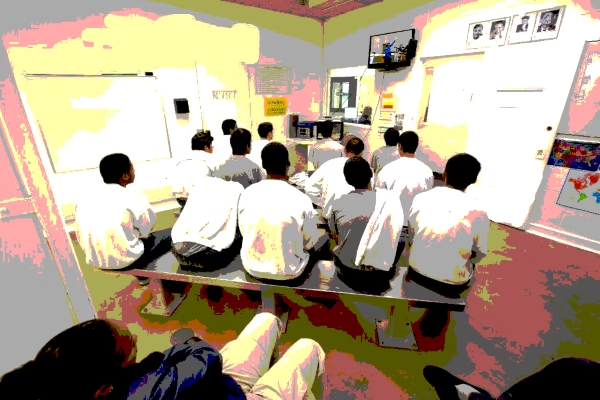
So, it is an odd synchronicity that last week Ms. Hahn and I were having a drink at the very same bar when she told me her latest story. She has been very concerned of late about the LA County juvenile detention centers that have been exposed for serious failures and scandals. She tells me that she received a handwritten petition from a group of boys at one center with a list of demands. It read:

We want fresher and more appetizing food; more re-entry programs, trade and music programs, more visits with our families, and lastly a hug from our mothers.

And with a slight tear in her eye, she told me that she went to the jail and met with the boys. Listened to their demands, and when she stood up to leave, she asked, “Who wants a hug?” and every single one of these young boys came over and hugged her.

You see, even these incarcerated young boys realized that they had a right to petition their government to redress their grievances! And that must have taken some amount of courage, too. And she recognized this for its honesty and as a teachable moment, as well as the opportunity to show leadership in the reform of the juvenile system that seems to have lost its core mission.

“Janice…What motivates you to do these things?”

“Faith and a belief in redemption,” she said.

So, what’s next? This week, she is going to Los Padrinos juvenile lockup and catering a full-on Thanksgiving dinner. “Would you like to come along?” she asks.

I won’t miss witnessing this act of charity and courage, because it brings a glimmer of light amongst all the darkness, madness, and hatred that has surrounded us these past few years.

This is in contrast to ICE raids, mass incarceration, and the lack of due process in deporting thousands of immigrants who live among us. We know from our history and not so distant past that standing up for what is right and just does take courage to risk something, perhaps even our own freedom, to do something for the greater good. And this is what heroism looks like in a time of madness.

Am I Next? Public Art Campaign Rises as a Bold Call for Justice


Walls of Los Angeles cultural institutions last week became canvases depicting Angelenos abducted from this city’s streets.

LA is home to 10 million people. In the home of the nation’s largest immigrant community, CalMatters reported in June, Immigration, Customs Enforcement (ICE) rounded up 1,600 people, most of whom have no criminal conviction, during raids in Los Angeles County.

Amidst this growing injustice, California Community Foundation (CCF), the Japanese American National Museum (JANM) and LA Plaza Cultura y Artes, have joined together with other cultural institutions throughout Los Angeles to tell the story of hundreds of Angelenos in a public art initiative, Am I Next?.

As of Oct. 29, the Migration Policy Institute reported there were 39,000 detainees in ICE custody when Donald Trump returned to the White House in January 2025, that number rose to a record 61,000 in late August.

Human Rights Watch analysis of the data confirms the sharp increase in arrests during the surge in raids from May 28 through July 28, the last day of available data. During this period, ICE alone arrested 540 people per week on average.

On Nov. 13 an “exhausted” Memo Torres of L.A. Taco reported in the previous two days they saw, combined, over 50 people taken in LA; a number that they saw a month-and-a-half ago for a whole week. In his reel, Torres warned that this isn’t going to go away. It’s only going to get worse. And to stay vigilant.

LA County and regions across the country are continuing to lose parents, pregnant mothers, brothers, sisters, children, students, workers, grandparents, friends and neighbors. With this project CCF stands against racialized targeting and the destruction of civil liberties.

Through projections of images, measuring about 20 by 30 feet, billboards and visual storytelling, the campaign brings real faces and truths into public view in an act of resistance and an invitation for collective responsibility. Two longtime racial justice advocates, actors and activists Edward James Olmos and George Takei, have served as the faces and voices in support of this campaign, inspiring action.

CCM’s mission, until this stops, is to tell the stories of these people whose rights have been violated — until the raids end. Am I Next? raises the urgent question: If people are arrested without regard to constitutional rights, who is safe?

At JANM, images of people are projected onto the museum’s pavilion. JANM will juxtapose images of Japanese Americans incarcerated during World War II with Angelenos standing against the ICE raids. The museum’s historic building and Norman Y. Mineta Democracy Plaza is where more than 37,000 Japanese Americans from Los Angeles boarded buses bound for America’s concentration camps in 1942. You can view the projection anytime after dark at the pavilion.

More images will appear in high-visibility areas in downtown Los Angeles, Long Beach, and the Westside.

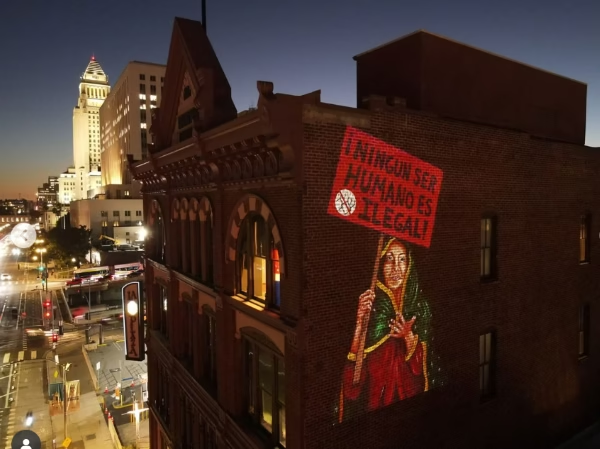
LA artist and cultural art educator Lilia Ramirez shared her projected image Ningun Ser Humano Es Ilegal for this project on Instagram which was highlighted in an LA Times story.

“Am I Next” Campaign alongside La Plaza de Cultura y Artes project “We Belong Here” on November 6, 2025 was launched!” Ramirez posted.

“The project transforms exterior walls into a nightly light installation from sunset to dawn, exploring the experiences of migrant workers and undocumented communities with themes of resilience and resistance.

The installation at LA Plaza features over 30 large-scale works by nine Los Angeles-based artists.”

Details: www.aminextla.org

The Mission Continues: Long Beach Low-Waste Market Receives Last-Minute Reprieve

It was late September, and the liquidation process had begun at Ethikli. Slated to close October 31, founder Katy Impellizzeri realized she needed to move the date forward a week to fully vacate the premises by the end of the month. Prices were reduced 20%, then 30% in an effort to clear out all remaining inventory. Display tables were sold, shelves, storage bins, even a large freezer.

Hoping against hope, Impellizzeri gave interviews to local press and made social-media posts putting out the call to find potential investors or buyers. But one thing she hadn’t done was create a listing on BizBuySell, “the Internet’s Largest Business for Sale Marketplace.” She first heard of it earlier in the month, but the $300 cost — money she didn’t have to spare — put her off, what with the end being so nigh.

But a week or so later, Katie McRaven, who’s been part of the Ethikli team since last November, was discussing the imminent closure with a friend at the Norwalk Farmers Market. Overhearing the conversation was another friend, who suggested BizBuySell. Though pessimistic about the prospect, McRaven passed along the recommendation to Impellizzeri.

“With her bringing it up, I thought, ‘Eh, let me just give it a shot, [because] I’m going to kick myself if I let an opportunity go by to potentially have some kind of sale or investor,’” Impellizzeri relates. “So I bit the bullet.”

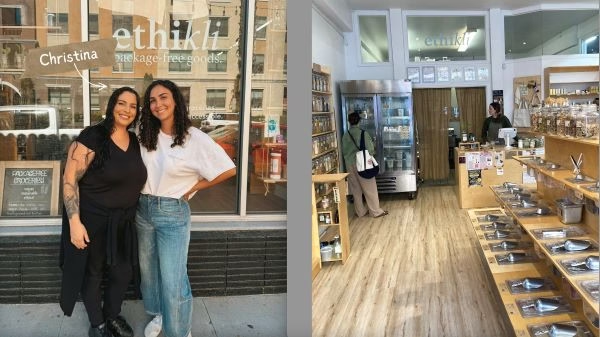
Within days Impellizzeri received a couple of inquiries, one of which was from Christina Peralta, a self-described “passionate ethical vegan” who lives mere blocks from Ethikli. Peralta’s boyfriend learned about the pending closure on social media, then brought the BizBuySell listing to Peralta’s attention.

“I remember when they first opened and being so excited and saying, ‘This is incredible! I can’t believe a store like this is opening here!’” Peralta says. “[…] I thought it was amazing that we now had this grocery store that was providing this fresh, healthy, clean food in an area where there weren’t many options. [… And] the lack of packaging, [along with] knowing where the food is coming from, really appealed to me.”

Although Peralta has no prior experience with business ownership, the opportunity was too good to pass up, and within two weeks the deal was done.

“For a very long time I had been wanting to do something other than my career in retail management, which was not very fulfilling for me, and this seemed like the perfect way to do something different that would serve a purpose and align with my values a little bit more,” she says. “[…] I saw a way to step in and keep the mission going. It just seemed like the universe was kind of putting this opportunity in my path.”

“It’s a beautiful story of a customer taking over the business,” Impellizzeri says. “[…] I’m thrilled that it’s staying open, because it was so heartbreaking to see all of the love and energy and time and passion that I put into it just disappear. So this is a dream come true. Obviously I wish I could stay in the area and run it, but I think finding somebody that shares our values and wants to keep it going — even keeping the name and whole mission intact — it’s kind of a best-case scenario.”

Peralta has no desire to completely cut ties with her predecessor. “It’s important to me that [Impellizzeri] still has some tie to the business that she created,” she says, a state of affairs that Impellizzeri confirms: “If nothing else, I’ll be continuing to support [Peralta], including updating the website (which I built), answering questions, etc., to help the business be a success, because it’s really important for me that the mission continues.”

Aside from no longer being open on Mondays, Peralta envisions no notable changes to Ethikli. This includes its status as an employee-owned concern. (Like Impellizzeri before her, Peralta has majority — rather than outright — ownership.) Minor changes on the horizon may include investing more in marketing and social media (the dearth of which Impellizzeri named as her biggest regret) and vending vegan wine.

Peralta also hopes the Long Beach city officials will take steps to increase foot traffic in the corridor between Pine Ave. and the East Village. “I think there’s definitely more that the City can do to foster more engagement in the area,” she says. “Fingerprints leaving [for Bixby Knolls] definitely was a big blow, [as] it was a big draw.”

Despite wishing she could stay in Southern California and continue to run Ethikli, Impellizzeri is gratified at the way the transition came about — and that even if Peralta hadn’t stepped up, it appears Ethikli would have remained open.

“We ended up having four or five other potential buyers contact us and one potential investor, so it seems like we would have found someone even if it hadn’t worked out with Christina,” she reports. “It solidifies the idea that people want what I built, and that it is making a difference. […] I really want the community to know how grateful I am for their support over the years — especially the last few weeks, for keeping us going long enough so we could find somebody else to keep the mission going. […] All the kind words and the love and support that [arose from word of the closing] definitely helped me get through the most challenging time. It’s super emotional, but in all the best ways. […] As difficult as it was — and is: I still worry about it every day — I would definitely do it again, because I think it’s very much needed right now.”

Ironically, the attention Ethikli garnered in regards to their formerly-pending closure may end up having a positive effect on business. Impellizzeri and McRaven note that online orders have increased over the last two months.

As if to make the point, a new customer stopped in the day I was in the shop gathering info for this article. “I came by here a couple of weeks ago and I saw the sign [saying Ethikli was closing], and I said, ‘Oh no!’” he told McRaven. “So I thought I’d come in here and give you a try.”

McRaven shares that regular customers are “elated” to hear that Ethikli will remain open, telling her, “‘I didn’t know what I was going to do without [Ethikli]’ or ‘I did know what I was going to do, but I didn’t like it.’”

Thankfully, we don’t have to find out. The mission — providing ethically-sourced, 100% vegan, cruelty-free, low-waste essentials at competitive prices while diverting consumer dollars away from oligarchic corporations and into small businesses with fair labor practices — continues.

Ethikli Sustainable Market is located at 352 E. 4th Street, Long Beach. Hours: Tuesday–Thursday noon to 6 p.m., Friday–Sunday 10 a.m. to 6 p.m. Phone: (562) 614-3647.