
Home Blog Page 106

California Wildfire Report: A Model For Climate Crisis Response?


This year began with two of the most devastating wildfires California has ever seen, due to the number of structures destroyed as well as their locations. They’re part of a long-term trend of worsening wildfires driven by climate change. Yet, there’s reason to hope, according to a new report, “California Wildfire 2025” from the Climate & Energy Policy Program at Stanford University.

As the Trump administration refuses to even participate in the COP30 climate summit in Belém, Brazil — and U.S. corporate media downplays its coverage — this report shines like a beacon, illuminating a major scope of action that the state of California can take on its own, regardless of the madness driving national policy. While it could require some major revisions going forward, as suggested by one expert Random Lengths consulted, the potential for a coherent long-term plan of action provides reason to hope.

Wildfire is a unique natural hazard in that society can have a profound impact on the magnitude of challenge it presents,” the report notes in its conclusion. “While climate change may make the problem worse, home hardening, good community preparation, and landscape fuels management can turn a “category 5” wildfire into a “category 2” wildfire that can be successfully managed by well-resourced fire services. Florida and Texas wish they could be so lucky with hurricanes. Science and experience suggest that if we do the work, we can have different outcomes.”

This could even be an understatement, since the climate-driven intensification of hurricanes may soon lead to the creation of a new category — “category 6,” reflecting how much worse things are getting elsewhere.

In addition, the report notes a profound historical parallel:

In the late 19th and early 20th centuries, fires burned large parts of the cities of Chicago (1871), San Francisco (1906), and Baltimore (1908), after which civil engineers, firefighters, and insurance experts worked together to redesign US cities so these disasters couldn’t happen again. We are confident that such an evolution can happen for the crisis we are now facing in California.

The report discusses the major forms of wildfire harm to the state, all of which are rising. These include structural losses, insurance costs, air quality impacts. Highlights include:

  • Structural loses: While they vary greatly year-to-year, cumulative losses have grown sufficiently to impact housing affordability and availability: The Palisades and Eaton Fires destroyed 11,674 residential structures, “approximately 9% of the number of new homes completed statewide in the prior year or more than 60% of the number of homes created in Los Angeles County in 2024.”
  • Insurance Costs: Average homeowner insurance rose 66% from $1,222 a year in 2020 to $2,029 in 2024. And some insurers are restricting underwriting, forcing homeowners to turn to the state’s insurer of last resort, the California FAIR Plan, which is bare-bones and requires purchase of a supplemental difference-in-conditions policy. As a result, “For a growing share of Californians, home insurance now costs more than $10,000 per year, placing additional pressure on housing affordability.”
  • Retail electricity costs: Price increases have outpaced inflation from 2020 to 2025, rising 73%, 73%, and 32% for residential PG&E, SCE, and SDG&E customers, respectively, while the Consumer Price Index has increased by only around 23%.
  • Wildfire smoke exposure: Increased from a typical level of less than 1,500 million person-days annually from 2010 to 2016, to a record high of 4,500 million person-days in 2020. The report notes that “Wildfire smoke contains a complex mixture of volatile compounds, toxic gases, and fine particles that can penetrate deep into the lungs and enter the bloodstream, exacerbating respiratory and cardiovascular conditions,” and that “there is no safe amount of wildfire smoke exposure; even low levels can be harmful.”

Three Levels Of Action

As noted above, there are three interlocking, overlapping levels at which action needs to be taken, that of individual structures (“home hardening”), communities, and the surrounding landscape. Although the report doesn’t use the term, at each level, a guiding principle is “biomimicry,” meaning “humans mimicking nature, and specifically looking at what characteristics and what features nature has evolved to deal with the environment,” as UC Merced fire expert Krystal Kolden explained to me in 2018, after the 2018 Camp Fire.

At the level of individual structures this means reducing the internal chances of ignition (by installing ember-resistant vents, for example, and protecting walls and roofs with fire-resistant materials — stucco for walls and metal for roofs, Kolden suggested) as well as external ones (by clearing nearby flammable material, particularly within five feet of structures known as “Zone 0”). The combination of such measures “can double the likelihood that a structure survives a wildfire” according to a recent study noted in the report.

At the community level, the report cites “Two particularly striking examples [that] occurred in September of 2024, when the Line Fire and Bridge Fire exploded in Southern California.” These occurred toward the end of what used to be “fire season,” just four months before the Palisades and Eaton fires brutally reminded us that that term is no longer meaningful.

The Bridge Fire “made an extraordinary nighttime run straight into the community of Wrightwood,” but just 13 homes, less than 1% of the community, were lost, largely due to “careful fuel management around structures by residents.” And the Line Fire “burned up a forested slope at high intensity … until it hit an area where vegetation had been actively managed to reduce flammable fuels in the path of homes in previous years, including through the use of a prescribed burn conducted earlier that year.”

The report notes that “These two outcomes show what is possible, even under the most extreme conditions, when careful preparation is combined with adequate fire fighting resources.” But the Line Fire example overlaps with the third level of dealing with the landscape through managed “beneficial fire.” This refers to low-intensity fire that helps keep ecosystems healthy and reduces the risk of uncontrolled high-intensity fire, which not only threatens life and property directly, but also produces much more severe health effects via smoke pollution.

Native Californians historically burned an estimated 4.4 million acres per year,” the report notes. “Now, after decades of wildfire suppression, beneficial fire has become an important tool for land managers,” with the goal set in 2020 of applying beneficial fire to 1 million acres per year in California by this year. That goal has yet to be met, and the report devotes significant attention to reasons involved. But there’s a deeper potential problem, according to Chad Hanson, a wildfire scientist with the John Muir Project, who is cited in the report’s footnote on the Bridge Fire.

Concerns Raised About Beneficial Fire

The report is correct that home hardening and good community wildfire preparation are highly effective, and essential,” Hanson told Random Lengths. “However, the report is wildly inaccurate and, frankly, dangerous in its promotion of ‘landscape fuels management,’” he warned. “Generally, that means logging and chaparral removal in wildlands distant from homes. That is where the vast majority of taxpayer money is going.” He cites three reasons it could actually increase the fire threat: by diverting resources, by giving a false sense of security, and by “removing trees and other vegetation” that “reduces wind friction and increases the speed of wildfires,” so that “they reach towns faster,” leaving less time for people to safely evacuate and for first responders to arrive and help.

But he’s not opposed to the idea in principle. “I support burning — managed wildfire, prescribed fire, and Indigenous cultural burning — so long as additional burning isn’t conducted in ecosystems that already have too much fire,” he said. “Forests in California generally still have a deficit of fire, but we are getting closer to natural levels now, whereas California chaparral ecosystems have too much fire, mostly from large numbers of unplanned ignitions from human communities adjacent to chaparral. So, adding more fire there is not a good idea and won’t help anything,” he warned.

Another issue Hanson raises is that “California has typically taken the scientifically false position that, in forests, logging must occur ostensibly to reduce forest density before burning can occur,” even though we have a half a century of science telling us otherwise, he said, providing a fact sheet listing 16 studies from 1975 to 2024 to back him up.

The report itself doesn’t advocate thinning, though an appendix cites three examples of tribal burning projects where thinning is involved. Rather, what it does say is that instead of mandating that fire suppression get the lion’s share of wildfire management funding, “Congress could empower federal land management agencies with the autonomy to develop, fund and implement holistic and responsive fire management plans.” If properly done, this could be guided by the science Hanson cites.

The report also devotes significant attention to the challenges of pursuing the policies discussed, such as the fact that while beneficial fire reduces harmful exposure from devastating wildfires “over the long-term,” the impact of smoke it produces “cannot be ignored.” Thus there’s a need to build “a consensus between groups concerned about the air quality impacts of prescribed fires and those advocating for their increased use” in order to create a regulatory framework that balances these concerns.

The promise of this report is that framing California fire policy in a comprehensive way that can help create such a consensus among all California stakeholders to address the most serious climate crisis impact we face as a state. While it’s a far cry from the global consensus on all climate issues that we ought to have reached decades ago, it’s an encouraging model that can both be improved on over time, and inspire others in similar efforts.
One in the Chamber


On Veterans Day, Long Beach Passes Military Equipment Order With Little Scrutiny

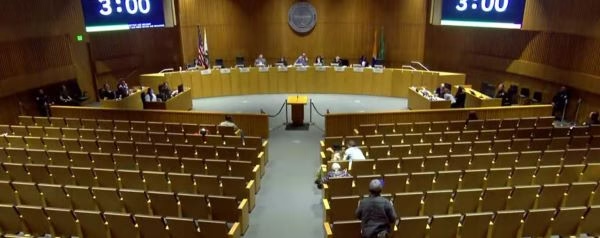
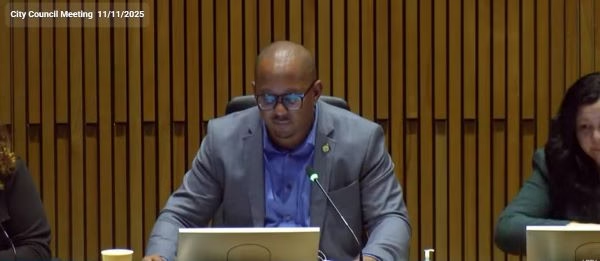
On Veterans’ Day, the city of Long Beach city council voted in favor of concluding the public hearing on the Long Beach Police Department’s 2024 Annual Military Equipment Use Report because no one was there to advocate for it.

Long Beach Mayor Rex Richardson asked if there was a brief report on the agenda item, to which the representative for the LBPD replied, “Only if you need one,” before the mayor called for another member of the council to second the motion to adopt the 2025 Military Equipment Special Order

The report is required by California Assembly Bill 481, a 2021 law that regulates how state and local law enforcement agencies can fund, acquire, and use certain kinds of “military equipment.”

Indeed, there was one public commenter, Kathleen Adams, who noted that the agenda item was “about the militarization of the police, apparently, but there doesn’t appear to be a report.”

Except, there was a report. The LBPD representative implied there was a report, but used the council’s malaise to allow the LBPD to get away with not reading the report into the record, let alone releasing it publicly.

The full report can be found at: https://www.longbeach.gov/police/about-the-lbpd/lbpd-ab-481

Ice Agents
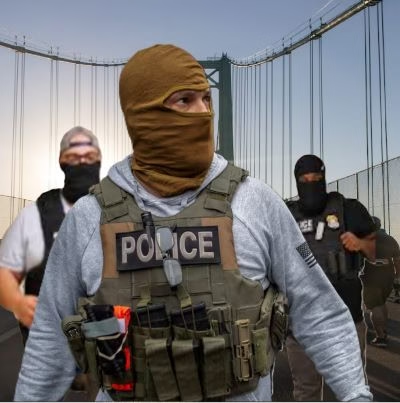
Graphic by Terelle Jerricks.

Ever since the Trump regime started deploying federal officers to round up racially profiled immigrants, documented or not, local elected officials have flirted with the idea that local law enforcement can be deployed as a kind of check on federal law enforcement officers going after the undocumented — a potentially dangerous naivety that ignores the militarization of local police departments that proactively pushes back on press freedom and protection of the press in times of protest.

During the June 2025 No Kings demonstration in downtown Los Angeles, multiple journalists were struck by non-lethal rounds in separate incidents while reporting live on immigration-raid protests—events documented by the L.A. Press Club and Status Coup that led to a federal lawsuit against the city.

Following the demonstrations, the L.A. Press Club and Status Coup filed a federal lawsuit against LAPD and the city, accusing officers of using “less-lethal munitions,” tear gas, and other tactics in violation of state law (SB 98) and First Amendment rights.

The First Amendment Coalition highlighted that reporters were “charged by horses, and forcibly prevented from filming” in their lawsuit announcement.

In July, U.S. District Judge Hernán D. Vera granted a 14-day restraining order preventing the LAPD from using non-lethal weapons (rubber bullets, chemical irritants, flash bangs) against journalists not posing a threat.

The order also bars the LAPD from removing journalists from closed protest areas, assaulting, obstructing, or arresting them simply for doing their reporting.

Despite the July court order, during a protest on Aug 8, officers used batons against a crowd that included journalists, resulting in reported bruises and injuries to photojournalists.

The plaintiffs filed a motion alleging contempt of court, asking for the injunction to explicitly forbid not just projectiles but “any other type of force.”

In September, Judge Vera extended his order to further restrict not just LAPD but also the Department of Homeland Security from using crowd-control weapons on journalists and nonviolent protestors.

The ruling criticized indiscriminate use of force, noting many journalists, observers, and peaceful protesters had been targeted.

The City of L.A. filed an appeal to the 9th Circuit Court, arguing the ban on use of less-lethal weapons is overly broad and operationally unworkable.

The L.A. City Council unanimously rebuked the City Attorney (Hydee Feldstein Soto) for seeking to lift Judge Vera’s order, calling the attempt “unacceptable” and reaffirming that force against journalists is not allowed.

Councilmember Hugo Soto-Martínez and others also pushed an ordinance to limit LAPD’s use of kinetic projectiles and chemical agents, especially against protesters and media.

The LBPD reported receiving no formal grievances or objections concerning the use of military equipment, while the LAPD reported 21 complaints, nine of which were ruled unfounded, six as demonstrably false, three found pending investigation, adjudication, or review; one ruled as having insufficient evidence to adjudicat,e and one exonerated.

Screenshot 2025 11 17 103718
Nov. 11 Long Beach City Council meeting. Screenshot of council meeting video.

Neither report reflected the No King protests that have emerged in 2025.

Holiday Giving Guide Supporting Local Nonprofits Across Long Beach and the Harbor Area


Supporting Local Nonprofits Across Long Beach and the Harbor Area

Compiled by Melina Paris

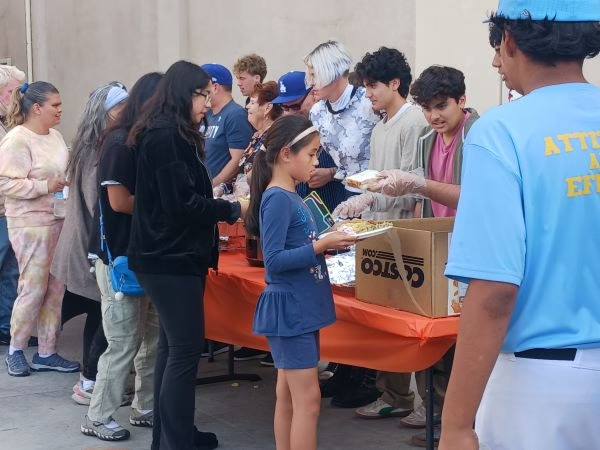
As the holiday season arrives, many families in Long Beach, Wilmington, San Pedro, and the greater Harbor Area are struggling with food insecurity, rising costs, and limited access to basic resources. Local nonprofits, mutual-aid groups, churches, and community centers are working tirelessly to fill the gap — distributing groceries, offering hot meals, supporting unhoused neighbors, and ensuring that vulnerable families have what they need to make it through the season.

These organizations rely heavily on community generosity. Whether you’re able to donate food, contribute financially, volunteer your time, or simply spread the word, your support helps strengthen the safety net for thousands of local residents. Below is a guide to nonprofits and community groups that could use a helping hand this holiday season. Together, we can uplift our neighbors and make sure every family in our community feels seen, supported, and nourished.

LONG BEACH

Light & Life

This food distribution program is providing a week’s worth of groceries to 200 families each week, including fresh produce, frozen meat and shelf-stable items. It is also distributing 100 grocery bags each week to our unhoused community. It sponsors a free farmer’s market event on the second Saturday of each month.

https://www.llcf.org/food

Los Angeles Regional Food Bank

Distributes food and other essentials to children, seniors, families and other individuals in need.

5580 Cherry Ave., Long Beach, CA

323-234-3030


Long Beach Community Table

Long Beach Community Table (LBCT) is a 501(c)3 nonprofit, cooperative (meaning that all volunteers and recipients share in the effort and the benefits), that nourish those who are struggling and provides resources that allow all to mutually sustain each other, their families, and neighbors. Many volunteers are also recipients, and vice versa. This is what makes it a true mutual aid organization and not a charity.

Donation dropoffs (during open hours only): 3311 E. 59th St., Long Beach

Facility address (during open hours only): 3311 E. 59th St., Long Beach


The Salvation Army Long Beach Red Shield Services & Marketplace

Each year The Salvation Army provides 56 million meals to those who are facing the threat of food insecurity. It provides valuable meal supplementation to the Long Beach community’s homeless and low-income residents.

Supplies grocery, hygiene and cleaning supplies every two weeks with photo ID and proof of residence for LB, Signal Hill and other cities in that region.

https://longbeach.salvationarmy.org/long_beach_citadel_corps/food-assistance-in-long-beach/


The Foodbank serves all of Los Angeles County, with a focus on the “poorest of the poor” neighborhoods in downtown Los Angeles, Compton, San Pedro, Antelope Valley, South Los Angeles, Watts and North Long Beach. https://www.foodbankofsocal.org/about-us/mission-and-vision/

Food Bank and Pet Food

Provides a food bank twice a week to anyone who is in need of food (cooking & non-cooking). The program provides: food to meet basic nutritional needs.

https://www.coalongbeach.org/food-bank-pet-food

Wilmington


SAN PEDRO

Toberman Neighborhood Center provides food assistance to those in need through their food pantry. This program provides: Clients may pick up groceries once a week from the center.

310-832-1145 ext. 106


Salvation Army Corps Community Center

138 S. Bandini St., San Pedro Phone: (310) 832-7228

Highlights: grocery pickup · eligibility requirement · appointment required

https://sanpedro.salvationarmy.org/san_pedro_corps/


Food Net – San Pedro Service Center – Food Distribution Center

769 W. 3rd St., San Pedro, 310-519-6091


Let’s Be Whole

Let’s Be Whole provides mobile food distribution to the community. This program supplies critical nutrition to hungry individuals and families

437 W. 9th St., San Pedro. Hours: Friday: 1 to 2 p.m.


Free Groceries in the South Bay (From 2019)

Harbor Interfaith Services 670 W. 9th St., San Pedro, 310-831-9123 serves San Pedro,

Listing of free groceries in South Bay:https://tinyurl.com/Free-groceries-in-South-Bay


Wilmington, Lomita, Harbor City, Harbor Gateway.

Toberman Neighborhood Center 131 N. Grand Ave, San Pedro, 310-832-1145 x106.

Anyone Homeless Food Net-San Pedro Service Center 769 W. 3rd St,, San Pedro, 310-519-6091.

St. Peter & Paul Church 736 N. Lagoon Ave, Wilmington, 310-834-5215 serves Wilmington, Harbor City, San Pedro families.

St. Philomena Catholic Church 21900 S. Main St., Carson, 310-835-7161 serves Carson residences only.

Harbor Gateway/Torrance Outreach 22400 S. Halldale Ave., Torrance, 310-328-3689 serves Torrance, Lomita, Gardena, Carson, Harbor Gateway.

St. Margaret Mary Catholic Parish 25511 Eshelman, Lomita, 310-326-3364 x15, 8:30 to 10a.m., serves Lomita, Wilmington, Harbor City, Torrance residents.

Calvary Light Christian Center 1101 N. Lakme Ave., Wilmington, 310-830-3043.

Crenshaw Baptist Church 18749 Crenshaw Blvd., Torrance, 310-323-2115.

Calvary Assembly of God 25501 Oak St., Lomita, 310-326-2757.

Vermont Ave Baptist Church 23325 S. Vermont Ave, Torrance, 310-530-0533.

Rock Solid Christian Assembly 275 W. 1st St., San Pedro, 310-832-2788.

Warren Chapel CME Church 1039 W. Elberon Ave., San Pedro, 310-547-5362.

First Christian Church of Wilmington 444 E. Lomita Blvd., Wilmington, 310-835-4114.


Harbor Community Health Centers Food Pantry and Distribution Resources

https://www.harborchc.org/contents/resources

San Pedro Food Pantry

Provides groceries and essential items to families in need. Weekly distribution times.
100 W. 7th St., San Pedro, 310-832-8000
https://www.sanpedrofoodpantry.org/


Long Beach Rescue Mission: Provides meals, groceries and emergency food assistance. Offers additional social services.
555 E. 3rd St., Long Beach, 562-591-1292
https://www.rescuemission.org/locations/long-beach-rescue-mission


Food Finders: Free food distribution events throughout Los Angeles Harbor and surrounding communities.
Various locations, see website for schedule.
https://www.foodfinders.org/


San Pedro Meals on Wheels

Delivers nourishing meals to homebound members of the harborside communities. Meals on Wheels is a service for anyone unable to prepare or shop for a nutritious meal, regardless of reason. https://www.sanpedromealsonwheels.org/


Beacon Light Mission

525 Broad Ave., Wilmington

(310) 830-7063

Types of food products accepted: prepared foods, nonperishable goods, fresh produce, dairy products, canned foods. Provides donation pickup.


Carson Hope Community Church

129 E. 223rd St. Carson

310-480-0117

Types of food products accepted:

Prepared foods, nonperishable goods, fresh produce, dairy products, canned foods.


Long Beach Rescue Mission

1430 Pacific Ave. Long Beach

562-591-1292 please call before delivery

Types of food products accepted: Canned goods and nonperishable food items


Los Angeles Food Bank

31734 E. 41st St., Los Angeles

323-234-3030

Types of food products accepted:

Dry foods, refrigerated foods, frozen foods, fresh foods and baby foods. Provides donation pickup.


Salvation Army Long Beach

3092 Long Beach Blvd. Long Beach

562-247-3528

Types of food products accepted:

Produce, prepared food, dairy products, dry food, baked goods, meats, canned food. Provides donation pickup.


Stone Foster Parent Association

451 E. 223rd St., Carson

310-806-7741

Types of food products accepted:

Prepared foods, nonperishable goods, fresh produce, dairy products, canned foods.


The Salvation Army Torrance Corps Stillman Sawyer Family Services Center

3820 W. Lomita Blvd., Harbor City

(310) 835-1986

Types of food products accepted:

Produce, dairy products, dry goods, canned goods, baked goods, meats, and frozen foods

Provides donation pickup


El Camino’s Holiday Help for Students

The Basic Needs Center has settled into its new home in the El Camino Commons, ready to serve students through the holidays.

Students and the community can access nutritious food items, including fresh fruits and vegetables, via drive-thru and walk-up distribution service. Warrior Pantry hours are posted online.

Basic Needs Center, El Camino commons map:https://tinyurl.com/zhs9n62d

Parking Lot L, 310-660-6178 or basicneeds@elcamino.edu

Details: https://tinyurl.com/ElCo-Basic-Needs-Center

MULTIPLE Cities

YMCA of Metropolitan Los Angeles is activating every Y center to help meet the growing need for food.

Ann & Steve Hinchliffe San Pedro & Peninsula YMCA

301 S. Bandini St., San Pedro

Weekly — Tuesday, 10:30 a.m. to 1:30 p.m.

Torrance-South Bay YMCA

2900 W. Sepulveda Blvd., Torrance

Weekly — Thursday, 1 p.m. to 2 p.m.

Wilmington YMCA

1127 N. Avalon Blvd., Wilmington

Weekly — Tuesday, 10 a.m. to 12 p.m.

https://www.ymcala.org/programs/social/feedla/

Montford Point Veterans, Family of Lt. Butcher Receive Congressional Gold Medals


Despite War Secretary Pete Hegseth’s crackdown on diversity, equity and inclusion, local military chapters and fraternal organizations are finding ways to honor service members and ensure the next generation can find a safe space in the U.S. armed forces. This past weekend, Nov. 15, the eighth chapter of the Los Angeles Montford Point Marines Association celebrated the 250th anniversary of the Marine Corps’ founding and presented the family of Lt. Vernon Butcher with his Congressional Gold Medal for being among the first class of Black Marines to train at the Montford Point Marine base.

Established in 1942 at Camp Lejeune, North Carolina, Montford Point was a segregated Marine Corps training base for African American enlistees. More than 20,000 recruits trained there during World War II, overcoming discrimination and harsh conditions to serve with distinction across the Pacific. The base operated until the Marine Corps was integrated in 1949. In 2012, Montford Point Marines received the Congressional Gold Medal, honoring their historic role in breaking the Corps’ color barrier.

Butcher, initially drafted in 1940, formally enlisted after Black men were permitted to join in 1942. In 1943, after passing a physical exam, he trained with the Motor Transport Company at Montford Point Camp, New River, North Carolina, the first training base for Black Marines. He rose to the rank of second lieutenant.

Also honored with Congressional Gold Medals were Staff Sgt. John R. Lynch Sr. and Staff Sgt. George H. Woods.

The event also honored Sgt. Maj. Ramona D. Cook, USMC (Ret.), a trailblazing Marine veteran known for her decades of service and leadership. Born in 1962 in Los Angeles, she enlisted in the Marine Corps in 1982 and completed recruit training at Parris Island.

Over her career, Cook held critical senior enlisted roles, serving as a drill instructor, senior drill instructor, series gunnery sergeant, and first sergeant of Company P, 4th Recruit Training Battalion at Parris Island. She later became sergeant major of Marine Corps Base Camp Pendleton, only the second woman to hold that post.

In 2005, Cook was selected to represent the Marine Corps at the Women in Military Service for America Memorial in Arlington National Cemetery and was honored by the Congressional Caucus for Women’s Issues as a senior enlisted leader.

Throughout her service, she earned the Meritorious Service Medal, the Navy and Marine Corps Commendation Medal, and the Navy and Marine Corps Achievement Medal. After retiring, she continued serving her community, becoming protocol officer for Marine Corps Installations West and serving as secretary on the board of directors for the Marines’ Memorial Association.

Environmental Justice Advisory Committee: Public Meeting, Dec.10


The Department of Pesticide Regulation or DPR is hosting a public meeting for the Environmental Justice Advisory Committee or EJAC, established by Assembly Bill (AB) 652. The meeting is open to the public.

The meeting is being held in-person in Sacramento and remote via Zoom. A live webcast of the meeting will be available for viewing.

Time: 3 to 7 p.m., Dec.10,

In-person participation: 3077 Fite Circle, Suite 100. Sacramento, CA 95827

Online participation via Zoom Webinar: Register

Webinar ID: 814 5386 9680

Passcode: 507059

Webinar ID: 814 5386 9680

Phone Number: (888) 475-4499 US Toll-free

Members of the public may join remotely via the Zoom link or at the address listed above. To the extent that Zoom requires members of the public to enter a name or other information as a condition of attending the meeting, members of the public may enter pseudonyms or other anonymous information.

View-only: English Webcast Link: https://video.calepa.ca.gov/#/player/3551

Spanish Webcast Link: https://video.calepa.ca.gov/#/player/3557

To only watch the meeting and not provide verbal comments, please view via the webcast.

Materials:

  • Meeting materials will be posted as they become available.

If you have questions, comments, require additional information, or otherwise, email EJACinfo@cdpr.ca.gov, no later than ten (10) business days before the meeting.

Language Services

This meeting will be offered in English and Spanish. To request translation of a written document, interpretation services for the meeting, or sign language services, please email LanguageAccess@cdpr.ca.gov as soon as possible and no later than ten (10) business days before the meeting.

Contact DPR to request information in your language: LanguageAccess@cdpr.ca.gov .

Accessibility

Users of a Telecommunications Device for the Deaf (TDD) may contact the California Relay Service at (800) 735-2929 or the teletype (TTY) voice line at (800) 735-2922. To request reasonable accommodation to participate in the meeting, please call 916-322-4553 at least ten (10) business days prior to the meeting. Learn more about accessibility within Zoom at www.zoom.com/en/accessibility.

LA County Sets New Strategy to End Veteran Homelessness


LOS ANGELES — The Los Angeles County Board of Supervisors Nov. 19 approved a motion to establish a unified countywide framework to end veteran homelessness in Los Angeles County, expanding the Department of Military and Veterans Affairs’ (MVA) role in coordinating veteran housing and support services.

“I think it is a collective sin that people feel — that those who put their lives on the line for us now find themselves sleeping on our streets,” said Supervisor Hahn. “The good news is veteran homelessness is an area where we’ve made progress. Now, I believe ending veteran homelessness is within our reach – and it is my goal that with this new framework we can break down the bureaucratic barriers that have made it too hard for veterans to get the help they need and ensure the entire county system and our partners in the State and the VA are finally rowing in the same direction.”

The motion builds on work launched in early 2023, when the board declared a local emergency on homelessness and instructed MVA and the chief executive office (CEO) to identify barriers that limit the county’s ability to effectively serve veterans.

According to the most recently published estimates, 3,050 veterans are experiencing homelessness — a notable improvement from recent years. Despite this progress, coordination with state and federal partners, including CalVet and the VA, confirmed that significant barriers persist, including fragmented service delivery, uncoordinated entry points, inconsistent eligibility requirements, and documentation challenges that slow or block access to housing. The motion aims directly at these gaps, creating a stronger, more coordinated system designed to remove these obstacles and accelerate progress.

These issues affect all veterans but fall most heavily on Black and Latino veterans in high-need communities such as Compton, Inglewood, and South Gate–East Los Angeles, where higher unemployment, elevated poverty and disability rates, and limited access to VA health services compound these challenges.

Early Collaboration Shows Strong Momentum

To improve coordination and access, the One Team initiative aligns outreach workers, housing navigators, and case managers across systems. Since the pilot launched, the county has seen measurable progress:

Permanent housing placements increased 43%

Veteran homelessness decreased 22.9%, from 3,878 in 2023 to 2,991 in 2024

New statewide funding through Proposition 1 and Mental Health Services Act reforms, along with support from Measure A, further strengthens the county’s capacity to serve veterans.

By aligning county, state, and federal partners under a unified framework, the motion is designed to reduce delays, expand access to services, strengthen retention in housing, and increase economic and workforce opportunities. The countywide framework will return to the board within 180 days, with supplemental reports due at 120 days.

Resources for veterans experiencing homelessness can call 310-268-3350 (Monday–Friday, 7:30 a.m. to 4 p.m.) for same-day housing assistance, or 211 for after-hours support.

Details: va.gov/greater-los-angeles-health-care/health-services/homeless-veteran-care


Shoemaker Bridge Ramps Demolition Meeting Set for Dec. 2


The Port of Long Beach will host a public outreach kickoff meeting Dec. 2 to inform the public and solicit feedback about a planned project next year that will demolish the ramps connecting the Shoemaker Bridge to the North Harbor area.

Requests for translation must be received by Nov. 25. Contact Veronica Morales at 562-283-7722 or veronica.morales@polb.com for translation or assistance registering for the event. Comuníquese con Veronica Morales al 562-283-7722 o veronica.morales@polb.com antes del martes 25 de noviembre para obtener servicios de interpretación o asistencia con el registro.

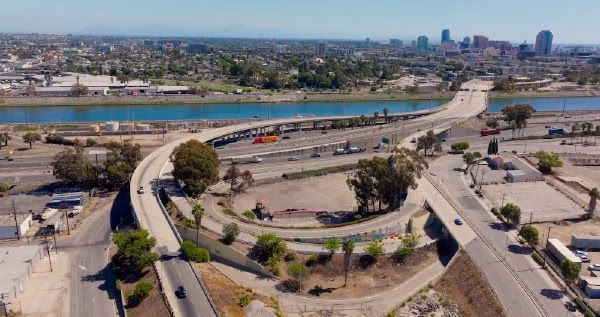
In 2026, the Port of Long Beach plans to demolish ramps between the Shoemaker Bridge and the port as part of construction of the Pier B On-Dock Rail Support Facility. The Pier B program will help to accommodate the expected growth of cargo volume, while taking trucks off the road and improving the environment.

The planned demolition work will remove the 9th and 10th Street on and off-ramps crossing over the 710 Freeway. Currently, as scheduled, the ramps will be permanently closed in spring 2026. The ramps are not heavily used and sufficient alternate routes are available in the area, including Willow Street, Pacific Coast Highway, Anaheim Street, Ocean Boulevard and the Queensway Bridge. Motorists will still be able to access the Shoemaker Bridge from West Seventh Street, West Third Street, West Ocean Boulevard and West Shoreline Drive, east of the Los Angeles River.

Work will require three temporary weekend closures in summer 2026: first, the northbound 710, then the Shoemaker Bridge, and finally the southbound 710. Dates have not been set.

View a fact sheet about the planned Shoemaker Bridge ramp demolition project.

In a separate project, the City of Long Beach separately plans to replace the Shoemaker Bridge. Learn more about that project here.

Time: 8:30 to 10:30 a.m., Dec. 2

Details: RSVP at www.polb.com/shoemaker.

Venue: Port of Long Beach Maintenance Facility, 725 Harbor Plaza, Long Beach

Rep. Barragán Introduces the HEAL A.I. Act to Encourage Further Development of A.I. Literacy for Medical Students


WASHINGTON, D.C. — Rep. Nanette Barragán (CA-44) Nov. 18 introd uced the Healthcare Education in AI Literacy (HEAL A.I.) Act, a bill that would establish a grant program for medical schools to create or continue the development of curriculums in literacy for artificial intelligence.

AI can advance health care through its abilities to strengthen diagnostic capabilities, streamline clinical operations, and automate routine tasks such as scheduling and patient documentation. It can also enable providers to dedicate more time to patient care while improving efficiency and accuracy across both research and clinical practices.

To embrace the opportunities this technology provides, medical professionals and the upcoming workforce must be prepared to leverage the benefits of AI. This bill will give medical schools and residency-sponsoring institutions the resources for students and residents to gain hands-on experience with AI tools in health professions, so that they can understand how to optimize A.I.’s ability to improve patient care, streamline workflows, and enhance decision-making before entering the workforce.

“The National Hispanic Medical Association (NHMA) supports the Healthcare Education in AI Literacy (HEAL-AI) Act, which prepares future physicians to use artificial intelligence (AI) responsibly in patient care. This bill ensures that AI training is grounded in ethics, equity, and transparency, which are important principles for reducing disparities in health outcomes. By prioritizing schools that serve Latino and other underrepresented communities, the HEAL-AI Act will help build a physician workforce ready to deliver innovative and equitable care,” said the National Hispanic Medical Association.

Specifically, the bill creates a grant program at the Health Resources and Services Administration (HRSA) in the Department of Health and Human Services for the education and training of medical students, medical residents, and medical faculty in the deployment of artificial intelligence.

The bill authorizes $1,000,000 per year from FY 2026 to FY 2030, with the maximum grant amount to be given to a medical school capped at $100,000 annually.

The bill also requires schools that receive the grant to publicly report how AI education and training were integrated into existing school curricula, the number of learners that enrolled and successfully completed at least one course funded by the grant funds, and to list any organization the school may have collaborated with to carry out the programming made possible by the grant.

Supporting Organizations: National Hispanic Medical Association

The bill is cosponsored by Representatives Josh Gottheimer (NJ-5) and Ted Lieu (CA-36).

Details: View the full bill text HERE.

City of Carson Earns First Place in California for Digital Innovation

CARSON—The City of Carson has won 1st in California and has been nationally recognized for its exceptional commitment to technology, placing 2nd in the United States among cities its size in the Center for Digital Government (CDG)’s 2025 Digital Cities Survey.

The Center for Digital Government’s annual survey celebrates U.S. cities that are effectively improving government services through smart, innovative technology. The City of Carson ranked #2 among cities with a population between 75,000–124,999, specifically for the city’s swift and complete digital transformation from outdated computer systems to leading-edge digital solutions.

Population of 75,000-124,999

1st City of South Bend, IN

2nd City of Carson, CA

3rd City of North Port, FL

4th City of Avondale, AZ

5th City of Independence, MO

6th City of Westminster, CO

7th City of Lynchburg, VA

7th City of Roanoke, VA

8th Village of Schaumburg, IL

9th City of Thousand Oaks, CA

10th City of Carlsbad, CA

Mayor Lula Davis-Holmes said, “The City of Carson shines bright as the Jewel of the South Bay, and this #2 ranking confirms our commitment to making technology work for everyone. Our promise is to serve all our residents and businesses—young and old—by leveraging technology while maintaining our tight-knit community interactions. With the vision set forth by the City Council, our Executive Team in place, and our finances on solid footing, there is no limit to what we can accomplish as we build a technologically advanced future for Carson.”

In the 2024-25 fiscal year, the City of Carson’s IT & Security (ITS) Department focused on ensuring all residents have fair access to the digital world (digital equity), improving public engagement, and strengthening cybersecurity. The department executed numerous projects to completely modernize the city’s technology backbone and the resident experience. Highlights include launching the Carson 311 app and a new city website with an AI chatbot, which makes it easier for residents to get help 24/7. Crucially, the city also funded and initiated phase one of Carson’s citywide fiber optic network to deliver high-speed internet directly to the community.

Solid October Volume at Port of Los Angeles Puts 10 Million Container Unit-Mark Within Reach for 2025


LOS ANGELES The Port of Los Angeles processed 848,431 Twenty-Foot Equivalent Units (TEUs) in October, a solid performance given all the trade volatility this year. After 10 months, the port efficiently processed 8,655,489 TEUs, 2% more than last year.

“With six weeks to go, we are within reach of the 10 million container unit-mark for the year,” Port of Los Angeles Executive Director Gene Seroka said at a media briefing. “If we reach that milestone, it would be the third time in our history and something no other Western Hemisphere port has achieved even once. That kind of performance is powered by the skill and dedication of our waterfront workforce along with the terminal operators who keep this port running safely and efficiently every day.”

Seroka expects cargo to soften in November and December compared to last year, when shippers were already bringing in cargo ahead of schedule as a hedge against tariffs. Today, retail and manufacturing inventories are well-stocked, so there’s less need for replenishment.

Joining Seroka for the briefing was Jennifer Barrera, President and CEO of the California Chamber of Commerce. Barrera discussed the impact of tariffs, the state’s business climate and regulatory reform efforts.

WATCH BRIEFING HERE

October 2025 loaded imports came in at 429,283 TEUs, 7% less than last year. Loaded exports landed at 123,768 TEUs, 1% more than 2024. The port handled 295,380 empty container units, 8% less than last year.