Home Blog Page 107

City of Los Angeles Rent Stabilization Policy Update


LOS ANGELES Last week, LA City Council passed an amendment to the Rent Stabilization Ordinance, marking the first major update to the law in more than 40 years. The new formula sets a 1% floor and 4% ceiling, tied to 90% of the Consumer Price Index or CPI, creating a balanced approach that protects tenants while supporting housing providers.This policy applies to units built before 1978, which make up housing for nearly half of Los Angeles residents. With most Angelenos renting, and more than half spending over 30% or more of their income on rent, stability and predictability in rent adjustments are critical. One in ten residents spends 90% of their income on rent, underscoring the need for reform.

“By setting a floor above zero, there is a steady framework that enables small landlords, especially family-owned property owners, to cover essential maintenance and operating costs. With a ceiling of 4%, it allows tenants to plan for increases with more certainty,” said Councilmember Tim McOsker.

AG Protects $200 Million for Designated for California Schools

CALIFORNIA — On Nov. 16 Attorney General Rob Bonta announced that the U.S. Department of Education has backed down from its effort to rescind states’ access to hundreds of millions of dollars in funding for the academic recovery of students following the COVID-19 pandemic. The stipulated agreement, filed in court, leaves in place preliminary injunctions secured by California and other states until all of the funding at issue in the lawsuit is disbursed, effectively resolving the lawsuit in the state’s favor. This means schools do not have to wait for litigation to play out and can confidently spend down this vital grant funding today. The attorney general is continuing to secure full and final relief for Californians across a number of its lawsuits.

Find more on the California Department of Justice’s work to hold the federal government accountable here: https://oag.ca.gov/federal-accountability.

Churches Targeted For Deportations In Holiday Season As Catholic Bishops Issue Special Message Opposing Indiscriminate Mass Deportation


Agencies involved in deportations have a comprehensive plan “to target Spanish-speaking churches across the country during the upcoming holiday season between Thanksgiving, Nov. 27, and Christmas, Dec. 25,” as first reported by This Week In Worcester, an independent news source that interviewed three Trump Administration attorneys briefed on the plan. Multiple versions of the plan are being reviewed, including an update “to include mosques and liberal synagogues in the wake of Zohran Mamdani’s recent win in the New York City mayor’s race.” It represents a dramatic increase in Trump’s war on the very idea of sanctuary.

While the Trump administration is apparently secretly reaching out to religious leaders to support its plan, the US Conference of Bishops has issued a rare public rebuke. In their first “special message” since 2013, approved 216-5, and released in a video reading by multiple bishops, they said, “Despite obstacles and prejudices, generations of immigrants have made enormous contributions to the well-being of our nation…. Catholic teaching exhorts nations to recognize the fundamental dignity of all persons, including immigrants…. We oppose the indiscriminate mass deportation of people. We pray for an end to dehumanizing rhetoric and violence.”

Hahn Will Open 177 Affordable and Supportive Units in Long Beach Nov. 19

LONG BEACH —On Nov. 18 Los Angeles County Supervisor Janice Hahn along with Long Beach Mayor Rex Richardson and Linc Housing will celebrate the grand opening of two Project Homekey communities in the City of Long Beach. The two projects will offer a combined 177 new affordable and supportive apartments. Zephyr includes 135 studio apartments and two managers’ units, and Crescent has 39 studios and one manager’s unit.

Linc Housing, a Long Beach-based nonprofit developer, renovated two old motels and converted them into apartment homes; Zephyr was a Holiday Inn and Crescent was a Motel 6. Financing for the conversions came primarily from state Project Homekey funds administered by Los Angeles County, with the Long Beach Housing Authority providing Section 8 rental vouchers for both properties.

Residents of the two sites will receive supportive services including mental and physical health services, employment counseling and job placement, education, substance use counseling, money management, assistance in obtaining and maintaining benefits, and referrals to community-based services and resources.

UPDATED – Special Comission Training on Law Enforcement Investigations Into Deputy Involved Shootings

UPDATEDNOTICE OF PUBLIC MEETING

Special Comission Training on Law Enforcement Investigations Into Deputy Involved Shootings

— THIS MEETING WILL BE HELD VIRTUALLY —

Iime: 9:30 a.m. – 12:30 p.m. Nov. 18

Original Announcement

The Los Angeles County Sheriff civilian oversight commission invites you to join a special training session for the commission that will shed light on law enforcement agency investigations into deputy-involved shootings. This training session will be open to the public.

The Los Angeles County Sheriff’s Department, office of inspector general, district attorney’s office, and medical examiner will discuss:

  • policies, procedures and guidelines related to investigations into deputy-involved shootings
  • monitoring, review and analysis of deputy-involved shootings
  • the difference between investigations into hit and non-hit deputy-involved shootings (“hit” refers to shootings where a deputy’s gunfire strikes a person while “non-hit” involves a deputy opening fire but not hitting anyone)
  • deputy accountability
  • decisions about whether to file criminal charges
  • the investigatory process

ANALYSIS: https://tinyurl.com/hit-non-hit-shooting-analysis

Time: 9:30 a.m. – 12:30 p.m. Nov. 18

Details: https://tinyurl.com/Sheriff-civilian-oversight

Attend in Person

Department of Public Health Auditorium

313 N. Figueroa Street, Los Angeles

Map:https://tinyurl.com/DPH-auditorium

Join virtually

Register in advance to participate in the meeting.

Event Password: COC123; https://tinyurl.com/yck5h5uy

Watch the livestream

https://tinyurl.com/Sheriff-civialian-oversight

Call in: : 213-306-3065, access code 2535 703 0247

Public comment:

Submit public comment during the meeting or online at

https://tinyurl.com/Oversight-public-comment


When Algorithms Break the News

Will chatbots replace Project Censored as a watchdog for underreported news?

Andy Lee Roth and Shealeigh Voitl

Hospitals denying maternal mental health care, employers using AI tools that drive workplace discrimination, and “phantom” nitrates in water supplies leading to chronic illness in children. These concerns sound like stories Project Censored highlights in its annual report of the most important but under-covered news stories.

Each of these topics and twelve additional stories like them were brought to our attention last June by Project Censored judge Nicholas Johnson. The author of How to Talk Back to Your Television Set (1970) and Your Second Priority (2008), and a former Federal Communications Commission commissioner (1966–1973), Johnson has served as one of Project Censored’s judges, helping the project identify and vet its annual record of each year’s top “censored” stories, since the organization’s inception in 1976. When Nick contacts us with story tips, we pay attention.

A chatbot had identified these news reports after Nick directed it to provide 15 examples of “potentially significant news stories, made public in publications with small circulations, that have not been given the attention of major media during the past year,” along with reasons why those stories should have been given more attention. Chatbots, such as OpenAI’s ChatGPT and Google’s Gemini, use generative AI to respond to user queries through written or spoken “conversations.”

At the time, Project Censored staff were undertaking our own review of the year’s top stories, as identified by students and their faculty mentors who participate in the Project’s Campus Affiliates Program, and vetted by the project’s panel of esteemed judges. Our story review process involves five distinct stages of meticulous examination to determine each candidate story’s importance, timeliness, quality of sources, and, ultimately, trustworthiness. This effort involves hundreds of hours of human effort, so we all smiled when Nick’s email message arrived with the winking salutation, “Sorry to be so late in getting this to you, but it took my AI at least 15 seconds to do it.”

Here’s one example from the story list Nick sent us, based on his chatbot’s response:

“Walmart’s Quiet Drone-Surveillance Rollout”

—Publication: The Plains Weekly Register (circ. ~4,000)

—Scoop: Leaked local franchise agreements show Walmart testing AI‐drone patrols in five rural states — without public notice or aerial-privacy rules.

—Why It Matters: Sets a precedent for commercial drone policing private property — civil liberties groups must litigate, yet the story died regionally.

At the conclusion of its report, the chatbot produced this analytic summary:

These stories highlight systemic gaps in coverage — when national outlets focus on high-profile crises, they often miss crises brewing in our backyards: local infrastructure failures, emerging health threats, new dimensions of environmental degradation, and AI’s stealth intrusions into daily life. Each tale carried not just local but national (even global) implications, and broader attention could have spurred swifter policy, regulatory, or public-health responses.

Reading this, we were impressed. That paragraph sounds as if it could have been lifted from a previous volume of the project’s State of the Free Press yearbook.

Perhaps, in a way, it was.

We quickly determined that not only were all of the “potentially significant” news stories on the chatbot’s list fabricated, but so too were all 15 of the allegedly independent news organizations credited with breaking those stories. The chatbot made it all up, but did not disclose that it was generating fictional information rather than providing factual answers.

To train datasets for large language models like ChatGPT and Gemini, tech developers scrape the internet, cataloging and extracting data from every corner of the web — often without the original creators’ knowledge or permission, much less any financial compensation. In theory, the chatbot’s list of stories that Nick shared could have been modeled after Project Censored’s annual Top 25 lists, which are archived on the Project’s website.

But because chatbots, unlike Project Censored, do not abide by guiding ethical principles of journalism, such as seeking the truth, with transparency and accountability, while minimizing harm, they simply mimic reporting that highlights societal inequities, without understanding the underlying context, sources, or human experiences that give stories, like the ones they’re generating, meaning.

Chatbots can reproduce the appearance of investigative journalism — which, at its best, uncovers corruption, censorship, or injustice — but they lack the moral and analytical frameworks to properly verify facts, assess motives, and weigh the potential consequences of their reporting. Celine Schreiber of Weave News describes this as the “risk of replication without representation: A simulacrum of independent journalism that lacks its political or community roots.”

Corporate media and tech companies refer to these errors as “hallucinations” — when AI systems literally make stuff up — a term that both anthropomorphizes the bots and downplays the consequences of perpetuating inaccuracies, both regular pitfalls of reporting on AI. Developers do not entirely know why hallucinations occur, so they have no way to stop them.

“Despite our best efforts, they will always hallucinate,” Amr Awadallah, the chief executive of Vectara, a start-up that builds AI tools for businesses, and a former Google executive, told the New York Times last May. “That will never go away.”

In October 2025, the BBC, in partnership with the European Broadcasting Union, published an extensive study, covering 22 public media service companies in 18 countries, that found AI assistants such as ChatGPT, Copilot and Gemini “misrepresent” news content roughly 45% of the time. About 31% of the responses researchers collected demonstrated serious “sourcing problems — missing, misleading, or incorrect information,” and about 20% “contained major accuracy issues.” As EBU’s deputy director general Jean Philip De Tender noted, “These failings are not isolated. … They are systemic, cross-border, and multilingual, and we believe this endangers public trust.”

According to Pew Research, while relatively few Americans currently use AI chatbots like ChatGPT to obtain news information, 42% of those who do report that “they generally find it difficult to determine what is true and what is not.” As more users turn to AI systems rather than traditional search engines to find information online, society faces a deepening crisis of misinformation — one in which greed, competitive pressure and unchecked technological expansion continue to erode public trust in media.

Recent research documents the potential for social media platforms to manipulate public opinion. Tech companies now control the tools for accessing information and the metrics of visibility, consistently shaping public discourse. Public vigilance and scrutiny are vital as AI strengthens its grip on our collective reality.

The chatbot’s Walmart “story,” mentioned above, closely resembles an actual news story from Project Censored’s list of this year’s most censored stories — a report by Jacobin about Amazon and Walmart using hostile surveillance technology against warehouse employees. The uncanny resemblance between the chatbot’s fabricated report and Jacobin’s real exposé underscores the urgent need for critical media literacy (CML), which empowers people not only to assess the trustworthiness of specific media messages but also to understand the power dynamics that shape those messages’ production.

Increasingly, those power dynamics include the role of chatbots and other AI-powered systems in filtering, blockading — and sometimes fabricating — the kind of information and perspective people need in order to be informed and actively engaged. For 50 years, people working with Project Censored — professors, students, media scholars, not machines — have scoured an increasingly large, diverse array of independent outlets to identify, validate and highlight important but underappreciated news stories. Reflecting the essential role of a free press in a functioning democracy, Project Censored remains committed to serving the public good, rather than private interests, by exposing social problems and empowering people to respond to them.

Critical media literacy demands examining media for its power and purpose by taking a closer look at ownership, production and distribution. Carefully following these trails combats AI misinformation. Without CML, as evidenced by Nick’s chatbot’s censored stories list, the information AI provides has become harder to distinguish from the truth.


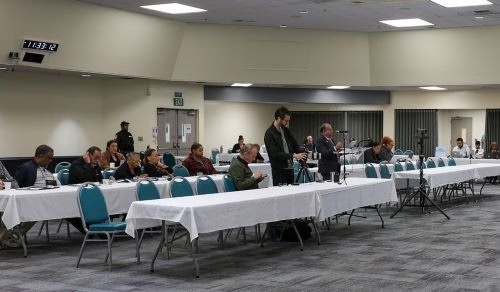
Notice of Public Meeting Sheriff Civilian Oversight Commission Meeting

The Sheriff Civilian Oversight Commission for the Los Angeles County Sheriff’s Department is hosting a hybrid commission meeting. The public is encouraged to attend. As the commission works to boost transparency and accountability, community input is vital to analysis of the department’s policies, practices and procedures. The agenda will be posted on https://coc.lacounty.gov and distributed when available.

The Los Angeles County Sheriff civilian oversight commission will hold its next business meeting on:

Time: 9 a.m. to 1 p.m., Nov. 20

Details: https://tinyurl.com/Sheriff-civilian-oversight

Attend in Person

St Anne’s Conference and Event Center

155 N. Occidental Blvd., Los Angeles

https://tinyurl.com/Oversight-meeting-map

Join virtually

Register in advance to participate in the meeting.

https://tinyurl.com/Webex-join-online

Watch the livestream

www.youtube.com/@LACountyCOC/videos

Call in: 213-306-3065, access code 2535 703 0247

Public comment:

Submit public comment during the meeting or online at https://tinyurl.com/Oversight-public-comment

Ports of LB, LA Approve Agreement with SCAQMD for Cleaner Air


The Long Beach Board of Harbor Commissioners voted unanimously Nov. 10 to approve a cooperative agreement with the South Coast Air Quality Management District and the Port of Los Angeles containing time-bound and enforceable commitments to develop zero-emissions infrastructure at the nation’s largest ports complex.

The agreement, which the SCAQMD Board approved Nov. 7, commits the ports of Long Beach and Los Angeles to developing and implementing plans for zero-emissions infrastructure for equipment types in three phases, starting with a draft plan in May 2027, followed by approved plans in place for all categories by the end of 2029. Taken together, the actions build on the landmark Clean Air Action Plan that has delivered progress in cutting emissions from port-related sources.

In the months ahead, the ports will also continue working with South Coast AQMD on additional “CAAP Plus” measures that will focus on emission-reducing strategies related to cleaner oceangoing vessels, the largest source of emissions at the ports, through strategies like the Environmental Ship Index Incentive Programs. The measures could also include strategies like committing clean truck fund rate revenue to subsidize the transition to zero-emission trucks and infrastructure, developing a zero-emissions drayage truck utilization incentive program and consulting annually with SCAQMD on spending priorities.

View the agreement between the ports and the SCAQMD here.

The Los Angeles Harbor Commission is scheduled to vote on the agreement at its next regular meeting Nov. 20, after which the three parties will execute the agreement. The additional CAAP Plus measures will be negotiated by the parties with a spring 2026 completion target.

Details: www.polb.com/environment or read the Green Port Progress Report, available here.

Do you have to be an Alanis acolyte to swallow “Jagged Little Pill: The Musical”?

If you’re not a fan of Alanis Morissette, Jagged Little Pill: The Musical may be a bad fit — yes because of all those hit songs you didn’t much like the first time around, but also because the sensibilities of Diablo Cody’s book are in keeping with the maladroit obviousism of Morissette’s lyrics, stacking up cliches like cords of firewood in anticipation of the worst winter on record.

But hey, Cody got a Tony for that book (which is sitting on the mantle right next to her screenwriting Oscar for Juno), and Morissette has sold like 75 million records, so what the fuck do you know? There’s an audience for this sort of thing — including most of the people around me on opening night in the nave of Long Beach’s historic First Congregational Church, as fun and unique of a venue in which you’ll ever she/hear a musical.

It’s Christmastime, and Mary Jane Healy (Megan O’Toole) is summing up the state of the Healy family for their annual holiday greeting card: successful Steve (Jay Dysart) is busy as ever at work, the kids are fab — Nick (Jacob Anthony Cain) just got into Harvard, Frankie (Evelyn Carter) is beavering away for social justice — and Mary Jane is the happy, healthy homemaker. But it’s what she leaves out that drives the action of play, particularly her opioid addition (jagged little pill, see?).

If you know the (song)Book of Alanis, you can guess at some of what’s coming: disaffection, putting up a false front, suffering/surviving sexual predation, the highs and lows of love. Into this stew Cody tosses “gender and LGBTQ+ identity, transracial adoption, and mental health” (says the program). Everybody goes through trials and comes out stronger and wiser on the other side, because you live, you learn, right?

Although Morissette and co-writer Glen Ballard could never write hooks the way, say, fellow ’90 supernova Noel Gallagher did for Oasis, the non-fan may be surprised to find how many of the duo’s meandering melodies resonate when repurposed into polyphonies for the ensemble. That’s easy to hear in this show, because singing together is the cast’s great strength. Music director Curtis Heard has them purring as one big, beautiful engine on “All I Really Want”, “You Learn”, and Act One closer “Forgiven”, which is all the more sonically dynamic for director Richard J. Martinez’s positioning Evelyn Carter (one of his strongest singers) amid the audience.

Heard has less success with the soloists. Even the non-fan must admit that Morissette is a strong, distinct vocal presence. Without it, some melodies seem particularly drab, even as the eight-piece band in the church basement consistently delivers the goods.

There are, however, a pair notably strong solos back-to-back in Act Two. On “Predator”, Sarah Ledesma absolutely knocks it out of the park, tunefully howling the pain of sexual victimization in a scene whose staging is probably Martinez’s best work. Then comes “You Oughta Know”.

Sure, “You Oughta Know” is far, far, FAR and away the non-fan’s favorite, but I guess that’s true for diehards, too (like “Rock and Roll All Nite” for KISS)? Because if the cast had waited for the applause to subside before carrying on with the rest of the show, I might still be sitting in my pew. But part of that outpouring of love was for Cole Whither’s channeling a lot of the energy of Morissette’s signature vocal. Occupational hazard: If the audience feels a particular song in a musical is the song, the performers better fucking bring it. Consider it brought. Whither, the band, the ensemble — damn.

Overall, the biggest weakness is the dancing. But you probably don’t come for the dancing. You probably come because you love the songs of Morissette/Ballard. To be sure, that love (or lack thereof) is probably the best predictor of whether Jagged Little Pill: The Musical has a chance with you.

Jagged Little Pill: The Musical at Long Beach Landmark Theatre Company

Times: Fri–Sat 7:30pm, Sun 7pm; “Unplugged” matinees Nov. 16 & 23 at 1 p.m.
The show runs through November 23.
Cost: $40–$65 (“Unplugged” matinees $25)
Details: (562) 856-1999, lblandmark.org
Venue: First Congregational Church of Long Beach (241 Cedar Ave., Long Beach)

St. Mary Medical Center Earns National Honors for Patient Safety and Clinical Excellence

LONG BEACH — Dignity Health – St. Mary Medical Center or SMMC Nov. 13 earned accolades for its commitment to patient safety and clinical distinction. SMMC has once again been rated Grade A for hospital safety by The Leapfrog Group and recognized by Healthgrades, ranking five-star ratings in three specialties, including two consecutive years for treatment of heart failure. These distinctions, based on rigorous, third-party evaluations of patient outcomes and safety data, provide the community with transparent insights into SMMC’s consistent delivery of high-quality hospital care.

“Our hospitals consistent achievement of an “A” grade for patient safety, alongside our distinguished five-star specialty rankings, directly reflects SMMC’s pursuit of clinical excellence,” said Carolyn Caldwell, FACHE, Hospital President and CEO. “St. Mary has been a cornerstone of care in the greater Long Beach community. These honors assure our residents that advanced, safe, and personalized care is available right here. Our team of dedicated physicians, nurses, and caregivers integrate inspired innovations and humankindness into every aspect of care to ensure the best possible outcomes.”

SMMC’s dedication to superior patient care is validated through independent assessments. The hospital has maintained this “A” Grade for hospital safety making it among the safest hospitals nationwide. Complementing its safety record, SMMC has achieved five-star ratings for cardiac care, gastrointestinal, and critical care.

Healthgrades evaluated risk-adjusted mortality and complication rates across approximately 4,500 hospitals nationwide. The Leapfrog hospital safety grade assesses how well hospitals protect patients from errors, accidents, injuries, and infections.

Details: dignityhealth.org/stmary.