
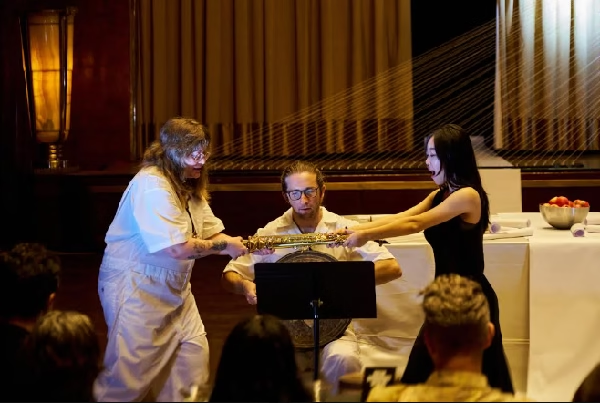
Because Long Beach Opera’s 48th season features their biggest-ever bill of fare, perhaps it’s fitting to start with what director James Darrah Black referred to as “aperitifs.” Thus, the so-called “Aperghis Trilogy,” three short works by George Aperghis performed for one night only aboard the Queen Mary, which hosts five of the season’s seven shows.
Associated with terms like “experimental,” “unconventional sounds,” and “theatrical chamber music,” Aperghis’s compositions fit snugly within LBO’s penchant for programmatic aleatory work since Black took over as artistic director. The first of the trio (not actually a trilogy, as there’s no connecting thread) was Le corps à corps, a solo performance by Brian Cannady on hand drum and vocals, with the latter eventually moving from onomatopoeia into a fractured narrative of a bloody race. While not especially compelling musically or narratively, Cannady’s focus and presence was enough to capture and hold the room’s attention.
Second up was Les sept crimes de l’amour, seven sequences featuring Cannady, saxophonist M.A. Tiesenga, and soprano Habin Kim working themes dictated by narrator Marjorie Beale. For example, in Sequence 3: “The singer is lying on the knees of the two instrumentalists. She holds a vertical clarinet tube against her mouth. The clarinet player applies the clarinet to the singer’s throat. The percussionist plays on the soles of the singer’s feet.” While the program notes call this work a “theatrical exploration of music, movement, and staging [which] unfolds across seven darkly charged scenes,” to me — admittedly, someone who isn’t especially charmed or intrigued by the likes of Aperghis — it came across as only a quaint, playful series of exercises, including elements like Kim vocalizing while eating an apple (which is cute, I guess).
Récitations featured Kim and Geneva Jacuzzi, decked out in a parachute harness-cum- straitjacket, engaging in what the program notes calls a “relentless conversation that pushes the boundaries of the human voice through precision and raw expression.” While that may be a bit of an overstatement, the 35 minutes of interwoven, mostly wordless a cappella — with director Black onstage at times literally pulling the straps/strings — ended with a tableau of Kim looking at Jacuzzi expectantly as they sat in silence for minutes on end.
All of the performers were more than equal to their tasks — par for the course for LBO. Kim and Jacuzzi had some particularly beautiful moments near the end, a bit reminiscent of Lisa Gerrard’s work on the Gladiator soundtrack. And though there wasn’t much to Prairie T. Trivuth’s mise en scène, when you’re staging in one of the Queen Mary’s elegant salons, you start out more than halfway home.
There was, however, a logistical problem. Throughout all three pieces, a bar located not far behind the audience was a constant source of noise, from ice tinkling and glasses clinking to the whirring of a point-of-sale terminal spitting out credit-card bills. During Le corps à corps the various sounds were quiet enough that I thought perhaps they might have been part of the performance (ice chips dropped into glasses can sound quite like quick strokes of a tiny xylophone), but by Les sept crimes de l’amour, when consistent use of a stapler joined the sonic milieu, it was a notable distraction. As the noise continued, it became obvious that, for reasons passing understanding, this salon had been chosen for the preparation of drinks and processing of transactions far beyond the confines of the Queen’s Salon. LBO patrons can only hope that better arrangements will be made for the season’s remaining four shows aboard the historic ship.
After the show, Black referred to LBO’s season opener as aperitifs, a fitting metaphor for a show that was more palette cleanser than main course. While it’s unlikely that any of these three Aperghis works left a lasting impression on those who made their way to the Queen Mary, they may have successfully whetted the appetite for what’s to come.