
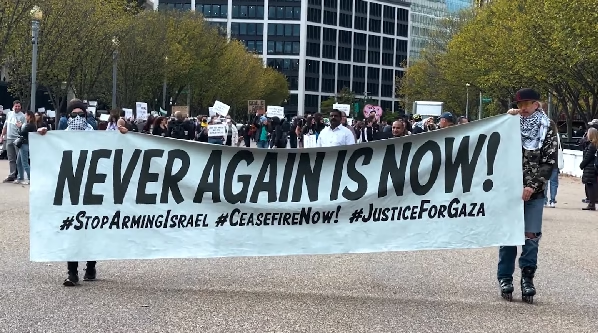
Matthew Solomon, director of Seeds For Liberation, had recently returned from a trip to Palestine when he spoke to Random Lengths about his film, which RLN reviewed upon its release in January of this year. The award-winning and enlightening film will be featured at the 2026 San Pedro International Film Festival, or SPIFFest, Nov. 14.
Seeds For Liberation centers Palestinian voices and experiences while connecting the Free Palestine movement to the ongoing Black resistance, Chicano activism, and other collective struggles. From Gaza and the West Bank to Stop Cop City and digital activism, the film spans decades of solidarity. It culminates in reflections on what liberation and a free Palestine truly mean. Since its release, Matthew has been touring the film globally, including in Palestine. Many more people both in the U.S. and internationally now understand these pervasive connections, thanks in large part to this film.
During this global tour, the most significant thing that has changed for Matthew in his relationship to the film was going to Palestine’s West Bank, and seeing everything for himself.
“Even before then, my relationship to the film has changed,” said Matthew. “Having been there, even after having made a movie about it, hearing the stories, sharing the footage, and seeing the footage, the reality of it, like [journalist] Abby Martin says in the film, ‘Nothing can prepare you for the reality on the ground. It’s so much worse than you even think it is.’”
The filmmaker experienced an emotional resonance while in the West Bank. Two Palestinians in the film, Mo Hamz, a Palestinian-American activist, author, and content creator, and Mimi Abu Ghazaleh, a Washington, DC-based organizer, both spoke about feeling a connection to the land and how beautiful it was. And Mo discussed the conflicting layers of emotions, the happiness, the sadness, the anger, the beauty.
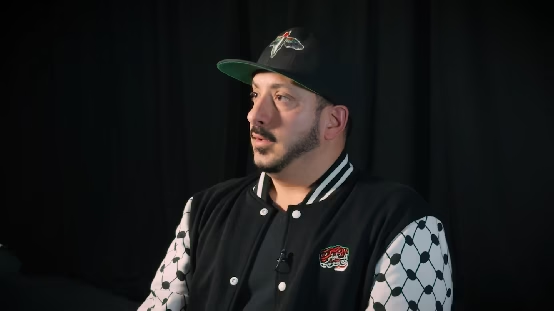
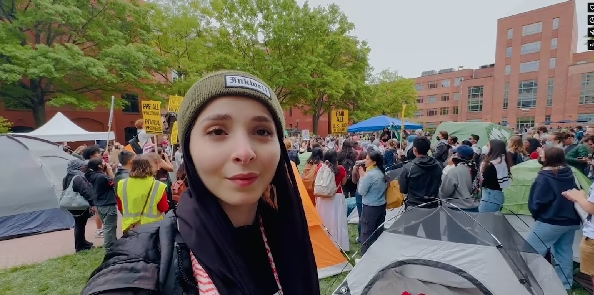
“I experienced all of that,” Matthew said. “I had their dialogue in my head the whole time. It’s just so blatantly obvious how it’s an apartheid state, and how Palestinians are targeted, harassed and violated every step of the way, because the Zionists and the Zionist Israelis just want them to leave, and they don’t care.”
Palestinians at the screening told Matthew that Seeds showed them they weren’t alone. It reminded them of how much support they have. Especially student activists who said that they’ve been so exhausted, and the film re-inspired them on what they were fighting for.
Seeds For Liberation screened in Ramallah and Hebron. Matthew recalled feeling self-conscious as the film started to roll, thinking, ‘This is a film about the horrors that are happening there, but we are there, these are the people that it’s happening to. I don’t know how it will be received …’
“The unfortunate thing is because [of this] there’s no re-traumatizing, it’s just a daily thing,” he said.
Seeds was received very positively with good discussions afterwards. Matthew said it was profound to show it in the West Bank. Yet, importantly, while the people were very happy to see the support, they’re still being bombed. So, they questioned, how is it stopping what’s happening, which, Matthew said, is fair.
As the genocide in Gaza continues, confoundingly, despite a so-called ceasefire, and settler violence and displacement permeate the West Bank, Seeds highlights Palestinian resistance. Seeds is a document on how social media has challenged dominant Western narratives and brought the Free Palestine movement into global consciousness.
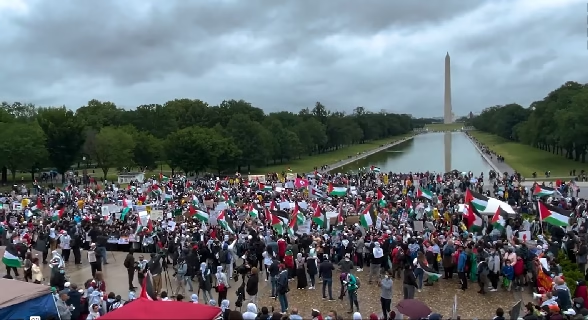
When asked if this experience has changed him in any way, Matthew said, “It just gets deeper and more meaningful. It increases my resolve.”
One of the cool things, he said, is that because the film shows footage from around the country and around the world, when he visits different cities, and a scene from that city plays, like a protest or an encampment, people are very excited to see that.
“We showed the film in Jalapa, Veracruz, in Mexico with Spanish subtitles, and people were reacting and responding to the film there,” he said. “They were asking questions about the Chicano movement, because they’re in Mexico, so it’s not a movement for them. So [it was] interesting that I’m explaining this.
Seeds makes clear the connections between Palestine history under the IDF and the Black, Chicano and collective liberation movements in the U.S. It also reveals the depth of the US-Israeli connection highlighting surveillance and the oppression of both its peoples. People around the world are against the genocide, en-masse. Most governments do not show the same resolve. There lies the issue. Our discussion led to the account of the paradigm shift in opinion the U.S. experienced in the late 1960s on the Vietnam war. What would it take for the U.S. to reach a profound level of opposition to this genocide?
“It’s gotten way past what we thought would need to happen for there to be the sea change,” Matthew said. Conversely, “Mo Hamza talks about how, as a Palestinian, he’s never seen this much support, and these many people talking about Palestine, to the extent where some politicians are distancing themselves from AIPAC.”
Matthew cited a statistic of Jews in the U.S. — around 30% — who are opposed to the genocide. (J Street found that 31% of Jewish poll respondents backed ending military aid to Israel, and agree its conduct in Gaza is a genocide. That number jumped to 60% for Jews under 35).
“With Vietnam, it was the nightly images on TV, I believe, that helped turn the tide. It also became very costly, because people in the United States would see the coffins coming back with flags on them. Most Americans don’t get how connected we are to Palestine. I don’t know what images it would take. It’s been horrifying what we’ve seen. Corporate media doesn’t show any of it … It would need to get to the point where it’s in the mainstream, [so] people are seeing what happens.”
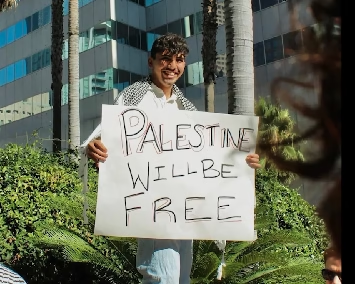
from “Seeds For Liberation.”
What to understand about Palestine and its people
“Palestinians have been talking about their experiences for almost 80 years,” Matthew said. “I don’t want to speak on their behalf … But because I’ve been there, I have a responsibility to share what I’ve seen, and I was invited there [with] a delegation of storytellers. The Palestinians are living under a violent occupation. Any suggestion that they have rights, [or] control over their living situation is just false.”
He noted a recent election happened there and about five-million Palestinians who live there are unable to vote because they’ve been disenfranchised. Either they’re not considered citizens, or there is an array of criteria and reasons they are given. Matthew compared it to how the United States is trying to disenfranchise voters
Being in Palestine reminded him of the U.S., “but completely unhinged, unchecked,” and how like here, there’s no checks and balances. He pointed to redlining, housing discrimination, and the racist criminal legal system here. He noted that what’s happening in Palestine happened here first, to the Indigenous people and Black people, through genocide, dispossession, and enslavement.
“When we talk about the imperial boomerang, it literally started here. Now, we see it [in Palestine], the way it was here 200-300 years ago. Manifest Destiny and the Zionist entity, it’s all the same. It’s just not as polite there.”
The theory describes how the repressive and violent control techniques — extreme militarization, state surveillance, and psychological operations — used by imperial powers to govern foreign colonies ultimately return home to be used against their own domestic citizens.
Matthew mentioned Chuck Modiano in Seeds, who discusses “the deadly exchange where police in the US train with the IOF” (Israeli ‘Offense’ Forces or IDF).
“We exchange weapons and tactics,” he said, “The knee on the neck with George Floyd is what the IOF regularly has done with Palestinians, the surveillance, the Cop cities, the urban training facilities — there’s at least 85 of them across the country — that’s all modeled after Little Gaza, (in Negev Desert) where the IOF trains their soldiers.”
SPIFFest
Matthew is super excited to return to SPIFFest. Despite his films’ successes, many festivals aligned with the Free Palestine movement didn’t program Seeds. Instagram also heavily suppresses it, as it does many pro-Palestine accounts.
“So, Ziggy and SPIFFest having the courage and just the integrity to show a film like this, like they did with Reimagining Safety, it just means a lot,” he said. “And San Pedro is a beautiful city. I love the opportunity to be in community with you all there, and to show the film, and to have it in a really nice theater, and bringing people out.
“I’m just really honored to have this be a part of SPIFFest. We’re doing what we can to get the film out there with no financial backing.”
Ziggy Mrkich, founder and festival director of SPIFFest, told RLN via email:
“Matthew Solomon’s Seeds for Liberation is a must-see film — powerful, timely, and deeply thought-provoking. SPIFFest is proud to have also screened his documentary Reimagining Safety. Together, these films demonstrate Matthew’s extraordinary ability to capture the zeitgeist and his unwavering commitment to addressing the most pressing issues facing our society today. His work reminds us that storytelling is more than an art form — it is a responsibility. When you have a voice and a platform, you have an obligation to use them to challenge injustice, spark meaningful dialogue, and amplify the voices of those who too often go unheard.”
Like with Reimagining Safety, all the interviews were filmed on iPhone, and edited on a laptop. In December, Seeds will tour Washington State. And the day of SPIFFest, Nov. 14, Seeds will screen in Mexico City, its third screening in our neighboring country, hosted by the Palestinian ambassador’s office.
SPIFFest Presents Seeds For Liberation, followed by a Q&A with filmmakers.
Time: 7 p.m., Nov. 14
Cost: $17.85
Details: https://tinyurl.com/seeds-for-liberation and https://www.seedsforliberationmovie.com
Venue: Starlight Terrace Cinemas, 28901 South Western Ave., Rancho Palos Verdes