
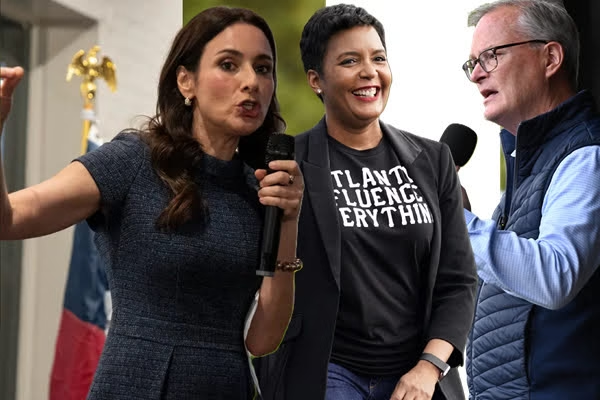
“And when the state of Georgia becomes blue, along with the state of Texas, they will not be able to hold us down. It’s gonna happen.”
— Rep. John Lewis, 2018
Nov. 3 was a tsunami election so big, so deep, and so diverse — the first Black female governor, first female Native American governor, first Muslim U.S. Senator, etc., etc., etc. —that it defies easy characterization. It was obviously a repudiation of Trump and MAGA Republicanism, but also — perhaps less obviously — a repudiation of the status quo politics that Democrats and the media have clung to for far too long, and it saw a resurgence of the inclusive religious left, with a commitment to the social gospel, and caring for “the least of these.”
It was, in short, an anti-system election, but with a Bernie Sanders/Alexandria Ocasio-Cortez slant rather than a Donald Trump one. And if Democrats remain in denial, and refuse to accept and act on it, then someone like Trump—or even worse—could return again, as Trump did in 2024.
But before considering what lies ahead, let’s review some of what just happened.
It was a Democratic landslide:
- It was the largest swing in House seats since 1974—the year after Watergate—and the largest swing along with change in control since 1946, the year after WWII ended.
- Democrats have flipped seven US Senate seats so far, with another certain, and another almost certain to come—for a total of 54, plus two independents who caucus with them. Even winning four seats seemed a long shot, if not impossible a year ago.
- Democrats have flipped five governorships, while holding onto the Kansas governorship for a third term for the first time since 1972. They now hold a majority of governors.
- Democrats won full control of six more states: Wisconsin, Michigan, Minnesota, Nevada, Pennsylvania, and New Hampshire.
- Democrats have won a majority of state legislative races for the first time since 2008, flipping control of 12 chambers (while Republicans flipped none), including Georgia’s and Florida’s houses, which they haven’t held since before the 2004 election.
It was an anti-system election:
- It was the most expensive election ever—up to $12 billion—but dark money proved counter-productive. Badly outspent candidates won up and down the ballot.
- Trillionaire Elon Musk spent half a billion dollars with nothing to show for it.
- Six DSA candidates were elected to the House: Darializa Avila Chevalier and Claire Valdez in NYC; Angela Gonzales-Torres here in LA; Melat Kiros in Colorado; Donavan McKinney in Michigan; and Chris Rabb in Pennsylvania.
- America’s two largest cities will now have DSA mayors, along with Washington, D.C. (Janeese Lewis George) and Providence, Rhode Island (David Morales). Here in LA, Nithya Raman is possibly headed to a double-digit victory with almost the entire Democratic establishment arrayed against her.
- Big idea fighters won the most pro-Trump districts—the kinds of districts that usually produce compromise-minded moderates. In rural Tennessee, Victoria Broderick flipped the most pro-Trump district this year (with Trump missing by 24.3%), with no party support, no ads, and a total campaign budget under $100,000. Political scientist Adam Bonica summarized her positions: “Medicare for All; pro-Roe; openly queer; backs trans rights; no corporate or AIPAC money.” Bonica lists five other candidates who swung double-digit Trump districts with little money (only one spent over $1 million) and calls for big change.
It was a map-redrawing election—most notably in the South and Mid-West.
- In Georgia and Texas Democrats swept all statewide executive offices and flipped the state houses, while also winning US senate races by double digits.
- In Kansas, Democrats won a U.S. Senate seat for the first time since 1932. They won the governors race for a third consecutive time for thee first time since 1972.
- In Mississippi, Democrats are poised to win a U.S. Senate seat for the first time since 1982
- In South Carolina, Democrats won a U.S. Senate seat for the first time in two decades.
- In North Carolina, Democrats won a U.S. Senate seat for the first time in a decade, and appear headed to win 10 House seats with a map gerrymandered for the GOP to win 10-4.
It was a diversity election:
- In Georgia, Kiesha Lance Bottoms became America’s first female Black governor.
- In Texas, Gina Hinojosa became the state’s first Latina governor.
- In New Mexico Deb Haaland was elected the first female Native American governor.
- In Michigan Abdul El-Sayed was elected the first Muslim U.S. senator.
- In Minnesota, Peggy Flannigan became the first-ever female Native-American senator, and in Alaska Mary Peltola is poised to become the second.
- In Mississippi Scott Colom became the first African-American U.S. senator from that state since Reconstruction.
- In South Carolina, Annie Andrews became the first woman elected U.S. senator from that state.
It was an election that saw the resurgence of the religious left.
- In Kansas, Democrats elected Rev. Adam Hamilton to the U.S. Senate. He is senior pastor of the United Methodist Church of the Resurrection, the largest United Methodist congregation in the United States.
- In Texas, Democrats elected James Talarico to the US Senate. He’s a former seminarian who made his religious faith a key element of his race, most notably the injunction “love thy neighbor” as an antidote to the politics of division and demonization.
Also in Texas, Rev. Frederick Douglass Haynes III, was elected in to represent the 30th congressional district. He’s ordained in the National Baptist Convention.
In Iowa, Rev. Sarah Trone Garriott was elected to represent the third congressional district. She’s ordained in the Evangelical Lutheran Church in America, a mainline Christian tradition.
The election was all these things and more. So perhaps the biggest post-election question of all is what will Democrats do with that anti-system energy? Try to contain it? Or put it to reconstructive use?
Fascism may have a string of defeats recently around the world—in Serbia, Brazil, and now the United States, but the global state of democracy is still in peril. “Never before has there been so many countries moving back from democracy at the same time,” Stafford Lindberg, founding director of the V-Dem Institute told Random Lengths. “Generally speaking, the 1930s was 15 years, we’ve already experienced 25 years.” V-Dem’s annual report this year warned that America had seen a more rapid deterioration of its democracy than any other country during this period, but said the mid-terms offered hope, since the first election after a strongman takes power is the best opportunity for reversal.
But we’ve already been through this before with Trump—both in 2018 and 2020. The problem with those victories was that they didn’t really restore what Trump had destroyed, much less strengthen and improve things so that he couldn’t return again. Incremental improvements and a “return to normalcy” that has already failed too many people has not proved a viable deterrent to fascist movements worldwide, and there’s no reason to think it will here.
So what form can big, transformational change take? In many respects, it will have to wait at the federal level until the next election, and the next two years are more a time of preparation, laying the groundwork. At the state and local level, it’s a different matter. Officeholders there are closer to the people, and can start making changes that impact them right away.
There’s also the level and perspective of political organizing. Here, political scientist Suzanne Mettler has something very important to say. Her most recent book, “Rural vs. Urban” examines what she argues is the most troubling political divide in America, but also the most capable of being overcome. In fact, she shows that up until 1994 a majority of the most rural 20% of congressional districts were represented by Democrats—a legacy of the New Deal and it’s multi-pronged agenda to bridge the rural-urban divide, even as market economic forces were threatening to leave rural America behind.
As recently as 2006 and 2008 Howard Dean’s 50-state strategy supported party-building that reached down to the party chair level and helped Democrats regain that majority, before it was wiped out in the Tea Party wave. Now Mettler see’s a chance to rebuild.
“A lot of people have thought that the rural urban divide is just like a natural occurrence and inevitable,” Mettler told Random Lengths. “Republicans were kind of resting on their laurels, thinking that because here they were getting all the support from rural voters, but not really responding to them with public policy that helps them out,” she said, while “Democrats have been ignoring rural voters just thinking, it’s impossible for them to support us. They just they won’t.”
But to many people’s surprise, she said, “You got a crop of candidates this time around, who were unwilling to accept that, and who worked hard in rural places and therefore you know the national tailwinds together with their efforts allowed them to flip seats.” Some of those were on Bonica’s list mentioned above.
“That’s the first big take away,” from the election she said: “the rural/urban divide is not natural and inevitable, and in this election shows that.”
“The second big take away is this creates now the potential for a rural/urban governing coalition in Congress,” she said. “It could be very effective and it could respond to the priorities of the vast majority of Americans, if such a coalition comes together. And so this is a really promising moment.”
Most or all of what they propose may be vetoed the next two years. But that only produces the seeds for further change.