


Home Blog Page 96

Global Cultures Converge: Latin American Pavilion Shines at LA Art Show, Jan. 7–11


Marking its 31st year, the LA Art Show, Los Angeles’ largest art fair, returns to the LA Convention Center from Jan. 7 to 11. Under the leadership of director and producer Kassandra Voyagis, the fair will present a world-class art experience featuring more than 90 exhibitors.

Highlights include Dublin’s Oliver Sears Gallery, the fair’s first participant from Ireland; Palm Beach’s Provident Fine Art with a solo exhibition of Sylvester Stallone’s abstract works; and London’s Pontone Gallery showcasing self-taught artist and renowned drummer Chris Rivers. The strong UK presence continues with first-time participants such as London’s John Martin Gallery and Quantum Contemporary Art.

Switzerland’s LICHT FELD Gallery will present the first public showing in more than 40 years of Karl A. Meyer’s woodcut prints, created during his transformative 1980s period on New York’s Crosby Street among the era’s most influential artists — work that fills a notable gap in the art history of that time.

Corridor Contemporary will showcase internationally renowned Israeli artist Yigal Ozeri, celebrated for his large-scale, cinematic portraits of young women set against lush, evocative landscapes. LA Art Show 2026 will also continue its strong Korean presence with 15 participating galleries, including J&J Art, presenting “Elegant Freedom” by Jinny Suh. Through traditional Hanji paper and vibrant color, Suh’s nature-inspired works offer emotional depth and an immersive experience that celebrates Korean culture through a modern lens.


8. Eclipse 120x88cm Pintura Sobre Piezas Realizadas En Tela 2024 1
Tadeo Muleiro, Eclipse, painting on pieces made of fabric; sobre piezas realizadas en tela, 2024. Photo courtesy of Tadeo Muleiro, LA Art Fair
2. Tadeo MuleiroEclipse 120x88cm Pintura Sobre Piezas Realizadas En Tela 2024 1
Tadeo Muleiro, Eclipse, 120x88cm, painting on fabric pieces, 2024. Photo courtesy of Tadeo Muleiro, LA Art Fair.

Latin American Pavilion

The 2026 introduction of the Latin American Pavilion, led by curator Marisa Caichiolo, marks a milestone in the international fair landscape and will advance LA Art Show’s global mission by spotlighting the talent of emerging artists from other regions of the American continent. In a notable recognition, Caichiolo, who also serves as curator of the LA Art Show’s DIVERSEartLA program, was recently selected to co-curate Chile’s official pavilion at the 61st Venice Biennale of Art in 2026.

Focusing on memory, migration and identity, the pavilion engages in deep ancestral inquiry into power dynamics of artist representation within the gallery system. It invites audiences to reconsider provenance, belonging and the evolving future of Latin American art — transforming how works move and resonate across borders.

“At a moment when immigration issues continue to disproportionately impact Latin American communities, it is especially important to provide a platform for these artists,” said Caichiolo. “Their perspectives are vital to a more complete and equitable understanding of contemporary art, yet they remain underrepresented at major fairs. This pavilion seeks to amplify their voices and affirm the cultural and creative contributions of Latin America on the global stage.”

Caichiolo invited a select group of galleries to form the pavilion, chosen for their representation of a diverse range of Latin American artists who embody the region’s voices and perspectives, including:

Artier Fine Art Gallery presents “In the Mouth of the Jaguar: Myths Reimagined” — a groundbreaking exhibition uniting 10 contemporary Latin American artists who explore, reclaim and reimagine the ancestral mythologies of the Americas. Treating myth as a living force — a jaguar with open jaws — ready to devour and reshape meaning for today’s world, the show features works by Natasha Grey, Ender Martos, Dario Ortiz, Moises Ortiz, Luigi Fantini, Brigitte Briones, Ariel Vargassal, Guillermo Bert, Miguel Osuna and Carlos Luna.

The curatorial statement reads in part: “Their works traverse mediums including painting, sculpture, textiles, kinetic installations, and augmented reality—blending sacred symbols with digital futures, ecological grief with feminist resistance, and personal memory with collective myth.”

“This is myth in motion,” says Ariel Vargassal. “These artists are shapeshifters, using ancient stories to speak to migration, decolonization, and the urgency of now.”

IMG 2177 1
Moisés Ortiz
“The Impermanence of Life”
Acrylic, spray paint on Italian linen. 2025. Photo courtesy of Tadeo Muleiro, LA Art Fair

Verse Gallery will feature six artists, including Maquiamelo, whose striking aesthetics reinterpret pop culture and identity; Esteban Jácome, who weaves emotional narratives through bold forms and color; Maca Vivas, who explores femininity through her delicate yet powerful “Fluffy Crowns”; and Johnny López, who fuses ancestral cultures with contemporary power and language, among others.

Building Bridges Art Exchange debuts Latin American Focus, spotlighting transnational voices shaped by resilience, cultural exchange and evolving futures. The presentation features Tadeo Muleiro’s latest project and works from the Rubinstein Collection, including pieces by Mariana Tellerías, Liliana Porter and Andrés Paredes. The booth also showcases selections from the Pangue International Video Art Festival, created by BBAX with Chile’s AAL Museum, featuring artists such as first-prize winner Mónica Arreola from Mexico, Joaquín Vargas from Argentina, Máximo Corvalán Pincheira from Chile and Carolina Bazo from Perú.

IMG 2182
Carlos Luna James.
“Mythical Mask.”
Photo courtesy of Tadeo Muleiro, LA Art Fair

DIVERSEartLA Returns

The fair’s non-commercial educational platform, DIVERSEartLA, also curated by Caichiolo, will examine the evolving role of biennials and museums within contemporary art ecosystems. The program highlights both their complementary and conflicting functions as spaces for innovation, dialogue and public engagement.

Time: 6 to 10 p.m. Jan. 7, 12 to 8 p.m. Jan. 8, 9, 12 to 8 p.m. Jan. 10, 12 to 6 p.m., Jan. 11

Cost: General admission, one day ticket $40

Details: www.laartshow.com

Venue: Los Angeles Convention Center, West Hall 1201 S. Figueroa St., Los Angeles
Best of Long Beach Theatre, 2025


Why didn’t we think of this before?! People love lists, right?

In 2025, I saw 20 theatrical works in the LBC and/or by Long Beach-based companies, and more often than not I came away at least reasonably satisfied. But there were five clear standouts. So, without further ado, in chronological order…:

Into the Woods — Musical Theatre West

When you do Sondheim, you’re cooking with gas but that shit can blow up in your face if you don’t have the talent necessary to bring out all the flavorful genius of one of musical theatre’s most demanding doyens. The Musical Theatre West peeps are pros, though. Act One was great fun (“Agony” in particular); but Act Two, where 70% of the show’s brilliance and the better part of its great music resides, was arresting. If you saw only the rondo of recrimination “Your Fault”, you’d know that this was an ensemble without a weak point. And the finale, “Children Will Listen”, had all the oomph it needed to serve as the capstone of a magnificent edifice. Even with a couple of directorial choices that missed the mark, this April show was easily the best thing that had been staged in Long Beach to that point in 2025 and set a bar high for the rest of the year.

Image0
From Musical Theatre West’s Into the Woods. File Photo


The Library of Maps — Long Beach Opera

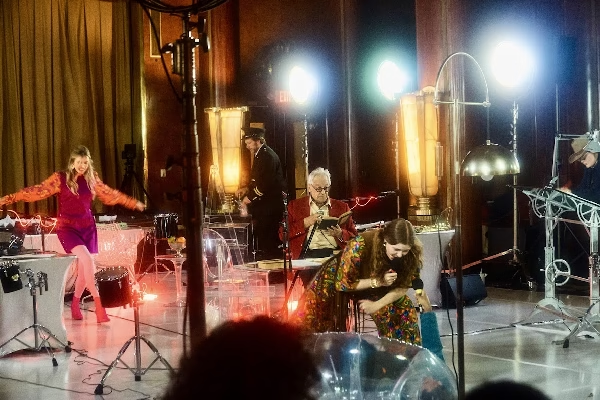
After their December 2024 one-off opener of a season dedicated solely to the “sonic meditations” of Pauline Oliveros, I thought Long Beach Opera’s year would be a complete bust for me. Seventy minutes of minimalist improv while sitting in a room full of shredded newspaper is not my idea of a great performance (though the newspaper bit was more thoughtful and aesthetically pleasing than it sounds). I liked their more ambitious March offering better — the site specificity, exploiting the entire grounds of L.A.’s Heritage Square Museum, was a real treat — but aleatory music doesn’t generally turn me on. Then, however, came May’s The Library of Maps: An Opera in Many Parts, performed just twice in the Queen’s Salon aboard the Queen Mary. Maybe I can’t say it’s the best thing LBO has ever done, but they’ve never given me a more pleasurable experience. Though inspired by Oliveros and drawing upon a small sampling of the two-dozen poems loosely comprising the libretto for her opera-concept, director/producer James Darrah and musical director Christopher Rountree helmed an original creation (“No score exists for the piece,” I was told, “no musical sketches”) of largely improvised music that never seemed to meander, with all eight performers exercising a discipline that unfailingly served the moment and the whole. The skeleton of a plot — we’re on a ship at sea, where the captain has just died and a new mapmaker has been born unto a library that contains all the maps in the universe; passengers and crew drift across the sea of time on a voyage without a fixed destination — mattered far less than the immersive gorgeousness of the music and mise en scène. As soon as it was over, I wanted them to perform the whole thing again. Wow.


A Doll’s House — Long Beach Shakespeare Company

I gave up on Long Beach Shakespeare Co. years ago — not because they were ever bad, but I simply found myself writing more or less the same review every time — Competent, minimalist Shakespeare in a black box — which I didn’t imagine was doing them a great service. But when I heard they were mounting Ibsen’s protofeminist tour de force, I had to see what’s what. I never expected it would be one of the best things I’d see all year, but great casting and thoughtful, unobtrusive directing, with no scene or snatch of dialog rushed, allowed all of Ibsen’s nuance to come across (despite much of the audience laughing at everything that seemed quaint through their veil of 21st-century, short-attention-span ignorance). With the emergence of the “womanosphere” in recent years, the choice to stage this story of unwitting complicity with patriarchy was extra timely. The play’s final scene is a true emotional and thematic climax if ever there was one, and the actors —including Ceili Lang as Nora, excelling at every stop along Nora’s broad character arc — played it for everything it’s worth.


Predictor — The Garage Theatre

How much do I know about the history of the at-home pregnancy test? A helluva lot more now that I’ve seen a staging of Jennifer Blackmer’s entertaining telling of how a 27-year-old non-scientist combined creativity and common sense to package the necessary elements so women could know what’s what privately — and the decade-long, sexist delay in bringing her breakthrough to the American market. Opening as an episode of an imaginary ‘60s gameshow called Who Made That? before launching into the narrative proper, Predictor never progressed too far down any one track before switching it up with flashbacks and fantasy sequences, a farrago of scenes that collide and interpenetrate ceaselessly, rhythms breaking against contrary rhythms. Director Jessica Variz grokked both the substance and style of Blackmer’s script and had her cast jumping through all the right hoops to deliver the goods.


A Christmas Carol — Long Beach Playhouse

Prior to 2025, Long Beach Playhouse had done a show based on Dickens’s classic novella a full 13 times. From seeing more than half of these, I can tell you that no two were the same, and some were quite good. But director Carole Louise Nicholson worked some fresh magic on this tried-and-true tale of redemption and viewing others as “fellowpassengers to the grave and not another race of creatures bound on other journeys.” With a perfect [I used that word a lot in my full review] cast from Scrooge to Tiny Tim, meticulous costumes and makeup, and understated lighting that’s every bit as thoughtful as every other element, iteration #14 was a masterclass in the dramatic arts, a piece of theatre whose every second was subsumed into a continuous flow, with each moment playing out organically and those moments succeeding each other in such a way that each scene seemed to have naturally sprouted from the one it replaced.

*

Although we’ll have to wait to see whether in 2026 Long Beach can produce any shows matching the above five, tune in right here next month to read about the general state of theatre in Long Beach as we launch into the second quarter-century of the millennium, including capsule histories and updates on every theatre company in town.

Was That a Speech or a Breakdown?

A stark look at the speech that blurred the line between leadership and losing control on the world stage…

Let me take off my psychotherapist hat and simply speak as a parent, an adult, a businessman, a citizen, and a human being.

There is something deeply and fundamentally wrong with Donald Trump,

Last night’s speech demonstrated it. He didn’t need to trash-talk Joe Biden, or try to claim that the country was “dead” when he came into office, or exaggerate his accomplishments, or lie about the state of things. None of that was necessary.

He didn’t need to put depreciating comments under the pictures of prior presidents in the White House, or replace Joe Biden’s picture with an autopen.

These are the kind of things junior high school boys do. And not even most junior high school boys; just the really dysfunctional ones. The bullies. The ones who are desperate to be part of the in crowd, but always on the outside looking in. The ones no one wants as friends.

This man is sick. And he’s inflicting his sickness on our country. And he’s surrounded himself with sick people, or at least with people willing to tolerate his mental, emotional, and spiritual sickness.

As well as people who share his sickness: there’s also clearly something wrong with man-children like Stephen Miller, Pete Hegseth, and Kash Patel.

With these men, it goes beyond the normal sellout-type of person willing to do anything for wealth and power, the kind of behavior we see in people like Pam Bondi or the administration members who’ll swear that the 2020 election was stolen.

There’s a deep cruelty combined with a pathological insecurity and a level of hate and intolerance for others that’s shocking. Anybody who’s ever played any sort of role in leadership is looking at this administration aghast. The leaders of the rest of the rest of the world must be in shock.

There’s a deep sickness at the head of this government. Childishness. The violence. The bloodlust that we see off the coast of Venezuela. The willingness to sanction rape and murder and land grabs in Ukraine. The enthusiasm to bring our country to the brink of war. Plastering gold-painted geegaws all over the White House.

And then last night Trump goes off for 20 minutes quite literally shouting at the country like an old man yelling at kids on his lawn. Ranting about Black Somalis. Bragging about nonexistent victories and peace deals. Just making shit up.

No president of the United States has ever behaved this way. Probably no governor or mayor has ever gotten away with this kind of psychopathology and obscene behavior.

It’s embarrassing. It’s humiliating America.

It’s setting a terrible example for our young people. Children who were just entering the early years of public school when Trump first ran based on a racist rant in 2015 are now graduating from high school thinking that this is normal.

That, in and of itself, is a disaster for their and America’s future.

And now he has an “armada” poised off the coast of Venezuela trying to provoke a war with that nation.

It’s also becoming increasingly clear that he was right in the middle of it all with Jeffrey Epstein, and is now frantically trying to avoid questions about the teen modeling agency and talent show he owned back in those days.

He gutted America’s principal agencies of soft power, The Voice of America and USAID, strung Ukraine along for almost an entire year as their people get slaughtered, and accepted hundreds of millions of dollars worth of naked bribes from foreign autocrats and American business leaders.

He’s deployed masked, secret police into our cities who are gleefully brutalizing brown-skinned people and anybody who tries to document their hugely unAmerican activity.

He kowtows before Vladimir Putin and China’s president Xi Jihping, and embraces murderous dictators who’ve ordered the killing of an American journalist and routinely cut the heads off of their own people. He tore down the East Wing of the White House in defiance of federal and local law, history, and respect for “The People’s House.”

It’s reached the point where we’re now confronted with a hard truth: this isn’t about left versus right anymore or even politics as usual. It isn’t about tax policy or border policy or whose yard sign we prefer.

This is now about whether we’re willing to normalize sickness in power.

Whether we tell ourselves comforting stories because confronting the actual reality in front of us is frightening.

Whether we allow cruelty, lying, and instability to become the cultural baseline simply because calling it out makes dinner conversations awkward or costs us friends or clicks or donors.

Turning points in history don’t usually announce themselves with marching bands. They creep in while decent people look away, hoping the fever will break on its own.

But it never does. Fevers break only when the body fights back. Democracies survive only when citizens decide that character still matters, that truth still matters, that children deserve better examples than tantrums and threats and gold-plated vulgarity.

Silence is not neutrality: It’s consent.

If you’re reading this, you still have agency. Use it. Talk to your neighbors. Support journalists and organizations willing to tell the truth. Show up, vote, organize, refuse to laugh it off, refuse to excuse it, refuse to become numb.

Demand leaders who are adults, not bullies. Who are steady, not sick. Who see power as a responsibility, not a toy.

This ends when we decide it ends. When we stop treating pathology as entertainment and cruelty as strength. When we remember that democracy is not self-executing; it requires citizens who are awake, engaged, and unwilling to surrender their moral compass for the illusion of order.

We don’t need to be perfect. We just need to be brave enough to say: this is wrong, and we will not accept it.

The future is watching us right now, and one day our children will ask what we did when it mattered. Let’s make sure we have an answer we can live with.

From Hard-Won Victories to Systemic Shock


A Year That Tested Community Power

Last January, as we marked the 25th anniversary of the MATES II study, longtime Wilmington organizer Jesse Marquez reflected on a quarter century of environmental justice victories. “We’ve won the war,” he said — not as bravado, but as a measured accounting of what sustained, community-rooted organizing had achieved against ports, shipping interests, political institutions, and regulatory indifference. It was a rare moment of looking back at hard-won progress, grounded in lived experience and collective struggle.

None of us could have imagined that the year ahead would so starkly test that legacy. Within weeks of the inauguration of Donald Trump as the 47th president of the United States, Marquez was struck by a vehicle at an intersection on Lomita Boulevard, just blocks from where he was born and raised. After emergency surgeries, he remained largely comatose for months before dying in November. His passing did not erase the victories of the past 25 years — but it did underscore how fragile even the strongest pillars can be, and how much work depends on the people who hold movements together.

As Marquez fought for his life, the country entered a period of accelerated political upheaval. The Trump administration moved swiftly, forming the so-called Department of Governmental Efficiency and rapidly gutting federal agencies, firing career staff, and restructuring governance with little transparency or time for public reckoning. In late January 2025, a sweeping Office of Management and Budget memo froze most federal grants and financial assistance, disrupting community health centers, Medicaid systems, and safety-net services nationwide. The move paralyzed payment systems, sowed fear among providers, and signaled a broader campaign to dismantle programs tied to public health, environmental protection and equity.

What followed was a relentless first year: more than 140 executive orders reversing environmental, labor, immigration and public health protections; the dismantling of DEI initiatives; the draining of institutional expertise from federal agencies; and an aggressive prioritization of fossil fuel production amid a worsening climate crisis. He even transformed Immigration and Customs Enforcement into his personal guard of 21st-century Brownshirts, kidnapping our neighbors off the street — undocumented and otherwise. By the time Jesse Marquez died, the country had endured 11 months of governance defined by speed, shock, and structural damage.

This Year in Review documents what that moment looked like on the ground — in environmental justice, health, democracy, labor, culture, and community life. It traces how local institutions, organizers, artists, workers, and neighbors responded to overlapping crises, and how resistance, memory and solidarity persisted even as the ground shifted beneath us.


Environmental Justice, Health, and Climate Crisis

We began the year celebrating the 25th anniversary of MATES II, community activist Jesse Marquez’s 25-year fight for Wilmington’s health that began after the March 2000 MATES II study revealed the area’s highest cancer risk from diesel exhaust. His activism, sparked by a port expansion plan, led to the formation of the Coalition for a Safe Environment (CFASE) and significant victories against ports, resulting in California’s landmark environmental legislation, like AB32, and the move toward zero-emissions freight.

That legacy echoed throughout the year. Harbor Community Health Centers (HarborCHC) celebrated its 55th anniversary after earning HRSA’s Gold Badge for quality care — an honor reserved for the top 10% of health centers nationwide. Under CEO Tamara King and Medical Director Dr. Caleb Lusk, HarborCHC expanded diabetes, wound care and substance use disorder services while addressing high pediatric asthma rates linked to pollution identified in the MATES II study. Plans were underway to expand into San Pedro and Long Beach when the new administration’s threats to funding became real.

On Jan. 29, Rep. Nanette Barragán denounced the Trump administration’s federal funding freeze on HarborCHC as a “rip-off.” Though rescinded, the freeze — triggered by a Jan. 27 OMB memo — had already caused chaos and fear. Rep. Robert Garcia called the move “drastic, confusing, and chaotic,” noting it shut down the Medicaid portal nationwide. King reaffirmed HarborCHC’s commitment to “Gold Badge care” despite what she called a deliberate distraction.

Climate-driven wildlife crises intensified in the spring. International Bird Rescue faced a rare dual emergency as domoic acid poisoning from toxic algal blooms struck seabirds and marine mammals simultaneously across the Southern California Bight. More than 50 birds — including brown pelicans — were treated as IBR also responded to an influx of displaced chicks and tested for avian flu.

The Marine Mammal Care Center recorded its 247th animal by April 8 — numbers typically seen over an entire year. The crisis was driven by an unusually early and toxic algae bloom, climate change, possible nutrient runoff from fires, and compounded by federal cuts to the National Oceanic and Atmospheric Administration (NOAA) research, making volunteers and donations essential.

In July, RLn profiled marine scientist and educator Alisa Schulman-Janiger, who leads the LA Gray Whale Census at Point Vicente. The count recorded the lowest migration numbers since 1984, reflecting a steep population decline caused by climate-driven food shortages in Arctic feeding grounds. Schulman-Janiger emphasized the role of citizen science and emotional connection to marine life as a foundation for protection.

Environmental solidarity also took cultural form through the “Respect the Locals” campaign, featuring limited-edition wildlife posters by John Van Hamersveld benefiting three San Pedro environmental nonprofits.

The year closed in mourning. In November, Jesse N. Marquez — founder of CFASE and godfather of Southern California’s environmental justice movement — died after spending his final days with family. His 25-year campaign reshaped public policy and proved that organized communities could confront industry and win.


Democracy, Repression, and Organized Resistance

Grassroots organizing remained central. In March, Indivisible San Pedro marked its eighth anniversary, continuing its resistance to the Trump/Elon Musk administration. Founded after the 2016 election, the group focuses on reclaiming the House in 2026 through phone banking, thousands of postcards, banner hangs, rallies, and sustained pressure on elected officials. Members described the meetings as both organizing hubs and emotional lifelines.

Warnings about democratic erosion escalated. Retired Maj. Gen. Peter Gravett called the administration’s actions “unthinkable,” citing ideological purges at the Pentagon, rollbacks of DEI programs, and efforts to erase Black military history. He warned that the country was being pushed backward toward the Jim Crow era.

That threat became tangible in “Palm Trees Burning — ICE Raids Ignite Pushback in L.A.”, which chronicled a federal crackdown that brought National Guard troops and Marines into local streets. Protests, mass arrests and an illegal deployment followed. RLn warned that local police risked becoming “ground troops of federal overreach.”

Resistance intensified through the Harbor Area Peace Patrol, which monitored federal agents throughout the summer. In August, masked agents violently detained nurse and activist Amanda Trebach near the Terminal Island ICE staging area. She was released without charges after two days. Supporters and elected officials called the arrest politically motivated intimidation.


Labor, Immigration, and Collective Power

Labor reporting underscored how repression and resistance intersect. RLn documented how mass detentions and deportations terrorized farmworkers while the H-2A guest worker program expanded — what many organizers call “practically serfdom.” The targeted arrest of Alfredo Juarez, a leader with Familias Unidas por la Justicia, illustrated the risks facing organizers even as unions continued building solidarity across worker status.

In “Union Roots, Modern Fights,” LIUNA Local 724’s Alex Aguilar Jr. linked today’s attacks on labor to immigrant-led organizing traditions, emphasizing unity as labor’s enduring strength.

David Bacon’s “Why Lelo Juarez Chose Self-Deportation” detailed the brutal conditions inside a private detention center and the toll of repression on an organizer who ultimately chose freedom with his family over a system designed to crush resistance.

In October, “The Case for a General Strike” traced growing calls for mass labor action, linking today’s moment to historic strikes and warning that authoritarian power now appears willing to “play chicken with catastrophe.”


Memory, Culture, and Community Identity

RLn continued documenting local history and cultural memory. February marked the 85th anniversary of Warren Chapel CME Church through a profile of Sam Flood, a labor and civil rights leader who helped build affordable housing and working-class power in San Pedro.

“A Mexican Hollywood” revisited a tight-knit Mexican American neighborhood erased by redevelopment, highlighting how residents forged survival through mutual aid despite poverty and neglect.

Culture became a site of political reckoning in October’s “When Punk Gets Punked by Politics, Riffs, Rage, and Right-Wing Donations,” which examined backlash after a punk festival founder donated to Trump. Band withdrawals, protest banners, and community outrage exposed tensions over complicity and resistance.

RLn also profiled Ronnie Fematt, whose life was shaped by wrongful suspicion after his wife’s murder and later by recovery, resilience, and redemption — another story of survival against institutional failure.


Development and the Heritage We’re Losing

Development pressures reshaped San Pedro throughout the year. In January, “Last Call at the Alhambra” chronicled the closure of the historic bar after bureaucratic failures, zoning errors, and permitting costs made survival impossible.

That same month, RLn investigated ongoing delays at the Warner Grand Theatre renovation, revealing underfunding, shifting timelines, and repeated failures by city agencies to comply with public records laws. In September, controversy erupted over plans to replace the theater’s historic marquee with a digital one, pushing reopening into 2027.

Preservation battles intensified. Two surviving Japanese American buildings on Terminal Island were named among America’s most endangered historic places, as advocates pushed for landmark status and a potential museum.

In “Demolition by Neglect”, RLn exposed how developers allow historic spaces to decay for profit, even as community resistance secured landmark protections for some sites.

In March, San Pedro said goodbye to Brouwerij West, which closed after nearly a decade, costing more than 30 local jobs. While Warehouse 9 remains active as a cultural venue, the loss symbolized the broader precarity facing community spaces.

As Trump Moves to Restrict LGBTQ Youth Health Care, California Launches Statewide Training with Trevor Project


SACRAMENTO — Gov. Gavin Newsom Dec. 18 announced the state’s partnership with The Trevor Project to further improve training for California’s 988 Suicide & Crisis Lifeline counselors to better support LGBTQ youth.

More than 1,000 crisis counselors will be offered the new training beginning this month through March 2026.

This effort is part of a statewide commitment Gov. Newsom announced earlier this year to support LGBTQ youth, who remain disproportionately impacted by suicide risk and mental health challenges.

Starting in July, The Trevor Project conducted detailed surveys of leadership and crisis counselors at all 11 California 988 centers to build a tailored training plan that directly responds to the needs of the state’s crisis workforce.

The training session is designed to improve understanding of LGBTQ identities, support needs, risk factors, and best practices for compassionate, effective crisis intervention.

“The Trevor Project’s research found that 35% of LGBTQ youth living in California seriously considered suicide in the past year. To meet these young people where they are, it’s critical for crisis counselors to understand their identities, and the unique challenges they face,” said Mark Henson, Vice President of Advocacy & Government Affairs at The Trevor Project. “We are beyond grateful for CalHHS’ partnership, and we look forward to our continued work together to ensure the state’s 988 crisis counselors get the training they need to give LGBTQ youth the culturally competent crisis care they deserve.”

The partnership comes at a time when California has seen a notable rise in LGBTQ youth turning to the state’s 988 centers for help. Early data show significant increases in contact volume after the Trump administration’s termination of Press 3, which provided specialized counseling service for LGBTQ youth, suggesting that LGBTQ young people began seeking support through the general 988 line in higher volumes.

How to get help

Call, text or chat 988 at any time to be connected with trained crisis counselors.

Reach The Trevor Project by calling 1-866-488-7386, via chat at TheTrevorProject.org/GetHelp, or by texting START to 678678.

Visit CalHOPE for non-crisis peer and family support.

Grand Theft at MLK Park Leads to Arrests by LBPD Detectives


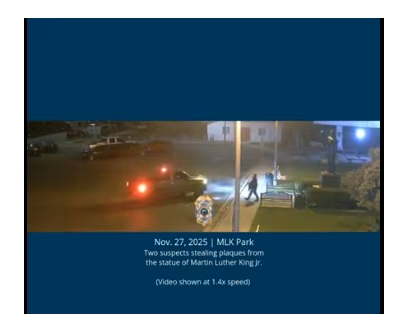
The LBPD Burglary Detail has identified and arrested two suspects responsible for stealing plaques from the statue of Martin Luther King Jr. at MLK Park.

In the early morning hours of Nov. 27, two suspects stole several plaques from the MLK statue. They then placed the plaques in the bed of a truck and left the area.

Detectives and professional staff immediately began to conduct an investigation. They collected security camera footage, canvassed the area, and began reviewing automatic license plate reader data to identify the suspects. Through their follow-up, detectives identified and arrested both suspects.

  • Sean Green, a 44-year-old resident of Long Beach, was arrested on Dec. 9. He has been charged with grand theft.
  • Anthony Martinez, a 34-year-old resident of Downey, was arrested on Dec. 11. He was booked on grand theft, conspiracy, and possession of methamphetamine.

“The theft and vandalism targeting the statue of Martin Luther King Jr. at MLK Park is unacceptable and will not be tolerated,” said Chief of Police Wally Hebeish. “The LBPD will continue to identify and arrest anyone involved in this type of insensitive criminal activity. The MLK statue holds immense sentimental value to our entire community, and I am extremely proud of the efforts of our personnel in bringing a measure of closure to the many individuals impacted by this crime.”

Detectives are continuing their investigation to recover the stolen plaques.

Anyone with information about this incident is urged to contact the burglary detail at 562-570-7351, or anonymously at 1-800-222-8477, www.LACrimeStoppers.org.

Hacegaba Testifies Before Congressional Subcommittee


Port of Long Beach incoming CEO Dr. Noel Hacegaba testified before a congressional subcommittee Dec. 17 to outline key priorities in the reauthorization of the Water Resources Development Act, noting federal investments in seaport infrastructure projects spur economic growth and jobs across the United States.

Hacegaba also highlighted how the Port of Long Beach plays a vital role in goods movement and national security during a WRDA stakeholder hearing held by the House Committee on Transportation and Infrastructure’s water resources and environment subcommittee. The WRDA is a water infrastructure bill that authorizes studies and projects aimed at improving harbors, rivers, flood control and other related policies under the U.S. Army Corps of Engineers.

“The policies in the WRDA have allowed the Port of Long Beach and other seaports across the country to move cargo more efficiently and compete in the global supply chain,” Hacegaba said. “This legislation is essential to our country’s economy and national security.”

During his testimony, Hacegaba also spoke in support of priorities shared by maritime trade associations, including the Coalition for America’s Gateways and Trade Corridors, the American Association of Port Authorities and the California Association of Port Authorities, where he serves as president.

The 2022 WRDA reauthorization permitted preconstruction engineering and design for a Channel Deepening Project at the Port of Long Beach to provide deeper, wider channels and allow the largest liquid bulk cargo and container ships to more easily access the harbor, speeding goods movement and improving the environment. Dredging is projected to start in 2028 on the project, which also deepens the Long Beach Approach Channel from 76 to 80 feet.

“The Port of Long Beach remains committed to supporting a more competitive, future-ready maritime industry,” Hacegaba said. “Ensuring that waterside access and landside capacity grow together is vital to the country’s economic prosperity.”

The Port of Long Beach supports a fair distribution of the harbor maintenance trust fund, which is collected by the federal government from ports based on the value of imports, some domestic cargo and on cruise passengers. Funding helps support dredging projects nationwide, and would help the Port of Long Beach complete critical safety and efficiency improvements.

Although the bulk of the Port’s $3.2 billion capital improvement plan over the next 10 years is designated for rail projects, there are specific needs for the maintenance and repair of existing rock dikes, concrete and steel bulkheads, wharves and other marine structures totaling nearly half a billion dollars. Many of these projects would be eligible for funding from the harbor maintenance trust fund.

Port of Long Beach On Course to Achieve Busiest Year


Goods moved before tariffs started earlier this year helped put the Port of Long Beach on course to have its all-time busiest year, exceeding the record-setting 9.6 million cargo containers moved in 2024.

The Port of Long Beach achieved its second-busiest November, when dockworkers and terminal operators moved 817,561 twenty-foot equivalent units (TEUs) of cargo, down 7.5% from the record set in November 2024. Imports declined 7.5% to 400,505 TEUs and exports decreased 7.5% to 110,122 TEUs. Empty containers moving through the port were down 8.2% to 306,934 TEUs.

“Cargo moved at a steady rate with no congestion or disruptions at the Port of Long Beach as consumers, businesses and supply chain partners endured an extraordinary amount of uncertainty caused by shifting trade policies throughout 2025,” said Port of Long Beach CEO Mario Cordero. “We will continue to move trade smoothly through the end of the year, and look forward to a moderate increase in cargo for 2026.”

The port has moved 9,047,477 TEUs through the first 11 months of 2025, up 2.9% from the same period last year.

Supervisors Appoint Eric Bates as Interim Inspector General

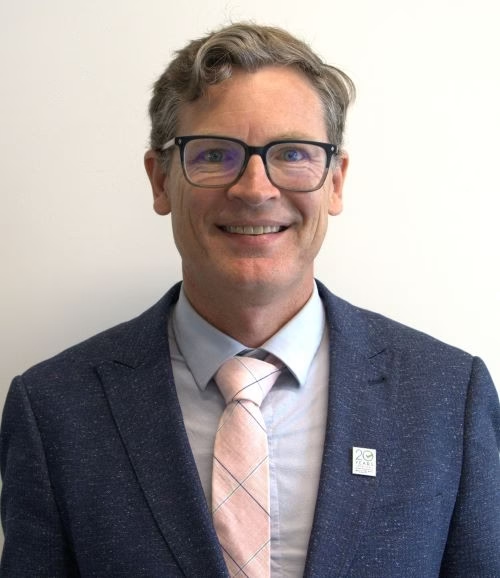
LOS ANGELES — The Los Angeles County Board of Supervisors Dec. 16 appointed Eric D. Bates as the interim inspector general for LA County.

“I am honored by the Board’s confidence and am committed to upholding the Office of Inspector General’s core mission of independent oversight, accountability, and transparency,” said interim inspector general Eric Bates. “My priority will be to preserve the independence and credibility of the oversight function while maintaining continuity in audits, investigations, and compliance monitoring, meeting legally-mandated obligations, and ensuring the Board receives timely, objective information to guide its oversight of the Sheriff’s and Probation Departments. Nothing is more important to me than strengthening the OIG’s work to identify systemic risks and improve public safety and trust.”

A highly experienced litigator with over three decades of oversight and trial experience, Bates most recently served as an assistant inspector general with the LA County office of the inspector general. Prior to his work for the County of Los Angeles, Bates served for five years as a special assistant inspector general with the California office of the inspector general, where he was responsible for oversight of the California Department of Corrections and Rehabilitation. With 15 years of experience as a deputy attorney general with the California Department of Justice, Mr. Bates has extensive experience in leading extensive investigations. Mr. Bates earned a doctorate in Law from Whittier College.

Erickson Named Port’s Program Management Director


The Port of Long Beach has named Mark Erickson to lead the program management division. The program management division, part of the port’s engineering services bureau, oversees improvements to port infrastructure — waterways, wharfs, terminals, railroads, bridges, roadways and utilities.

Erickson most recently served as assistant director of program management, having been appointed to the position in 2024. He joined the port in November 2015 as a senior program manager and earned a promotion to deputy chief harbor engineer in 2019. During his time at the port, he has made significant contributions to the organization’s capital program, including a leadership role on the $1.8 billion Pier B On-Dock Rail Support Facility project.

Prior to joining the Port of Long Beach, Erickson worked as an engineer at the Port of Oakland. There he led numerous projects, including a waterfront improvement at the Oakland Ferry Terminal, construction of the Port Field Support Services Complex, expansion of the Joint Intermodal Terminal and the redevelopment of the Oakland Army Base.

He earned a bachelor’s degree in civil engineering from the University of California, Davis. He is a board-certified civil engineer with the state of California and a member of the American Society of Civil Engineers.

The appointment of Erickson was effective Dec. 1, 2025.