Home Blog Page 88

Piazza Miramare Ribbon Cutting Ceremony


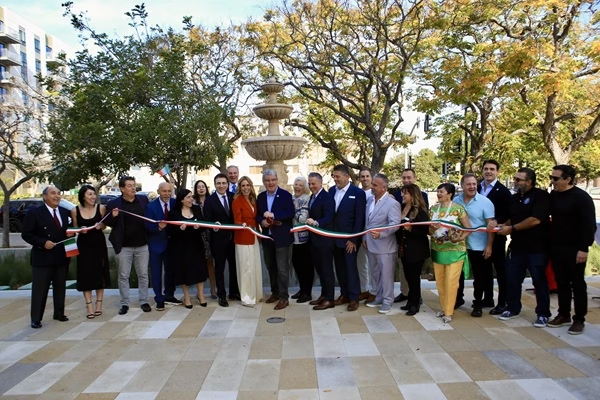
On Jan. 17, Councilmember Tim McOsker joined the Little Italy of Los Angeles Association, Italian Consul General of Los Angeles Rafaella Valentini, and community members for a ribbon-cutting ceremony celebrating the official opening of Piazza Miramare, the first Italian piazza in California. Located a block from the San Pedro waterfront, Piazza Miramare is envisioned as a public gathering space where residents and visitors can enjoy coffee, connect, and spend time outdoors. Photo by Chris Villanueva

Letters to the Editor

DJT…Won’t He Do It?

You published my letter. Minneapolis events recently… Everyone must consider the obvious unlawful homicide and what might have happened in a neighborhood where military grade weapons were used. Could Donald Trump claim children were Liberal Terrorists? Only he would do it.

Michael Rolenz

Harbor City


Remembering Jan 6 2020
We all remember what happened five years ago this week. Donald Trump sent a mob to the Capitol to steal an election.

He had just lost an election, fair and square, and he didn’t like the result. So he decided he was going to try to silence the voices of 81 million people.

It was one of the darkest days in the history of our country, but we made it through.

Now he’s back, five years later, and it’s the same scheme. His Secretary of Defense, Pete Hegseth, is trying to silence me as we speak. He thinks he can make an example out of me, and intimidate others into staying quiet.

But here’s the thing: Americans really like freedom of speech. You sign an oath to defend it when you join the military. Trying to silence people into compliance is just about the most un-American thing you can do. Period.

There is nothing Trump or Hegseth or anybody in that administration can do to shut me up. I am going to keep fighting for our people, our democracy, and our Constitution.

We’re not going to let him win. Not a chance. So, five years on from January 6th, I want you to take this to heart: Do not be afraid. Do not be silent. Speak out.

We’re going to get through this the same way we did back then: together.

Mark Kelly, US Senator AZ


AI isn’t Authentic

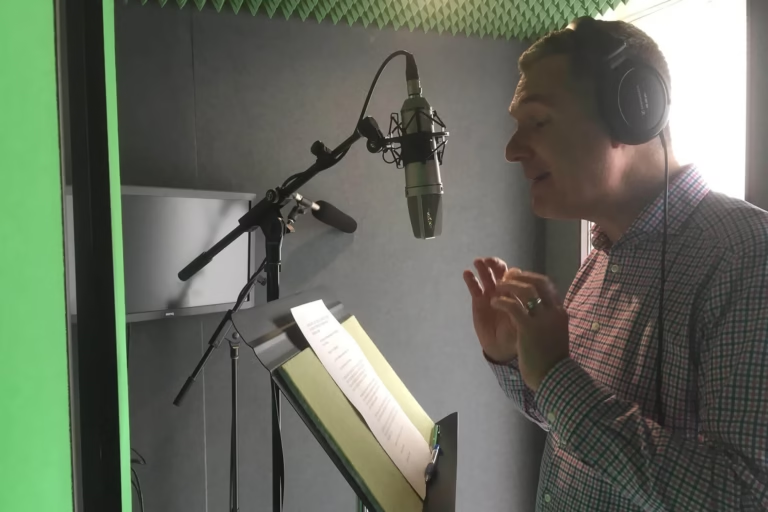
The voice‑over world isn’t just changing — it’s being aggressively rearranged by technology that didn’t even exist a few years ago. Remote work is now the industry’s default setting, which means every actor is expected to moonlight as their own engineer, studio manager, and tech support hotline. And then there’s AI: the uninvited guest who showed up early, cloned everyone’s voice, and started auditioning without asking. Synthetic voices are getting frighteningly good, but here’s the twist — the better they get, the more clients cling to real humans for anything requiring nuance, trust, or, you know… feelings. Authenticity has become a selling point because the alternative is a machine that never gets tired, never asks for usage fees, and never complains about direction. Globalization is accelerating too, turning every project into a multilingual puzzle where cultural fluency matters as much as mic technique. Casting has gone data‑driven, so your voice isn’t just a voice anymore; it’s a statistic in someone’s dashboard. And the market itself is jittery — shaped by economics, politics, and whatever mood corporate messaging is in this quarter. Through all of it, the job has evolved from “sound good and read the copy” to “own your identity, understand the tech, navigate AI ethically, and stay adaptable while the ground shifts under you.” The craft is still the heart of the work, but the business now demands a whole new level of awareness — and a sense of humor doesn’t hurt either.

Ray Buffer

Orange County

Uncertainty aside, State of the Port is nothing but good…according to the Port, at least

A complaint I’ve always had about Long Beach’s State of the City event is that, rather than provide an honest look of where we’re at, the mayor acts as head cheerleader, telling one and all that the city is “strong and getting stronger” (a quote we hear literally every year), with no ownership taken of what’s wrong.

But it turns out that compared to the State of the Port event, the State of the City is almost hard-bitten realism. To hear new Port of Long Beach CEO Noel Hacegaba tell it, the only takeaway from last September’s “once-in-a-lifetime mishap” at the Port was a silver lining, in that the response of all parties involved “showed that we don’t just train to be resilient, we are resilient.”

Is there really nothing but good at the Port, both now and on the horizon? We caught a few things — both substantive and trivial — that makes us wonder.

Is it really all that?
Before Hacegaba even took the stage, the spin machine was in full effect. In his introductory remarks, Mayor Rex Richardson praised the Port’s recent “landmark agreement with the South Coast Air Quality Management District […] that puts a major step forward toward faster, cleaner, zero-emission[s] infrastructure while protecting our local jobs and the workers that power our economy.” Hacegaba himself went on to tout this “cooperative agreement,” saying it “contains time-bound and enforceable commitments to develop zero-emissions infrastructure […].”

But nonprofit, nonpartisan news org CalMatters urged the SCAQMD to vote against “the so-called cooperative agreement” on the grounds that “impacted community members were not meaningfully included” in the process of crafting the agreement, which “weakens the [D]istrict’s ability to reduce emissions and it creates a dangerous precedent.” CalMatters noted that the agreement “includes a five-year ban on rulemaking. That handcuffs South Coast Air Quality Management District, effectively blocking the agency’s authority to address port pollution when the South Coast Air Basin can least afford a delay.”

Don’t quit your day job
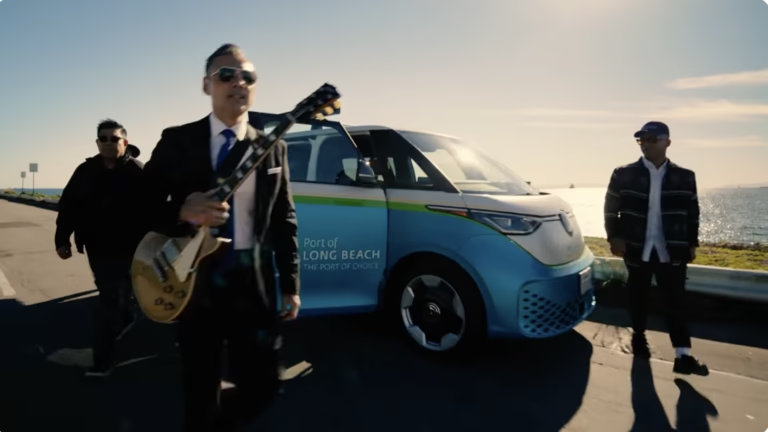
Immediately prior to Hacegaba’s taking the stage, we got a music video featuring of The TCUs — an ad hoc employee band featuring Hacegaba on lead guitar — performing a version of Modern English’s “I Melt with You” so lazily rewritten it made absolutely sense: “Moving forward using all my breath / Making sure the Port is never second-best / I saw the world the world growing all around your face / Never really knowing it was always mesh and lace….”

Busy and getting busier
Hacegaba noted that 2025 was the busiest year in the Port’s 115-year history, moving nearly 9.9 million TEUs (Twenty-foot Equivalent Units, i.e., standard shipping containers), only the third time in the Port’s history they’ve moved over 9 million TEUs. But that’s nothing compared to what’s coming: by 2050, the Port expects to move over 20 million TEUs per year.

To handle this increase, the Port is slated to complete the “largest in-port railyard in the world” by 2032. “The development of modern, sustainable infrastructure is all part of our 10-year, $3.2 billion Capital Improvement Program, the largest of any seaport in North America,” Hacegaba said. “And the centerpiece of this is the $1.8 billion-dollar On-Dock Rail Support Facility at Pier B. We call it America’s Green Gateway. It will double the acreage of the existing rail yard and more than triple the volume of cargo moved by rail from 1.5 to 4.7 million TEUs. […] Speed to market is the key to our success and rail connectivity is the key to our future.”

For all this, Hacegaba harped on the Port’s goal of being “the first zero-emissions port in the world,” setting 2050 as the target date.

But he admitted that much is uncertain, at least in the near-term: “[… W]e continue to keep a close eye on the U.S. Supreme Court’s decision on the International Emergency Economic Powers Act case, which is expected to be announced any day. The Supreme Court’s opinion is poised to rule on the legality of the tariffs, but it will not remove the uncertainty already created by tariffs. The only certainty is…more uncertainty.”

Always check your work, kids
According to one graphic flashed up behind Hacegaba, between 2024 and 2025 soybean exports to Indonesia rose from 19,000 TEUs to 27,000 TEUs, which is “up 6,000 TEUs.” Let’s hope their accounting is better where it counts.

Semantics?
“With your help, we became the first green port,” Hacegaba declared. But despite being recognized as an industry leader, the Port of Long Beach was not even the first green port in California. That honor goes to the Port of Hueneme, which achieved “Green Marine” certification in 2017 — recognition that the Port of Long Beach has yet to receive, while the Ports of Stockton, Oakland, and San Diego have since joined the list. (Two terminal operators at the Port of Long Beach, Metro Ports and SSA Marine, have been certified Green Marine.)

But that’s nothing compared to this bizarre boner: “Last July, the railroad sector made major news with the proposed merger of Union Pacific and Norfolk Southern,” Hacegaba announced. “This would establish the first transcontinental railroad in U.S. history.”

Considering that the first transcontinental railroad line was completed May 10, 1869, we’re not entirely sure what Hacegaba was talking about. But whatever it was, Union Pacific and Norfolk Southern will have to straighten some stuff out before it comes to pass, because the day after the State of the Port, their merger application was rejected.

Words, words, words
In addition to a litany of bumper-sticker slogans (e.g., “We lead with vision and inspire with action”; “Teamwork makes the dream work”; “We’re doing the right things for the right reasons in the right way”), Hacegaba occasionally extended himself into empty metaphors. “Any football fans here today?” he asked. “[…] This is what I told the team: we’re going to reset the goal line, we’re going to expand our playbook, we’re gonna update our gameplan, and we’re moving to a hurry-up offense, because here in Long Beach we play to win — and together we’re going to put a lot of points on the board.”

Whatever you say, coach.

Valentines Random Happenings:


Celebrate & Dance on Valentine’s Day at the Long Beach Symphony Pops

This Valentine’s Day, Long Beach Symphony invites couples, friends, and music lovers to enjoy an exuberant evening of romance and rhythm at Endless Love – A Valentine’s Concert! on Feb. 14, at the Long Beach Arena. It’s the perfect soundtrack for a night out, blending lush symphonic music and a social experience designed for couples and friends alike.

This holiday experience offers a festive night out at an accessible price. The evening features live music and dancing, along with a relaxed, bring-your-own dining experience option. Guests are welcome to bring their own food, beverages, and table décor, or pre-order from a curated list of preferred local restaurants that will deliver straight to their tables. They can even sponsor a song to be dedicated to a special someone (see event webpage for more information).

Under the dynamic baton of Conductor Herb Smith, Grammy-caliber vocalists Chester Gregory and Shayna Steele will lead audiences through a dazzling repertoire of timeless love songs. Dance to beloved classics such as Could It Be I’m Falling in Love, What’s Love Got to Do with It, Stand By Me, At Last, Unforgettable, The Best, and more—performed with full symphonic richness.

Doors open at 6 p.m. Everyone will be embraced by the spirit of the evening. Dancing shoes are highly recommended as the symphony transforms the evening into a lively celebration of love and music.

Presented as part of Long Beach Symphony’s vibrant Pops Series, Endless Love offers a unique blend of a live orchestral performance, immersive social experience, and spirit—perfect for date night or a joyous night out with friends. Special discounts are available for groups of 10 or more, and season subscriptions for three or more concerts start at $66.

Time: 7:30 p.m., Feb. 14

Cost: Tickets start at $39

Details: 562-436-3203 ext. 1; LongBeachSymphony.org

Venue: Long Beach Arena, 300 E Ocean Blvd, Long Beach


Benise Ignites

Make this Valentine’s Day a sizzler to remember.

Armed with his Spanish guitar and a stage full of musicians and elaborately choreographed dancers, Emmy winner Benise brings 25 Years of Passion to the Cerritos Center for the Performing Arts this Valentines Day, Feb. 14. The romantic showcase of Spanish Flamenco, Cuban Salsa, Brazilian Samba, Parisian Waltz, and exotic drumming will enchant you and your companion.

“The Prince of Spanish Guitar” is celebrated for his virtuoso Flamenco Nouveau style,Since age 11, Roni Benise taught himself to play the guitar and mastered a variety of different styles that eventually meshed to become his own unique technique. When he was rejected by all the Los Angeles clubs, Benise started busking on the streets, quickly winning the admiration of native Angelenos and tourists from around the world who called him the “Pied Piper” of the Spanish guitar.

Benise composed original works that were embraced widely for their edgy, exotic, and sensual personality. From the street shows, his crowd-pleasing performances took on a life of their own, showcasing a colorful assembly of dancers, cirque performers, percussionists, and African tribal drummers. Benise added stage theatrics and eye-catching lighting to complement the music and mood, dazzling audiences whose word-of-mouth quickly led to sold-out concerts worldwide and the Emmy-winning PBS special Nights of Fire!

Make the evening even more sensational with exclusive VIP packages offering special perks.

Time: at 7:30 p.m.

Cost: $48 and up

Details: cerritoscenter.com.

Venue: Cerritos Center for the Performing Arts, 18000 Park Plaza Drive, Cerritos

VIVA VERDI!— Where the Music Never Retires


Inside Casa Verdi and the Artists Living Their Encore

Los Angeles does not have a single, famous “musician-only” retirement home like Italy’s Casa Verdi, but the region offers several senior living communities catering to artists and creatives, including the NOHO Senior Arts Colony, Burbank Senior Artists Colony, and the Motion Picture & Television Fund (MPTF) in Woodland Hills. These facilities provide artistic environments, performance spaces, and musician-focused activities, alongside general senior residences with strong arts programs like Hollenbeck Palms.

Locally, San Pedro’s Pacific Arts Colony, while not specifically for retiree’s, that was part of its original intent. Pac Arts currently offers apartments for artists and others – including six live/work spaces.

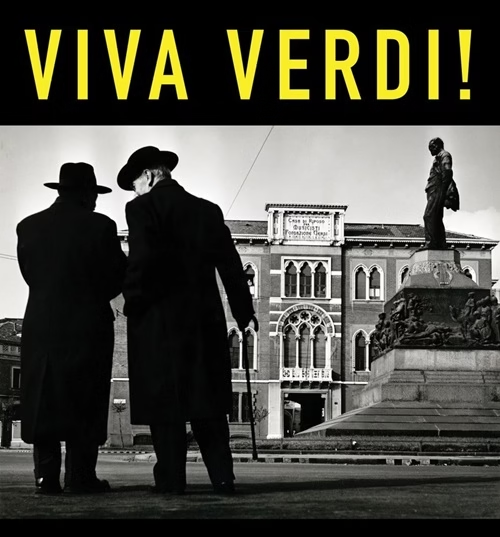
If this retirement situation sounds enticing, you will love the Oscar-contending VIVA VERDI!, directed by Yvonne Russo and produced by Christine La Monte, p.g.a., and Ron Simons. The documentary provides an in-depth view into the daily lives of the celebrated opera singers and musicians living out their encore while mentoring international music students who live among them at Casa Verdi. Built by the composer Giuseppe Verdi, Casa Verdi has welcomed more than 1,500 retirees since it opened in 1896.

As award season approaches, the VIVA VERDI! film score, Sweet Dreams of Joy, written and composed by Nicholas Pike and performed by soprano Ana María Martinez, has been shortlisted for the Oscars’ Best Original Song.

Viva Verdi
Viva Verdi film poster

From the artists who reside in Casa Verdi, aged 77 to 107, comprised of international opera singers, ballet dancers, musicians, conductors and composers, the film shares their fascinating personal and professional stories filled with history, music and passion.

Giuseppe Verdi, Italy’s most celebrated composer― of La Traviata, Aïda, Falstaff, Rigoletto― willed his fortune to build a retirement home for musicians and artists in Milan, Italy. Entering the elegant neo-Gothic mansion, even through film, feels like walking into a living masterpiece, where the sound of music — pianos, violin, opera and concerti — envelops the visitor.

The documentary, filmed between 2013 and 2023, shows how age has not dulled the residents’ love for music and their compulsion to create. Through one-on-one interviews, you will hear stories of romance, regret, and remembrances. Verdi’s ‘guests’ are still creating, performing and mentoring students – future stars of opera, ballet and music.

Among my works, the one I like best is the home that I have had built in Milan for accommodating old singers not favored by fortune, or who, when they were young, did not possess the virtue of saving. The poor, dear companions of my lifetime! Believe me, my friend, that home is truly my most beautiful work.” – Giuseppe Verdi

Screenshot 431
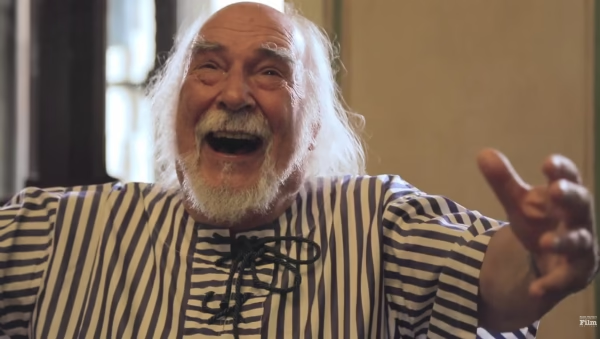
Still photos from the film Viva Verde!

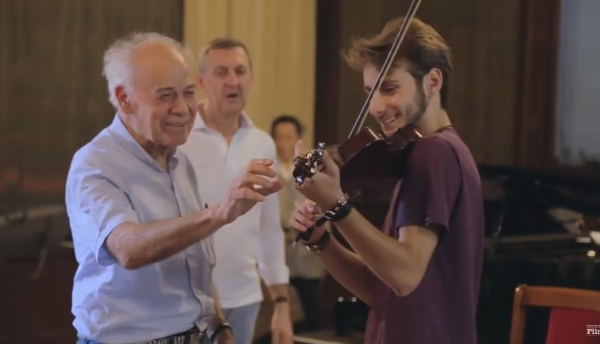
Casa Verde residents have daily music classes, which provide a time to revisit their former days of work and zeal. One of the first musicians we see is Tina Aliprandi, a 91-year-old dexterous violinist who said she never thought she would play again. But she keeps performing.

“At this age, music is still helpful and it helps me to live,” said Aliprandi, who plays an hour a day.

Chitose Matsumoto, a soprano from Tokyo who learned La Traviata at 20 years old, fell in love with opera. She decided to move to Italy, but eventually the musicians’ union protested the Japanese opera singer, saying the operatic performers should be Italian. Matsumoto had to instead become a freelancer, but the former opera singer was still able to become a resident at Casa Verdi.

Sixteen international students also live at Casa Verdi, where they work with and are coached by the senior residents. Each generation builds bonds and learns from one another.

Many concerts take place at Casa Verdi, which have also been covered in the local paper. The residents are active and joyful, often breaking out into song with voices that have maintained their magnificence. These musicians and singers have also kept their passion and are living out a vibrant encore in a retirement home, sharing and still learning along with their peers.

Not a bad gig.

Screenshot 430
Still photos from the film Viva Verde!

While Los Angeles does not have this exact model for its elderly musicians, it comes close. The Harbor Area is also fortunate to have the Long Beach Blues Society, which serves seniors, youth, veterans, and other underserved communities by providing learning opportunities, concerts, and interactive programs across Southern California.

Random Lengths spoke with Rich West and Bob “Music Writer Dude” Barr of the LBBS. West performs in the organization’s primary band, while Barr, president emeritus of LBBS, oversees festival operations and is a long-time contributing writer for Random Lengths.

West participates in most of LBBS’s programs in Long Beach, including events at César E. Chávez Park, Houghton Park, Park Pacific Towers on Pine Avenue, the VA Hospital, and for American Gold Star Manor families. The band has also performed in nearby cities, including Anaheim, Bellflower, Lakewood, and Carson.

LBBS has also put on performances for Long Beach Gives and the City of Long Beach. West noted they need sponsorship for these events, or sometimes, they can work within the organization’s budget to expand its services. All of the events are carried out through the time and talents of award-winning Blues artists, writers, broadcasters, and educators.

Barr noted that when LBBS performs at the senior centers, the residents, who love to dance, are right in line with the musicians on the music they enjoy listening to. And the talent behind the shows is great; Dig Lewis – bass, Lester Lands of the South Central LA Blues scene – guitarist, Albert Trepagnier Jr.- drummer, and William (Bill) Grisolia – pianist and founder of LBBS.

Los Angeles and its Harbor area have room to expand to bring this type of residence, and many seniors who would benefit from these programs. The Los Angeles-Long Beach-Anaheim metro area consistently ranks among the top in the nation for the employment of musicians and singers. If we’re very fortunate and smart, someday Los Angeles will see several retirement homes for its many musicians to live out their encore with dignity, passion and purpose.

Director Yvonne Russo summed this idea up well.

“Our goal is to provide a glimpse into the vital lives of these legendary artists, who are a testament to the importance of being creative at any stage of life.”

Details: https://vivaverdithefilm.com and www.longbeachbluessociety.org


ALERT: Port of LA Opens New On-/Off-Ramps, Updates SR-47 Traffic Pattern in San Pedro


The Port of Los Angeles Jan. 12 opened the new northbound (NB) on-ramp to I-110 and new southbound (SB) off-ramp from SR 47 at Front Street/Harbor Blvd. as it enters a new phase of construction near the Vincent Thomas Bridge in San Pedro as part of the SR 47 Interchange Project. Along with the new ramps, the Port debuted a newly realigned Knoll Drive to access Knoll Hill.

Starting Friday, Jan. 23 through Aug. 31, crews will close both the NB SR 47 on-ramp and NB SR 47 off-ramp at Harbor Blvd. (aka Harbor Blvd off ramp from SB I-110).

As construction continues, the following detours are in place:

  • DETOUR A: SB I-110 to Harbor Blvd.

Exit at Channel Street/Pacific Avenue and continue to Front Street/Harbor Blvd.

(See orange route on map.)

  • DETOUR B: Pacific Ave. to NB SR 47

Take Pacific Avenue to Channel Street to SB I‑110 to NB SR 47

(See green route on map.)

  • DETOUR C: Harbor Blvd. to NB SR 47

Take Front Street/Harbor Blvd. to 1st Street to Gaffey Blvd. to NB SR 47

(See purple route on map.)

Truckers should follow posted traffic signs and detours accordingly.

Those with questions may leave a message on the public phone line at 310-732-7778. Calls will be returned within 24 hours.

The SR 47 Interchange Project is replacing the existing southbound SR 47 off-ramp from the Vincent Thomas Bridge with a new off-ramp on the north side. Additional improvements include realigning the existing on-ramp to the northbound I-110 connector; modifying the northbound SR 47 off-ramp onto Harbor Blvd.; modifying the northbound SR 47 on-ramp onto the bridge toward Terminal Island; and improving local streets near the interchange. The project is expected to be completed in December 2026.

For updated project information, visit portofla.org/sr47.

U.S., the Immigrant and the Stranger

I Left My Country, but the Borders Never Left Me

By Sophie Schoenfeld, Guest Columnist

It’s 2025. I’m checking out at Smart & Final in San Pedro. My teller is a Latin trans guy with face piercings and colorful makeup galore. He is awkward, unsure of himself. He looks me up and down. Yes, I’m a privileged white lady, “normal” as can be. That’s what he sees. What endless borders exist between us? What wordless spaces separate them and me?

At 15, I arrived at London Heathrow Airport to finally reunite with my mother, wearing an oversized sheepskin coat that belonged to my 6-foot-tall stepfather, boots two sizes too big that were my stepmother’s, and carrying a passport of a country that no longer existed. It said, in proud gold letters against crimson red, USSR. The customs officer looked at it suspiciously. By 1993, this passport had become the pariah of passports. The Soviet Union had collapsed, and with it all its glory. Handing it over felt like handing a dirty rag to someone with clean hands.

I learned history the way you learn a language in exile — out of sequence, mistranslated, and always slightly wrong.

The Swedes and Germans in line looked calm and at ease. Not how it would have been in customs lines in the ’40s, I imagine. Nevertheless, here I was — an alien not in New York. I didn’t speak English. I had no cultural reference to this new world I had been transplanted into. Grateful, though. I was grateful. The majority of my male friends had been killed one way or another during the unrest in Georgia. The heroin epidemic swept through my father’s generation. Parts of the Black Sea were lost in a fumbled civil war. Refugees flooded the city, many having walked hundreds of miles in snow and freezing weather, dying along the way. Violence hung in the air like stale musk.

“Georgia?” Hahahaha! “That’s not a country!” was a frequent reaction when Brits asked where I was from.

There were no Georgian books I could buy. Not even an English–Georgian dictionary to use for translating my essays on Macbeth. I wrote my English assignments in Russian because, under the Soviet Union, Georgia was a bilingual country. Maybe I was Russian after all. Maybe Georgia was only an idea that existed in our minds.

But then again, I am a little Russian. My grandmother was. I never knew her, but her mother was Polish. They immigrated from Poland to Russia after the Soviet Revolution, before parts of Russia were part of Poland, and before Poland became part of Russia after the war.

At some point, Poland was Russia, or Russia was Poland, or perhaps it only mattered who had the guns that year.

My great-grandmother, her two daughters, her sister and her mother escaped the Leningrad siege in 1941 — before Leningrad became St. Petersburg again, after Petrograd, after the land once called Swedish Ingria. Who am I? No one really knows where Georgians came from. Supposedly, we were Iberians — related to the Basques in Spain — mixed with the Portuguese colonizers. Or maybe that’s just another story people tell themselves when records collapse.

Georgia was ruled by Persia, then absorbed into the Byzantine Empire. The Mongols burned and slaughtered us for centuries. Then came the Ottomans, then the Russians. Before all that, ancient Georgians traded gold with Egypt and Greece. In short, thousands of years of rape, pillage, and border politics. Who are we? Where do we belong? How many cities, borders, and lines were crisscrossed on maps before we came to name ourselves? How many Georgian women were kidnapped to grace the harems of various shahs? Whose blood runs through the ancestry of my Smart & Final teller’s lineage? Perhaps there’s some Iberian in them, too. Maybe we’re distant cousins after all.

London in the ’90s was vibrant, jubilant, brilliant and exciting. Neon signs glistened in perpetual drizzle. Red double-deckers whizzed through the narrow streets of southwest London, where my great-aunt had lived since 1945. She immigrated to the UK after the war, having married a British MI6 officer. My great-grandmother never forgave her. She left, and the family was blacklisted. Their brother was arrested and executed. That was the price the family paid for her escape to the west.

Still, my mother and I were grateful for her legacy. Otherwise, we would have been sitting under candlelight, counting gunshots in Tbilisi. My father had fled to Russia by the time we moved to London ― a strange blessing. He had been blacklisted in Georgia for his involvement in opposition movements and anti-government activism. That was why we were granted political asylum in the UK. Georgia, which endured coups, wars and total collapse in just four years, receded into the rearview mirror of my life.

I was grateful. Privileged to get out.

My beautiful Tbilisi ― cobblestoned boulevards, chestnut trees–lined streets, and ancient Turkish baths in a golden haze. Gypsy women sweeping the early morning streets in colorful skirts. Old ladies selling violets and sunflower seeds. Lilacs perfuming old courtyards behind wrought-iron gates. This ancient, magical home had turned into a rat-infested ruin full of angry people living inside the collapsed carcass of an empire. It was terrifying. And worse than that, it was sad.

When you are privileged enough to leave your broken home, to leave every familiar face, to leave not knowing if you’ll ever taste your grandmother’s sweetbreads again or lie under grape vines counting fireflies, you’re not allowed to grieve. You amputate and move on. You swallow down nostalgia like bitter medicine and focus on how lucky you are not to belong. How wonderful it is that no one understands your language, that you get to keep a secret world locked inside yourself.

But those you meet are strangers, too. They are not your family. Still, you cling to threads of belonging. At least we have the language ― this strange, unnecessary language, like a code to a tomb that no one cares to open.

As an immigrant, your identity becomes tangled with documents. You apply for status. You wait. And wait. You cannot travel. Your grandfather is dying. He wore a fedora. When it rained, and he tilted his head, water dripped from the brim, and you laughed. He brought you meringues every night after work and made you dance for them when you were little. He is dying, but you can’t go — because you have no papers. You are not allowed to cross these borders. Your pain does not exist. Only your documents do.

Every border crossing fills you with fear. They don’t like our passports. We are from shitty countries. They pull you aside. Question you. They take you to a separate room. You are ashamed, scared… anxious. This continues until you are naturalized. Until then, you belong nowhere. Your own country’s customs officer resents you — you got out, you got lucky. You return to Heathrow, and no one says welcome home.

Being an immigrant entails amputations. With time, limbs regrow, but they are never the same. There is a silent vastness inside you that is not allowed to exist publicly. You become an intricately folded origami. On the outside, you are integrated, assimilated. No one knows how many times you folded yourself to keep the form intact. Maybe even you no longer know who you really are because there is a part of you that gets lost in translation. You are a history without borders, a city with multiple names… a human lost in the papers, and yet wherever you go, you encounter some new part of you that you did not know existed.

“Arriving at each new city, the traveler finds a past of his that he did not know he had.” ― Italo Calvino, Invisible Cities

Thirty-three years have passed since I defected to the UK. In some surreal dream that is my life, I ended up living the majority of it in Los Angeles, San Pedro to be exact. Locals call it “Peeedro,” and by locals, I don’t mean Tongva, or Chumash, or Spanish/Mexicans for that matter, by locals, I mean mostly Croatians, Italians and Sicilians that settled here in the early 1900s, drawn by the fishing and cannery industry at the port of Los Angeles.

According to the “locals,” however, no one is allowed to claim ownership of “Peedro” besides being born here, and they know you don’t belong if you say Cabrillo Beach with silent Ls. I find this funny, audacious, and colonial, all at once. Living 20 years of my life in one community in LA that is filled with European immigrants who will never accept me as their own is an interesting juxtaposition in the narrative of my identity. Perhaps displacement ― not belonging ― is what connects us most deeply to one another, and that brings me to the difference in being an American immigrant versus a British one.

When Lives Don’t Count

Trump EPA Scraps Health Benefits to Spare Business Costs

Ever since the Ronald Reagan administration, the Environmental Protection Agency has weighed the costs of environmental regulations to polluters against their benefits to public health. The benefits have routinely outweighed the costs, not by 2-1 or 3-1 but by double digits. But now, without fanfare — without a public process, as required by law — the Trump EPA has simply decided to stop counting them, setting them to zero and thus letting polluters off the hook.

“Ignoring potential health benefits” [this way is] “looking at the issue with industry-provided blinders,” said Ed Avol, USC emeritus professor of environmental health. “The driving purpose for these standards under the Clean Air Act is the protection of human health for current and future generations. If health considerations (such as these health benefits calculations) are removed from consideration, the resulting calculations will by definition be less health-protective and biased towards increased and undue exposure.” he said. “This announced approach is simply not based on sound science or best-practices regarding public health protection.”

The magnitude of what’s being ignored is staggering. For example, in a study covering all Clean Air Act regulations 1970 to 1990, EPA reported benefits ranging from $5.6 to $49.4 trillion, in 1990 dollars, with a mean, or central tendency estimate, of $22.2 trillion versus a cost of $523 billion — a ratio of $42 in benefits for every dollar in costs.

But now, based on the false claim that “the EPA historically provided point estimates [of health benefits] instead of just ranges” and that this misleads the public, Trump’s EPA is arbitrarily setting those estimates to zero. It flatly stated that “the EPA is no longer monetizing the benefits from PM2.5 and ozone” in a final rule issued Jan. 12, weakening emission regulations from combustion turbines at gas-burning power plants.

That same day, the New York Times reported that the changes had been underway for a while, based on “internal agency emails and documents” it had reviewed. But none of this was done in public, as required by federal law under the Administrative Procedures Act (APA). And with its mental gymnastics, Trump’s EPA was actually trying to deceive the public in the same way it falsely accused the EPA of doing previously. The lawlessness and dishonesty were strikingly similar to how RFK Jr. and his appointees have gone about attacking public health — particularly vaccines.

The Times’ account didn’t dig deeper into the underlying lawlessness, which was obvious to Random Lengths from past cases we’ve covered. Seth Johnson, a senior attorney at Earthjustice, confirmed our understanding.

“Basic administrative law generally requires EPA to go through a notice-and-comment process when it issues a final rule,” Johnson said. “That means the public must generally be given the opportunity to comment on important aspects of a proposal. EPA didn’t provide any hint in its proposal or its notice reopening the comment period that it was thinking about stopping monetizing public health benefits. That deprived the public of an opportunity to comment on this big change.”

But legal reality and public theater are light-years apart.

On X, Trump’s EPA chief, Lee Zeldin, falsely claimed “the EXACT OPPOSITE” of the Times’ headline was “the actual truth.” But on Bluesky, Natural Resources Defense Council senior attorney John Walke responded to Zeldin’s “dishonesty & theatrical indignation” with a detailed documented response. Random Lengths spoke with Walke to shed further light on what was going on.

First, we asked, wasn’t uncertainty built into EPA’s methodology?

“Yes of course, and that’s what the ranges are for,” Walke said. “EPA acknowledges that uncertainty, it’s standard economic practice and scientific practice to do so. This is a straw man to carry out a conclusory political outcome, in my opinion.”

And wasn’t Trump’s EPA doing exactly what it accused past EPAs of doing — misleading the public with false certainty?

“That’s exactly right,” Walke responded. “When the agency declares that either costs or benefits are going to be treated qualitatively rather than quantitatively, they assign a zero dollar value to those items.

“So from now on, in cost-benefit analysis, you will see two things: On the benefit side of the equation, you will see zero dollar benefits assigned to the whole array of health benefits associated with reductions in smog and soot — ranging from days missed from school or work, ER visits, bronchitis, asthma attacks, premature death avoidance, things that have been part of the cost benefit calculation for four decades. And then on the cost side, you will see uncertain and self-serving industry compliance costs assigned very specific dollar values.

“So they are accepting uncertainty when compliance costs are at issue. So the issue is really not certainty or uncertainty. The issue is a conclusory political outcome, because that’s what they want to achieve.”

If this had been a good-faith process, it would have unfolded quite differently. To do things properly, “One would not do what they did here,” Walke said: reveal the decision “for the very first time in a final rule making, in an obscure regulatory document called an economic impact analysis, where no notice was given to the public at the proposed rulemaking stage, or the stage where an economic analysis was prepared for the proposal for this action.”

On top of that, “You would not see two or three conclusory paragraphs where the word ‘uncertainty’ is thrown around with literally six or seven different concepts, so one cannot even figure out what the driver is supposed to be here.

“They talk about the uncertainty of assigning dollar values. They talk about the uncertainty of harm at low levels. They talk about the uncertainty of the linear relationship between harm and exposure. It’s like they threw the word ‘uncertainty’ at a wall, and tried to associate as many concepts as they could.”

If done properly, “What you would see, is them announcing this, for the first time, in a proposed rulemaking or an advance notice of proposed rulemaking, where they lay out the full case for why they believe these things are uncertain, where they address past studies and rulemaking this and reports for the public explaining why these things were previously considered certain, and worthy of monetization for four plus decades.”

After that, “You would invite input from the public, you would take that input, you would respond to those comments in a public way, the way that administrative law requires one to act.” Then, “You would issue a final rule responding to all those comments, laying out all the explanations, addressing all the counterpoints, all the agencies’ own prior statements and studies, and then there would be an opportunity for judicial challenge to that.”

Obviously, none of that occurred. Which makes it a clear violation of the APA.

“There’s a very famous Supreme Court decision called the State Farm decision,” Walke said, “where the court decades ago laid out the framework for reasoned decision-making by an agency: evidence that the agency has fully considered the problem, that the agency has considered counter evidence, that the agency has identified what the controlling factors are, and that they’ve addressed those controlling factors. None of that was deployed here.”

The lawlessness on display here is hardly unique. “Just as a citizen, I’m struck by the remarkable parallels and echoes with actions that they are taking across the federal government, with immigration and law enforcement, and invasions of other countries,” Walke said. “They are acting in completely ahistorical, unconventional, illegal ways at odds with all past practice, even under their first administration.”

And as an environmental lawyer, he’s seen other examples of unprecedented conduct in his field. As an example, he cited a case where the Trump EPA and Justice Department asked a federal court to “just void the standards” for soot (PM2.5) pollution, “not by reaching the merits of the case that had been fully briefed when EPA was on the other side,” but just ignoring it. “I’ve been a clean air attorney for over 30 years. I’ve never seen anything like this in my life,” he said.

More broadly, Walke said, “We’re just seeing levels of unprecedented recklessness and I think in this case they were itching to eradicate benefits because there have been not just tens of billions, but trillions of dollars in benefits that outweighed compliance costs to industry. And they realize that all of these [regulatory] rollbacks [being planned] were going to generate dis-benefits” that would generate public alarm and opposition. “They didn’t want the public to know how much harm this was causing, so they zeroed out those harms so that the dollars would never be revealed.”

The particular comparison with RFK Jr.’s attack on public health is “spot on,” Walke said. “In both instances, it brings to mind the adage that power corrupts, absolute power corrupts absolutely.” In both cases, “There are no norms or accepted scientific consensus that they are not prepared to ignore and overturn in order to carry out what by all appearances is a frenzied agenda by a one-term administration that has Stephen Milleresque chaos at its heart. … You see this parallel across all agencies and departments and issues. It is even by comparison to the first Trump administration starkly more extreme than what we saw in that administration.”

“Ozone and PM standards, levels, and emissions in the Harbor Bay area have been an ongoing challenge for decades,” Avol said. “If this approach is adopted, it will affect local considerations. California historically has been allowed to set its own state standards, but the Trump administration has been at odds with California over so much of its environmental approach that any comfort that CARB’s independence will not be challenged in this arena as well may be short-lived.”


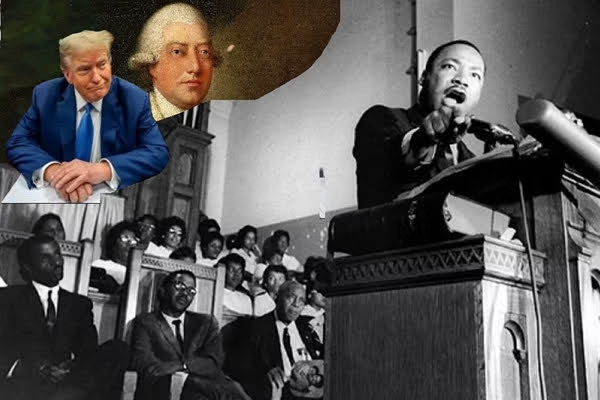
From King George to Donald Trump


When History’s Warnings Go Unheeded

On the anniversary of Martin Luther King Jr.’s birthday, I was struck by the airing of his 1967 speech, “Beyond Vietnam,” on radio station KPFK (90.7FM). Delivered at the Riverside Church one year before his assassination in 1968, the speech brought back a flood of memories from this critical period in the Civil Rights Movement — the anti-Vietnam War protests, the violent uprising that both preceded and followed his murder, and eventually ended the presidency of Richard Nixon. https://tinyurl.com/Beyond-Vietnam.

Not only were his words relevant then as an indictment of America’s military neo-colonial empire, but suddenly it resonates today with the killing of Americans protesting ICE raids, the mass arrests of people with no warrants, the invasion of Venezuela, and the threat of war over Greenland. It is like all of the progress that the people have fought for and won has been dialed back to the Red Scare days of the McCarthy era and the Cold War.

Now I realize that not everyone who came of age after this time will feel the resonance of this current moment in our history. But the resemblance is perfectly clear, repression at home, denial of civil rights and a focus on the military use of force for financial gain not for any noble mission. Veterans of the Iraq War may remember fighting a war for no apparent reason and coming home disillusioned. That is how most Vietnam War vets felt too, “What were we fighting for?” Many returned wounded and disillusioned.

In the eyes of many, the heroes of that era were those who resisted the draft, were beaten by Bull Conner and were jailed for speaking truth to power. Yet, America was deeply divided then. In that context, as now, people must decide between our conscience and our convenience.

King argued that America’s soul is poisoned by war, racism, and poverty, urging an immediate end to bombing, unilateral ceasefire, and talks including the National Liberation Front, framing the struggle as a moral imperative against militarism and injustice. Today it’s Gaza, Minneapolis, Los Angeles and Venezuela. The militarism has come home to oppress the very people who pledge allegiance to a symbol that represents oppression abroad but supposedly promises us “freedom and liberty for all” at home— except it doesn’t. I stopped saying the Pledge of Allegiance back in 1967.

For those who need a lesson on true American patriotism I urge you to watch Ken Burn’s documentary on The American Revolution. Again, that history resonates to now.

In the years before the war British Gen. Howe ordered some 1,000 red coats into the city of Boston to quell an uprising of resistance over the Royal taxes that were levied upon the American colonies. When the troops arrived, a protest erupted and seven American English subjects were murdered in the streets of Boston. The soon to be American patriots stormed the tax collectors house, burned it to the ground and tar and feathered the British tax collector, before they dumped the tea in the harbor.

This is where the cry “No taxation without representation” comes from. The British Parliament eventually rescinded the tax but the die had been cast for the Revolution based upon these and other grievances.

The Declaration of Independence lists numerous grievances against King George III, primarily focused on tyranny, lack of representation, and obstruction of justice, including imposing taxes without consent, forcing colonists to quarter troops, cutting off trade, denying trial by jury, obstructing laws, dissolving legislatures, and maintaining standing armies in peacetime, all aimed at establishing absolute control over the colonies.

Now if some of this doesn’t sound like what the twice impeached Orange Felon is doing to the American people right now then you have your head in the sand. Trump is a tyrant of the most despicable kind, petty, grievance driven, vexatious, greedy and without any moral compass or compassion. He has become a national embarrassment and continues on a daily basis to express some of the most asinine pronouncements, proclamations and pardons. It is a tragedy that he wasn’t convicted and imprisoned before the 2024 election. And he thinks he deserves a Nobel Peace Prize?

The American people will long remember the words of King and will continue to honor him even after these many years from his death. The vast majority of people hardly recall what the tyrant Trump was espousing last week — and still his Republican Congress remains afraid to tell the mad king he has no clothes. His naked aggression against everyone is what will in the end defeat him.

And when he is buried and gone, you are all invited to piss on his grave.

Until then, if you truly believe that you are patriotic, now is the time to resist this tyranny.

Whales of Hope: From Near Extinction to Climate Guardians


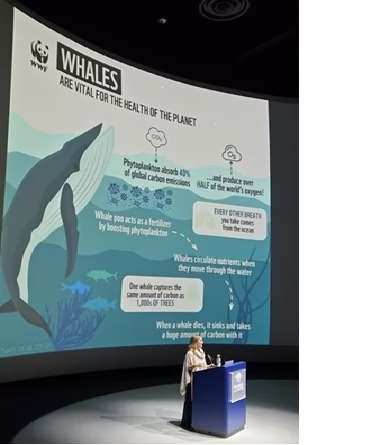
A packed audience at the Long Beach Aquarium of the Pacific heard a special presentation Jan. 7, titled Whales of Hope: From Near Extinction to Climate Guardians, focusing on their impacts on our marine environment and their impacts in our harbor.

The presentation by Holly S. Lohuis, a biologist and co-director of the Santa Barbara Channel Whale Heritage area, is part of a monthly series of lectures sponsored by the aquarium.

Untitled Aq
Biologist
Holly S. Lohuis. Photo courtesy of Mark Friedman

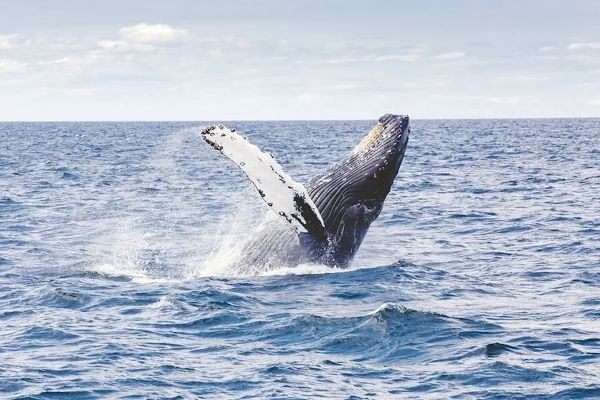
With video clips of whale species from around the world, she noted that nearly one-third of the world’s whale species live in the ocean off Southern California. She described the region as a vibrant marine ecosystem shaped by coastal upwelling, which brings nutrients to the surface and supports life ranging from plankton to sea lions and other cetaceans. The ecosystem includes krill consumed by some of the largest whale species, as well as a wide assortment of animals that are integral to the marine food web.

Lohuis focused on the Channel Islands, where she has been involved in extensive conservation and restoration of the terrestrial environment. Combined with protected marine life within a sanctuary, these efforts are transforming tourism. The region is notable for having the world’s highest density of dolphins, as well as the migration of killer whales, also known as orcas, which are the subject of special research projects. Scientists are also tracking approximately 30,000 humpback whales.

“We have seen lately, however, skinny gray whales and the planet’s population of 27,000 has plummeted to only 12,000 in just five years due primarily to climate. The lack of krill that can propagate under ice sheets in the Arctic has diminished due to global climate change.”

She noted a positive development in the voluntary change of ship routes approaching the Long Beach and LA Harbor, which, through speed reduction, reduced the number of ship strikes that result in injured and dead whales.

She also pointed to the devastating impact of ghost fishing nets; nets that are abandoned or break free and are not collected by fishing vessels, which drift in the ocean and entangle numerous species, from whales to dolphins and sea turtles. She showed a video of successful efforts to freea whale off our coast.

The aquarium’s First Wednesdays focuses on animals, nature and conservation efforts. These events bring scientists, authors and other experts to the aquarium’s theater for talks paired with book signings, cocktails/social hour with music and crafts. They are suited for high school and college students, young professionals and adults. The lectures are also live-streamed.

The next lecture is Feb. 4 on “Climate change and weather events.” Lectures are held at Long Beach Aquarium,100 Aquarium Way, Long Beach. For information 562-590-3100 or visit https://www.aquariumofpacific.org.