

Home Blog Page 68

Us, the Immigrant and the Stranger — Part II

From Britain to America — The Disappearing Edge of Difference

By Sophia Schoenfeld, Columnist

My first migration — from the Soviet Union to the United Kingdom — was loud. It was
obvious. It came with paperwork, accents, questions and a clear social marker:
immigrant.

When my mother and I arrived in Britain, we were unmistakably foreign. Our history
clung to us. Our names required explanation. Our vowels gave us away before we
finished a sentence. And strangely, that clarity created something relational.

In the UK, being an immigrant was a defined position. People knew what you were.
They were often curious. They asked questions about where you came from, what life
was like there, what you ate and how you celebrated. British culture, particularly toward
young newcomers, often carried a pedagogical warmth. There was a sense of, “Let us
show you how things work here.”

You stood across from the culture. It stood across from you. Two separate identities in
dialogue.

And in that dyadic space, something important happened: You got to keep yourself.
You were different, yes — but the difference was acknowledged. There was a kind of
cellophane wrapped around your identity. It remained intact, visible, preserved.

This dynamic was not entirely new in my family. My great-grandmother had immigrated
from Russia to Georgia during wartime. She was welcomed and integrated socially, yet she
never fully assimilated. She never learned Georgian; Russian and Polish remained the
languages of her inner world. She was both included and separate. She belonged, but
always slightly from the outside.

There is a particular immigrant experience in which identity is suspended like that —
protected, yet frozen. You carry your country with you, but the version you carry
eventually becomes outdated. You are no longer fully of the place you left, because
history has moved on without you. Yet you are not fully of the place you inhabit, either.
You become a time capsule.

In Britain, I felt that capsule. My identity was intact, even if it was peripheral.
America was different.

When I moved to the United States, I was not fleeing instability or seeking asylum. I
immigrated for love. I was stepping into a life, not escaping one. America felt to me like
a quest for my own personal El Dorado. This wasn’t an amputation; it was an odyssey
of self-discovery. I was moving between two English-speaking countries. Conceptually, it
felt less like crossing civilizations and more like changing cities. Coming to America was
more about individuation; with it, I carried the dream of becoming.

There were no dramatic visa barriers rooted in geopolitics. I was not arriving from a
collapsed empire or a war zone this time. I was coming from an allied, established
Western country — one that had, historically, exported much of the cultural DNA that
shaped America in the first place.

On paper, this was the softest migration. Yet it became much more instrumental in my
identity formation than the original move, which appeared far more dramatic.

The United States operates on a different model of immigration than Europe. In Britain,
immigrant identity is visible and socially recognized. In America, immigration is
foundational. The culture itself is built upon waves of arrivals. There is no clean division
between “immigrant” and “native.” Instead, the classification shifts to generations.
Are you first-generation? Second? Were you born here? Where were your parents
born?

The focus moves from difference to lineage.

And in that shift, something subtle happens: the immigrant edge softens — sometimes
to the point of disappearance.

In America, you are not always held as foreign in the same relational way. You are
absorbed. Your accent is either faint enough to blend or exotic enough to be charming,
but rarely structured, because everyone has an “accent”; it becomes simply your style,
like clothing you might choose to wear. The expectation is not that you will remain a
defined outsider, but that you will integrate into a broader national narrative and you
will become part of the cultural quilt. [It’s far easier for white immigrants than those of color].

The “melting pot” is less dyadic than the European model. It does not stand across from
you and teach you its norms. It assumes you will fold into them. In that sense, it erases
the conditioned framework of your identity. This kind of shedding can be both liberating
and disorienting. If I am not delineated by my original shape, then who am I really? This
is a much deeper identity crisis because it becomes existential, not purely cultural.
I was no longer the obvious immigrant child navigating school systems with a
heightened sense of otherness. I was a young woman marrying into an American family,
speaking the language fluently and understanding the cultural references. I could pass. But
could I really?

When your difference is not explicitly marked, you are left to manage it internally. There
is no external acknowledgment of the border you crossed. The narrative becomes:
You’re here now. This is home.

Yet psychologically, home is not a switch you flip. Making a home becomes an internal
process; does it ever translate, even though you speak the same language? Identifying
mismatches become illusive. We both say the same words, but the meaning is subtly
different, we nod assuming we understood each other, but connection isn’t happening. It
takes years to realize you were never truly understood. Yet as the years pass, you begin to live inside a dream, the American dream of belonging. And that is what being American is… no one is truly understood, yet if you live here, you use the same words, you participate in the architecture of the system you belong to. You are an American!

In the UK, my foreignness was mirrored back to me constantly. In America, it dissolved
into ambiguity. Was I British? Was I Russian? Was I American? My identity no longer
had the protective cellophane. It began to seep.

The deeper shift in the United States was not about language or paperwork. It was
about narrative ownership, an individual choice.

You came here. You are married. You built a life.

When you immigrate for love, your sense of belonging is intertwined with the
relationship that brought you there. Your legal status, your social network, your early
sense of community — all tethered to a partnership. That is a different kind of
vulnerability than migrating with your family unit under shared necessity.

And when a migration is attached to a person, the integration process can feel more
intimate — and more destabilizing if the relationship shifts.

Over time, I began to understand that the American immigration model does not
preserve identity in the same suspended way as the European one. It metabolizes it. It
expects motion. It requires reinvention; it is dynamic.

In many ways, this is the American promise: You can become. You are your own
creation, the pioneer of your own destiny. The accent softens. The references change.
The cultural reflexes adapt. You find yourself measuring distance in miles instead of
kilometers. You absorb idioms you once found strange. You begin to dream in a slightly
different rhythms.

And one day, you realize the time capsule has opened.

You are no longer frozen. But you are also no longer entirely sure where the original
version of your lives. You are untethered. The American immigration model is truly
intertwined with the very core of its cultural essence; it is “the land of the free,” not just
politically, but it is the land of the free from the perspective of one’s identity. Here, none of
us belongs, and in that, there is a type of unbreakable existential belonging.

National Public Defense Day (Gideon Day Special)


LA County, Public Defenders Union Negotiations Stall, Overwhelming Caseloads Threaten Constitutional Rights

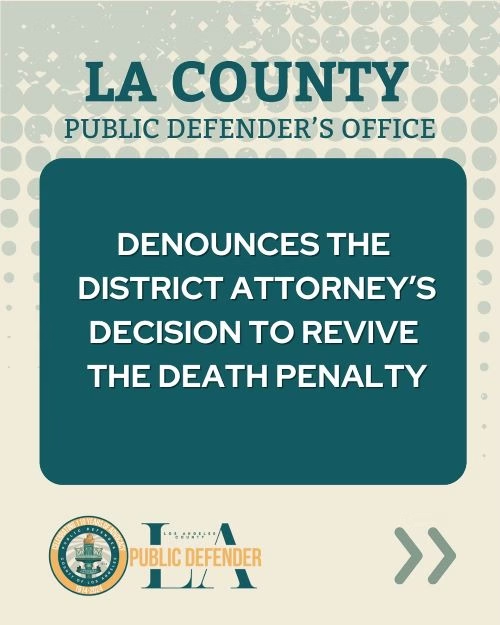
LA County “has refused to address overwhelming caseloads, attorney burnout and poor retention” in stalled contract negotiation, according to the Los Angeles County Public Defenders Union – Local 148, in a press release days before National Public Defense Day (Gideon Day) on March 18.

On March 18, 1963, in Gideon vs Wainwright, the US Supreme Court held unanimously that the Sixth Amendment’s guarantee of the right to counsel is a fundamental right. Writing for the Court, Justice Hugo Black noted that “lawyers in criminal courts are necessities, not luxuries.”

With that in mind, Local 148 President Ruby Mejia, said, “We pose this question: will Los Angeles uphold the Sixth Amendment? Or will it continue to extract labor from dedicated professionals until the system collapses?”

The union says it’s “being pushed to the brink” after a fruitless marathon negotiating session with Interim LA County CEO Joe Nicchitta and Public Defender Ricardo Garcia.

“Our current workloads make it impossible to consistently fulfill our constitutional duty to provide effective assistance of counsel,” the union said in an open letter to the negotiators and the County Board of Supervisors signed by over 330 members that was written in advance of the failed negotiating session. “By refusing to commit to meaningful workload reductions, the County is knowingly tolerating a system that risks ineffective assistance of counsel for some of the most vulnerable residents of Los Angeles,” it said.

“Modern cases demand exponentially more time” compared the 1970s, when standards were set, the letter notes, citing the 2023 National Public Defense Workload Study. “Today, attorneys must review hours of body worn camera footage and digital evidence, analyze complex forensic data, litigate increasingly technical issues, and build trust with clients who often carry profound trauma,” the letter stated. “When those standards are applied to our office, the conclusion is unavoidable we are severely understaffed.”

As a result, “The consequences are immediate and concrete. Overworked public defenders cannot fully investigate cases, litigate necessary motions, or meaningfully prepare for trial without asking clients to remain in custody longer. Instead, attorneys are forced to triage–deciding which clients receive adequate attention and which cases receive only what time allows. That is not zealous advocacy. It is damage control. No defender should have to choose which constitutional rights to protect and which to neglect.”

Adopt, Heal, Repeat: Inside the Heart of San Pedro Pet Pals


By Gretchen Williams, Columnist

A thundering herd of short, squat dogs came to the front door. Theresa Sardisco’s warm smile and the snorting bulldogs welcomed me. Rescue for bulldogs was her specialty, but it was easy to see that Theresa’s talent for rescue extended to all, canine & feline, as well as human.

Theresa Sardisco was appointed Los Angeles Animal Control Commissioner by Councilman Tim McOskar. Her ongoing work with the rescue community has grown into San Pedro Pet Pals, a support group for the Harbor Animal Shelter. Promoting adoption, rescue, spay & neuter clinics, reunification, and microchipping, Pedro Pet Pals also operates an outreach van for adoptable pets.

The low-cost veterinary resources and adoption services are identified by appealing pup and kitty murals on the San Pedro Pet Pals building at 7th and Mesa. Since its 2009 inception, the Pet Pals organization has raised money through a variety of fundraisers – bingo is popular – though Theresa says “100% of our fundraiser events sell out”.

The Cat Cafe’ at San Pedro Pet Pals is great fun, with cuddle time with adoptable kitties along with coffee. Hyla’s Heart to Home Cat Lounge honors long-time cat volunteer Hyla Morrow. The Canine Crew highlights pups and dogs available for adoption. Theresa emphasizes that all of the functions of the Pet Pals are performed by volunteers. She is happy to note that pet owners are healthier and happier, an idea backed up by science. “Come and meet your new best friend” says Theresa.

San Pedro Pet Pals 395 West 7th Street San Pedro

Robbed at the Pump Again

The past isn’t even the past. It just keeps coming back to haunt us

You are being robbed at the pump once again in another illegal war over oil, a commodity that we are now self-sufficient in, and slowly weaning ourselves off dependence on. All for the benefit of another U.S. president bent on oil dependence — it’s like an addiction. As of this writing, the price of oil has risen in the last three months from $60 a barrel to more than $95 and seems to be headed higher. It is important to understand how our clandestine foreign policies over decades are tied to Iran and the Persian Gulf.

These policies have not only robbed the Persian people of a democratic republic but also Americans of the benefits of free college education and resulted in escalating real estate prices.

Let me start at the beginning

After World War II, there was an attempted assassination of the Shah of Iran, who had protected the oil interests of the British. The war brought the beginning of the end to the British colonial empire worldwide. This gave rise to the election of Prime Minister Mohammad Mosaddegh, who knew that the British had never paid Iran adequately for the oil it extracted. When he sought to audit the documents of the Anglo-Iranian Oil Company (now part of BP), they refused and Mosaddegh nationalized the Iranian oil and kicked the British out.

It has now been well documented that the UK’s MI6 and the USA’s CIA conspired to overthrow Mosaddegh in a coup d’etat and return Reza Pahlavi as Shah of Iran.

According to the CIA’s declassified documents and records, “On 19 August 1953, some of the most feared mobsters in Tehran were hired by the CIA to stage pro-shah riots. Other men paid by the CIA were brought into Tehran in buses and trucks and took over the streets of the city.”

The Shah took over control of Iran and suppressed any attempt to democratize the country for the next quarter-century. In 1979, there was a student uprising that overthrew the Shah, who fled to the US, and they captured 66 Americans in the Tehran embassy.

President Jimmy Carter’s actions toward Iran were dominated by the 1979 Iran Hostage Crisis, leading him to impose severe economic sanctions, including freezing Iranian assets and halting oil imports, breaking diplomatic relations, and authorizing a failed military rescue mission (Operation Eagle Claw) to free 444 American hostages held at the U.S. embassy in Tehran. These efforts to pressure Iran into releasing the hostages ultimately failed during his presidency, with the hostages freed on the day he left office. Some always wondered, “Why?”

This was the year Ronald Reagan ran for president, and the Iranian hostages dominated the news for the entire campaign. Carter had struck a deal with the Iranian moderates, but the conservative Islamic fundamentalists were in talks with Bill Casey, a former OSS and CIA officer who was working for the Reagan campaign.

In what became known as the “October Surprise,” the Reagan campaign promised the Islamic Shia a “much better deal” under Reagan if they just didn’t let the hostages go until after the election. And that’s what happened.

In the end, the hostages were released the day after Reagan was inaugurated, and so started the arms for hostages deal, which empowered Ayatollah Khomeini and the Islamic clerics, stopping any democratic reforms and giving rise to a theocratic state. This became exposed years later as the Iran/Contra scandal that ended up with the U.S. trading weapons to Iran, guns and ammunition to the American-backed Contras in Nicaragua, and in the process dumping tons of cocaine and crack onto the streets of South-Central LA with automatic weapons to launder the money. All of this was both illegal and treasonous — only a few members of his cabinet were ever convicted but were later pardoned by President George H. Bush, who followed Reagan into office.

At the same time, Reagan began his “trickle down” economic policies that cut taxes on the rich, gutted public education, the welfare structure, defunded the arts, and raised the price of oil, gas, and ultimately the prices of real estate– because the petrodollar determines the price of almost everything in America. He dumped Carter’s energy policies for solar and wind energy independence by the year 2000. And attacked American unions and opened the gate to ship American jobs overseas.

Just watch now as there’s a direct correlation between the price at the pump and everything else you consume. We are still oil dependent. And the current regime only wants to drill, baby drill, defund solar, gut the EPA, and ditch windmills because they kill birds. As if he really cares about birds or nature.

Now here’s the insane part — the Orange Felon, who promised to bring down inflation, is going to crash the value of the dollar, raising the cost of living and after spending billions on a war that he claimed he’d never do (because he’s the “peace president”) is going to announce that HE HAS WON THE WAR that no one supported. This is as we enter into the next Trump-instigated recession.

Remember what happened during the COVID-19 pandemic; this recession may just be worse!

And the Orange Felon will declare it all a Great Success on Truth Social, and Fox News will applaud.

Oh isn’t it just fine to watch America become Great Again?

Foot note: The United States is the world’s largest oil producer, consistently leading with production over 20 million barrels per day, followed by Russia and Saudi Arabia, though figures vary slightly by source and specific month/year. The U.S. production surge is largely due to advances in unconventional tight oil, making it a top producer, consumer, and major importer of oil despite its high output.

The People’s Champion


How Sup. Janice Hahn Transformed LA Through Service and Advocacy and Why We Think She Should Be Honored With Our Woman of Leadership Award

In this moment of honoring the contributions of women to our community, we can think of none other than LA County Supervisor Janice Hahn to present with our Woman of Leadership award. She has held four elected positions over the last 26 years: first on the Los Angeles Charter Reform Commission, then on the Los Angeles City Council, in the U.S. Congress, and, most recently, as the first Democratic woman elected to represent the 4th District on the Los Angeles County Board of Supervisors.

However, what separates her from many elected officials is that she never lost touch with her roots or core values, believing that she was there to serve all the people, especially those without a voice — the homeless, the disabled veterans, the gay and the Black communities. And because of her outspoken opposition to the ICE raids in LA and across this nation, she has earned the honor of being number 56 on the Orange Felon’s enemies list.

Courage and conscience don’t often go hand in hand in politics, which is why Janice Hahn stands out and deserves credit for her accomplishments.

For all of this and probably much more, she deserves the honor and recognition of our entire community.

In 1997, Hahn was elected to the commission that rewrote the Los Angeles City Charter and was a vocal supporter of the neighborhood council system that gave local communities a formal advisory role in city decision-making.

When she was elected to the city council to represent the 15th District, she called and hosted the first emergency meeting with residents, clergy, gang intervention workers, school officials, and the Los Angeles Police Department following a surge of 18 shootings and several homicides within a single month. It was at this critical juncture in Los Angeles history that she brought community members and police into the same room to create a structured space for dialogue and conflict resolution. These meetings, held weekly in her Watts district office beginning in January 2006, became the Watts Gang Task Force. It was in this space that Hahn helped broker early conversations and cease-fire efforts between rival gangs, encouraging community leaders and former gang members to participate in mediation and intervention work.

During her time in Congress, representing the 36th District, Hahn played a key leadership role in bringing the historic battleship USS Iowa (BB-61) to the Los Angeles Harbor, turning the historic battleship into a museum that boosts tourism, preserves naval history, and contributes to the ongoing redevelopment of the Los Angeles waterfront.

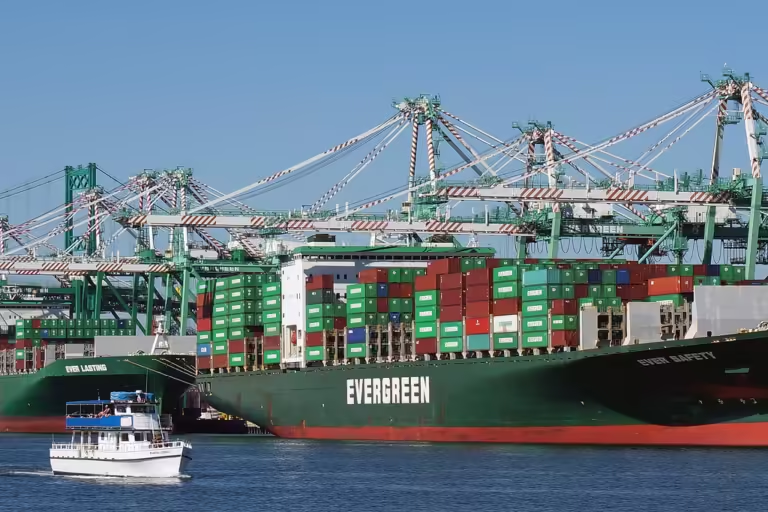
Also during her time in Congress, Hahn played a founding and leadership role in establishing the Ports Caucus, focusing on issues affecting the nation’s major ports, especially the Port of Los Angeles and the Port of Long Beach.

The caucus helped secure federal investment for expansion and modernization, which supports local jobs and the national supply chain and has provided a platform for Congress to address port security, infrastructure resilience, and trade efficiency, ensuring ports can safely and efficiently move goods critical to the U.S. economy.

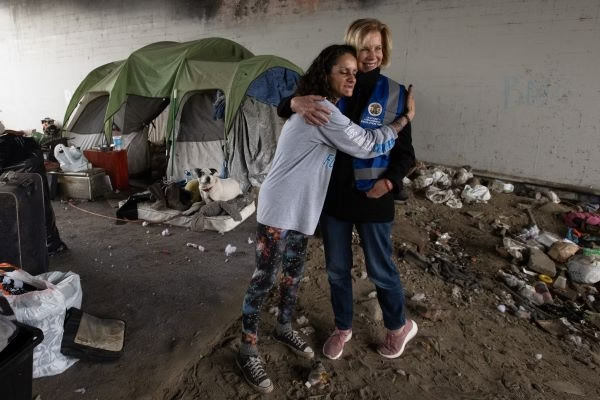
Supervisor Janice Hahn embraces a member of the Bruce family in 2021 after leading the County effort to return the beachfront property to the direct descendants of the family. File photo

When she left Congress to run for supervisor for the 4th District, she returned Bruce’s Beach to the living descendants of Willa and Charles Bruce, marking the first time a government in this country returned land stolen from a Black family.

She played a key leadership role in ensuring that the Pride flag is flown over all Los Angeles County buildings, signaling the county’s support for the LGBTQ+ community.

Janice Hahn. File photo.


Her career has been defined by tangible, community-centered leadership:

  • Transformed the empty public health offices on 8th Street in San Pedro into a homeless shelter in a matter of weeks — bringing entire encampments in downtown San Pedro inside.
  • Secured funding from Gov. Gavin Newsom’s Project Homekey program to purchase the former Best Western on 1st and Gaffey in San Pedro and strategically developed it as housing for formerly homeless veterans — now known as the Louis Dominguez Veterans Resource Center.
  • Created the Whittier LGBTQ Center — the first of its kind in southeast Los Angeles County.
  • Was the first woman and first Democrat elected to the Fourth Supervisorial District
  • Created LA Found, which has saved lives by changing the way LA County responds to find missing people with dementia, Alzheimer’s, and autism
  • Prevented the changing of the name of the Los Angeles Memorial Coliseum to the United Airlines Memorial Coliseum
  • And last but not least was named number 56 on President Donald Trump’s list of enemies!

For all of these accomplishments — from grassroots community engagement to historic policy achievements — Janice Hahn embodies leadership, courage and a commitment to serving the people. She is truly deserving of the Woman of Leadership Award and the admiration of our entire community.

Hahn Honors Catalina Hinojosa as 2026 Woman of the Year


County Supervisor Janice Hahn, on March 9, honored Catalina Hinojosa, founder and CEO of the San Pedro Recovery Alliance, as her 2026 Woman of the Year.

“Like so many women across Los Angeles County, Catalina faced daunting challenges in her own life,” said Hahn. “After the heartbreaking loss of her mom, she struggled and eventually found herself incarcerated. For most of us, that might seem insurmountable — but not for Catalina.”

Hinojosa’s journey is one of resilience, redemption and service. After the loss of her mother, she faced significant personal challenges that eventually led to her incarceration. Determined to turn her life around, Hinojosa rebuilt her future while in custody. She achieved sobriety, earned her GED, began taking college classes, and found strength through her church community while helping fellow detainees.

Following her release, Hinojosa continued her transformation with the support of community programs and mentors, including Homeboy Industries. Inspired by the compassion and encouragement that helped her rebuild her life, she honored the support she received by helping others facing similar struggles.

Through Homeboy Industries, Hinojosa worked for Project 180, where she learned homeless case management. Then she worked for the People Concern, where she worked getting people from tents to housing.

RLN published a profile on Hinojosa in 2023, when she had worked as a homeless outreach worker for Homeless Healthcare LA for two years. Prior to that she worked in homeless services for six years. At that time, she said, “You have to really want to reach these people. There’s no set way to run into a person who’s sleeping on a street, but if you walk up to them like a normal person and treat them like a normal person, with a lot of humanity, they respond a lot more.”

Today, as the founder and CEO of the San Pedro Recovery Alliance, Hinojosa leads efforts to support formerly incarcerated individuals, people struggling with addiction, and people experiencing homelessness. Her organization provides connections to transitional housing and re-entry services, as well as access to medical care, employment support, mental health resources and life skills training.

While accepting the award, Catalina Hinojosa thanked Hahn and said the recognition “reminds me that people really do believe in second chances.

“This award is for everyone who has fallen but found the strength to rise again,” continued Hinojosa.

Hahn presented the award to Hinojosa during the annual Women of the Year celebration hosted

by the Los Angeles County commission for women. Each year, members of the Los Angeles County Board of Supervisors select a Woman of the Year from their district. Hahn selected Hinojosa in recognition of her inspiring personal journey and her dedication to helping others rebuild their lives.

“Against all odds, Catalina forged a new path for herself and altered her own destiny,” Hahn

said. “She saw the power that compassion and encouragement from others had in her own recovery, and she wanted to pass that on. Catalina is an inspiration and the work she does every day is changing lives in the Harbor Area.”

The Woman of the Year awards ceremony was held in the ballroom of the Biltmore Hotel in Downtown Los Angeles. Hinojosa accepted her award from Hahn on stage in front of a crowd of hundreds, including her children.

Details: https://www.sanpedrorecoveryalliance.com/

Revitalization or Waiting Game?

The Ownership Reality Behind Downtown San Pedro

By Devonte Barr, Columnist

Downtown San Pedro, with its vacant storefronts and low-rent offers, can feel like a place constantly on the cusp of revitalization. Yet who decides when — or if — that change happens? The answer lies in ownership.

Of the 804 parcels in downtown San Pedro’s Improvement District, only 5% are publicly owned. The remaining 95% sit in private hands, often concentrated among a relatively small number of entities. One of the most significant is Jerico Development, which owns and operates more than 1.2 million square feet of commercial space, including several historic buildings, and is spearheading the West Harbor waterfront project.

Property and Business Improvement Districts (PBIDs), like San Pedro’s, operate under a 1994 state law and are funded through mandatory assessments on property owners within designated boundaries. These districts are governed by boards composed exclusively of property owners or their representatives, who make decisions about security, graffiti removal,, marketing strategy and redevelopment timelines — without direct input from residents, renters, or everyday shoppers.

When landlords control multiple properties, the financial incentives shift. Vacancies can become strategic — a calculated wait for higher-paying tenants rather than a rush to fill space with local operators. Consolidated ownership spreads risk across portfolios. What looks like stagnation from the sidewalk can look like patience on a balance sheet.

Downtown’s future will be debated in meetings and promoted in press releases, but its immediate reality is shaped more quietly — through property records, lease negotiations, and decisions about whether to lower rent or hold the line.

The question isn’t whether revitalization is happening.
It’s who it’s happening for.

But that question — important as it is — isn’t the whole story.

Ownership determines leverage. It doesn’t eliminate the other half of the equation.

Concentrated property control creates a single structural force. Distributed community energy creates another. The tension between them is what actually shapes a downtown — not master plans or marketing campaigns, but the daily friction between what landlords can afford to wait for and what residents are willing to live with.

Improvement districts can coordinate services, fund security and market a vision. What they cannot manufacture is the pattern of habits that makes a place feel occupied rather than managed. Foot traffic. Word of mouth. The difference between a block that feels watched and one that feels alive. That only exists if people treat the space like it belongs to them, whether the deed says so or not.

This isn’t sentiment. It’s structural. Property value doesn’t come from ownership alone — it comes from demand, and demand comes from use. A coffee shop that stays open past eight doesn’t survive on optimism. It survives because enough people consistently show up to justify the hours. Safety doesn’t come from surveillance. It comes from density, familiarity and eyes on the street.

Downtown isn’t just a collection of parcels. It’s a pattern of habits. And habits, unlike leases, can’t be negotiated behind closed doors.

If concentrated ownership shapes leverage, the only real counterweight is concentrated participation.

Tripling Housing, Testing Community

The Complex Future of Rancho San Pedro

By Devonte Barr, Columnist

City decisions are often made in planning documents and council chambers far from the neighborhoods they will reshape. In San Pedro, one of those decisions could soon transform the Rancho San Pedro housing complex—478 public housing units built during World War II—into a redevelopment more than three times its current size.

Supporters say the One San Pedro Project will modernize aging housing and bring new investment to San Pedro. But redevelopment projects of this scale inevitably raise difficult questions for the communities they touch. How many of the roughly 1,400 residents who live in Rancho San Pedro today will realistically return once redevelopment is complete? Who ultimately benefits from the more than 1,500 housing units proposed for the site? What kind of San Pedro is being built for the future?

The Rancho San Pedro complex occupies 21 acres near downtown and contains 478 public housing units operated by the Housing Authority of the City of Los Angeles (HACLA). Built during World War II to house harbor workers, it remains one of the largest public housing sites in the area. Residents pay rent based on a percentage of their income, while HACLA manages the property directly.

The proposed One San Pedro redevelopment would replace the existing complex with a mixed-income development of up to 1,553 units over roughly 20 years, including affordable housing, market-rate units, retail space, and public areas. If built to capacity, the project could eventually house more than 4,000 residents—tripling the site’s current population. The project is structured as a public-private partnership between HACLA and the One San Pedro Collaborative, a development team including the Richman Group, Century Housing Corporation, and National Community Renaissance. HACLA would retain land ownership while leasing portions to the development team under long-term ground leases, with financing from federal and state housing programs, including the Low-Income Housing Tax Credits and the Community Development Block Grants. Environmental review documents identify soil contamination requiring remediation before construction begins.

The current 478 units house roughly 1,200 to 1,400 residents. While HACLA has promised current residents the right to return once replacement units are built, the lengthy construction timeline means many may not be able to.

To better understand how residents themselves see the future, I spent an afternoon walking through the Rancho San Pedro complex and speaking with people who live there today.

Walking through the complex, it becomes clear this is not simply aging buildings awaiting demolition—it is a living community of more than a thousand residents forming a neighborhood with its own rhythms, relationships, and daily routines.
Those who spoke openly expressed a wide range of perspectives about the redevelopment.

One family of three, who asked to remain anonymous, told me, “It’s easy to see the negative, but for some people it might actually be a blessing to relocate.”

Ms. Ward, who lives near W. 1st Street, struck a more cautious tone. “I don’t know much, but I know the plans are big,” she said. “I’ll believe it when I see it. The relocation seems disorganized. Four or more people live in each unit—we’d have more space, but at what cost to residents?”

Another resident, Maira, was among the few who expressed excitement about the project. “We’re happy,” she said. “We’re one of the first families that will be relocated. It’s not like we didn’t have the option either—we do. And we have the option to come back after the redevelopment is finished.”

Still, she noted the challenges facing the neighborhood today. “It’s hard to try and be part of the community when public transportation has decreased routes through this neighborhood.”

The physical environment showed its age—dated buildings and worn landscaping that redevelopment plans aim to replace.

Yet the streets were largely clean, and the small front yards told another story. Many were tightly packed with outdoor furniture, children’s toys, and the small signs of everyday life.

That became clear in an unexpected way as I was leaving the property. While taking a photo of the Rancho San Pedro sign on the corner, I stepped backward into the street to get a wider shot. Across the road, about thirty yards away, a shirtless man casually called out to someone nearby.

“Yeah, he’s by your car, taking pictures.”

Not thinking much of it, I walked over toward my car—black, parked near the sign—and opened the driver’s door.

At least, I thought it was my car.

The front door of the unit behind the corner suddenly flew open, and another resident hurried across the grass toward me.

“Hey—what’s up, you good?” he asked, eyeing me carefully.

I started explaining. “Yeah, sorry if I look like a creep. I’m taking pictures for a story—I write for the local paper.”

He squinted for a moment, then asked the only question that mattered.

“Is that your car?”

I looked down at my keys, then at the car door, halfway inside. It wasn’t my car. I hit the lock button on my key fob—beep—and my actual car chirped right in front of me.

The two men burst out laughing. My hurried apologies were met more with amusement than anger. An older woman who had appeared behind them—likely the rightful owner of the car—looked equally relieved and entertained.

The moment was revealing. Neighbors had noticed a stranger by their car and stepped in immediately.

For a place often described only through statistics and redevelopment plans, it was a small reminder that Rancho San Pedro is still a neighborhood where residents watch out for one another—where the future being planned will ultimately reshape their very real community.

A Harbor Classic: Sardisco Family Ends 70-Year Run at Domenick’s


By Gretchen Williams, Columnist

Domenick’s Pizza and the Sardisco family hung up the pizza peel after 70 years in business. The perfect pizza and pasta is now but a cherished memory for devoted fans in San Pedro and Carson.

With roots in long-ago Terminal Island, Domenick’s original location in Carson was right on the rail line. Hungry railroad engineers could pull the locomotive up to a special window at Domenick’s to pick up pizza and sandwiches.

Terminal Island in the ’40s was the working heart of the harbor, beating with the steady rhythm of the canneries, the railroad and the Bethlehem shipyard. Loose cargo and bulk loads preceded the stacks of today’s container traffic.

The Radio Cafe was the beginning of the Sardisco restaurant legacy, turning out stacks of sandwiches for the workers on T.I. from ’44 to ’55. By ’56, Domenick had partnered with a friend who owned an empty asphalt-paving company warehouse in Carson. The restaurant evolved to include pasta, pizza and the legendary sandwiches. Just off the Harbor Belt Line run, the new “Domenick’s” used a window in the back to hand off sandwiches and pizza to rail workers. This pass remained in use until 2025.

Domenick’s opened in San Pedro at the restaurant on Western Avenue, offering a full menu of Italian dishes, pizza and pasta. Domenick’s sons, Domenick and Anthony, and daughter Theresa ran both restaurants, pleasing a loyal customer base for over seven decades. The Harbor Area will miss the wonderful food and happy atmosphere at both Domenick’s establishments.

Supervisors Approve Motion to Protect Small Businesses and Boost Economic Resiliency


LOS ANGELES — The Los Angeles County Board of Supervisors March 18 approved a motion to strengthen protections for small businesses and bolster economic resiliency through the establishment of a permanent, ongoing fund in response to the Trump administration’s federal immigration enforcement, tariffs, and other economic disruptions.

The motion builds on a June 17, 2025, board action introduced by chair Solis directing county departments to assess the economic effects of immigration enforcement activity. That action followed reports of workplace raids that resulted in workforce losses, reduced customer traffic and declining revenues for local businesses.

A subsequent economic impact report, conducted by the Los Angeles County Department of Economic Opportunity in partnership with the Los Angeles County Economic Development Corporation, found that nearly 60% of surveyed small businesses were concerned about their ability to maintain their workforce in the coming months, while 44% reported revenue losses exceeding 50%. The report also found that immigration enforcement activity contributed to a broader climate of fear that reduced consumer activity and discouraged residents from visiting local businesses.

The motion directs the Department of Economic Opportunity, in collaboration with the Department of Consumer and Business Affairs and other county departments, to develop a framework for a permanent business interruption fund to support small businesses impacted by economic disasters, including natural disasters, public health emergencies and immigration enforcement activity. It also calls for the creation of a flexible, low-interest loan program through the County’s Economic Development Trust Fund, with a focus on reaching the most impacted communities.

Both programs would be paired with culturally competent, multilingual technical assistance to help small businesses access capital, improve financial literacy and navigate application processes. The motion also calls for evaluating eligibility requirements across county-supported disaster funding programs to reduce barriers and improve access for microbusinesses, immigrant-owned businesses and those operating in cash-based economies.

County departments are expected to report back to the Board within 90 days with implementation plans and recommendations.