

Home Blog Page 171

California Climbs to #4 Global Economy — Plus, CalRx® Naloxone Now Available Statewide


California is Now the 4th Largest Economy in the World

SACRAMENTO — Gov. Gavin Newsom April 23 announced that California has officially overtaken Japan to become the world’s fourth-largest economy, according to newly released data from the International Monetary Fund or IMF and the U.S. Bureau of Economic Analysis or BEA.

According to the IMF’s 2024 World Economic Outlook data released April 22 and BEA data, California’s nominal GDP reached $4.1 trillion, surpassing Japan’s $4.02 trillion, and placing California behind only the United States, China, and Germany in global rankings. California’s GDP figure is based on the latest state-level GDP data from the BEA.

Outperforming the Nation

California’s economy is growing at a faster rate than the world’s top three economies. In 2024, California’s growth rate of 6% outpaced the top three economies: U.S. (5.3%), China (2.6%) and Germany (2.9%). California’s success is long-term — the state’s economy grew strongly over the last four years, with an average nominal GDP growth of 7.5% from 2021 to 2024. Preliminary data indicates India is projected to surpass California by 2026.

California is the backbone of the nation’s economy

With an increasing state population and recent record-high tourism spending, California is the nation’s top state for new business starts, access to venture capital funding, and manufacturing, high-tech, and agriculture.

The state drives national economic growth and also sends over $83 billion more to the federal government than it receives in federal funding. California is the leading agricultural producer in the country and is also the center for manufacturing output in the United States, with over 36,000 manufacturing firms employing over 1.1 million Californians.

The Golden State’s manufacturing firms have created new industries and supplied the world with manufactured goods spanning aerospace, computers and electronics, and, most recently, zero-emission vehicles

Protecting California’s economy

Gov. Gavin Newsom last week filed a lawsuit in federal court challenging the president’s use of emergency powers to enact broad-sweeping tariffs that hurt states, consumers, and businesses. The lawsuit seeks to end President Trump’s tariff chaos, which has wreaked havoc on the economy, destabilized the stock and bond markets, caused hundreds of billions of dollars in losses, and inflicted higher costs for consumers and businesses. These harms will only continue to grow, as President Trump’s tariffs are projected to shrink the U.S. economy by $100 billion annually.


Gov. Newsom makes CalRx® Naloxone available for all Californians at $24

Screenshot 266
CalRx Naloxone Production. Department of Health Care Access and Information.

SACRAMENTO – Gov. Newsom April 22 announced that individual twin-packs of CalRx®-branded over-the-counter or OTC naloxone HCL 4 mg nasal spray are now available to all Californians at the price of $24 per carton – almost half the standard market price. Previously offered only to government entities and businesses in packs of 24, this new direct-to-consumer program expands individual access to this life-saving overdose reversal medication.

Naloxone, a medication that blocks the effects of opioids, can quickly reverse an overdose, giving individuals crucial time to receive medical help.

Anyone residing in California can now visit the CalRx website to purchase an individual twin-pack of naloxone HCL 4 mg nasal spray for $24, plus tax and shipping fees. This price makes the CalRx offering among the most cost-competitive options currently available.

The launch of CalRx®-branded naloxone in May 2024 was more than just an expansion of access to a single medication — it represented a larger shift in how California is reshaping the pharmaceutical market to prioritize affordability, transparency, and public health.

By leveraging state purchasing power and strategic partnerships, CalRx is establishing a new standard for making essential medications more accessible at lower, more predictable prices. This initiative demonstrates how bold, state-led action can disrupt traditional pricing models and ensure that cost never stands in the way of care.

This initiative is part of Governor Newsom’s Master Plan for Tackling the Fentanyl and Opioid Crisis. A recent study published on the Naloxone Savings Dashboard revealed that the state’s CalRX initiative has saved California over $6 million to date. For more information on opioids and how you can protect yourself and loved ones, visit Opioids.CA.GOV, a one-stop shop for Californians seeking resources around prevention and treatment.

Impact on the opioid crisis

For the first time in California, data through June 2024 showed a decline in synthetic opioid-related overdose deaths, from drugs such as fentanyl and tramadol. This had reversed a trend of increased synthetic opioid-related death in the state from 2018 through June 2023. The overdose crisis remains complex and is constantly evolving due to a variety of factors. Year-to-year changes cannot be credited to any one cause, but it is clear that a comprehensive effort is making a difference, as we continue to address opioid trafficking, prevent overdoses, support those with opioid use disorder, and raise awareness about the dangers of opioids.

How to obtain CalRx Naloxone

  1. Online ordering: California residents and businesses can order CalRx® Naloxone HCL 4 mg nasal spray for $24 per box by visiting the CalRx Get Naloxone website.

    2. Naloxone Distribution Project: Eligible organizations may qualify for free CalRx® Naloxone HCL 4 mg nasal spray through the Department of Health Care Services’ Naloxone Distribution Project (NDP). For more information, visit the NDP website.​

CalRx® program

The California Department of Health Care Access and Information, which administers the CalRx program, recently published its Naloxone Savings Dashboard, revealing that this initiative has saved California over $17 million to date.

Details: CalRx® Naloxone.For more information regarding California’s response to the opioid crisis, visit http://opioids.ca.gov.

American Concentration Camps

By Chris Hedges

Once a regime starts to send people to concentration camps — including those in El Salvador — it creates a system of detention that eschews due process and disappears citizens into black holes.

https://chrishedges.substack.com/p/american-concentration-camps

Our offshore concentration camps, for now, are in El Salvador and Guantánamo Bay, Cuba. But don’t expect them to remain there. Once they are normalized, not only for U.S.-deported immigrants and residents, but U.S. citizens, they will migrate to the homeland. It is a very short leap from our prisons, already rife with abuse and mistreatment, to concentration camps, where those held are cut off from the outside world — “disappeared” — denied legal representation and crammed into fetid, overcrowded cells.

Prisoners in the camps in El Salvador are forced to sleep on the floor or in solitary confinement in the dark. Many suffer from tuberculosis, fungal infections, scabies, severe malnutrition and chronic digestive illnesses. The inmates, including over 3,000 children, are fed rancid food. They endure beatings. They are tortured, including by water-boarding or being forced naked into barrels of ice-cold water, according to Human Rights Watch. In 2023, the State Department described imprisonment as “life-threatening,” and that was before the Salvadoran government declared a “state of exception” in March 2022. The situation has been greatly “exacerbated,” the State Department notes, by the “addition of 72,000 detainees under the state of exception.” Some 375 people have died in the camps since the state of exception was established, part of El Salvadoran President Nayib Bukele’s “war on gangs,” according to the local human rights group Socorro Jurídico Humanitario.

These camps — the “Centro de Confinamiento del Terrorismo” (Center for Terrorism Confinement) known as CECOT, to which U.S. deportees are being sent, holds some 40,000 people — are the model, the harbinger of what awaits us.

Metal worker and union member Kilmar Ábrego García, who was abducted in front of his five-year-old son on March 12, 2025, was accused of being a gang member and sent to El Salvador. The Supreme Court agreed with District Judge Paula Xinis who found that García’s deportation was an “illegal act.” Trump officials blamed their deportation of García on an “administrative error.” Xinis ordered the Trump administration to “facilitate” his return. But that does not mean he is coming back.

“I hope you’re not suggesting that I smuggle a terrorist into the United States,” Bukele told the press at a White House meeting with Trump. “How can I smuggle — how can I return him to the United States? Like, I smuggle him into the United States? Well, of course I’m not going to do it…the question is preposterous.”

This is the future. Once a segment of the population is demonized — including U.S. citizens Trump labels “homegrown criminals” — once they are stripped of their humanity, once they embody evil and are seen as an existential threat, the end result is that these human “contaminants” are removed from society. Guilt or innocence, at least under the law, is irrelevant. Citizenship offers no protection.

“The first essential step on the road to total domination is to kill the juridical person in man,” writes Hannah Arendt in “The Origins of Totalitarianism.” “This was done, on the one hand, by putting certain categories of people outside the protection of the law and forcing at the same time, through the instrument of denationalization, the nontotalitarian world into recognition of lawlessness; it was done, on the other, by placing the concentration camp outside the normal penal system, and by selecting inmates outside the normal judicial procedure in which a definite crime entails a predictable penalty.”

Those who build concentration camps build societies of fear. They issue relentless warnings of mortal danger, whether from immigrants, Muslims, traitors, criminals or terrorists. Fear spreads slowly, like a sulfurous gas, until it infects all social interactions and induces paralysis. It takes time. In the first years of the Third Reich, the Nazis operated ten camps with about 10,000 inmates. But once they managed to crush all competing centers of power — labor unions, political parties, an independent press, universities and the Catholic and Protestant churches — the concentration camp system exploded. By 1939, when World War II broke out, the Nazis were running over 100 concentration camps with some one million inmates. Death camps followed.

Those that create these camps give them wide publicity. They are designed to intimidate. Their brutality is their selling point. Dachau, the first Nazi concentration camp, was not, as Richard Evans writes in “The Coming of The Third Reich” “an improvised solution to an unexpected problem of overcrowding in the goals, but a long-planned measure that the Nazis had envisioned virtually from the very beginning. It was widely publicized and reported in the local, regional and national press, and served as a stark warning to anyone contemplating offering resistance to the Nazi regime.”

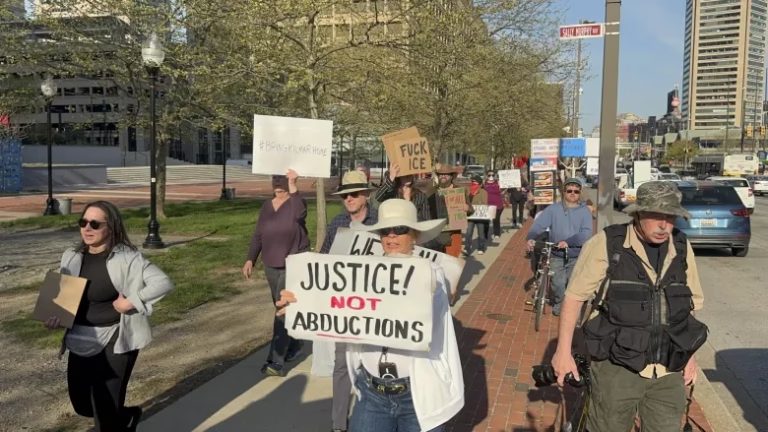
Immigration and Customs Enforcement (ICE) agents, wearing plainclothes and circling neighborhoods in unmarked cars, kidnap legal residents such as Mahmoud Khalil. These abductions replicate those I witnessed on streets of Santiago, Chile under the dictatorship of Augusto Pinochet, or in San Salvador, El Salvador’s capital, during the military dictatorship.

ICE is swiftly evolving into our homegrown version of the Gestapo or The People’s Commissariat for Internal Affairs (NKVD). It oversees 200 detention facilities. It is a formidable domestic surveillance agency that has amassed data on most Americans, according to a report compiled by The Center of Privacy & Technology at Georgetown.

“By reaching into the digital records of state and local governments and buying databases with billions of data points from private companies, ICE has created a surveillance infrastructure that enables it to pull detailed dossiers on nearly anyone, seemingly at any time,” the report reads. “In its efforts to arrest and deport, ICE has — without any judicial, legislative or public oversight — reached into datasets containing personal information about the vast majority of people living in the U.S., whose records can end up in the hands of immigration enforcement simply because they apply for driver’s licenses; drive on the roads; or sign up with their local utilities to get access to heat, water and electricity.”

Those abducted, including the Turkish national and PhD student at Tufts University, Rümeysa Öztürk, are accused of amorphous behaviour such as “engaging in activities in support of Hamas.” But this is a subterfuge, accusations no more real than the invented crimes under Stalinism where people were accused of belonging to the old order — Kulaks or members of the petit bourgeoisie — or were convicted for plotting to overthrow the regime as Trotskyites, Titoites, agents of capitalism or saboteurs, known as “wreckers.” Once a category of people is targeted, the crimes they are charged with, if they are charged at all, are almost always fabrications.

Concentration camp inmates are severed from the outside world. They are disappeared. Erased. They are treated as if they never existed. Nearly all efforts to obtain information about them are met with silence. Even their death, should they die in custody, becomes anonymous, as if they were never born.

Those who run concentration camps, as Hannah Arendt writes, are people without the curiosity or the mental capacity to form opinions. They don’t, she notes, “even know any more what it means to be convinced.” They simply obey, conditioned to act as “perverted animals.” They are intoxicated by the God-like power they have to turn human beings into quivering flocks of sheep.

The goal of any concentration camp system is to destroy all individual traits, to mold people into fearful, docile, obedient masses. The first camps are training grounds for prison guards and ICE agents. They master the brutal techniques designed to infantilize inmates, an infantilization that soon warps the wider society.

The 250 purported Venezuelan gang members shipped to El Salvador in defiance of a federal court were denied due process. They were summarily herded onto planes, which ignored the judge’s order to turn back, and once they arrived, were stripped, beaten and had their heads shaved. Shaved heads are a feature of all concentration camps. The excuse is lice. But of course it is about depersonalization and why they are in uniforms and identified by numbers.

The autocrat openly revels in the cruelty. “I look forward to watching the sick terrorist thugs get 20 year jail sentences for what they are doing to Elon Musk and Tesla,” Trump wrote on Truth Social. “Perhaps they could serve them in the prisons of El Salvador, which have become so recently famous for such lovely conditions!”

Those that build concentration camps are proud of them. They show them off to the press, or at least the sycophants posing as the press. Secretary for Homeland Security Kristi Noem, who posted a video of herself visiting the El Salvadoran prison, used the shirtless and head shaved inmates as a stage prop for her threats against immigrants. If fascism does one thing well, it is spectacle.

First they come for the immigrants. Then they come for the activists on foreign student visas on college campuses. Then they come for green card holders. Next are the U.S. citizens who fight Israeli genocide or the creeping fascism. Then they come for you. Not because you broke the law. But because the monstrous machine of terror needs a constant supply of victims to sustain itself.

Totalitarian regimes survive by eternally battling mortal, existential threats. Once one threat is eradicated, they invent another. They mock the rule of law. Judges, until they are purged, may decry this lawlessness, but they have no mechanism to enforce their rulings. The Department of Justice, turned over to the Trump sycophant Pam Bondi, is, as in all autocracies, designed to block enforcement, not facilitate it. There are no legal impediments left to protect us. We know where this is going. We have seen it before. And it is not good.

Gov. Newsom Announces Appointments


SACRAMENTO – Gov. Gavin Newsom April 22 announced the following appointments:

Sophia Carrillo, of Santa Monica, has been appointed assistant general counsel of enforcement at the California Environmental Protection Agency. Carrillo was an assistant United States attorney at the United States Attorney’s Office, Central District of California from 2023 to 2025. She was a deputy attorney general at the California Department of Justice from 2019 to 2023. Carrillo was a judicial law clerk at the United States District Court, Eastern District of California from 2018 to 2019. She was an associate director of the mayor’s office of talent and appointments/D.C. human resources at the executive office of Mayor Muriel Bowser in 2015. Carrillo is a member of the Latino Community Foundation’s Los Angeles Giving Circle. She earned her Juris Doctor degree from Stanford Law School and a Bachelor of the Arts degree in Political Science and Sociology from the University of San Diego. This position does not require Senate confirmation and compensation is $174,000. Carrillo is a Democrat.

Vanessa Ejike, of Cerritos, has been appointed to the State Board of Education. Ejike was a poll worker for the Los Angeles County Registrar-Recorder/County Clerk and an Intern for Assemblymember Sharon Quirk-Silva in the California State Assembly in 2024. She is the national partnerships director for the High School Democrats of America, local affairs director for California High School Democrats, communications coordinator for the Pacific Coast Coalition of Girl Up USA, student representative for the Legislative and Policy Committee at the ABC Unified School District, and founder and chair of the Principal’s Advisory Council at Gretchen Whitney High School. This position does not require Senate confirmation, and the compensation is $100 per diem. Ejike is not registered to vote.

Government’s Case Against Abrego Garcia is Based on PG County Cop Who Was On the SA’s Do Not Call List


Based on his illegal use of information, Ivan Mendez was only an active duty officer for five days after alleging without evidence that Abrego Garcia was a gang member.

By Baynard Woods, April 17 https://tinyurl.com/Baltimore-Beat-Abrego-Garcia

The Maryland cop who first linked Kilmar Abrego Garcia to alleged gang activity in 2019 was placed on a “do not call” list published by Prince George’s County State’s Attorney Aisha Braveboy in 2021 — meaning he was deemed unfit to testify in state court due to criminal charges filed against him for sharing confidential information about a police investigation.

This means that the Trump administration has detained Abrego Garcia in the CECOT prison in El Salvador, against the rulings of the Supreme Court and a Maryland District Court, based solely on the word of a cop deemed untrustworthy by the county’s state’s attorney’s office.

The New Republic first reported that PGPD Corporal Ivan Mendez, who filled out Abrego Garcia’s “gang field interview sheet,” pleaded guilty to criminal misconduct in office charges based on giving information about a police investigation to a sex worker in December 2018, according to Maryland Case Search — just months before Abrego Garcia’s arrest in a Home Depot parking lot.

Attorney General Pam Bondi released on Wednesday a redacted form of the “Gang Field Interview Sheet” filled out by Mendez when PGPD arrested Abrego Garcia in 2019, with right-wing media outlets crowing that they “reveal” his MS-13 gang “rank” and “street name.”

Abrego Garcia has been illegally abducted by the Trump administration and imprisoned in El Salvador on the basis of the allegation of gang membership, which, the administration claims, annuls the 2019 “withholding order” that made it illegal to deport him to El Salvador.

Baltimore Beat reporting shows Mendez was one of 57 officers on a “do not call” list published by Prince George’s County State’s Attorney Braveboy in 2021.

At the time the list was released, Braveboy said that untrustworthy officers risk “the integrity of cases brought to the justice system.” And yet, the United States Department of Justice is basing the extraordinary rendition of a Maryland resident solely on the credibility of just such an officer.

According to Maryland Case Search, Mendez’s crime occurred on December 31, 2018, when, according to the Prince George’s County Police Department, he provided “confidential information to a commercial sex worker who he was paying in exchange for sexual acts. The information he provided focused on an on-going police investigation.”

On March 28, 2019, Abrego Garcia went to the Home Depot in Hyattsville, looking for work as a day laborer. While waiting around for a job, Abrego Garcia and three other men were stopped by police, according to court documents. “At the police station, the four young men were placed into different rooms and questioned. Plaintiff Abrego Garcia was asked if he was a gang member; when he told police he was not, they said that they did not believe him and repeatedly demanded that he provide information about other gang members. The police told Plaintiff Abrego Garcia that he would be released if he cooperated, but he repeatedly explained that he did not have any information to give because he did not know anything,” a 2019 court filing reads.

Mendez filled out the “Gang Field Interview Sheet” that deemed Abrego Garcia a member of MS-13, based on the fact that he was wearing a Chicago Bulls hat and hoodie “indicative of the Hispanic gang culture” and a confidential informant who told them that Abrego Garcia was “an active member of MS-13 with the Westerns clique,” even though the Western clique is located in Long Island — a place Abrego Garcia had never been. “Officers know MS-13 gang members are only allowed to hang around other members or prospects for the gang,” Mendez wrote.

Then, only three days later, on April 1, “PGPD was first made aware of the allegations against Mendez,” the department’s statement reads. “He was suspended on April 3, 2019.”

“The officer’s police powers were then suspended and he remains suspended. We then brought our investigation to the State’s Attorney Office for consideration of charges,” said then-Interim Police Chief Hector Velez. “All allegations of criminal misconduct by our officers are taken seriously and thoroughly investigated.”

Mendez was investigated thoroughly enough that he pleaded guilty to misconduct in office in state court in 2022, being sentenced to probation before judgment.

So, because of his illegal use of information, Mendez was only an active-duty officer for five days after alleging that Abrego Garcia was a gang member. Meanwhile, Abrego Garcia remained locked up for months in the Howard County Detention Center, where he married his pregnant wife Jennifer Vasquez Sura in a ceremony that was “far from how we ever imagined it.”

In October 2019, after months of incarceration based solely on the word of Mendez, who had already been charged with misconduct in office, a judge granted Abrego Garcia “withholding of removal” status, which made it illegal for him to be deported to El Salvador because of “past persecution based on protected ground, and the presumption of a well-founded fear of future persecution,” which means that the government could not deport him to El Salvador because to do so would cause irreparable harm based upon past threats.

Then, more than five years later, after Mendez pleaded guilty to misconduct in office, the entire executive branch holds Mendez’s Gang Field Interview Sheet, filled out in the period between Mendez committing a crime and his imminent exposure, above the ruling of the U.S. Supreme Court, which, in a 9-0 decision, ordered the Trump administration to facilitate the return of Abrego Garcia.

After the power trip press conference held by President Trump and El Salvador’s President Nayib Bukele, in which they made a verbal game of Abrego Garcia’s rendition and detention, Maryland Senator (D) Chris Van Hollen travelled to El Salvador on Wednesday where he met with Vice President Félix Ulloa, but was denied a visit or even a phone call with Abrego Garcia, to at the very least confirm that he was healthy and, in the worst case scenario, still alive.

Abrego Garcia’s wife Vasquez Sura has not heard from him since March 15, the day before he was sent to CECOT, when he called her from an ICE detention center in Louisiana.

“That call was short and Kilmar’s tone was different. He was scared. He was told he was being deported to El Salvador…to a super-max prison called ‘CECOT,’” Vasquez Sura wrote in a court filing. “After that, I never heard from Kilmar again.”

She only knows he’s at CECOT because she was able to pick him out of one of the published photographs of stripped and shaved inmates who had been deported to the prison without due process. Neither she nor his lawyers have had any news or contact with him since then.

“President Trump and our Attorney General Pam Bondi and the Vice President of the United States are lying when they say Abrego Garcia has been charged with a crime or is a member of MS-13,” Van Hollen said in a statement. “This is a lie to cover up what they did…they illegally abducted Mr. Abrego Garcia from Maryland.”

Van Hollen is the first lawmaker to take real action attempting to effectuate Abrego Garcia’s return. Senator Angela Alsobrooks, who was the county executive for Prince George’s County when Mendez first arrested Abrego Garcia, has not responded to the Beat’s questions about the role of the disgraced PGPD corporal in Abrego Garcia’s illegal, out-of-country detention.

Gov. Newsom Announces Continuation of SUN Bucks to Feed California Children Over Summer 2025


SACRAMENTO — Gov. Gavin Newsom announced April 22 that California will soon be releasing electronic benefits transfer or EBT cards for the SUN Bucks food program in summer 2025. California was one of the first states in the nation to launch SUN Bucks in the summer of 2024. In its first year, nearly $500 million in food purchases were made and the families and caregivers of more than 4.3 million California children activated their SUN Bucks cards. More than four million eligible California children will automatically receive SUN Bucks EBT cards that can be used to purchase groceries starting in June, and each eligible child will receive $120.

How SUN Bucks works

Most children who qualify for free or reduced-price meals through a school meal application or Universal Benefits Application, or receive CalFresh, CalWORKs, and/or Medi-Cal benefits (certified at or below 185% of the Federal Poverty Level), are automatically enrolled. Children in foster care, experiencing homelessness or attending Head Start are also categorically eligible and are automatically enrolled. Based on California Department of Social Services or CDSS and California Department of Education or CDE data, more than four million children will be automatically enrolled this year.

Children who are not determined to be automatically eligible may apply by submitting a school meal application or Universal Benefits Application to their school or school administrator’s office by Sept. 1, 2025, in order to receive SUN Bucks benefits for summer 2025.

SUN Bucks cards for summer 2025 are scheduled to arrive in the mail beginning in June and will continue until mailings are complete. SUN Bucks EBT cards will provide $120 per child, which is equivalent to $40 per month for June, July, and August, the three months schools are typically closed.

Regardless of when a SUN Bucks EBT card is mailed or received, every card is loaded with the full $120 per child. Per federal rules, funds must be used within 122 days of the funds being added to the card. Any unused funds on the card will expire after 122 days. Expired benefits cannot be replaced. Visit the CDSS website for more information.

Participation in SUN Bucks will have no bearing on eligibility for CalFresh or any other public benefit program. Children who receive SUN Bucks may still participate in other summer meal options, such as SUN Meals.

Flower Power Blossoms: Vibrant Exhibition Showcases 50 Artists, Featuring Able ARTS Work Collaboration


Flower Power will finally get its day in the sun at Long Beach’s Rodd Briggs Gallery. The exhibit was proposed by local artist Sonja Krastman following a call for exhibition proposals by the Long Beach Creative Group last year. The call out resulted in 186 applications for 361 artworks, from which Krastman and fellow jurors Tom Lamb and John Flores selected 57 pieces.

The Long Beach Creative Group, last year, held an open call for exhibition proposals. More than 40 proposals were submitted, from which the board selected six. Flower Power, which opens on April 26 in the Rod Briggs Gallery in Long Beach, was proposed by local artist Sonja Krastman. The exhibition received 186 applications for 361 artworks, from which Krastman, and fellow jurors Tom Lamb and John Flores selected 57 pieces.

“This show invited artists to celebrate the enduring allure and symbolic power of flowers through their art,” said Travis Stock-Tucker, board president of the LBCG. “[The show] explores botanical themes from a contemporary perspective, highlighting the profound ways flora, whether seed pods, petals, or entire blooms, can connect and inspire humanity.”

Amiya Eva Marie Aging Uterus Exploration
Amiya Eva-Marie “Aging Uterus Exploration,” courtesy of LBCG.

Included works consider the cultural significance of flowers throughout history and in daily life. “Flower Power” showcases works that underscore how flowers bring people together — whether through their beauty, their role in history and culture, or in how they evoke emotion.

“This exhibition is a tribute to the timeless ability of flowers to inspire unity, admiration, and creative expression,” Stock-Tucker said.

Featured artists include Adam Abraham, Eva-Marie Amiya, Sarah Arnold, Elaine Atwood, Delbar Azari, Tonya Burdine, Michael Nannery, Alexis Neumann, Elaine Piechowski, Olivia Prior, Michele Rene, Juno Rinaldi, Jennifer Caloyeras, Jessica Cervantes, Brenda Cibrian, Fumie Coello, Carlos Cordero, Carmen Daugherty, Steven Dick, Vanessa Estes, Joseph Fleming, Walter Focht, Susan Hartman, Janet Havey, Kimberly Hocking, Emma Hughes, Yeri Hwang, Ava Lanto, Luna de Jesus Licea, Michael McFadden, Michele Morgan, Erin Roach, Connie Roldan, Corliss Rose, Stephanie Rozzo, Meagan Segal, Michelle Shanahan, Nicholas A. Sitter, Emma Speelman, Martha Spelman, Alexandra Sullivan, Alexandria Swanson, Ziyi Tan, Donald Tiscareno, Maureen Vastardis, Sasha Washington, Todd Westover, Cindy Whitlock, Xiaoxiao Wu, and a collaborative work from Able ARTS Work.

During this exhibition, the LBCG is offering four special events. On May 3 from 5 to 7 p.m., it will host Sip & Sketch: An Evening in Full Bloom. Participants can unwind with a glass of wine and let their creativity blossom. This is an adults-only event, and all skill levels are welcome. All materials will be provided. There is a $25 fee for this event, and reservations are required.

On May 9 at 7:30 p.m., the gallery will host a free screening of the acclaimed 2016 documentary David Lynch: The Art Life. The film explores the auteur’s early life, leading up to the creation of his first film, Eraserhead. Directed by Jon Nguyen, the film is constructed from more than 20 interviews that took place over four years.

On May 18, from 6 to 8 p.m., the LBCG is hosting Floral Slam: The Language of Petals, a free, all-ages, open mic poetry slam where anyone can share original works inspired by nature’s most delicate storytellers: Flowers.

Michele Rene White Rose
Michele Rene “White Rose,” courtesy of LBCG.

Finally, on May 22 from 6:30 to 8:30 p.m., join “Styling Stems,” where participants will learn how to design and arrange a beautiful floral bouquet that guests will be able to take home. This hands-on workshop is free, but reservations are required.

Reservations:

May 3 – Skip & Sketch: www.zeffy.com/ticketing/flower-power-sip-and-sketch

May 22 – Styling Stems: www.zeffy.com/ticketing/flower-power-styling-stems


Time: 1 to 4 p.m., Friday to Sunday, April 26 to May 24

Cost: Free

Details: www.LongBeachCreativeGroup.com

Venue: LBCG, Rodd Briggs Gallery, 2221 E Broadway in Long Beach

From Ashes to Art: L.A. County Champions Creative Recovery in Altadena

This week, the Los Angeles County Board of Supervisors has approved a motion to invest in supporting art-centered fire recovery initiatives in Altadena.

The motion allocates $50,000 from Supervisor Barger’s Fifth District discretionary fund to help restore and preserve the cultural fabric of Altadena, which was deeply impacted by the recent Eaton Fire. The funding will support initiatives including conservation clinics, fire recovery preservation kits, and resources for artists and community members whose creative works and personal collections were damaged by the fire.

“As we celebrate two decades of civic art in our county, it’s important that we also use the power of art to help communities heal,” said Los Angeles County Board of Supervisors Chair Kathryn Barger. “Altadena is a vibrant, arts-rich community that has endured profound loss from the Eaton Fire. I’m committed to preserving the spirit of our community and ensuring art remains a cornerstone in its recovery. I’m proud to invest in efforts that not only conserve what was lost but also uplift and inspire hope through creativity.”

Library Arts Month
Library arts month. LA county Dept. of Art and Culture

The motion directs the LA County Department of Arts & Culture to listen to the community and use what they learn to help guide recovery efforts. The department will also support other county departments to help ensure Altadena’s unique arts, culture, and identity are part of the rebuilding process.

The motion also celebrates 20 years of LA County’s civic art program and spotlights LA County Library’s “Passport to Civic Art” program – launched in April as the county honors Arts Month – and encourages county departments to collaborate with the LA County Department of Arts & Culture’s Civic Art Division on best practices for maintaining civic artworks at public facilities.

LA County Acknowledges Legacy of the Armenian Genocide with April 24 Remembrance Day

This week, the Los Angeles County Board of Supervisors approved a motion introduced by Supervisors Kathryn Barger and Hilda L. Solis declaring April 24, 2025, as Armenian Genocide Remembrance Day in Los Angeles County.

The motion also directs county departments to promote related events and educational materials to honor the memory of the 1.5 million Armenians killed during the Armenian Genocide and raise awareness of ongoing threats faced by the Armenian community.

“Honoring the victims of the Armenian Genocide is both a solemn responsibility and a powerful act of remembrance,” said Los Angeles County Board of Supervisors Chair Kathryn Barger. “We must ensure their stories are not forgotten and that we continue to raise awareness about the atrocities they endured — and those that are still happening today. The recent forced displacement of Armenians from Artsakh underscores the ongoing struggle for justice and recognition. Los Angeles County will continue to be a voice for truth and human dignity.”

Los Angeles County is home to the largest Armenian diaspora outside of Armenia and has served as an advocate for truth, justice, and human rights on behalf of the Armenian people. The board’s action reaffirms that commitment and continues a tradition of standing in solidarity with the Armenian community.

“We continue to honor and remember the many lives lost and impacted by the Armenian Genocide, and the resiliency of the Armenian people who fled persecution and overcame adversity to establish themselves and their families in the United States, including right here in Los Angeles County,” said Chair Pro Tem and Supervisor Hilda L. Solis. “The First District is proudly home to communities of Little Armenia in East Hollywood and the Armenian Genocide Martyrs Monument in Montebello, and now, more than ever, I know it is vital that we preserve history, reject hate, and safeguard our communities. On this Armenian Genocide Remembrance Day, let us recognize the loss and strength of our Armenian communities.”

The motion highlights recent human rights violations against Armenians, including the 2020 military assault on Artsakh, the blockade of the Lachin Corridor, and the forced displacement of more than 100,000 Armenians in 2023. The Los Angeles County Board of Supervisors has consistently called on the federal government to impose sanctions on Azerbaijan and to demand the release of Armenian hostages.

Under the approved motion, the county’s chief executive officer will work with all county departments to promote educational programming, events, and resources via department websites and social media platforms in recognition of Armenian Genocide Remembrance Day.

Faith Leaders Join El Super Workers in ‘Stations of the Workers’ Cross’ March Ahead of Contract Talks


Los Angeles — On Good Friday, April 18, United Food and Commercial Workers (UFCW) members from El Super joined the LA Catholic community, members of Clergy and Laity United for Economic Justice (CLUE), and Immaculate Heart Community in a powerful “Stations of the Worker’s Cross” –commemorating the Passion of Christ, and exploring how it resonates with workers’ struggles for fair pay and safe staffing in Southern California today. The procession took place in front of an El Super store in South Los Angeles.

The Stations of the Cross came just two days after the contract covering approximately 600 El Super workers in Southern California expired (April 16) and a few days before critical negotiations begin with Chedraui USA (April 28-29). The procession took place ahead of a busy Easter weekend for El Super workers, in a time where grocery store corporations have raked in record profits, while their workers struggle to afford housing and to put food on the table.

This symbolic action in the Christian tradition enacted key moments in Jesus’ journey to the cross. Participants related Jesus’ last moments to the struggles faced by essential grocery workers today. The Stations displayed the challenges El Super workers face amid a larger movement by grocery store workers for adequate staffing levels, wages that account for the rising cost of living, access to healthcare, pension plans that allow workers to retire with dignity, and the promotion of a higher standard for all El Super workers otherwise treated as expendable and replaceable.

CLUE Executive Director, Jennifer Gutierrez said, “Just as Jesus was seen as a threat to the powerful in his time, the workers at El Super have more power than they know. They are essential workers that deserve our respect, in addition to a fair wage and benefits.”

“El Super is failing workers and customers by prioritizing profits over people,” said Araceli Pinedo, a cashier at El Super on Vermont and Slauson in Los Angeles who spoke at one of the Stations of the Workers’ Cross. “When an elderly woman faints in line from waiting too long, or when cashiers are forced to close the store alone at 11 p.m., it’s clear: this company’s greed is endangering our safety and dignity. We demand enough staff to protect workers and customers, fair hours, and respect—because we are the ones who make this business successful.”

“We’re forced to work with broken equipment that causes injuries, stand on worn-out mats until our legs swell, and face daily safety risks—all while the company ignores these hazards,” said Xiomara Romero, who works at the same El Super store in Los Angeles. Enough is enough. We demand safe equipment, fair staffing, and respect. El Super’s success depends on us; it’s time they act like it.”

“After 16 years at El Super, I’ve seen how understaffing hurts both workers and customers,” said Daniel Marín, a meat clerk in Los Angeles. “We’re ready to negotiate in good faith – and we expect the same from El Super. No more delays. We need fair wages, stable schedules, safe staffing levels, and respect now. When workers win, the company and our customers win too.”

As hundreds of El Super workers kick off “The Super Fight at El Super/ La Super Lucha en El Super” contract campaign for just and transformative contracts for themselves, their families and their communities, the vibrant interfaith movement for worker justice joined them in solidarity and resilience.

About CLUE: Clergy and Laity United for Economic Justice (CLUE) educates, organizes, and mobilizes religious leaders and community members to walk with low-wage workers, immigrants, and communities of color while advocating for dignity, fair work, and healthy communities.

About El Super workers: Approximately 600 Union workers –predominantly Latino employees working at El Super –owned by Chedraui USA, are represented by UFCW Locals 324, 770, 1167, and 1428 in Southern California.

El Super workers are part of Grocery Workers Rising –a larger movement of over 65,000 UFCW members across Southern California fighting for living wages, full time hours, safe staffing, and secure benefits. While grocery corporations profit, grocery store workers struggle to afford the basics in high-cost California.

Barragán Amplifies Call for Climate Justice and Chemical Safety on Earth Day


WASHINGTON, D.C. — In recognition of Earth Day, April 22, Rep. Nanette Barragán (CA-44) introduced and reintroduced a package of environmental justice legislation bills that aim to protect communities from pollution, prevent chemical disasters, and invest directly in frontline communities battling climate change.

“Earth Day is an annual reminder that we have an obligation to protect our environment and keep our planet clean and safe for everyone — especially for the communities who face the greatest pollution risks every day,” said Rep. Barragán. “We must take bold action to ensure safe air, clean water, and healthy neighborhoods for all families, not just the wealthy and well-connected. As we face the growing threats of climate change, toxic pollution, and environmental injustice, we cannot allow corporate polluters or a rogue EPA to endanger our communities.”

Rep. Barragán introduced the following bills:

  • The Chemical Disaster Prevention Act (new)
    This bill prevents the Trump Administration’s Environmental Protection Agency (EPA) from rolling back life-saving safeguards that protect workers, first-responders, and nearby communities from chemical plant disasters. The bill ensures stronger oversight of nearly 12,000 chemical facilities nationwide and safeguards frontline communities from toxic accidents. EPA recently announced its plans to reconsider its Risk Management Plan Rule, which Rep. Barragán fought for last year. EPA’s Risk Management program regulates chemical facilities, which include the Wilmington and Carson refineries in the district, and Rancho LPG.
  • The Clean Water Justice Act (reintroduced)
    This legislation updates outdated Clean Water Act penalties to hold polluters accountable when they knowingly discharge illegal pollutants into sewer systems or water treatment facilities. It increases minimum and maximum fines and adjusts penalties for inflation, sending a strong signal that polluting our waterways is unacceptable. Rep. Barragán first introduced the bill in the 118th Congress in response to blatant illegal dumping by the Carson oil refinery into the Los Angeles County sewer system.

The Climate Justice Grants Act (reintroduced)
This bill creates a $1 billion per year grant program at the EPA to directly fund community-driven climate projects in low-income communities and communities of color harmed by pollution. Projects may include clean energy, weatherization, electric vehicle infrastructure, and climate-resilient upgrades. In the Inflation Reduction Act (IRA), Rep. Barragán successfully fought to include $3 billion in funds for environmental justice communities, some of which the Trump Administration tried to cancel. The federal court for the District of Rhode Island recently ordered five federal agencies, including the EPA, to unfreeze IRA and infrastructure funding that had been awarded to nonprofits.