Home Blog Page 114

The Case for a General Strike


Seven million people across the United States and around the world participated in the No Kings demonstrations this past weekend — a number that far exceeds previous demonstrations. It’s a number that shows just how deeply unpopular the regime occupying the White House really is, and how deeply unpopular its policies have become. Anti-authoritarian figures who have raised their voices against the regime are now urging Americans who turned out for the No Kings demonstration not to let this moment fade as if it were just a massive pep rally with no agenda for what comes next.

Fortunately, many organizers — from the grassroots on up — have been outlining that agenda for months. If you are an American of conscience who despises what the regime is doing to this country, now is the time to act. Take up causes aligned with your passions. Protect your family, friends and neighbors, as Paul Rosenberg explains in his column, “No Kings… And No Courtiers, Either: What’s Next in the Fight for Democracy.”

Chicago Mayor Brandon Johnson made one of the most eloquent calls to resist, declaring, “We are here to stand firm, to stand committed that we will not bend, we will not bow, we will not cower, we will not submit to authoritarianism.”

Perhaps the most powerful point he made was connecting this moment to the unfinished business of the Civil War: “If my ancestors, as slaves, can lead the greatest general strike in the history of this country, taking it to the ultra-rich and big corporations, we can do it too!”

Johnson was alluding to the enslaved Black people who launched the nation’s first general strike during the Civil War. Following the Emancipation Proclamation, they broke the tools that sustained the Confederate economy and fled plantations for Union lines — taking with them their labor, their bodies and the foundation of Confederate (and American) wealth.

Other key quotes from Mayor Johnson:

  • “We must put aside our differences and get in formation — labor, community, and people of conscience together — because what’s happening threatens our democracy and the very fabric of our communities.” 
  • “ICE has become a private, militarized force. They are acting like an occupying force in communities of color — that will not stand in Chicago.” 
  • “We are going to make them pay their fair share in taxes — to fund our schools, to fund jobs, to fund health care, to fund transportation.” 

From labor, Sara Nelson, international president of the Association of Flight Attendants-CWA, publicly urged a general strike at the No Kings demonstration in Washington, D.C. She directed her comments to UAW President Shawn Fain, who has also called on the labor movement to organize toward a general strike. Fain’s advocacy predates No Kings but helped shape union participation in the rallies.

Here in the Los Angeles Harbor, we remember martyrs Dickie Parker and John Knudsen, whose blood helped give rise to the International Longshore and Warehouse Union.

The ILWU continues to honor “Bloody Thursday” every July 5 by shutting down all West Coast ports and remembering Nick Bordoise, Howard Sperry and other workers killed by police during the 1934 strike. The union has also stopped work to protest Italy’s invasion of Ethiopia, fascist intervention in the Spanish Civil War, apartheid in South Africa, and the Iraq War.

The immediate consequences of the 1934 West Coast General Strike were sweeping: commerce in entire cities was shut down, wages and business revenues fell sharply, supply lines and municipal services were disrupted, and employers and government were forced to the bargaining table — often backed by costly police and National Guard deployments.

Shipping was halted along the entire coast, immediately reducing port receipts, freight throughput and related business. In Minneapolis, the Teamsters’ strike halted nearly all commercial trucking and city distribution for weeks. Groceries, newspapers and wholesale goods went undelivered, causing shortages and stalling retail restocking.

Striking workers and many small businesses lost income during the shutdown. Employers lost sales while paying for strikebreakers and security. Yet the strikes achieved rapid political and economic results: they forced negotiations, secured concessions and reshaped labor relations by establishing union hiring halls and recognition rights that reallocated wage and bargaining power for generations.

The difference between then and now is that today’s regime has shown it will play chicken with catastrophe so long as its pockets remain lined with ill-gotten gains. Americans are finding they little else to lose before as the regime continues terraforming this democracy into something unrecognizable.

Governors Briefs: National Guard to Support Food Banks, State to Sue Fed’s if Troops Sent to SF and CA. to Train More Than 22,000 Workers

California to Deploy National Guard to Support Food Banks

SACRAMENTO — Gov. Gavin Newsom Oct. 22 announced that he will deploy the California National Guard under his command and California Volunteers on a humanitarian mission to support food banks as the federal government shutdown delays food benefits for millions of California families.

In addition to the California National Guard, Gov. Newsom is fast-tracking upwards of $80 million in state support ahead of funding delays triggered by the shutdown. The deployment mirrors the Governor’s action in March 2020, where the California National Guard supported food banks during the pandemic. At that time, California created an urgent force overseeing the deployment of the California National Guard, the California Service Corps, and tens of thousands of volunteers to support food bank operations during the pandemic, serving more than 800 million meals.

The California National Guard will not be acting as law enforcement. Service members regularly provide support to state civilian authorities, including for Governor-directed missions to support wildfire preparedness and response, tackle deadly drug trafficking, and surge medical capacity during the global COVID-19 pandemic.

The federal government has directed states to hold November 2025 benefit data that would normally allow CalFresh funds to be allocated to persons with CalFresh benefit cards. This impact is immediate and first affects persons newly enrolling in CalFresh during the second half of October and then all 5.5 million enrollees after October 23, unless President Trump and Congress reopen the federal government by this date or take action to fund benefits.


Gov. Newsom to Trump: We’re suing if you send troops to San Francisco

SAN FRANCISCO — Gov. Gavin Newsom and Attorney General Rob Bonta Oct. 21 announced the state will file a lawsuit immediately if the President breaks the law again by sending federalized members of the military to San Francisco.

“There is no basis to send National Guard troops to San Francisco. No emergency. No rebellion. No invasion. Not even unrest,” said Attorney General Bonta. “President Trump has long abandoned any pretenses for the illegal federalization and deployment of California’s National Guard. He does not care about satisfying the conditions of the law; he cares about himself, and he cares about power. Trump has made no secret of his intentions: To use our National Guard as his own Royal Army and our cities as a training ground for the military. This is outrageous, indefensible—and most importantly illegal. San Francisco may be the President’s latest target, but California is no stranger to the President’s political games and unconstitutional tactics. We’re ready to go to court immediately if the President follows through on this latest illegal plan.”

In recent weeks, Trump has publicly stated his intention to unlawfully send in the National Guard to San Francisco.

Community partners and local leaders have vehemently disagreed with the President and have said no to this domestic military intervention in the city – public safety is up and crime is down all because of significant investments and meaningful partnerships between state and local leaders.

California Strengthens Pipeline for Good-Paying Jobs, Providing $25 Million to Train More Than 22,000 Workers

SACRAMENTO – Gov. Gavin Newsom Oct. 20 announced the approval of $25 million in grants for 88 apprenticeship programs through the Employment Training Panel (ETP) that will train 22,208 California workers in the skilled trades. Many of those who will join the apprenticeships funded Friday are women, justice-involved individuals, veterans and people transitioning from unemployment or low-paying jobs. This announcement follows the $30 million investment announced last week in apprenticeship funding to fill high-demand jobs in health care, education, and technology.

The Employment Training Panel or ETP provides funding to California employers to upgrade worker skills for long-term jobs. The awards are funded by the Employment Training Tax on employers and do not come out of the state’s General Fund.

Supporting California’s construction industry

The construction industry, one of California’s economic anchors as outlined in the California Jobs First Economic Blueprint, generates more than $156 billion in annual economic activity and employs close to one million Californians. Additionally, labor market information division data shows that careers in construction account for 12 of the 15 top occupations accessible with a high school diploma or less, making apprenticeships and careers in construction a reliable and accessible on-ramp to a high-paying career.

Apprenticeships are integral to the health of the construction sector as they predictably supply employers with a skilled workforce built upon a highly-structured training system that is typically jointly developed by labor unions and employers based on the future supply of jobs.

Long Beach Baseball Club Reveals Final Three Team Names; Citywide Ballot Locations Announced for Final Round

LONG BEACH— The Long Beach Baseball Club or LBBC Oct. 22 announced the three finalists in its community-driven team-naming contest, following a surge of local and national participation. After tallying 3,888 online votes from 34 states (in addition to California) and 974 in-person votes cast at ballot boxes across Long Beach, the final three contenders are:

  • Long Beach Coast
  • Long Beach Parrots
  • Long Beach Regulators

Each name is VERY Long Beach and captures different aspects of the city’s character.

Long Beach Coast – The LBC. Long Beach is a city defined by its edges, 11 miles of coastline that connect neighborhoods, cultures, and generations from the west side to the east. It’s a place where land and water, grit and glam, tradition and innovation all meet. Long Beach beaches are as diverse as the city itself, from quiet baysides to buzzing boardwalks, each stretch offering its own rhythm and identity. The Coast unites them all.

Long Beach Parrots – In the heart of Long Beach, a unique symbol takes flight: the wild parrots. A diverse collective, these birds, from distant lands, have chosen our city as their sanctuary. Known as a “pandemonium,” they are a force of nature: loud, unapologetic, and undeniably present. Whether you admire their spirit or are challenged by their audacity, one thing is certain: the wild parrots of Long Beach are here to stay, embodying the city’s own dynamic and resilient character.

Long Beach Regulators – The 90s. A golden era when Long Beach became a global music powerhouse, thanks to the pioneering sounds of West Coast rap. Regulators is a tribute to that legacy, echoing the spirit of Warren G’s “Regulate”, an anthem that defined a city and a sound. We honor the rhythm, the flow, and the undeniable swagger that put Long Beach on the map. Regulators, mount up!

Final-round voting will open Oct. 22, and close on Oct. 29, at 11:59 p.m. PT. Fans can vote online at www.longbeachbaseballclub.com

“This is exactly what community baseball should feel like, fun, inclusive, and unmistakably Long Beach,” said Long Beach Mayor Rex Richardson, who has been a supporter of bringing a minor league baseball team to Long Beach. “From Joe Jost’s to the Michelle Obama Library, the team met families, students, and lifelong baseball diehards. The communities’ votes got us here; the next vote will help make history.”

Finalist Ballot Locations (October 22, 2025)

  • d’Arnaud Athletics
  • Long Beach Airport (LB Airport)
  • Michelle Obama Library
  • SteelCraft Long Beach
  • SteelCraft Bellflower
  • Watch Me! Sports Bar
  • Annex Training Center
  • Precise Barber Shop

Fans may also vote online at www.longbeachbaseballclub.com

How We Got Here — By the Numbers

  • 4,862 total votes in the semi-final round
  • 3,888 online votes from 34 states (in addition to California)
  • 974 in-person votes from community ballot boxes at: Michelle Obama Library, ISM Brewing, District 4 Pizza, Joe Jost’s, Long Beach Airport, Riley’s on 2nd Street, and SteelCraft (Long Beach)

Following the final-round vote, LBBC will commission brand and logo design for the winning name, with the official team name announcement scheduled for January 2026.

LBBC continues to work closely with California State University, Long Beach or CSULB and the City of Long Beach on lease negotiations for historic Blair Field. With minimal overlap with the CSULB Dirtbags’ season, LBBC believes there is a clear path to professional, independent baseball at Blair Field starting in 2026 as part of the Pioneer Baseball League or PBL.

Gov. Newsom Announces Judicial Appointments

SACRAMENTO – Gov. Gavin Newsom Oct. 22 announced his appointment of 12 Superior Court Judges: three were in Los Angeles County.

Los Angeles Superior Court

Jill Casselman, of Los Angeles County, has been appointed to serve as a judge in the Los Angeles County Superior Court. Casselman has served as an assistant U.S. attorney at the U.S. Attorney’s Office, Central District of California since 2019. She was an associate at Robins Kaplan from 2013 to 2019 and an associate at Wasserman, Comden, Casselman & Esensten from 2009 to 2013. Casselman received a Juris Doctor degree from Boston University School of Law. She fills the vacancy created by the retirement of Judge Patricia Titus. Casselman is a Democrat.

Seza Mikikian, of Los Angeles County, has been appointed to serve as a judge in the Los Angeles County Superior Court. Mikikian has served as a deputy district attorney at the Los Angeles County District Attorney’s Office since 2007 where she also served as a law clerk from 2005 to 2007. Mikikian received a Juris Doctor degree from Southwestern Law School. She fills the vacancy created by the retirement of Judge Stephanie M. Bowick. Mikikian is a Democrat.

Afsaneh Ashley Tabaddor, of Los Angeles County, has been appointed to serve as a judge in the Los Angeles County Superior Court. Tabaddor has been a law professor at Southwestern Law School and an independent policy consultant since 2025. She served as the chief counsel at the United States Citizenship and Immigration Services, Department of Homeland Security from 2021 to 2025. Tabaddor served as an immigration judge for the Department of Justice, Executive Office for Immigration Review from 2005 to 2021. She served as an assistant U.S. attorney for the U.S. Attorney’s Office, Central District of California from 2002 to 2005. Tabaddor served as a trial attorney in the U.S. Department of Justice from 2000 to 2002 where she also served as an attorney advisor from 1999 to 2000. Tabaddor received a Juris Doctor degree from the University of California College of Law, San Francisco. She fills the vacancy created by the retirement of Judge Kenneth R. Freeman. Tabaddor is a Democrat.

Victims Without Victimizers

How Corporate Democrats Led to the Trump Era

By Norman Solomon

The human condition includes a vast array of unavoidable misfortunes. But what about the preventable ones? Shouldn’t the United States provide for the basic needs of its people?

Such questions get distinctly short shrift in the dominant political narratives. When someone can’t make ends meet and suffers dire consequences, the mainstream default is to see a failing individual rather than a failing system. Even when elected leaders decry inequity, they typically do more to mystify than clarify what has caused it.

While “income inequality” is now a familiar phrase, media coverage and political rhetoric routinely disconnect victims from their victimizers. Human-interest stories and speechifying might lament or deplore common predicaments, but their storylines rarely connect the destructive effects of economic insecurity with how corporate power plunders social resources and fleeces the working class. Yet the results are extremely far-reaching.

“We have the highest rate of childhood poverty and senior poverty of any major country on earth,” Senator Bernie Sanders has pointed out. “You got half of older workers who have nothing in the bank as they face retirement. You got a quarter of our seniors trying to get by on $15,000 a year or less.”

Such hardship exists in tandem with ever-greater opulence for the few, including this country’s 800 billionaires. But standard white noise mostly drowns out how government policies and the overall economic system keep enriching the already rich at the expense of people with scant resources.

This year, while Donald Trump and Republican legislators have been boosting oligarchy and slashing enormous holes in the social safety net, Democratic leaders have seemed remarkably uninterested in breaking away from the policy approaches that ended up losing their party the allegiance of so many working-class voters. Those corporate-friendly approaches set the stage for Trump’s faux “populism” as an imagined solution to the discontent that the corporatism of the Democrats had helped usher in.

While offering a rollback to pre-Trump-2.0 policies, the current Democratic leadership hardly conveys any orientation that could credibly relieve the economic distress of so many Americans. The party remains in a debilitating rut, refusing to truly challenge the runaway power of corporate capitalism that has caused ever-widening income inequality.

“Opportunity” as a Killer Ideology

The Democratic Party establishment now denounces President Trump’s vicious assaults on vital departments and social programs. Unfortunately, three decades ago it cleared a path that led toward the likes of the DOGE wrecking crew. A clarion call in that direction came from President Bill Clinton when, in his 1996 State of the Union address, he exulted that “the era of big government is over.”

Clinton followed those instantly iconic words by adding, “We cannot go back to the time when our citizens were left to fend for themselves.” Like the horse he rode into Washington — the Democratic Leadership Council (DLC), which he cofounded — Clinton advocated a “third way,” distinct from both liberal Democrats and Republican conservatives. But when his speech called for “self-reliance and teamwork” — and when, on countless occasions throughout the 1990s he invoked the buzzwords “opportunity” and “responsibility” — he was firing from a New Democrat arsenal that all too sadly targeted “handouts” and “special interests” as obsolete relics of the 1930s New Deal and the 1960s Great Society.


The seminal Clintonian theme of “opportunity” — with little regard for outcome — aimed at a wide political audience. In the actual United States, however, touting opportunity as central to solving the problems of inequity obscured the huge disparities in real-life options. In theory, everyone was to have a reasonable chance; in practice, opportunity was then (and remains) badly skewed by economic status and race, beginning as early as the womb. In a society so stratified by class, “opportunity” as the holy grail of social policy ultimately leaves outcomes to the untender mercies of the market.

Two weeks before Clinton won the presidency, the newsweekly Time reported that his “economic vision” was “perhaps best described as a call for a We decade; not the old I-am-my-brother’s-keeper brand of traditional Democratic liberalism.” Four weeks later, the magazine showered the president-elect with praise: “Clinton’s willingness to move beyond some of the old-time Democratic religion is auspicious. He has spoken eloquently of the need to redefine liberalism: the language of entitlements and rights and special-interest demands, he says, must give way to talk of responsibilities and duties.”

Clinton and the DLC insisted that government should smooth the way for maximum participation in the business of business. While venerating the market, the New Democrats were openly antagonistic toward labor unions and those they dubbed “special interests,” such as feminists, civil-rights activists, environmentalists, and others who needed to be shunted aside to fulfill the New Democrat agenda, which included innovations like “public-private partnerships,” “empowerment zones,” and charter schools.

Taking the Government to Market

While disparaging advocates for the marginalized as impediments to winning the votes of white “moderates,” the New Democrats tightly embraced corporate America. I still have a page I tore out of Time magazine in December 1996, weeks after Clinton won reelection. The headline said: “Ex-Investment Bankers and Lawyers Form Clinton’s Economic Team. Surprise! It’s Pro-Wall Street.”

That was the year when Clinton and his allies achieved a longtime goal — strict time limits for poor women to receive government assistance. “From welfare to work” became a mantra. Aid to Families with Dependent Children was out and Temporary Assistance for Needy Families was in. As occurred three years earlier when he was able to push NAFTA through Congress only because of overwhelming Republican support, Democratic lawmakers were divided and Clinton came to rely on overwhelming GOP support to make “welfare reform” possible.

The welfare bill that he gleefully signed in August 1996 was the flip side of his elite economic team’s priorities. The victims of “welfare reform” would soon become all too obvious, while their victimizers would remain obscured in the smoke blown by cheerleading government officials, corporate-backed think tanks, and mainstream journalists. When Clinton proclaimed that such landmark legislation marked the end of “welfare as we know it,” he was hailing the triumph of a messaging siege that had raged for decades.

Across much of the country’s media spectrum, prominent pundits had long been hammering away at “entitlements,” indignantly claiming that welfare recipients, disproportionately people of color, were sponging off government largesse. The theme was a specialty of conservative columnists like Charles Krauthammer, John Leo, and George Will (who warned in November 1993 that the nation’s “rising illegitimacy rate… may make America unrecognizable”). But some commentators who weren’t right-wing made similar arguments, while ardently defaming the poor.

Newsweek star writer Joe Klein often accused inner-city Black people of such defects as “dependency” and “pathology.” Three months after Clinton became president, Klein wrote that “out-of-wedlock births to teenagers are at the heart of the nexus of pathologies that define the underclass.” The next year, he intensified his barrage. In August 1994, under the headline “The Problem Isn’t the Absence of Jobs, But the Culture of Poverty,” he peppered his piece with phrases like “welfare dependency,” while condemning “irresponsible, antisocial behavior that has its roots in the perverse incentives of the welfare system.”

Such punditry was unconcerned with the reality that, even if they could find and retain employment while struggling to raise families, what awaited the large majority of the women being kicked off welfare were dead-end jobs at very low wages.

A Small Business Shell Game

During the 1990s, Bill and Hillary Clinton fervently mapped out paths for poor women that would ostensibly make private enterprise the central solution to poverty. A favorite theme was the enticing (and facile) notion that people could rise above poverty by becoming entrepreneurs.

Along with many speeches by the Clintons, some federal funds were devoted to programs to help lenders offer microcredit so that low-income people could start small enterprises. Theoretically, the result would be both well-earning livelihoods and self-respect for people who had pulled themselves out of poverty. Of course, some individual success stories became grist for upbeat media features. But as the years went by, the overall picture would distinctly be one of failure.

In 2025, politicians continue to laud small business ventures as if they could somehow remedy economic ills. But such endeavors aren’t likely to bring long-term financial stability, especially for people with little start-up money to begin with. Current figures indicate that one-fifth of all new small businesses fail within the first year and the closure rate only continues to climb after that. Fifty percent of small businesses fail within five years and 65 percent within 10 years.

Promoting the private sector as the solution to social inequities inevitably depletes the public sector and its capacity to effectively serve the public good. Three decades after the Clinton presidency succeeded in blinkering the Democratic vision of what economic justice might look like, the party’s leaders are still restrained by assumptions that guarantee vast economic injustice — to the benefit of those with vast wealth.

“Structural problems require structural solutions,” Bernie Sanders wrote in a 2019 op-ed piece, “and promises of mere ‘access’ have never guaranteed black Americans equality in this country… ‘Access’ to health care is an empty promise when you can’t afford high premiums, co-pays or deductibles. And an ‘opportunity’ for an equal education is an opportunity in name only when you can’t afford to live in a good school district or to pay college tuition. Jobs, health care, criminal justice and education are linked, and progress will not be made unless we address the economic systems that oppress Americans at their root.”

But addressing the root of economic systems that oppress Americans is exactly what the Democratic Party leadership, dependent on big corporate donors, has rigorously refused to do. Looking ahead, unless Democrats can really put up a fight against the pseudo-populism of the rapacious and fascistic Trump regime, they are unlikely to regain the support of the working-class voters who deserted them in last year’s election.

During this month’s federal government shutdown, Republicans were ruthlessly insistent on worsening inequalities in the name of breaking or shaking up the system. Democrats fought tenaciously to defend Obamacare and a health-care status quo that still leaves tens of millions uninsured or underinsured, while medical bills remain a common worry and many people go without the care they need.

“We must start by challenging the faith that public policy, private philanthropy, and the culture at large has placed in the market to accomplish humanitarian goals,” historian Lily Geismer has written in her insightful and deeply researched book Left Behind. “We cannot begin to seek suitable and sustainable alternatives until we understand how deep that belief runs and how detrimental its consequences are.”

The admonitions in Geismer’s book, published three years ago, cogently apply to the present and future. “The best way to solve the vexing problems of poverty, racism, and disinvestment is not by providing market-based microsolutions,” she pointed out. “Macroproblems need macrosolutions. It is time to stop trying to make the market do good. It is time to stop trying to fuse the functions of the federal government with the private sector… It is the government that should be providing well-paying jobs, quality schools, universal childcare and health care, affordable housing, and protections against surveillance and brutality from law enforcement.”

Although such policies now seem a long way off, clearly articulating the goals is a crucial part of the struggle to achieve them. Those who suffer from the economic power structure are victims of a massively cruel system, being made steadily crueler by the presidency of Donald Trump. But progress is possible with clarity about how the system truly works and the victimizers who benefit from it.

Copyright 2025 Norman Solomon

Featured image: “Every citizen should be a soldier. This was the case with the Greeks and Romans, and must be that of every free state.” ` Thomas Jefferson. by Alane Golden is licensed under CC BY-NC-ND 2.0/ Flickr


Legacy Media Is Failing Trans People

Politically manufactured panic over “transgender extremism” endangers trans people, and the corporate media is unfortunately playing along.

Oct. 16

By Shealeigh Voitl

https://www.projectcensored.org/legacy-media-is-failing-trans-people/

The same day that Tyler Robinson shot Charlie Kirk, co-founder of the conservative student organization Turning Point USA, at Utah Valley University, the Wall Street Journal hastily and erroneously reported that the bullets Robinson used were inscribed with “transgender ideology.” Quickly, advocates and other news outlets, even the New York Times—which has a track record of biased and inaccurate coverage of LGBTQ issues—pushed back, contending that the unvetted report about rampant violence perpetrated by trans people “had gained enough heft to become fixed in the right-wing imagination.”

And it did.

Conservatives had already been using the tragic August 2025 shooting at a Minneapolis Catholic school, perpetrated by a transgender woman, to ramp up inflammatory anti-trans rhetoric—and the establishment press played right into their hands. After Kirk’s death, while Nancy Mace (R-SC) called for all trans people to be institutionalized and used a slur for trans people on the House floor, the Los Angeles Times ran an op-ed by Josh Hammer, a conservative political commentator, who wrote that “transgenderism … found itself implicated in another horrific shooting.”

Hammer’s op-ed was not just an “alternative viewpoint”; it was rife with deliberate misinformation, as underscored in a subsequent letter to the editor that the paper published days later. His use of “transgenderism,” a derogatory term employed by anti-trans figures, delegitimizes trans identities. Hammer also suggests trans people are more prone to political violence—a familiar and calculated ploy by those on the right to dehumanize trans people, which viciously, in turn, makes them targets.

Never mind that countless analyses have concluded that trans people are far more likely to be victims of violence than they are to commit violence against others, or that the out-of-control anti-trans legislation actively puts trans people in danger. When corporate media neglect to emphasize these points, its coverage bolsters anti-trans politics.

And it’s already shaping culture. Robby Starbuck, an adviser on AI bias for Meta, has spent time since his appointment ceaselessly spreading disinformation about “shootings, transgender people, vaccines, crime, and protests” online. Eric Bloem, vice president of corporate citizenship at the Human Rights Campaign Foundation, told The Guardian, “People should be able to find safe, welcoming communities online. Robby Starbuck pushes a dangerous anti-LGBTQ agenda, spreading disinformation and denying the very existence of transgender people.”

At a time when trans rights are increasingly threatened, Democrats are distancing themselves from trans issues while attempting to forge middle-of-the-road positions on trans issues that might be more palatable to centrists and Republicans.

In June 2025, the Supreme Court ruled, in U.S. v. Skrmetti, that bans on gender-affirming care for transgender minors are constitutional. The Court’s 2022 Dobbs decision had included comparable language, reasoning that abortion should be at the discretion of “the people and their elected representatives.” The Dobbs ruling caused a collective uproar for Democrats, who held “press events, hearings and rallies in support of abortion and women’s rights,” as many outlets, including NOTUS, reported.

But when asked if the Skrmetti decision should encourage the left to renew and reinvigorate its support for trans people, Rep. Julie Johnson (D-TX), co-chair of the Congressional Equality Caucus, said that although she believes “health care should be at the right and the role of the parent … the Supreme Court has ruled” and the Democrats are “either a party that supports the rule of law or not.”

In her 2025 memoir, Kamala Harris stated that the Trump campaign mischaracterized her position in its “Harris is for They/Them” ad. She maintains that although she feels a “deep connection” with transgender people (whatever that means), she has “concerns” over trans-inclusive sports policies. Still, she acknowledged that her campaign failed to give “even more attention to how we might mitigate Trump’s attacks.”

Prior to this, some Democrats attributed Trump’s win to the Harris campaign focusing too much on transgender rights.

“The Democrats have to stop pandering to the far left,” Rep. Tom Suozzi (D-NY) told the New York Times last November. “I don’t want to discriminate against anybody, but I don’t think biological boys should be playing in girls’ sports.”

This oft-repeated concern has been consistently challenged and debunked by both trans advocates and scientific experts. Yet, the New York Times presented Suozzi’s statement without context or correction, treating it as a legitimate position rather than scrutinizing its accuracy or implications.

Joshua D. Safer, executive director of the Mount Sinai Center for Transgender Medicine and Surgery, told the ACLU that “a person’s genetic make-up and internal and external reproductive anatomy are not useful indicators of athletic performance.” Moreover, he said that, for example, “for a trans woman athlete who meets NCAA standards, there is no inherent reason why her physiological characteristics related to athletic performance should be treated differently from the physiological characteristics of a non-transgender woman.”

It’s also important to recognize that trans-inclusive sports policies are just one part of a much broader and urgent conversation about the fundamental safety and basic rights of transgender people in the United States. When political leaders, lawmakers, and major media outlets center nearly every discussion of trans rights around sports, they not only fail to address the full range of issues trans people face—including barriers to healthcare, housing and employment discrimination, and a heightened risk of violence and harassment (especially for Black trans women)—but also mislead the public about the true scope and severity of the threats confronting transgender communities.

After Charlie Kirk’s death, the right-wing Heritage Foundation, most famous for its authoritarian Project 2025, called for the FBI to designate “Transgender Ideology-Inspired Violent Extremism,” or TIVE, as a domestic terrorism threat category. This unhinged appeal by the Heritage Foundation arose from a bogus claim by the organization that “50% of all major (non-gang related) school shootings since 2015 have involved or likely involved transgender ideology.” When Wired asked for the data behind this figure, the Heritage Foundation’s Oversight Project could not properly cite the research. Instead, they supplied a tweet from one of its vice presidents.

This frightening push by conservatives to treat trans people as a national security threat was utterly absent from corporate media outlets, including the New York Times, Washington Post, and CNN. The silence allowed a dangerous narrative to fester unchallenged in right-wing echo chambers, where calls for state surveillance of trans people are becoming more normalized.

Anti-trans legislation and policies further endanger an already marginalized group. But so, too, does shoddy media coverage. For example, the New York Times frequently quotes Tony Perkins, president of the notoriously homophobic and transphobic Family Research Council (FRC), but regularly features his more moderate (or more secular) claims, rather than representing him and his organization authentically as demagogic and divisive.

The New York Times even described FRC as “a conservative policy and lobbying group” at a time when the Southern Poverty Law Center designated it as an anti-gay hate group that “portray[s] gay men as sexual predators and pedophiles, pushing the fantastic falsehoods that the LGBT rights movement seeks to eliminate age of consent laws and that adoption by gay parents creates a risk of parental sexual abuse.”

These “filtered” versions of the spokespeople for anti-trans organizations skew the public’s perception. When media institutions fail to investigate extremist narratives masquerading as policy (or even uninformed positions), they create space for hateful, fringe ideologies to gain traction under the guise of legitimacy, ultimately bestowing authority on figures and groups that a dutiful Fourth Estate ought to hold accountable.

As attacks on trans communities intensify, both politically and rhetorically, responsible journalism must rise to meet the moment. Anything less is a failure not only of the press but of our shared commitment to truth, equity, and basic human dignity.

County to Protect Medi-Cal and CalFresh Access for 1.7 Million Residents Amid New Federal Work Requirements

LOS ANGELES — The Los Angeles County Board of Supervisors Oct. 21 approved a motion to safeguard access to Medi-Cal and CalFresh for hundreds of thousands of county residents at risk of losing benefits due to new federal work requirements.

The motion comes in response to H.R. 1, a federal budget reconciliation package backed by congressional Republicans and signed into law by President Donald Trump on July 4. The law enacts sweeping changes to public assistance programs, including the implementation of work requirements for individuals receiving Medi-Cal through the Affordable Care Act expansion and for those enrolled in CalFresh. The policy changes expand the age range of so-called “able-bodied adults” subject to work requirements, include new categories of impacted individuals such as veterans, former foster youth and people experiencing homelessness, and place additional administrative burdens on recipients and local agencies.

According to the county’s estimates, as many as 1.5 million Medi-Cal beneficiaries could be at risk of losing coverage when the work requirements take effect Jan. 1, 2027. For CalFresh, approximately 202,000 individuals, more than double the current number, will be required to meet work requirements beginning Feb. 1, 2026.

The motion also calls for the expansion of workfare and volunteer opportunities across county departments and through community-based organizations. This motion builds on the “Keep Your Coverage” campaign to raise awareness among beneficiaries, as directed in a previous board-approved motion. In alignment with this effort, the motion directs departments to prepare for the development of a coordinated verification system to track work and volunteer participation, exemptions, and eligibility across both Medi-Cal and CalFresh programs. The motion further instructs the county to engage with the state to advocate for a flexible and minimally restrictive verification process that complies with federal regulations without creating unnecessary barriers to care and assistance.

The Department of Public Social Services will also report back in 90 days with updates on the expansion of workfare opportunities and the development of a comprehensive database that includes technology solutions, data integration and partnerships with nonprofit and community-based organizations.

Details: To view the motion, click here.

Governors Briefs: CalRx® Insulin, $11 a Pen, Will Soon be Available and Appointment Announced

Affordable CalRx® Insulin, $11 a Pen, Soon to be Available for Purchase

SACRAMENTO – As the first and only state contracting for its own affordable insulin, Gov. Gavin Newsom last week announced that CalRx® biosimilar insulin glargine pens will be available to consumers in California beginning Jan. 1, 2026. This launch marks a significant step in the state’s ongoing effort to lower prescription drug prices and improve medication access statewide.

Through an agreement secured by Civica Rx — a nonprofit generic drug manufacturer — with Biocon Biologics, Californians will have access to an interchangeable biosimilar insulin glargine pen offered under the CalRx brand and pricing.

Insulin glargine is a long-acting insulin analog used in the management of diabetes. The CalRx insulin glargine pens are interchangeable with Lantus®, ensuring seamless substitution for patients, and will be available to California pharmacies for $45 and to consumers at a suggested retail price of no more than $55 per five-pack of 3 mL pens—a substantial reduction from current retail market prices.

The insulin glargine pen agreement with Biocon Biologics complements Civica Rx’s broader insulin development strategy. Civica Rx continues its ongoing efforts to independently produce interchangeable biosimilar versions of insulin glargine and rapid-acting insulin under the CalRx label, further solidifying a reliable and affordable insulin supply for Californians.


Governor Newsom Announces Appointments

SACRAMENTO – Gov. Gavin Newsom Oct. 17 announced the following appointment:

Rafael Sweet, of Los Angeles, has been reappointed to the board of chiropractic examiners, where he has served since 2022. Sweet has been a trial attorney with his own practice since 2020. He was a trial attorney at The Dominguez Firm from 2019 to 2020. He was a senior trial attorney at the Law Offices of Michael A. Kahn from 2016 to 2019. Sweet was a senior trial attorney at Cellino & Barnes in 2016. He was founder and principal attorney at Contreras Sweet Law from 2013 to 2016. Sweet was an attorney at Pettit Kohn Ingrassia & Lutz PC from 2012 to 2013. He is a member of the Consumer Attorneys Association of Los Angeles. Sweet earned a Juris Doctor degree from Loyola Law School, Los Angeles. This position does not require Senate confirmation and the compensation is $100 per diem. Sweet is registered without party preference.

Purdue Student Paper Shows Solidarity With Rival


After the Indiana University Media School fired its director of student media and banned print publication of a homecoming edition of the Indiana Daily Student, students at IU’s rival, Purdue, distributed a special free speech edition of their paper, The Exponent, in its place. They first offered to print a replica of the banned publication, but the IDS declined, according to reporting by WFYI. “It understandably decided to turn us down,” Kyle Charters, publisher of The Exponent said. “I think out of fear … that there would be some further retribution from the school.”

The resulting paper “includes editorials and letters that emphasize the importance of preserving editorial independence on college campuses—written by the editors-in-chief of both student papers, other student journalists and an IU alumna,” WFYI reported..

Indiana shut down regular weekly print publication (but not special editions) last year, ostensibly over cost concerns—though the university continues to produce and distribute print public relation materials. The homecoming edition was clearly spared by that earlier decision, so the last-minute decision to ban it was obviously content-based censorship, regardless of any claims to the contrary.

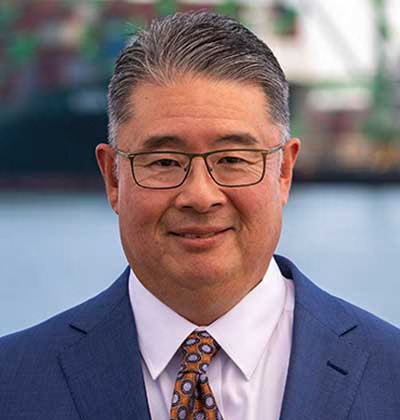
POLA Lead Attorney Steve Otera Named Corporate Counsel of the Year by LA Business Journal


LOS ANGELES — The Los Angeles Business Journal has given a top legal honor to Port of Los Angeles General Counsel Steve Otera. The prestigious Corporate Counsel Award in the non-profit/government/municipal category recognizes the achievements of industry-leading corporate counsel and their ongoing efforts to support the Los Angeles community and business sector.

“Steve’s broad grasp of both legal frameworks and the complex dynamics of port operations allows him to deliver insightful, forward-looking counsel that safeguards compliance and enhances performance,” said Port of Los Angeles Executive Director Gene Seroka. “We’re proud to see his exceptional contributions over 23 years at the Port recognized with this honor.”

Otera was appointed general counsel at the port in 2022 and reports to Los Angeles City Attorney Hydee Feldstein Soto. In this position and as a member of the port’s leadership team, Otera oversees all legal matters related to the City of Los Angeles Harbor Department. He also supervises the attorneys who provide general legal advice to the Los Angeles Board of Harbor Commissioners, Alameda Corridor Transportation Authority and Intermodal Container Transfer Facility.

Before his appointment, Otera served as an assistant city attorney assigned to the Port of Los Angeles, where he supervised staff providing in-house legal services. Prior to that position, Otera spent more than a decade in private practice, including as director of legal compliance and education at LRN (formerly the Legal Research Network). Before that, he served as an associate attorney for various local area law firms.

Otera earned his bachelor’s degree from UCLA and Juris Doctor degree from Loyola Law School in Los Angeles.