


Home Blog Page 113

Trump Drops the Hammer on Farmworkers

On October 2 Trump finally dropped the hammer on farmworkers. At the end of the season, when most workers who might protest are no longer in the fields, he cut the wages of 400,000 people by as much as a third.

Trump’s order, a Federal regulation published in Thursday’s Federal Register and implemented immediately, alters the way wages are set for farmworkers brought to the U.S. by growers on H-2A visas. These workers are recruited mostly in Mexico, and sign contracts to work for a maximum of 10 months per year. After that, they have to return home.

H-2A workers are very vulnerable to pressure from their employers. They can only work for the growers who recruit them, who can legally impose production quotas and fire workers for not meeting them. Recruiters are legally allowed to refuse to hire women, and almost all H-2A workers are young men. They can be fired for protesting, organizing, or simply working too slowly. They then lose their visas and usually find themselves on a blacklist, unable to return to work in subsequent seasons.

Existing Federal regulations require growers to provide housing, and transportation from the border and to work every day. Every year the Department of Labor sets a minimum wage for each state, called the Adverse Effect Wage Rate. It is usually a little higher than the state minimum wage in those states that have them. The reg’s original intent was to keep H-2A wages high enough that growers wouldn’t use H-2A recruits to displace local farmworkers. The new regulation changes both the wage system, and the housing requirement.

The new rule, called the “Adverse Effect Wage Rate Methodology for the Temporary Employment of H-2A Nonimmigrants in Non-Range Occupations in the United States,” says the wage in California for Skill Level One farmworkers will be $16.45 per hour. That’s a nickel below the state’s minimum wage this year. There is a higher, Skill Level Two wage, of $18.71, but Daniel Acosta, immigration director for the Economic Policy Institute, believes that “more than 90% of H-2A workers will get the lower wage.”

Today the existing AEWR wage, received by the 37,511 H-2A workers who labored this year in California fields, was $19.94. The wage those workers will be paid when they return next year, if growers pay the state minimum wage, will be $16.90 per hour, or three dollars less than they were paid this year. In addition, the new regulation allows growers to charge H-2A workers for housing, which they previously had to provide for free. In California, the allowed charge will be $3.00 per hour. The total cut will therefore be from $19.94 to $13.90 – over six dollars.

The day after the regulation was issued I stopped to talk with two H-2A workers at an old motel in California’s wine country. A half-dozen farm labor busses, all with Mc4F Solutions, LLC, painted on the side, were parked in front. The company is listed is an H-2A labor contractor, according to the Centro de los Derechos del Migrante, an advocacy organization for H-2A workers. The two said they’d been coming to work in the same vineyards for several years, and joked that by now they knew each vine personally. Both depend on the work to support families back home. Being away for most of the year, for them, was the biggest downside.

When they return next year, however, the company will have to tell them about the new, lower wage. In addition, they’ll be paying about $500 a month to sleep three to a room at the motel. The company may even save enough to buy the place. All over California H-2A labor contractors have taken over old motels, a process this regulation will accelerate. Other growers are building labor camps, now using this involuntary gift from their workers to pay off construction costs.

PORTERVILLE, CA – H-2A workers, working for Porterville Citrus, were housed by the labor contractor Fresh Harvest at the Palm Tree Inn in Porterville. During the pandemic some rooms had notices on the windows saying they’d been decontaminated and/or disinfected. Workers organized a protest when they weren’t paid their full wages at the end of their work contract.

Savings by Napa’s gentlemen farmers and wineries listed on the stock exchange is unlikely to produce good accommodations, however. Bad housing is one of the most common complaints among farmworkers. Nevertheless, regardless of its condition, workers will pay $3.00 an hour for it. The California Department of Housing and Community Development responsible for all employer-provided housing in the state, won’t be much help. It only has three inspectors, and in 2022 it failed to issue a single citation for illegal conditions, while issuing permits without making inspections.

The text of the regulation acknowledges “negative impacts” in government-speak. “Certain current H-2A workers may experience reductions in wages as a result of lower prevailing wage rates,” it warns. According to Marcos Lopez, a researcher for the University of California Davis Labor and Community Center, the total number of H-2A workers who worked in the U.S. this past year is close to 400,000. In simple language, they will get a wage cut. “This effect will be mitigated by an increase in the number of certified H-2A job opportunities, which will create additional employment for new H-2A workers.” In other words, new workers will be recruited if the old ones don’t like it.

Wage cuts for H-2A workers will affect all workers – bitter news for the people who were called essential during the pandemic. But the wages of farmworkers have never corresponded to the difficulty of the job, the skill needed to perform it, or the cost to workers’ families or their own bodies. Last year Juana, a strawberry picker in Santa Maria, told me, “Not many people can do this job,” she said. She’d been working in the berry fields for 15 years. “I have permanent pain in my lower back, and when it rains it gets very intense. Still, I get up every morning at 4, make lunch for my family, and go to work. It’s a sacrifice, but it’s the only job I can get.”

Juana was making $16, then the state minimum wage. The work season lasts for eight months, and produces an income of $21,760. But she and her husband pay $2000 a month rent, or $24,000 a year – more than her entire earnings. “We have to save to pay the rent during the winter when there’s no work,” she added. “If we don’t, we don’t have a place to live. And during those months there are always bills we can’t pay, so by March there’s no money at all, and we have to get loans to survive. Plus, I have to send money to my mama and papa in Mexico. There are many people depending on me.”

This year another worker, Emma, described to me the toll farm work takes on her. “In the oranges I have to climb ladders with a 40 or 50 pound bag on my shoulders,” she explained. “When I’m bunching carrots, I’m on my knees all day. Every season my body has to learn to adjust to the way my hands and back hurt. It can take an hour and a half to get to the field, and for all that the most I make is $700 a week. And last year 70 percent of the time I only got four hours of work a day because the company hired so many other people.”

Emma’s description of the cut in her hours is increasingly common. “A lot of workers come to us, saying they’ve been replaced in middle of season, or that they don’t get the hours they did before,” Sarait Martinez, director of the Binational Center for Oaxacan Community Development, told me. Martinez organizes Indigenous Mexican farm workers in California – people from towns in southern Mexico, speaking languages centuries old when Spanish colonizers arrived.

She explained that recruiters in Mexico target those communities. As a result, Indigenous farmworkers in California, both local and H-2A workers, sometimes find themselves at odds over displacement. “We do a lot of education,” she says, “where we emphasize to workers that the system exploits both. It wants us to fight each other over who has the right to work in the fields.”

To Martinez and other farmworker advocates, the new regulation was not a surprise. “Trump 1.0 used the exact same playbook in 2020,” Daniel Costa recalls. “First he got rid of the Farm Worker Survey used to set the Average Effect Wage Rate, just as he just did again. Then he said he’d just freeze H-2A wages for two years.” The United Farm Workers filed suit and blocked the move.

Discarding the Farm Worker Survey again this past August came after other moves to please growers. At the end of June Trump scrapped the Farmworker Protection Rule, regulations put in place by Julie Su, Biden’s Secretary of Labor, that provided minimal protections for H-2A workers. By getting rid of it, growers can now bar outsiders (community groups or unions) from H-2A housing, give workers contracts in languages they can’t read, retaliate against those who complain of bad conditions, and even stop using seat belts in the vehicles transporting them to the fields.

Trump’s new Agriculture Secretary, Brooke Rollins, promised changes like these in her Congressional nomination hearing. She told Congress she’d modernize the H-2A program “to do everything we can to make sure that none of these farms or dairy producers are put out of business [by immigration enforcement].”

Last year the Department of Labor gave growers 384,000 certifications for H-2A visas, for workers who now make up about a fifth of the U.S. agricultural workforce. That’s up from 98,813 in 2012, and from 48,000 twenty years ago. “Already H-2A workers make up a quarter of the crop workforce,” Costa charges. “Now growers will have a massive incentive to replace more people. We could see 500,000 H-2A workers.”

The new regulation, however, claims the wage cut is needed because of an emergency caused by the administration’s own actions. “With the historic near total cessation of illegal border crossings-the Department must take immediate action to provide agricultural employers with a viable workforce alternative while concurrently averting imminent economic harm.” It parrots grower claims that they face a severe labor shortage because “domestic applicants are not applying for agricultural positions in sufficient numbers.”

Edgar Franks, political director of Familias Unidas por la Justicia, a farmworker union in Washington State, recalls that during Trump’s first administration, Washington State’s Employment Security Department and the US Department of Labor agreed to completely remove the guaranteed piece-rate wage for H-2A workers picking apples, the state’s largest harvest. That effectively lowered their wages by a third, and undermined local workers too. “If wages drop even more, it won’t be worth it to pick apples,” he warned. “They manufacture a labor shortage to deincentivize the work for local workers. If they want to attract workers, they should pay higher wages. But the real intent is to lower wages.”

In addition, Martinez says, “the deportations and kidnapping of immigrants are now an excuse for growers to bring more H-2A workers and cut our wages.” The regulation acknowledges “that illegal aliens currently employed in agriculture may be adversely affected as growers shift toward reliance on the lawful H-2A program rather than illegal aliens.” Martinez counters that “the lack of immigration status disproportionally affects Indigenous workers. But while we’re forced to leave jobs and homes by raids and deportations, growers are still guaranteed workers.”

The new regulation, and the politics behind it, make winning and enforcing workplace rights and decent wages for farmworkers more difficult. Enforcement of even the regulation’s weak worker protections is already in trouble. In 2019, under Trump, only 26 of the 11,472 employers using the H-2A program were punished for labor violations. With Biden the DoL staff fell to only 810 investigators for the nation’s 164.3 million workers, or one inspector per 202,824 workers. Then over 2,700 DoL employees, or 20 percent of its workforce, left the department in the wake of Trump executive orders and job cutting by Elon Musk’s Department of Government Efficiency.

For organizers like Franks, organizing farmworkers is still the answer, especially with a Federal government undermining wages and terrorizing workers with immigration raids. “Organizing farmworkers is always difficult, but not impossible,” he says. “At Sakuma Farms we won our contract in 2017, and wages there are good and workers are protected. There’s never been a shortage of workers there.”

H-2A workers in Washington have protested in the past, including a strike after one worker died of heat and air contamination in 2018. “I think there will be anger over this new reg, especially by workers who are experienced, produce more, and expect to be rewarded for their work” Franks predicts. “And we’ve supported H-2A workers when they have protested. So as organizers we have to do a better job of supporting workers whenever they try to change things.”


Letters to the Editor: Toberman Seniors Rebuild Reputation, School Library Proposal, and Praise for “Art, Authenticity vs. Hypocrisy”

0


Toberman Seniors Club Seeks to Restore Its Good Name Amid Unexplained Changes

We, the members of the Toberman Seniors Club — formerly located at the Toberman Neighborhood Center in San Pedro for more than 60 years — feel compelled to clear our good name and reputation.

Last year, several unexpected changes began to affect our group without any explanation. These included restrictions on parking, limited restroom access, changes to our meeting room, a lack of communication from staff, and even the removal of our club’s U.S. flag, which was never returned.

In addition, serious accusations were made against our members, including claims that we intimidated staff and disrupted meetings with clients. We requested a meeting with the individual who made these allegations, but that request was denied. We also asked to speak with the organization’s board, but that opportunity was not granted either.

We are writing this letter in hopes that the good name and reputation of the Toberman Seniors Club — a group that has been a valued part of the San Pedro community for generations — may be restored.

Thank you in advance for considering and publishing our letter

Sincerely,

Diana Bejarano of Toberman Seniors Club


Request for School Library·

Hi! I’m Ms. Marissa, the librarian at Cabrillo Avenue Elementary School and a neighbor here. This project will help to bring brand-new graphic novels to our elementary school library! Graphic novels are very popular among our students, so adding new titles regularly is a must. Support my students here: https://tinyurl.com/CabrilloSP-Library

Marissa Hassani

Cabrillo Elementary School

San Pedro

“Art, Authenticity vs. Hypocrisy,” in the October 9-22, 2025

Dear Mr. Allen,

I am writing to express my profound appreciation and wholehearted support for your brilliant editorial, “Art, Authenticity vs. Hypocrisy,” in the October 9-22, 2025 issue. Your piece is one of the most incisive and clearly articulated commentaries on public art and civic integrity I have enjoyed reading. I was particularly impressed with how you framed the central conflict not merely as a matter of aesthetic taste, but as a fundamental struggle for the soul of our community. Your analysis of how art can be co-opted by “civic branding” and corporate interests, thereby losing its authentic voice, was incredibly compelling. The point you made about the difference between art that decorates a power structure versus art that questions and challenges it is a crucial distinction that is too often glossed over. You gave a voice to the vague unease many feel when public art feels more like a public relations campaign than a genuine expression of community spirit.

Furthermore, your ability to connect this artistic hypocrisy to broader political and social issues gave the editorial tremendous weight. It was not just an article about art; it was a powerful metaphor for accountability.

On a related note, as a United States Marine Corps veteran, I must also thank you for a previous piece where you referenced the wisdom of one of my heroes, Major General Smedley D. Butler. Seeing his powerful assertion within his speech and published book, “War is a Racket,” in your publication left a lasting impression. It demonstrated the same intellectual courage and commitment to uncomfortable truths you displayed in this latest editorial. Your work consistently goes beyond surface-level reporting to engage with the foundational principles that shape our community; for that, you have my most profound respect.

Your voice is a vital one. Please continue to challenge, provoke, and inspire your readers with this caliber of journalism. Thank you for your dedication and insight.

In Peace and Justice, Coach

Dr. Lawrence J. Gist II, Esq.

International Humanitarian Law

Rancho Palos Verdes, CA

Dr. Gist,

Thanks for the appreciation of my work, many times I hear more complaints than I do applause in the letters section, but that’s not to say I and RLN don’t get the vast majority of this town’s approval and appreciation. I am often stopped and told so when shopping or going out to dinner. And yet there’s a small cadre of business boosters who are living in their own PR bubble that refuse to listen, read or comprehend that there’s a different perspective than theirs and one which is better informed or historically more contextual.

Thanks for writing,

James Preston Allen, Publisher

Becoming Daddy AF, Through Dance and Storytelling


David Roussève Charts Life, Loss and Resilience

Telling a personal narrative that digs through 600 years of DNA history while incorporating a body of work that spans 40 years in dance seems like a feat only David Roussève could accomplish. And he did just that in Becoming Daddy AF, a powerful dance performance presented in October at CAP UCLA’s Nimoy Theater.

Written, created, and performed by David Roussève, Becoming Daddy AF draws on his seminal dance-theater pieces created for his company REALITY, weaving them into a new narrative that bridges past and present.

Becoming Daddy AF includes references to realities of racism, violence, sexual assault, enslavement and suicide. This truthful, first-hand telling charts the life of an African American man born in the U.S. in 1959 — and the histories his body holds, presented in three parts: 1. Love 2. Family and 3. Freedom — or “Love and family = freedom.”


FullRes Rousseve MassMoca 1236 1
Becoming Daddy AF (in-progress), by David Roussève, co-presented by MASS MoCA and Jacob’s Pillow, 2025. Pictured: David Roussève. Photo: Ryan Harper.

Love

Roussève, standing in front of a film backdrop of undulating ocean waves, began with his birth story. Portrayed initially through joyful movement, the dancer moved his arms and hands progressively in heartfelt, fluid gestures, in an unmistakable body language, depicting an artistic expression of childbirth. This was followed by Roussève’s narration, delivered in an exuberant Creole dialect, as his mother, telling the story of “King David’s” birth by a white Jewish doctor (who sent the “perfect” infant David to ICU for five days because of his misdiagnosis of jaundice when noticing Roussève’s “yellow” ie, Creole coloring upon delivery — unaware that “Creole babies take some time to brown up”).

Driven by deeply personal stories around love and family, Becoming Daddy AF uses humor to explore many of these themes, including 600 years of genealogy (from France, Portugal, Germany, Mali, Senegal, Haiti and Cuba), a roller coaster journey with HIV, and the shattering loss of a husband of 26 years. Roussève revisits movement from 35 years of dance-making to explore the meaning of virtuosity for a 65-year-old body.

Through his experiences and a professorial explication, Roussève’s performance reveals a man defying death while unable to fully embrace life. He recounts two divergent childhood events. The first is a sweet boyhood belief that a magical creature with a symbol of love, portrayed on stage as a vision of Peter Pan, would come to him. The second was about his being “inappropriately touched” by a male cousin, which subsequently allowed Roussève to discover his “super power” — disengagement. He became a master of disengagement, able to do so in an instant, yet he also managed to pour all of his emotion into his art.

Roussève talked about when he met the love of his life, his husband of 26 years, Conor, at a funeral. “Grief became love,” said Roussève. “Twenty-nine years later. love became grief and then transformed again.” Through this relationship, Roussève discovered what he called unconditional love, a love that helped him navigate the trials of an HIV diagnosis. A medication he was prescribed for HIV treatment destroyed the cells that make up the fatty deposits in your face. The effects of this left Roussève with a skeleton appearance, of sunken eyes and a face of only skin and bone. Fading away, he began to call himself “Skeletor.” This name upset Conor deeply, who, in response, rebuked Roussève for saying such a thing about himself.

09 David Rousseve Daddy AF Photo Ryan Harper 1
Becoming Daddy AF (in-progress), by David Roussève, co-presented by MASS MoCA and Jacob’s Pillow, 2025. Pictured: David Roussève. Photo: Ryan Harper.

Later, during the winter of 2018, to Roussève’s devastation, he and Conor divorced. One thing Conor never told Roussève was that he loved him. But after 10 years of couples therapy, the two promised to stay together, forever, as a queer family. This is where grief transformed to love again.

Family

Roussève’s narratives of his family included how his grandfather traced his family’s history and discovered many branches on the Roussève side, which ended up being largely white. It wasn’t lost on Roussève that while he was thankful for the records, he understood this was because of the privilege of record keeping not afforded to his Creole mother’s side of his family. Yet, he did know about his “cunning” maternal great, great grandfather who had a brain for business and could also dance. Other histories told of the elder Roussève men who were all “dedicated to the betterment of negro people” in their careers, including his father, Roland Roussève, who, even as it was a “disappointment” to his parents, achieved success as a well-known professional French Quarter jazz musician. He was also one of the first African Americans to enter graduate school at Louisiana State University.

Additionally, in 1977, while attending Princeton University, Roussève was told by an older professor who recognized his name that his grandfather wrote a book titled The History of the Negro in Louisiana. (Slides of the still-unpublished manuscript were on view in the lobby of the theater.)

Freedom

Roussève recounted his close brush with death when he spent three weeks in the hospital in 2009; he had given up, feeling he had no reason to live. Conor returned to visit him — after their divorce — and Roussève knew he couldn’t die; he had a reason to live. He “lives for love,” and this was the bittersweet manifestation of agony and ecstasy for Roussève.

At 65 years of age, Roussève stands, through his diagnosis, still performing, writing, creating and working. This in itself is a profound statement on the power of love and family in life, and for the dancer, this equates to freedom. Indeed, Roussève noted Becoming Daddy AF is dedicated to the four great loves of his life: his mother, Genevieve Arceneaux Roussève; his father, Roland Raymond Roussève Sr.; his first husband, Conor McTeague; and his current husband, Steven Rubenstein.

Notably, Becoming Daddy AF’s diegetic sound was excellent. It included both well-known and loved jazz and R’n’B numbers, along with either original or lesser-known tunes that were remarkably beautiful and captured the emotion of Roussève’s narratives.

11 David Rousseve Daddy AF Photo Ryan Harper 1
Becoming Daddy AF (in-progress), by David Roussève, co-presented by MASS MoCA and Jacob’s Pillow, 2025. Pictured: David Roussève. Photo: Ryan Harper.

In an especially joyful part, Roussève performed to Nat King Cole’s L-O-V-E, showcasing his elegance in an exuberant expression of dance. After the show, during a brief conversation, CAP UCLA director of education and special initiatives, Meryl Friedman, told Roussève she recently heard someone say, “You are what you remember.” Remarking on his performance to

L-O-V-E, Friedman noted that she could see what Roussève’s body remembers. Roussève replied, “I know it, they [the audience] see it,” which recalled his assertion that the body knows the truth.

Details: www.davidrousseve.com

Aunt Robbie’s Revolution Cart Brings Soul and Spice to San Pedro’s Sidewalks


LA street food culture is dominated by Mexican cuisine, from tamales to burritos, followed by hot dogs and sandwiches, despite the landscape featuring ethnic cuisines from the Pacific Rim, the Mediterranean Crescent, the Caribbean, and the Americas, with all of its variations and iterations. It’s diversity that makes LA’s food culture fun.

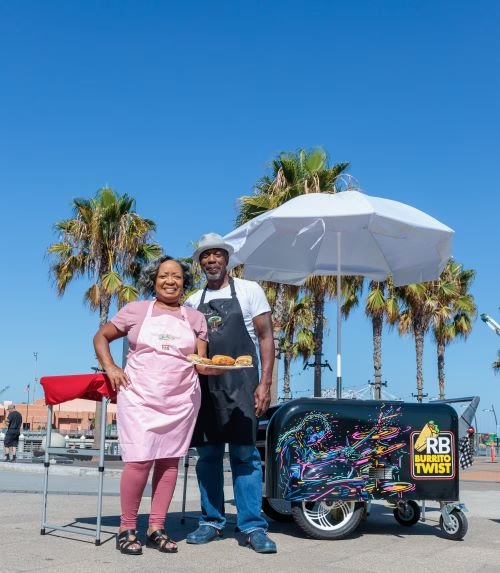
Now there’s a new food cart on the scene — RB Burrito Twist — where you can get a flavorful, satisfying meal and a soda for just $7. Robinett Gant’s Revolution Cart offers fusion fare that combines Cajun and Latin American cuisine. Gant, known as Aunt Robbie by friends and clients alike, offers burritos, tamales, and her special Twist fried rice bowls, which are filled with mild beef sausage and teriyaki chicken.

The shredded beef burrito, which is comparable to barbacoa but wrapped in flour tortillas and cheddar cheese, is seared on all sides. The shredded beef is so highly seasoned and flavorful that the only thing you may think is missing is a side order of barbacoa sauce.

RB Burrito Twist’s menu also includes bite-sized fried Cajun corn on the cob, 8-ounce cups of Brother’s Chilli with crackers, beef hot dogs, baked potato, and the Brother’s Potato Salad. All of the food is prepared in a professional kitchen and wrapped and kept warm in the state-of-the- art Revolution Cart.

“Once the health department sees that you have a Revolution Cart, they automatically okay them,” Gant said. Gant has had her permit for a little more than two years, having received it in December 2023.

A Revolution Cart is a Health Department-compliant, mobile street-food vending cart developed to legalize hot food vending in LA. A Revolution Cart is a new type of street-food vending cart designed specifically to meet Los Angeles County Department of Public Health rules for selling hot, freshly prepared food on sidewalks.This permit means that she doesn’t have to worry about her food being seized for lack of a license.

In the past year, the price of getting the permits has decreased significantly from when it first started back in 2020. Unfortunately, the price decrease came just after she had paid for all her permits. Gant noted the price decrease came as a bid to get more vendors operating without permits to buy in.

“Even though we’re selling burritos, we try to put a little soul into it. So we added a little bit of teriyaki. My specialty for the burritos is the teriyaki chicken burritos with jasmine rice and cilantro sauce,” Gant said.

A 35-year resident of San Pedro and child care provider for three decades, Gant chose to pivot to a small business focused on her creative pursuits as she transitions into retired life.

Gant’s RB Burrito Twist cart can be found at every First Thursday ArtWalk between Pacific and Mesa on 6th Street. Gant aims for her cart to be visible when West Harbor officially opens, as well as the community events at the town square at the Water Cut near the LA Maritime Museum.

To keep up with RB Burrito Twist, follow on Instagram: @RBBurritoTwist

Icon versus Caricature


The Orange Felon has just become a cartoon of himself

You don’t have to look any further than to look at the money in your pocket to know the icons of American democracy — George Washington, Thomas Jefferson, Abraham Lincoln, Andrew Jackson, Ulysses S. Grant and Benjamin Franklin. The monuments too are iconic — the Statue of Liberty, the Washington Monument and Lincoln Memorial and of course the White House (the people’s house) where presidents past and present live. These physical monuments are historic treasures representing the legacy of our democratic republic, “If,” as Franklin said, “you can keep it.” That’s the challenge today.

Once again the Orange Felon is desecrating our republic and one of our iconic treasures, the White House, by taking a wrecking ball to the East Wing without any authorization to build a 900-seat ballroom now being called the Epstein Ballroom. And for what — more presidential grift parties to pad one of his political PACs or worse? He’s made a mockery of the American presidency and has turned both his terms in office into bad reality TV.

Every day comes a new outrage: the firing of thousands of government employees; the blowing up of fishing boats off Venezuela by American armed forces. Then there are the ever-changing tariffs, the government shutdown, kicking the press corps out of the Pentagon and his childish cartoon responding to the No Kings day demonstrations. He has become a cartoon of himself. What is the next animated show on Fox network: Orange Man? Or putting his face on the statue of Liberty?

Don’t give him too many ideas here because you never know what’s coming next. One thing is for certain, he’ll do whatever it takes to keep the Epstein files out of public view, maybe even starting a war or crashing the economy. What you can be sure of is he’s hiding something with all of the chaos and distractions.

Only Donald Trump could look at years of legitimate criminal investigations into his corruption, obstruction and espionage — and somehow decide he’s the victim who deserves a taxpayer-funded payday.

In an unprecedented and jaw-dropping move, he is demanding that the Department of Justice hand him $230 million in “compensation” for the investigations into his own wrongdoing. That’s right: the same man who was caught hoarding classified documents, tried to overturn an election, and spent years undermining the rule of law now wants the American people to cut him a check — for doing it.

For the fiscal year that ended in September, the federal deficit, or the difference between government spending and revenue, totaled $1.78 trillion, down slightly from the prior year. The total outstanding federal debt is now more than $30 trillion, roughly equal to 100% of annual GDP, and near the highest on record since World War II, as measured by share of GDP. The debt service on this is equal to the discretionary part of the federal budget! This is completely unsustainable and the only way out of this historically is to raise taxes on the rich and/ or reduce the defense budget.

The big tax bill that was signed on July 4 cut so much of the social safety net, alongside the damage caused by the Department of Government Efficiency gutting many agencies across the federal government. There’s still a $1.78 trillion deficit? All I can say is that we have the largest military budget in the history of the world, the best equipped soldiers and yet in my lifetime they have yet to outright win a war. Not Korea, Vietnam, Iraq War I and II nor Afghanistan. None of these were as decisive as World War II, the Civil War or the Revolutionary War. Those wars the soldiers knew what they were fighting for and against. Now I’m not sure the U.S. military and definitely not the generals and admirals know what the core mission is of their respective services, especially after the mandatory sit down (or was it a dressing down) by Pete Hegseth, another caricature, the new secretary of war. Except there is no declared war but for the Orange Felon’s threats against Los Angeles, Chicago, Portland and Washington, D.C., etc.

What we are witnessing is the total deconstruction of the federal government in alignment with libertarian philosophy that the government’s only role should be to defend our borders and enforce the laws (except the ones they want to break).

The difference between being a true icon and a caricature is in the authenticity of the ideals you stand for. Things that will last beyond your own life that are baked into the culture and the psychology of a people. It comes from courage and struggle‚ not from bullying, bribery and fear.

The next time you pull out your wallet, take a moment to reflect on what it took for the person on your money to be revered as an American icon—and compare that to what you see now. Just imagine how you’ll feel when his face appears on the national cryptocurrency. You’ll know exactly what it’s worth.

Justice Ketanji Brown Jackson to Lecture at CSUDH


The U.S. Supreme Court’s conservative majority has faced criticism for decisions seen as undermining democratic norms. In contrast, Justice Ketanji Brown Jackson has drawn attention for her dissents, often aimed at protecting procedural fairness and minority rights while signaling guidance for future jurists — much like Justice John Marshall Harlan’s lone dissent in Plessy v. Ferguson, the 1896 Supreme Court decision that upheld segregation laws. Harlan’s dissent declared the Constitution “color-blind” and intolerant of classes among citizens.

Since joining the Supreme Court, Jackson has authored several notable dissents:

  • Chinn v. Shoop (death-row case) – Jackson dissented from the denial of review, arguing that suppressed evidence could have affected the outcome. She was joined by Justice Sonia Sotomayor. 
  • Glacier Northwest, Inc. v. International Brotherhood of Teamsters (2023) – The sole dissent addressed whether a state tort suit for property damage during a strike is preempted by the National Labor Relations Act. Jackson warned the decision could weaken workers’ right to strike and undermine the National Labor Relations Board. She wrote: “Workers are not indentured servants, bound to continue laboring until any planned work stoppage would be as painless as possible for their master.” 
  • Trump v. CASA, Inc. (2025) – Jackson dissented separately from the majority’s ruling limiting lower courts’ ability to issue nationwide injunctions against executive actions, calling it “an existential threat to the rule of law.” She argued that allowing the executive to act against people who have not yet sued is dangerous.

Jackson will appear as a visiting lecturer at California State University, Dominguez Hills, this fall as part of the Presidential Distinguished Lecture Series. Her lecture, “Lessons from My Life in the Law,” will include a discussion with CSUDH President Thomas A. Parham and a faculty panel. The series, established by Parham, aims to engage the campus and community in conversations on pressing societal issues.

Last week, the Roberts Court heard arguments in Louisiana v. Callais, a case challenging whether Louisiana’s remedial congressional map — adding a second majority-Black district to comply with Section 2 of the Voting Rights Act — constitutes unconstitutional racial gerrymandering. Plaintiffs argue race predominated in the map’s design; the state contends it was necessary to remedy minority vote dilution. The court is examining the balance between Section 2 protections and the Constitution’s Equal Protection and 15th Amendment limits.

While Jackson is unlikely to comment on this or other pending cases at the lecture, her perspective at this moment is especially timely.

Harbor Area ICE Watch


By Rosie Knight, Columnist

Since early June, ICE agents have been staging on Terminal Island, escalating raids and testing new tactics — echoing 1942, when Franklin Delano Roosevelt erased the island’s Japanese fishing community and sent residents to internment camps. Today, a federal force again disappearing our neighbors, using our community as its base of operations. This column will track ICE actions, community responses, and upcoming protests to ensure such history is neither forgotten nor repeated.

If you see an ICE operation in progress, call the Rapid Response Hotline at 888-624-4752.

Raids Continue Across LA

ICE raids continued across Los Angeles on Oct. 17, with confirmed activity in Santa Monica, Inglewood, San Pedro, Anaheim, San Bernardino and Fontana, according to LA Taco’s daily tracker. Many cities reported multiple detentions, reflecting a growing pattern of coordinated federal actions throughout the region.

Harbor Area Peace Patrol to Host Costume Protest

The Harbor Area Peace Patrol will host a Terminal Island costume party, Oct. 24 from 4:30 p.m. to dark, to protest ICE’s use of the Coast Guard base for daily operations. Organizers urge participants to wear costumes — but no weapons or props — and to demonstrate peacefully under the banner “ICE Out of LA!”

Nationwide ‘No Kings’ Rallies Denounce Authoritarianism

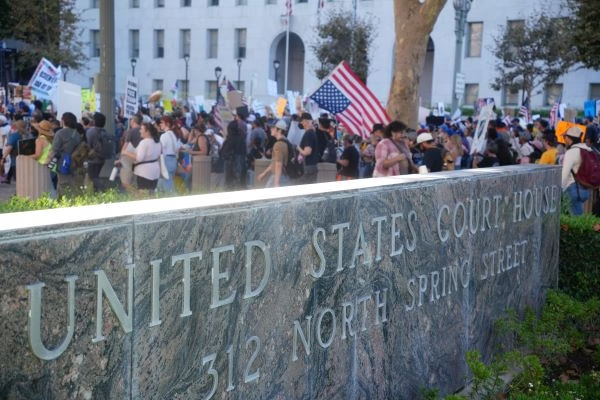
On Oct. 18, millions joined “No Kings” rallies across all 50 states to protest authoritarian overreach and government abuses. In Los Angeles, thousands rallied at more than a dozen sites, joining a national call for democracy, accountability and community resistance.

Learn more at: https://tinyurl.com/No-Kings-Rally

Blitz of Harbor Area ICE Raids Leads to 20 Confirmed Kidnapped Community Members

San Pedro residents woke up Wednesday morning on Oct. 8 to what at first seemed like more of the same: Heavy Immigration and Customs Enforcement activity at Terminal Island and, therefore, a wariness about safely moving in and around the Harbor Area. And as it has been since the current administration sent ICE into Los Angeles and San Pedro in June, our loved ones, families and neighbors resiliently got up and went about their days. They got dressed and stepped out of their front doors, hoping that today they would get to return home. Sadly, that was not the case for all of our neighbors.

According to Harbor Area Peace Patrol, 13 people were kidnapped in San Pedro on Oct. 8, including a local tamale vendor, a man walking past Louie’s No. 2 Chinese Cuisine on Pacific Ave., and people snatched from parking lots. Though it is likely that the number is higher because these are only confirmed kidnappings.

In a segment of an emailed statement to Random Lengths News, Harbor Area Peace Patrol encouraged readers to join their community of volunteers:

Our communities are under attack. How do we explain to our children the masked figures tackling, handcuffing, and dragging away the tamale vendor, the day laborer, or the car wash employee? Their continued presence in our community brings only fear, damage to the economy, distrust in elected officials, and division in our country. We encourage all of our neighbors to contact Harbor Area Peace Patrols (harborareapeacepatrols@gmail.com) and learn how to protect each other during this ongoing siege.

It was only a few days later that HAPP reported on seven confirmed kidnappings in Wilmington, after another day of raids on our community.

San Pedro Film Festival Marks 14th Year with Exciting Films and Update in Arts Community Engagement


Festival to teams up with launch of the first “Second Saturday ArtWalk,” a New Downtown San Pedro Arts Initiative

SAN PEDRO — The San Pedro Film Festival or SPIFFest, Oct. 19 announced its 14th annual celebration, showcasing a diverse selection of independent films, compelling documentaries, and engaging screenings this November 7 to 9. This beloved community event continues to cultivate the local arts scene, foster creative expression, and bring residents and visitors together through the power of cinema.

This year marks an exciting milestone with the launch of the first “Second Saturday ArtWalk,” on Nov. 8, from 1 to 7 p.m., an initiative created by the art community of downtown San Pedro. Coinciding with the festival, the ArtWalk will transform the downtown area into a vibrant art walk from gallery to gallery, featuring local artists, music and food. This collaborative event affirms San Pedro’s growing reputation as a hub for creativity and cultural connection.

IMG 3483 Enhanced NR
Alan Padilla of the Artistry Lounge in San Pedro. Photo by Arturo Garcia-Ayala
IMG 2762
Image from the SP ArtWalk. File photo.


“This partnership between film and art celebrates what makes San Pedro so unique,” said Ziggy Mrkich, SPIFFest founder and festival director. “Each year, the San Pedro Film Festival brings our community together to celebrate creativity, diversity, and shared stories. We’re thrilled to expand that celebration through the Second Saturday ArtWalk — a new way to experience the spirit of San Pedro.”

The 2025 festival features an eclectic lineup of films from emerging and established filmmakers, highlighting stories that reflect the rich cultural tapestry of San Pedro and beyond. In addition to screenings at local venues, SPIFFest will host panel discussions, filmmaker Q&As, workshops, and special events designed to celebrate the art of storytelling and promote local talent.

Highlights of this year’s SPIFFest include the award-winning documentary In Plain Sight directed by Rosanna Xia (LA Times journalist) and Daniel Straub, which explores the issue of DDT barrels in the ocean just off the Southern California coastline. The festival also features premieres of several local films and a screenplay competition showcasing emerging writers.

482346869 1039949618169033 1621389252195300607 N
SPIFFEst

Visitors can purchase festival passes and individual tickets through SPIFFest.org and plan their experience with the full schedule of showtimes, events, and ArtWalk activities. Saturday night the SPIFFest Mixer will happen at Wunderkammer at Crafted.

Details: www.SPIFFest.org

No Kings — From Our Smallest Towns to Our Largest Cities

By Senator Bernie Sanders

Thank you to the millions of Americans — from our smallest towns to our largest cities — who are gathering today at thousands of rallies.

House Speaker Mike Johnson called these events “hate America” rallies. Boy, does he have that wrong. Millions of Americans are out here not because we hate America, but because we love it.

We’re here because we honor the sacrifices of millions who, over 250 years, fought and sometimes died to defend our democracy and our freedoms.

In 1776, with extraordinary courage, the founders of our country told the world they would no longer be ruled by the king of England, who had absolute power over their lives. They demanded freedom — and fought a bloody eight-year war against the most powerful empire on earth. Tens of thousands died, but they won.

And in 1789, they did something revolutionary. They created the first modern democratic government, declaring to the world: No more kings. In America, we the people would rule.

Today, in 2025, our message is the same: No, President Trump, we don’t want you — or any king — to rule us. We will not move toward authoritarianism. In America, the people will rule.

When George Washington was sworn in as our first president, he called this attempt at self-government “an experiment entrusted to the hands of the American people.”

My fellow Americans, that experiment is now in danger.

It’s in danger when we have a president who wants more and more power in his own hands — and in the hands of his billionaire friends.

It’s in danger when peaceful protesters in Portland or Chicago are called “insurrectionists” while the U.S. military is deployed against them. It’s in danger when masked ICE agents break down doors, detain people without due process, and take them to unknown places.

It’s in danger when a president sues and intimidates the media, silences dissent, and undermines the First Amendment — the very foundation of our democracy.

Our democracy is in danger when he threatens to arrest political opponents — including a sitting U.S. senator, the governor of California and the attorney general of New York. When he undermines freedom of thought at our universities. When he threatens to impeach judges who rule against him. When he ignores Congress, diverts federal funds for political gain and redraws congressional maps to fix future elections.

It’s in danger when he illegally fires tens of thousands of federal employees and rips up the union contracts workers fought to win. And it’s in danger when he violates the Constitution by accepting lavish gifts — like a $400 million plane from Qatar’s royal family — and rewards them with a military contract on U.S. soil.

But this is about more than one man’s greed or corruption. This is about a handful of the wealthiest people on earth who have hijacked our economy and our political system to enrich themselves at everyone else’s expense.

I’m talking about Elon Musk, Jeff Bezos, Mark Zuckerberg and the other billionaires who funded Trump’s campaign, showered him with gifts and saw their fortunes explode under his presidency.

We live in a nation where one man, Mr. Musk, owns more wealth than the bottom 52% of Americans. Where the top 1% own more than the bottom 93%. Where the richest have never been richer while 60% of our people live paycheck to paycheck — struggling to pay rent, child care, health care, and food, while trying to save for retirement.

We are the wealthiest country in human history, yet we have one of the highest rates of child and senior poverty in the industrialized world. Eighty-five million Americans are uninsured or underinsured. Eight hundred thousand are homeless — while Mr. Musk is on track to become a trillionaire.

The richest among us are pouring billions into artificial intelligence and robotics — technology that could eliminate tens of millions of jobs. This billionaire class believes they have a divine right to rule, to take massive tax breaks and avoid accountability.

My fellow Americans: We rejected the divine right of kings in the 1700s. We reject the divine right of oligarchs today.

And now, on the 18th day of a government shutdown, millions of federal workers are going without pay. What is this shutdown about? It’s about Trump’s “Big Beautiful Bill,” which gutted Medicaid and the Affordable Care Act, throwing 15 million Americans off health care.

When you take away people’s health care, studies show 50,000 of them will die unnecessarily every year.

That same legislation doubled premiums for 20 million Americans. In Vermont, people have seen premiums triple or even quadruple. Across the nation, families are being crushed by skyrocketing health costs — all to give $1 trillion in tax breaks to the top 1%.

So let me be clear:
No, I will not vote for a budget that throws 15 million people off health care and causes 50,000 needless deaths every year.
No, I will not vote for a budget that doubles premiums for working families.
No, I will not vote for a budget that forces nursing homes, rural hospitals and community clinics to close — all so billionaires can hoard more wealth.

To my Republican colleagues: End this shutdown. Come back from vacation. Negotiate in good faith. Stop destroying the American health care system.

But ending the shutdown isn’t just about health care. It’s about declaring, once and for all, that we will not live under the rule of one man.

My friends, we are the greatest country in the history of the world. When we stand together — when we refuse to be divided by demagogues — there is nothing we cannot accomplish.

Yes, we can build a democracy that ends Citizens United and keeps billionaires from buying elections.
Yes, we can guarantee health care as a human right.
Yes, we can take on Big Pharma and stop paying the highest prescription drug prices in the world.
Yes, we can build millions of affordable homes so young people can achieve the American dream.
Yes, we can make public colleges tuition-free and build the best child care and public school system in the world.
Yes, we can expand Social Security so every senior can retire with dignity.
Yes, we can raise the minimum wage to a living wage and protect every worker’s right to join a union.
Yes, we can lead the world in ending fossil fuels, creating millions of good-paying jobs while saving the planet.
Yes, we can guarantee that every woman has the right to control her own body.
And yes, we can ensure American tax dollars never again starve children in Gaza or anywhere else.

Now, people ask me all the time: “Bernie, how are you going to pay for it?”

Here’s how: At a time when billionaires pay a lower effective tax rate than nurses and truck drivers, the wealthiest 1% and the largest corporations will finally pay their fair share.

My fellow Americans: The establishment wants you to believe you are powerless — that you cannot change the status quo. That is a lie.

Throughout our history, when Americans have stood up and fought for justice, they have prevailed.

When the founders stood up to King George, they were told it was impossible. But they won.
When abolitionists fought to end slavery, they were told it was impossible. But they won.
When workers organized unions, when women demanded the vote, when Black Americans fought segregation, when LGBTQ people demanded equality — they were told it was impossible. But they won.

They did it then. We can do it now.

And how do I know we will succeed? Look around you. Look at this crowd in Washington. Look at the millions marching across the nation — more people in the streets today, Oct. 18, 2025, than at any other time in American history.

This is not the end. This is just the beginning.

Together, we will build the kind of nation we know is possible — a nation devoted to freedom, justice and democracy.

No Kings… And No Courtiers, Either: What’s Next In The Fight For Democracy


Seven million people turned out in a patriotic protest of Trump’s ongoing attempt to subvert American democracy on Oct. 18. It was by far the largest such demonstration ever, 10 times larger than the Tea Party at its peak and 2 million more than the first No Kings demonstration in June.

Inspired by the example of Portland, there was a widespread playful presence of inflatable costumes, mocking the president’s ludicrous attempts to portray the demonstrations as a menacing threat to the republic.

“Fun and play are often a part of social movements as the people trust the larger group to hold their values as the conflict with the state expands,” social movement scholar Dr. Lisa Corrigan‬ explained on Bluesky. “When the conflict expands in scale & scope, the good feelings help propel people to do hard things,” she added.

A unicorn-clad protester in LA told MSNBC’s Jacob Soboroff, “We’re here peacefully protesting, looking as ridiculous as we can, just so maybe we appeal to the president, because he’s a ridiculous leader that is normalizing abuse of power. And we cannot stand and act like nothing is happening.”

“Why the costumes?” historian Joanne Freeman asked‬ on Bluesky. “Authoritarians grab power with fear. They can’t STAND mockery. It weakens their hold. That’s why.”

And Trump’s hold was weakened, dramatically. He responded to the protests that night with infantile rage on his social media platform in the form of an AI-generated video showing him wearing a crown and flying a fighter plane over a crowd of protesters whom he showered with shit. In a normally-functioning democracy, he would be out of office by the time you read this. But we are not a normally-functioning democracy.

That’s the whole point of No Kings protests and movement. Sustained non-violent protest movements have a high (though not perfect) rate of success in ousting strongmen once they reach a threshold of around 3.5% of the population (about 11 million Americans), so the No King movement is more than halfway there in nine months time. Which raises the question of what comes next.

Leah Greenberg, co-founder of Indivisible, a principal No Kings backer, gave a two-fold answer the morning afterwards on MSNBC. “If this is your first protest, find your organizing home. That could be an Indivisible group, that could be a 50501 group, that could be another local organizing hub,” the point is to find people in your community to take effective action with.

Second, she said, would be the fruit of a follow-up organizing call, “to collectively come together and make sure that people are taking action on a regular basis to push back on the enablers of Trump and MAGA,” she said. “This is not just about one man. This might be no kings, but there’s an entire court that is holding him up, and we actually have to apply our collective power to mobilizing but also to pushing those folks.”

We’ve already seen examples of how this can work, with the swift reinstatement of Jimmy Kimmel as a prime example. Another example is the recent refusal of colleges, including USC, to agree to the Trump administration “compact” that would destroy the fundamental framework of academic freedom.

When Trump was inaugurated, a lot of powerful people thought he was going to consolidate power, and they decided to go along, Greenberg noted. “What we are doing is we are bringing together millions and millions and millions of people, more every single time we come out to say ‘Oh no! He is not going to. He is actually facing a bigger and growing and rising force all over this country that is going to push back on him, and you better factor that into your own decisions — if you’re a corporation, if you’re a university, if you are making a decision about whether you’re going along with Donald Trump or whether you’re pushing back, you’ve got to understand that we are out there, and we are watching.”

So we should expect to see some striking developments in how the No Kings movement expands on these sorts of battles going forward.

Meanwhile, local leaders with two Indivisible chapters offered Random Lengths some follow-up suggestions of the first sort even before No Kings Day. “I would encourage people to get involved in any way they can,” said Kenny Johnson with South Bay Indivisible. “People’s passions and talents are needed everywhere to push back against the authoritarianism from the Trump administration and the Republican Party.”

“There’s a lot of fear, anger, and despair over everything that’s happening, and the best way to counteract that is with courage, love, and hope,” said Heather Rodriguez of Lakewood Indivisible. “Instead of witnessing terrible things happening in isolation, I encourage everyone to come together and be comforted in the fact that you are not helpless; in fact you are joining in important work to help your community, and there are others like you right here who will help you too.”

First, she said, “We will be doing a Disappeared in America candlelight vigil on Oct. 28 by our Lakewood city council chambers during the city council meeting to bring awareness to people kidnapped by ICE within our city. We would love people to attend and have invited all of our local representatives.”

In addition, “We are suggesting people support street vendors by buying from them. We collected donations to buy a bunch of flowers from a local flower vendor for tomorrow’s protest,” she said. “Donating food or clothing to mutual aid programs is so helpful. Our group has seen a huge increase in local need. Many established mutual aid groups are so overwhelmed, they refer people to more grassroots groups in hopes that we can get supplies and help faster. It’s insane. Some of us are putting home gardens to use in getting healthy donations as well.”

There are also organized options. “Join a local rapid response or ICE patrol group,” she suggested. “Our volunteers make contact with day laborers, car wash employees, and other at-risk people and maintain a visible presence to deter ICE, get resources to people who need them, record ICE interactions, etc.”

Putting it all together, she said, “We have built this network of helpers and it’s beautiful. Please come and be a part of it with us.”

Johnson struck some similar themes, suggesting joining community self defense groups “like Union del Barrio, Harbor Area Peace Patrols, or others to help keep your neighbors safe from ICE and DHS,” as well as joining an ICE rapid response network, with groups like CHIRLA and Orale. He also suggested people “Join a mutual aid organization, tenants union, or other groups that are seeking to provide aid and protection to our most vulnerable communities.”

But there are also political actions to consider. With the November election just weeks away, the most urgent thing Johnson mentioned was canvassing, phone-banking or text-banking for Prop 50, the ‘Election Rigging Response Act,’ to help offset the GOP redistricting efforts Trump has been pushing, starting in Texas. “It’s critical that Democrats take back the House in 2026,” Johnson said.

In addition, he suggested, “Join your local Indivisible, DSA, Working Families Party, or Democratic club. We’ll need all hands on deck for 2026 to get Democrats and (preferably) progressives elected — especially those willing to fight back.”

But don’t just work to elect folks. “Demand more from your elected officials,” he said. “Call them, email them, show up to town halls, city council meetings, etc.”

And he also advised running for local office, countering what MAGA Republicans have done in running for school boards, library commissions and city councils. Run For Something has a well-developed support system for potential candidates, and Local Progress has support for advancing progressive policy once folks are elected.

There are, in short, a wide range of different things people can do. “No one can do everything, but everyone can do something,” political scientist Nathan Kalmoe wrote on Bluesky. It’s a saying whose origins are uncertain, but “It’s a super important concept,” he said. “Empowering, with the bonus of being true. Problems feel overwhelming until we can see how a little bit from all of us adds up to make big changes.”

In addition, “It also emphasizes that change requires many types of contributions. People think doing politics is voting, posting on social media, and maybe protesting/donating. But it’s also civics lessons, and legal briefs, and healthcare guided by awareness of discrimination, and sermons centering empathy and care, and helping a neighbor or family member understand why it matters to them, and equitable hiring practices in business and workplace organizing.”

Seen in this expansive framework, the question becomes one of how to make the most of what people are already doing alongside what more they might do. Organizer and author Stacey Abrams provides a multi-level model for this in her podcast, “Some Assembly Required.” On the micro level, Abrams provides a framework for individuals to integrate what they’re already doing with something more, while on the macro level she provides a framework for doing the same collectively.

The micro level framework is laid out in every episode. While Abrams discusses a wide range of salient political issues with one or more knowledgeable experts, she routinely closes with a three-part “toolkit”: First, be curious (find more information to better informed); second, take action (do something concrete to advance policy change); and third, do good (provide specific help). For example, on her Sept. 11 episode, she explored Trump’s attacks on public education. The toolkit for that episode was:

  • BE CURIOUS: To learn how the right wing’s attacks on public education have misled policymakers and parents, read Death and the Life of the Great American School System: How Testing and Choice Are Undermining Education by Diane Ravitch.
  • SOLVE PROBLEMS: Protecting education is a job for all of us. Attend a school board meeting where you live before December to learn about what’s happening in your community’s schools. Don’t assume everyone knows what’s going on — talk to your neighbors about the issues you care about most. And empower your older children to join you in these efforts.
  • DO GOOD: With cuts to SNAP, many children will not have access to regular meals. Consider joining up with neighbors to put together weekend food backpacks for kids. Visit www.feedingamerica.org and search “backpack program” for more information.

Then at the macro level, Abrams provides another model. In her work, she uses the “Ten Steps to Autocracy” framework inspired by Princeton Professor Kim Scheppele, which begins with step one: “The powerful are chosen in a free and fair election, but it’s likely the last one,” and concludes with step 10: “They end democracy itself by disrupting elections, undermining voting systems, and formalizing authoritarian rule.”

In her Sept. 18 episode, she introduced a contrasting framework, “Ten Steps to Freedom and Power,” articulated as action verbs. “In every nation that has faced this fight and reclaimed democracy,” she said, “the Ten Steps are these: commit, share, organize, mobilize, litigate, disrupt, deny, engage, elect, and demand. In total, the Ten Steps campaign is about how we realize we are not alone and that we can win. We can save ourselves. Like one of those photo mosaics, each of us is part of the larger picture. Even though we feel very small. Yes, we may feel overmatched and like we’ve already fallen too far behind. But victories have been won with less.”

This echoes what Kalmoe was saying about the many different types of contributions, and the recognition that “everyone can do something.” But one other thing that Abrams said is crucial:

“The time for absolute agreement is over. Now is the time to get to work with whomever is willing to work with us. We don’t have to do the same things in the same way or for the same reason, but we all have to take action now.”