
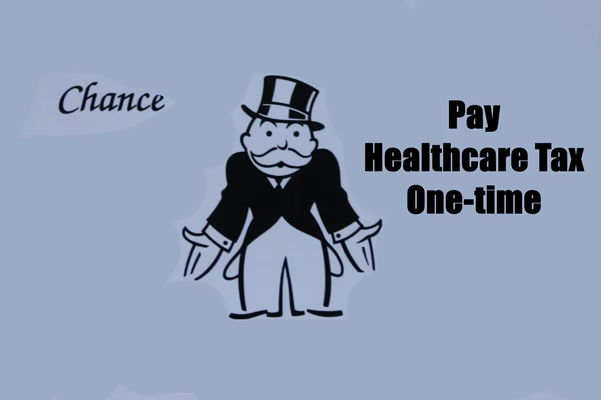
Proposition 40—the billionaire tax—has a dual character: what it is and what it symbolizes. What it is, on the one hand, is a modest one-time tax of 5% on the wealth of billionaires (still leaving their tax rate lower than others in the top 1%), that will be used to make up for cuts to health care and food assistance in the GOP’s so-called “One Big Beautiful Bill,” which also gave massive tax cuts to those same billionaires and their companies.
Nothing about the bill itself justifies the hysterical attacks on it. There’s no billionaire mass exodus over such a modest one-time tax, nor is investment fleeing either. California has attracted 80% of all new venture capital funding in America this year—after the wealth tax initiative was announced—compared to about 50% before 2025, as noted in a letter by six Nobel Prize-winning economists who support Prop 40.
They also put the tax’s modest size into perspective. “Over the 2019-2025 period, the total amount of California income tax paid by billionaires amounted to only 1.6% of their $1.4 trillion wealth gain,” they wrote, “much less than what ordinary Californians pay on their paychecks.” In fact, others in the top 1% pay 12% in income taxes, so the one-time wealth tax would still leave them paying barely more than half what the rest of the 1% pays, just for one single year. And they have up to five years to pay it.
What Prop 40 symbolizes, on the other hand, really could be earthshaking. This is the first billionaires tax in the world, and the first wealth tax in America. And that’s what the billionaires are really afraid of. “Proposition 40 offers the first opportunity for the people to start reining in the power of billionaires,” the Nobel laureates wrote. “If the state that houses some of the country’s most powerful billionaires votes to tax their wealth, it will kickstart a movement to tax ultra-high-net-worth individuals in other states — and eventually at the federal level and in other countries. As Californians head to the polls, their vote may well come to be seen as a turning point in the battle between democracy and oligarchy.”
In essence, what Prop 40 does is reverse some of the damage done when the GOP cut more than a trillion dollars from health care spending and more than $200 million from food assistance, to give tax cuts to wealthy Americans. To counter this, Prop 40 is estimated to raise to $100 billion, with 90% of the revenue devoted to offsetting Trump/GOP cuts to Medicaid and 10% devoted to offsetting cuts to food assistance.
Not all billionaires oppose the tax. Nvidia’s CEO Jensen Huang has said he would be “perfectly fine” with it, and Tom Steyer is actively supporting it. But Google co-founder Sergey Brin—whose wealth is based on initial public funding from the National Science Foundation (NSF), DARPA, and NASA— is a leader among a tight-knit group of billionaires opposing the measure with everything they’ve got—not just baseless fearmongering mentioned above. An early idea—never implemented—was buying a signature-gathering firm hired to qualify Prop 40, but what they settled on was creating new organizations to defeat Proposition 40, along with promoting two poison-pill propositions—41 and 42—that would nullify Prop 40 if they got more votes.
The most prominent organization was Build a Better California, funded mostly by Brin to the tune of a hundred and two million dollars as of late summer. Other pop-up groups were Golden State Promise and Stop the Squeeze. True to their nature as billionaires, they set out to create a whole new ecosystem of groups just to defeat Prop 40—not for the fearmongering reasons they give, but because of its symbolic nature, as a potential “turning point in the battle between democracy and oligarchy.”
These groups are financing campaigns against Proposition 40, and Build a Better California is also backing Propositions 41 and 42—two newer initiatives that, if passed, could nullify the wealth tax
Polls show Democratic voters strongly behind it, roughly 3-1, and the state Democratic Party endorsed it as well. But prominent California Democrats—led by Gavin Newsom—have come out against it, echoing the billionaires’ fearmongering. This profound split between the Democratic base and the politicians supposedly representing them has been seen across the country this year, as insurgent candidates with democratic socialist support have repeatedly beaten much better-funded establishment picks. It’s too early to tell how this will play out here in California, but the opening for a new wave of candidates seems undeniable.
Not only did Newsom come out against Prop 40, he more recently endorsed Prop 42, which would not only invalidate Prop 40 if it got more votes, but it would also ban any future wealth tax as well. The endorsement “runs counter to his own Democratic Party and some labor unions,” CalMatters noted, but “It also aligns him with some of the wealthy tech donors with whom he’s maintained longstanding relationships dating back to his days as mayor of San Francisco.”
So, what exactly would the billionaire-backed propositions do? Each of them builds on different anti-tax campaign strategies of the past.
As described in the state voter guide, Prop 41 “Nullifies state taxes enacted after January 1, 2026 that exempt their revenues from voter-approved state spending limit,” which the billionaire tax does. That’s really all you need to know about it.
But it doesn’t just block the billionaire tax, as the League of Women Voters explains. The League opposed the spending limits in the 1979 Gann Initiative “because its spending limit was too inflexible to assure adequate government services in an uncertain future. Prop 41 would extend that constraint to new tax revenue.”
The voter guide also says that Prop 41 “Requires pre-election and recurring audits of programs funded by new special taxes.” Once a tax initiative gained 25% of the signatures needed to make the ballot, an audit would be required, and it would have to include identifying ways to reduce costs by 10 percent—which is a perversion of how normal, objective audits work. It takes the conservative assumption that government spending is inherently wasteful and tells the auditor to find ways of justifying the assumption, regardless of the facts. The resulting “audit” would thus give the assumption of government waste the false appearance of objective fact.
Since special taxes are proposed to meet previously unforeseen needs, the contrary assumption that 10% cuts could be made instead is particularly perverse. Ebenezer Scrooge would be delighted.
While Prop 41 relies on the rhetoric of “protecting taxpayers from wasteful government spending,” Prop 42 takes a different tack: “they’re not coming after billionaires, they’re coming after you!”
Prop 42 would ban any wealth tax whatsoever, but as CalMatters explains, “Proponents primarily argue that middle-class workers’ retirements and pension accounts should never be taxed as assets before the gains are later taxed a second time as income, even though there is no such proposal.” Indeed, any such proposal would be far too unpopular to be passed into law.
If that really was the problem that Prop 42’s authors were worried about, they could have written the proposition to only protect workers’ retirement and pension accounts from any future wealth taxes. But of course, that wasn’t what they were worried about at all. They’re just gaslighting about what they’re trying to achieve. Still, that was enough to get Gavin Newsom on board. “We all agree that Californians deserve to have their retirement and life savings protected from new state taxes so those savings are there when they need them,” he said in a statement supporting Prop 42.
But the League of Women Voters, which opposes it, has a very different view. “Prop 42 would lock broad new restrictions on state taxing power into the California Constitution, limiting California’s ability to respond to future needs,” they say. “The ban goes far beyond retirement savings. It would prohibit new state taxes on the ownership or control of a wide range of personal property, including stocks and other financial assets, business interests, art, intellectual property, retirement accounts, and other savings and assets.”
To put it more simply: do you really think that Google co-founder Sergey Brin would spend $10 million several times over to protect workers’ pensions from a non-existent threat? Or is he just trying to defeat the billionaire tax to avoid paying half of his fair share for just one year?
Returning to a point made earlier, billionaires would have up to five years to pay the full amount owed. If things keep going as they have, their increased wealth will easily more than cover the tax’s cost.
But there’s a much higher looming cost they’re ignoring, according to economist Dean Baker, an early predictor of both the dotcom and the housing bubble bursts. “If the collapse of the AI bubble is like the collapse of the tech bubble, the billionaires could lose half of their wealth, ten times as much as the hit from the wealth tax,” Baker told Random Lengths.
The recurrent rise and bursting of bubbles in an under-regulated economy is far more damaging to the economy than a modest wealth tax would be. In fact, a wealth tax would be economically beneficial. As the Nobel laureates wrote in their letter:
What will allow California to thrive in the future is not letting a handful of billionaires live tax-free: it is adequate public spending on health, education, and public infrastructure, key engines of economic growth to which it is only fair to ask the ultra-wealthy to contribute.