
It was simply the opening of a coffee shop in San Pedro… At least that’s how the afternoon started. It was a Saturday afternoon at the grand opening of Smart Drip Coffee, a new business led by Rashawn Vaughn, whom I had originally met at a farmers market in Marina del Rey.
A veteran… A brother… An entrepreneur who took that huge leap of faith that so many people talk about but relatively few are willing to take: starting his own business in a tough economic environment.
When Rashawn told me in Marina del Rey that he was moving from the farmers market into an actual brick-and-mortar location in San Pedro, I suggested that he reach out to Council District 15 Councilmember Tim McOsker and invite him to stop by for his grand opening.
That is part of what a City Councilmember does… Show up for a new neighborhood business. Tim McOsker showed up… It was noon… He was there…And so was I. His San Pedro field deputy did her best, as members of his staff occasionally do ― okay, always do ― attempt to keep me from doing what I tend to do whenever I get within talking distance of Councilmember McOsker:
Ask questions.
I wanted to talk about Jones Chemicals, Inc., I wanted to talk about the mess at Silver RV Park, I wanted to ask about the new cannabis dispensary near 227th Street and Western Avenue.
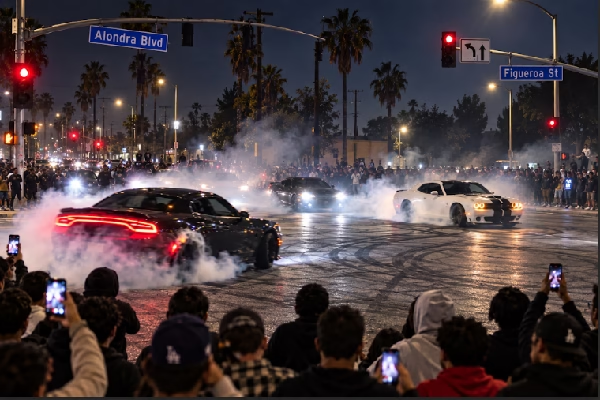
McOsker had something else on his mind. He told me where he expected to be later that night… Or, more accurately, very early the next morning. Alondra Boulevard and Figueroa Street in the Harbor Gateway.
At about 2 o’clock in the morning.
Let me get this straight… A Los Angeles City Councilmember was planning to leave the comfort of his home in the middle of the night and sit near an intersection in Harbor Gateway that residents had been complaining about for months because of illegal street takeovers? You gotta be kidding me… Usually when you hear about a politician getting up at 2 a.m. to go to work, you start looking for television cameras.
But this was different. McOsker had been receiving the calls…The texts… The emails… The complaints… And apparently he had decided that reading about what was happening at Alondra and Figueroa wasn’t enough… He wanted to see it himself.
Introducing David Matthews
If McOsker represents the governmental side of this story, David Matthews represents something equally important: The community side.
David Matthews is a longtime Harbor Gateway community activist who has worked on more neighborhood issues than I probably can’t fit into this column. But the street takeovers around Alondra and Figueroa have become one of the most frustrating public-safety problems facing residents in this part of Los Angeles. And David Matthews kept pushing. He called. He complained. He documented. He contacted the Council office.
And, according to what I was told, those calls were coming, “Every weekend.”
Those two words would stay with me.
Several weeks later, I attended a Saturday evening press conference following what had become one of the largest Los Angeles Police Department responses to an illegal street takeover in recent memory. While there, I spoke with two young residents who live near Alondra and Figueroa. They told me the takeovers were happening, “Every weekend.”
I asked them again.
Every weekend?
“Every weekend.”
They explained that residents had become so conditioned to what was happening that the sound of an engine revving could trigger an immediate reaction. “We dial 911 the second we hear a car revving up their engine,” they told me. Think about that. Imagine living in a neighborhood where the sound of an engine at 1, 2, or 3 in the morning causes you to reach for your telephone because you know what may be coming next.
Burnouts… Doughnuts… Screaming engines… Smoke… Hundreds of spectators… Cars block intersections. And residents are wondering whether this will finally be the night when somebody gets seriously hurt. This wasn’t some exaggerated neighborhood fear. Earlier in 2026, a takeover at the same intersection became so disruptive that a Metro bus was trapped in the crowd while people climbed onto it. LAPD responded and dispersed that gathering. And therein was one of the biggest frustrations for residents.
Disperse… The police would arrive… The crowd would leave. And too often the problem simply moved somewhere else. Harbor Gateway residents weren’t asking Los Angeles to relocate their problem. They wanted Los Angeles to deal with it.
From Phone Calls to City Hall
By August, the complaints coming from people such as David Matthews and other residents had moved beyond phone calls.
On August 19, McOsker introduced a City Council motion aimed specifically at strengthening Los Angeles’ response to illegal street takeovers, with particular attention to Alondra Boulevard and Figueroa Street.
The motion asked LAPD, the Department of Transportation, the City Attorney and other departments to identify existing and additional enforcement tools. It also sought examination of stronger administrative penalties, legally permissible investigative technology and ways to make people responsible for damaging streets and other public infrastructure pay for that damage rather than leaving taxpayers with the bill.
There was another component that shouldn’t be overlooked. The motion called for examination of physical roadway and traffic improvements that could make recurring takeover locations more difficult to use. In other words, enforcement alone wasn’t supposed to be the entire answer.
And then came Labor Day weekend.
This Time, LAPD Didn’t Just Disperse Them
Early Saturday morning, September 5, the people who gathered around Alondra and Figueroa encountered something very different. LAPD called it Operation Street Sweeper. Police had gathered intelligence about four planned takeover locations. Officers ultimately converged on Alondra and Figueroa. This time they didn’t simply show up and chase everybody away.
They surrounded them.
More than 150 law-enforcement officers participated in the operation. More than 700 people had gathered. Police buses were brought in. Tow trucks were lined up. By the time it was over, according to the LAPD, 69 people had been arrested, 570 citations issued, 200 vehicles impounded, and seven firearms recovered. Of the arrests, 66 related to participation in the speed contest, while three others involved allegations of assault, battery and obstructing officers. Among the citations, 442 went to alleged spectators and another 128 involved juvenile curfew violations.
That last number deserves attention. One hundred twenty-eight juveniles.
LAPD Chief Jim McDonnell used the press conference to send a message directly to parents and guardians: children attending these events aren’t simply standing around watching cars. “They are entering an active crime scene where they can be arrested…and where they can be hurt,” he said. And police recovered seven guns. That’s why describing these gatherings simply as young people having fun with cars doesn’t begin to describe the potential consequences for the people who live there.
The Difference Between Dispersal and Consequences
For residents, Operation Street Sweeper represented a significant change in tactics. FOX 11 reported that LAPD’s objective was specifically not to disperse the gathering and allow participants to move to another intersection. Police boxed the crowd in from the north, south, east and west. Then officers processed people individually. The drivers were arrested… Spectators were cited… Vehicles were impounded… Juveniles were taken to the station to be picked up by their parents… That distinction matters.
For years, Los Angeles’ response to street takeovers has faced an obvious problem: If hundreds of people shut down an intersection, burn rubber, damage streets, terrorize a neighborhood and then simply scatter when police arrive, what exactly has been accomplished? The event may have ended…The behavior hasn’t…It just moves.
Operation Street Sweeper tested another approach: Consequences.
And Then City Hall Moved
Three days after the operation, the Los Angeles City Council unanimously supported McOsker’s motion calling for a report on existing and additional tools to combat street takeovers. McOsker also requested updated information about the 50 Los Angeles intersections most affected by takeover activity. The numbers presented to the Council demonstrate that this isn’t simply a Harbor Gateway issue.
LAPD Deputy Chief Mark Green told the Council there were 867 street takeovers in Los Angeles in 2024, 230 in 2025, and 266 already recorded in 2026 at the time of the September 8 meeting. That makes what happened at Alondra and Figueroa potentially important beyond CD15. Because Los Angeles now has an example of what happens when neighborhood complaints, political attention, police intelligence and a coordinated enforcement strategy all converge on the same problem.
Don’t Forget Who Started Making Noise
But here’s where I come back to David Matthews…The city government gets the headlines. The Councilmember gets interviewed. The police chief stands behind the microphones. Television cameras show police cars, tow trucks, and buses. But before any of that happens, somebody usually has to be the person who refuses to shut up. Somebody must make the phone call… Then another one… And another one…Somebody has to send the email…Somebody must tell the Council office: This is still happening.
Somebody must call again the following weekend and say:
It’s happening again…That is what community activism looks like when there isn’t a television camera around…David Matthews and the residents surrounding Alondra and Figueroa kept making noise about what was happening in their neighborhood. And McOsker eventually decided to experience that neighborhood at an hour when most elected officials and most of us would rather be asleep.
I don’t agree with Tim McOsker on everything. Anybody who has read my columns knows that. And I’m certainly not going to stop asking him about Jones Chemicals. Or Silver RV Park. Or that cannabis dispensary.
Sorry, Tim… Those questions aren’t going anywhere… But neither should acknowledgment of what happened here… A community complained… A community activist kept pushing.
A Councilmember went out… In the middle of the night… Or morning… To see the problem himself… He introduced legislation… LAPD developed a coordinated operation… And on September 5, instead of simply dispersing another takeover at Alondra and Figueroa, LAPD surrounded it.
Sixty-nine arrests… Five hundred seventy citations… Two hundred vehicles impounded… Seven firearms were recovered…Those are not promises… Those are documented results.
The bigger question is what happens next.
Because one massive police operation doesn’t erase the problem of street takeovers in Los Angeles. And it certainly doesn’t erase what Harbor Gateway residents have endured. Enforcement has to continue. The City’s examination of physical changes to takeover-prone intersections has to continue. Parents need to understand exactly where their children are going at 2 o’clock in the morning.
And residents need to continue doing what David Matthews and his neighbors did: Make noise… Make phone calls… Demand answers… And refuse to allow illegal activity to become accepted as simply another part of living in Los Angeles. Because when residents tell their government that something dangerous is happening “every weekend,” eventually those two words should become impossible to ignore.
This time, at Alondra and Figueroa, they weren’t.