
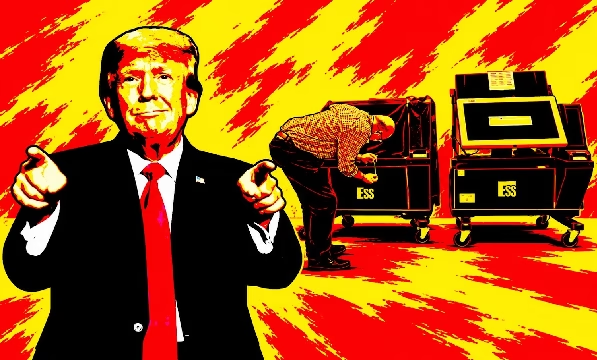
He’s Been At It Ever Since Retaking Office
Trump’s efforts to steal the 2026 midterms entered a new phase at his poorly-attended convention on Sept. 10, as he led his supporters in a pledge to “cheat like hell,” based on the false premise that Democrats already do so. Fittingly, it came in a mockery of the Pledge of Allegiance, “to the greatest president in the history of the United States that loves us so much he can’t even breathe.”
In reality, historians have repeatedly ranked Trump dead last among presidents, and the GOP’s cheating — most vividly with a wave of racist gerrymandering across eight states — is already without precedent in modern American history. Trump’s public approval has fallen to 33% in the latest polls from Reuters/Ipsos and the Financial Times, raising the need to cheat even further to 11 on a scale of one to 10.
That same day saw a dire warning of how hard Trump allies might cheat even after the election, as well as the kick-off of a mass movement effort to fight back, as the No Kings coalition held its kick-off organizing call for its Oct. 17 event to boost early voting to historic highs and counter GOP election subversion.
‘We are all familiar with the dirty tricks designed to disenfranchise voters,” Indivisible co-founder Leah Greenberg said on the call. “Early voting en masse disrupts those strategies.”
Thousands of local events are anticipated nationwide. “If you have hosted a barbecue, if you have hosted a gathering of your neighbors, you can host a No Kings event,” Greenberg said.
Meanwhile, in a New Republic article titled “The Final Battle for America’s Democracy,” retired conservative judge J. Michael Luttig — whose advice helped Mike Pence refuse to play his key role in Trump’s Jan. 6 coup attempt — outlined how Republicans could pull off a similar post-election power grab this time around, by simply refusing to seat duly elected Democrats in the House, to maintain a GOP majority there.
The seating decision is made by the clerk of the House, and in Luttig’s scenario, Speaker Mike Johnson would remove the current clerk and replace him with a MAGA loyalist to do the job. Court challenges would take weeks, if not months, paralyzing the country, leaving it “helplessly vulnerable to all the world’s evil,” with the ultimate outcome in the hands of an irresponsible Supreme Court.
“Today,” Luttig warned, “Donald Trump and his Republican congressional allies are even more determined to prosecute the president’s war against American democracy to its catastrophic end.”
And as if to prove Luttig’s point, that same day Johnson told GOP convention attendees “We cannot and will not allow them [Democrats] to take the majority in the Congress. We’re not gonna do it.”
Three Buckets of Election Attacks Aren’t as Separate as They Seem
Some experts think of election threats falling into three buckets: before, during and after election day. In their perspective, No Kings and Luttig are talking about totally different things. But of course that isn’t true.
The most basic threat is Trump’s relentless attack on the legitimacy of America’s elections and all other institutions not directly controlled by him. This attack goes across all three buckets, beginning broadly on day one by pardoning his fellow Jan. 6 insurrectionists, and giving rise to all sorts of specific attacks. Partisan gerrymandering alone has netted a probable cushion of 11 extra House seats, helped along by the Supreme Court’s gutting of the Voting Rights Act.
In the No Kings kick-off call, Greenberg noted several other attacks specific to elections.
“The election deniers playbook is to sow chaos and fear and disinformation to make voting harder and more unpredictable, and to target marginalized folks, ultimately to create the pretext for interventions and blockages at the polls and the counting process,” Greenberg said. “We are all familiar with the dirty tricks designed to disenfranchise voters, shut down polling places, suppress the vote. Everything from bomb threats to ICE deployment, to throwing people off the rolls. We’re watching an ongoing effort to sabotage voting by mail.”
But, she went on to say:
Early voting en masse disrupts those strategies. We turn election day into election season. We get people out to vote early enough so that if something goes wrong, there is time to address it. We short-circuit the sabotage strategies, and we create a cultural moment together around voting that helps to burst the disinformation bubble, helps create the sense of confidence and joy and defiance that we all need and deserve as we exercise our rights.
Finally she said, “We use the event as the foundation to organize and bring people in to protect and defend our election results.”
Although she didn’t discuss it, defending those results would certainly extend to fighting the kind of post-election attacks Luttig describes. From the very beginning, opposition to Trump has come from the bottom up, while elite opposition has lagged far behind. The first 50501 protests — precursors to No Kings — were held on Feb. 5, barely two weeks after Trump’s inauguration. Here in LA, hundreds of high school students — who don’t even have the right to vote — were the most prominent participants.
The protests grew steadily in size and scope (alongside spontaneous Tesla Takedowns in response to Elon Musk’s leadership at DOGE) until the No Kings coalition was formed and the first No Kings demonstration, on June 15, drew 5 million people nationwide, coinciding with the initial anti-ICE demonstrations and community mobilization here in LA. It was only after this that elite opposition to Trump began to solidify, and knee-jerk collaboration began to fade.
The Battlefield Now
Fast forward to today, and popular opposition to Trump’s tariffs, the Iran war, data centers and mass surveillance have created an increasingly broad popular coalition in opposition to Trump’s agenda and his allies. Even the Kansas and Nebraska senate races are so close that the Republican incumbents in both states have trailed in a recent poll, and South Carolina may be just as close. None of these three states are being talked about as competitive, but what little polling there is says they are. While Trump’s billionaire allies will dump tons of dark money into races across the country, the deepening disaster of Trump’s policies — especially their economic impact — makes a Democratic sweep of both houses of Congress increasingly likely.
Democrats’ lead on the generic ballot is 11 in three recent polls, and could well go higher if current trends hold. In the Senate, a 52-seat majority seems increasingly possible, typified by James Talarico’s narrow, but persistent polling lead in Texas against the state’s deeply corrupt attorney general Ken Paxton. Even candidates currently being ignored — such as Kansas minister Adam Hamilton — could potentially win historic upsets if this year’s wave election comes to resemble 2006, the last midterm for a second-term GOP president.
If this should happen — helped significantly by the kind of mobilization No Kings is helping create — then the sort of post-election scenario Judge Luttig suggests becomes a predominant concern. Luttig inexplicably puts his faith in a Supreme Court that he simultaneously says “has cynically authorized Trump’s lawlessness for the past two years.” In the end, he may be right (and it may not even get that far), but the reason may lie with the sort of mobilization that No Kings is spearheading.
Lower courts have largely blocked most of Trump’s election interference schemes, including most redistricting cases (over-ridden by the Supreme Court) and almost every case related to purported voter fraud, particularly those related to his March 31 executive order on mail voting and the U.S. Postal Service.
Regarding these, election attorney Marc Elias recently wrote, “Across the countless legal filings in the many lawsuits challenging Trump’s order and USPS’s subsequent rules, the DOJ has repeatedly failed to provide evidence backing the central claim behind them: that noncitizen voting and mail ballot fraud are real.” On Sept. 14, the Supreme Court finally closed the door on this — at least for this election — after which Elias warned, “This was one tactic that Donald Trump had to make it harder to vote and easier to cheat, but it won’t be his last.”
In fact, a separate policy remains in place: the Post Office no longer post-marks mail the day it’s mailed, so ballots must be mailed several days early.
Another voter-suppression strategy is the threat of ICE agents showing up at polling places on election day, asking for proof of citizenship, which very few people commonly carry.
“The fear is the point,” disinformation researcher Kate Starbird said. “They don’t have to send ICE to the polls to suppress Black and brown voters. They just have to make folks think they might.” The No Kings early voting effort is particularly intended to combat this fear.
Election Day and Beyond
No one can say what election day will look like, but the more people who vote early, and vote by mail securely, the less Trump’s allies will be able to prevent a normal day of voting. However, election deniers have been infiltrating significant parts of the country’s electoral infrastructure, from the most local level on up, so it’s quite possible that the basic process of counting ballots could be disrupted, or that election officials could refuse to certify results, sowing further chaos and doubt.
Here the size of a Democrats’ blue wave could prove crucial. The more convincing a Democratic win is, the less likely deniers will be to successfully subvert the post-election process. This holds true all the way through to Jan. 3 — the key day that Luttig focuses on, when the new House will be seated — and beyond, to any potential court battles.
Luttig is a life-long conservative Republican, primarily distressed by how so many others like him have abandoned traditional core principles of American democracy. He worries about the fate of the GOP if it tries to block seating Democrats on Jan. 3, and the Supreme Court later over-rules them. But while he presents a detailed discussion of how such a scenario might unfold, he doesn’t explain why the Supreme Court, which has done so much to help keep Trump out of jail and in king-like power, should be expected to turn against him.
There is a reason to expect it, however, which can be seen from the court’s own record of carefully calibrated political activism.
The GOP’s gerrymandering plans got a major assist from the court’s Callais decision in April, when it virtually gutted the Voting Rights Act, opening the floodgates for wiping out districts designed to elect minority representatives. But utterly unlike Trump’s chaotic, spur-of-the-moment attacks, Callais was the culmination of a carefully-crafted 40+ year strategy to roll back the 1960s voting rights gains of the Civil Rights Movement. It directly mimicked how the 19th century Supreme Court took several decades to undo the Civil War Amendments and accompanying legislation that gave equal citizenship to freed slaves after the Civil War.
Chief Justice John Roberts was the primary executor, if not architect of this plan, and the pretense of being a balls-and-strikes-calling institutionalist who kept out politics was key to his political project’s success. But the record shows that Roberts will be as ruthlessly political as he can get away with, without losing his reputation of not being political. He will even risk some reputational loss if the political gain is significant enough — as he did in keeping Trump out of court and out of jail prior to the 2024 election.
This is yet another reason why No Kings organizing and the size of Democrats’ win in November will matter so much. If Democrats win the House by less than 10 seats, then Luttig’s scenario becomes quite plausible — except that Roberts’ Supreme Court could actually let Johnson refuse to seat enough Democrats to keep control of the House. The larger the Democrats’ seat total gets, the less likely this scenario becomes. And if Johnson knows that he will ultimately lose, the less likely he will be to try fighting this battle in the first place.
Once again, this shows that the three buckets of election theft — before, after and on election day — aren’t really separate at all. The theft attempts overflow from one to another, and so does the fight to counter them. The best way to stop the next Jan. 6-style coup attempt is by winning massively between now and election day, just as No Kings is organizing for.