
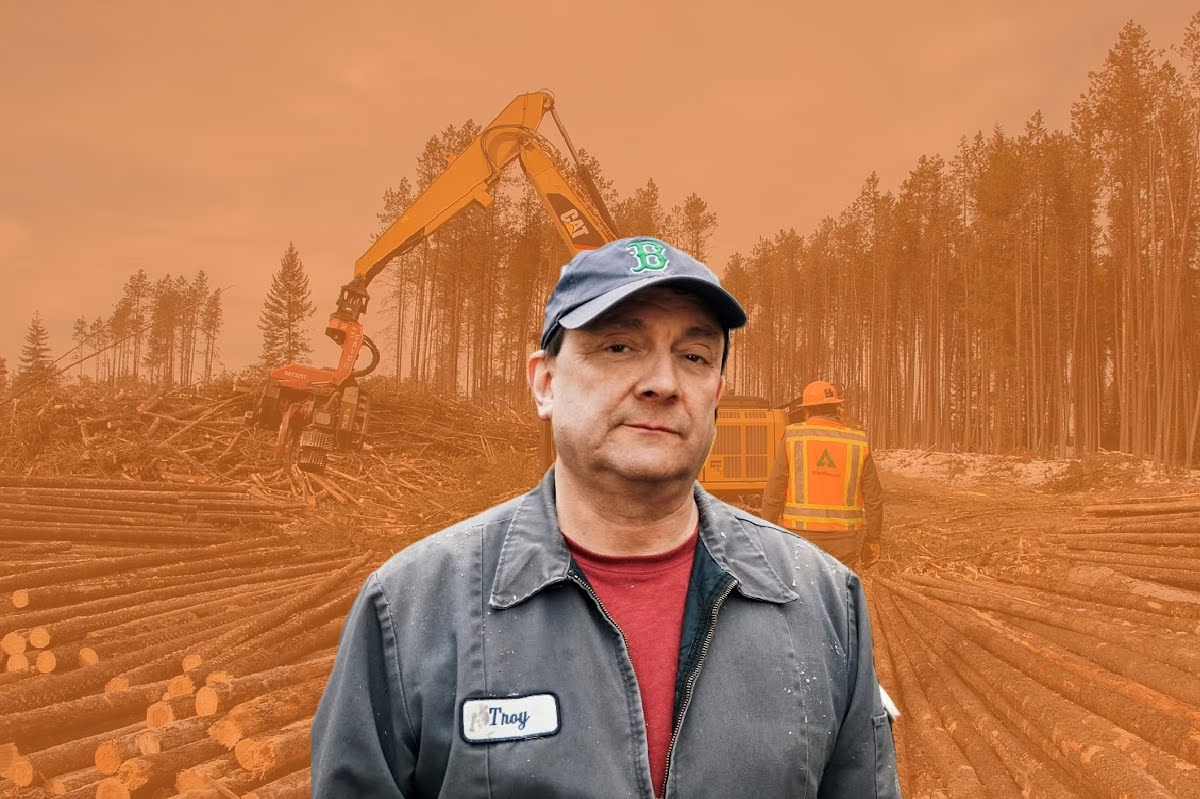
When Maine Democrats replaced U.S. Senate candidate Graham Platner with Troy Jackson on June 25, they traded in a would-be working class hero for the real deal. Platner played the part extremely well on social media, but had never been in a political fight before. Jackson, a fifth-generation logger, was born into the fight.
He saw his first strike when he was in 7th grade. In 1998, he came to public prominence as a leader of a week-long blockade, when 14 Maine loggers physically blocked low-paid Canadian loggers from crossing the border at three border checkpoints. At the time, the Bangor Daily News reported, “Of the 680 logging jobs offered by 40 timber companies in Aroostook County [Maine’s largest, northenmost county] in the past year, 18 have gone to Mainers and 662 have gone to Canadians.”
Twenty-one years later, as president of Maine’s Senate, a bill he sponsored finally gave loggers and haulers the right to unionize — similar to the struggle to get workers’ rights for port truckers, since they, too, were misclassified as independent contractors. So when he speaks, it’s not just words.
“We’ve been robbed of so many things in this world by the people who control it,” Jackson said, beginning his first speech as the official party candidate. “And what little time we have is being stolen by an oligarchy who see us as nothing more than a commodity. You know, we’re seeing a movement of everyday working-class people, people that have been left behind, people that don’t have health insurance, people that don’t have childcare, people that are looking for a government that’s going to fight for them. Together, we can fix what’s broken in Washington. We can pass Medicare for all. We can take on corporate power and the politicians in their pocket. We can create the future Mainers and Americans deserve.”
As his campaign website explains, his first taste of the fight came when he was in 7th grade:
His dad and his fellow loggers were standing up to a wealthy landowner who thought he could squeeze them for more. They weren’t asking for any special treatment or a pay raise — they were just asking for basic fairness.
He told them: Do the work for what I’ll pay you today, or I’ll replace you tomorrow. That was the familiar situation of powerlessness that Jackson was born into. And it only grew worse over time as he followed in his father’s footsteps. In a 2019 op-ed, he explained:
By the time I was working in the woods, large landowners had already systemically stripped away workers’ rights by making loggers and haulers independent contractors instead of employees. …
The blockade was the product of generations’ worth of resentment among loggers and haulers, who were just trying to make a living. …
Things came to a head in October 1998, when we blocked the border to protest the illegal hiring of Canadian loggers over hardworking Mainers. Canadian loggers could work for less due to the exchange rate and their national health care system. We couldn’t compete. Landowners pitted workers against each other to grow their profits.
The blockade came about after everything else had failed. The group of loggers Jackson led “filed like 137 complaints to the U.S Department of Labor and every single one of those 137 complaints get denied,” he said in a 2020 YouTube video about the blockade.
The Canadian loggers came in under the H-2A visa program, which requires employers to file an application “stating, among other things, that there are not sufficient workers who are able, willing, qualified, and available, and that the employment of aliens will not adversely affect the wages and working conditions of workers similarly employed in the U.S.,” according to the Department of Labor’s website.
But it’s absurd to believe this could be true, as forestry expert Mitch Lansky noted in the aftermath of the blockade:
If half the logging jobs in northern Maine have been eliminated by mechanization over the last 15 years, why isn’t there a surplus rather than a shortage of Maine workers?
Why, in the face of high unemployment in northern Maine, has the number of Canadian workers increased rather than decreased?
If there is a shortage of labor, why don’t companies pay higher wages and offer better working conditions rather than allow logging wages to decline relative to average wages statewide?
The blockade was a turning point in Jackson’s life. As explained on his campaign website:
Politicians — including then-first-term Senator Susan Collins — promised to listen, but they left Troy and his fellow loggers high and dry. After that experience, he realized nothing would change for him or anyone else like him unless there was a working class voice in the room when decisions got made. So he ran for the Maine state legislature.
As Random Lengths has reported in our Project Censored coverage, “People considered ‘working class’ make up half the country’s labor force, but only 1.6 percent of state lawmakers,” which “seriously distorts the legislative process, both in terms of issues considered and solutions proposed.” So Jackson faced seriously long odds when he first ran for a state house seat. In fact, he lost on his first try in 2000, running as a Republican, but won on his second try as an independent in 2002, in what The Bangor Daily News called the biggest upset of the 2002 elections in Maine.
Jackson re-registered as a Democrat before running again in 2004, ran successfully for a state senate seat in 2008, became majority leader in 2013, and senate president in 2018, leadership positions that are almost never held by working-class politicians. But he didn’t just hold high office; he got things done.
“In the legislature, Troy fought hard to lower prescription drug prices successfully, passed universal school meals, protected union jobs, expanded rural health care, delivered property tax relief, safeguarded our environment, and championed and passed some of the strongest reproductive health protections anywhere in the country,” his website sums up.
But given his roots, one accomplishment deserves special attention: a 2019 bill he sponsored allowing loggers and wood haulers to unionize.
“For too long, Maine loggers and wood haulers have been taken advantage of by large landowners, who hold significant power over these workers and their ability to provide for their families. This bill will right this wrong by giving these workers the same rights as everybody else,” Jackson said at the time. “LD 1459 will ensure that loggers and haulers finally get what they deserve — a fair shot to have strong wages, reasonable hours and safe work environments.”
With just over three months left til the November election, Jackson faces a tough uphill fight, despite a slight lead over incumbent Susan Collins in the polls. That’s because of the massive cash advantage Collins enjoys — and can readily expand thanks to what the New York Times described as “a towering Republican super PAC apparatus that is intent on re-electing Senator Susan Collins,” consisting of “a web of deep-pocketed outside groups, funded largely by billionaire megadonors,” that will “spend tens of millions of dollars on advertising promoting her and attacking the Democratic nominee.”
While Jackson is sure to be vastly outspent, he’s accustomed to the David-vs-Goliath role and confident that a broad small-donor base can raise enough to cut through the avalanche of lies ahead. His campaign raised roughly $2 million from about 30,000 donors in the first 24 hours after his nomination Saturday, according to figures his campaign shared Sunday night.
“I’m humbled beyond words by the tens of thousands of people who have stepped up to become part of this campaign,” Jackson said in a statement. “Every contribution — whether it was five dollars, twenty dollars, or more — is a vote of confidence in the working-class movement we’re building together,” he said. “I’m grateful to every person who has chipped in, volunteered, or told a neighbor about this campaign. This belongs to all of you.”