
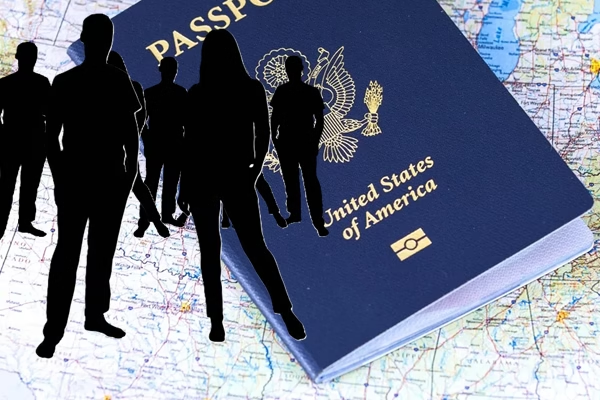
I Left My Country, but the Borders Never Left Me
By Sophie Schoenfeld, Guest Columnist
It’s 2025. I’m checking out at Smart & Final in San Pedro. My teller is a Latin trans guy with face piercings and colorful makeup galore. He is awkward, unsure of himself. He looks me up and down. Yes, I’m a privileged white lady, “normal” as can be. That’s what he sees. What endless borders exist between us? What wordless spaces separate them and me?
At 15, I arrived at London Heathrow Airport to finally reunite with my mother, wearing an oversized sheepskin coat that belonged to my 6-foot-tall stepfather, boots two sizes too big that were my stepmother’s, and carrying a passport of a country that no longer existed. It said, in proud gold letters against crimson red, USSR. The customs officer looked at it suspiciously. By 1993, this passport had become the pariah of passports. The Soviet Union had collapsed, and with it all its glory. Handing it over felt like handing a dirty rag to someone with clean hands.
I learned history the way you learn a language in exile — out of sequence, mistranslated, and always slightly wrong.
The Swedes and Germans in line looked calm and at ease. Not how it would have been in customs lines in the ’40s, I imagine. Nevertheless, here I was — an alien not in New York. I didn’t speak English. I had no cultural reference to this new world I had been transplanted into. Grateful, though. I was grateful. The majority of my male friends had been killed one way or another during the unrest in Georgia. The heroin epidemic swept through my father’s generation. Parts of the Black Sea were lost in a fumbled civil war. Refugees flooded the city, many having walked hundreds of miles in snow and freezing weather, dying along the way. Violence hung in the air like stale musk.
“Georgia?” Hahahaha! “That’s not a country!” was a frequent reaction when Brits asked where I was from.
There were no Georgian books I could buy. Not even an English–Georgian dictionary to use for translating my essays on Macbeth. I wrote my English assignments in Russian because, under the Soviet Union, Georgia was a bilingual country. Maybe I was Russian after all. Maybe Georgia was only an idea that existed in our minds.
But then again, I am a little Russian. My grandmother was. I never knew her, but her mother was Polish. They immigrated from Poland to Russia after the Soviet Revolution, before parts of Russia were part of Poland, and before Poland became part of Russia after the war.
At some point, Poland was Russia, or Russia was Poland, or perhaps it only mattered who had the guns that year.
My great-grandmother, her two daughters, her sister and her mother escaped the Leningrad siege in 1941 — before Leningrad became St. Petersburg again, after Petrograd, after the land once called Swedish Ingria. Who am I? No one really knows where Georgians came from. Supposedly, we were Iberians — related to the Basques in Spain — mixed with the Portuguese colonizers. Or maybe that’s just another story people tell themselves when records collapse.
Georgia was ruled by Persia, then absorbed into the Byzantine Empire. The Mongols burned and slaughtered us for centuries. Then came the Ottomans, then the Russians. Before all that, ancient Georgians traded gold with Egypt and Greece. In short, thousands of years of rape, pillage, and border politics. Who are we? Where do we belong? How many cities, borders, and lines were crisscrossed on maps before we came to name ourselves? How many Georgian women were kidnapped to grace the harems of various shahs? Whose blood runs through the ancestry of my Smart & Final teller’s lineage? Perhaps there’s some Iberian in them, too. Maybe we’re distant cousins after all.
London in the ’90s was vibrant, jubilant, brilliant and exciting. Neon signs glistened in perpetual drizzle. Red double-deckers whizzed through the narrow streets of southwest London, where my great-aunt had lived since 1945. She immigrated to the UK after the war, having married a British MI6 officer. My great-grandmother never forgave her. She left, and the family was blacklisted. Their brother was arrested and executed. That was the price the family paid for her escape to the west.
Still, my mother and I were grateful for her legacy. Otherwise, we would have been sitting under candlelight, counting gunshots in Tbilisi. My father had fled to Russia by the time we moved to London ― a strange blessing. He had been blacklisted in Georgia for his involvement in opposition movements and anti-government activism. That was why we were granted political asylum in the UK. Georgia, which endured coups, wars and total collapse in just four years, receded into the rearview mirror of my life.
I was grateful. Privileged to get out.
My beautiful Tbilisi ― cobblestoned boulevards, chestnut trees–lined streets, and ancient Turkish baths in a golden haze. Gypsy women sweeping the early morning streets in colorful skirts. Old ladies selling violets and sunflower seeds. Lilacs perfuming old courtyards behind wrought-iron gates. This ancient, magical home had turned into a rat-infested ruin full of angry people living inside the collapsed carcass of an empire. It was terrifying. And worse than that, it was sad.
When you are privileged enough to leave your broken home, to leave every familiar face, to leave not knowing if you’ll ever taste your grandmother’s sweetbreads again or lie under grape vines counting fireflies, you’re not allowed to grieve. You amputate and move on. You swallow down nostalgia like bitter medicine and focus on how lucky you are not to belong. How wonderful it is that no one understands your language, that you get to keep a secret world locked inside yourself.
But those you meet are strangers, too. They are not your family. Still, you cling to threads of belonging. At least we have the language ― this strange, unnecessary language, like a code to a tomb that no one cares to open.
As an immigrant, your identity becomes tangled with documents. You apply for status. You wait. And wait. You cannot travel. Your grandfather is dying. He wore a fedora. When it rained, and he tilted his head, water dripped from the brim, and you laughed. He brought you meringues every night after work and made you dance for them when you were little. He is dying, but you can’t go — because you have no papers. You are not allowed to cross these borders. Your pain does not exist. Only your documents do.
Every border crossing fills you with fear. They don’t like our passports. We are from shitty countries. They pull you aside. Question you. They take you to a separate room. You are ashamed, scared… anxious. This continues until you are naturalized. Until then, you belong nowhere. Your own country’s customs officer resents you — you got out, you got lucky. You return to Heathrow, and no one says welcome home.
Being an immigrant entails amputations. With time, limbs regrow, but they are never the same. There is a silent vastness inside you that is not allowed to exist publicly. You become an intricately folded origami. On the outside, you are integrated, assimilated. No one knows how many times you folded yourself to keep the form intact. Maybe even you no longer know who you really are because there is a part of you that gets lost in translation. You are a history without borders, a city with multiple names… a human lost in the papers, and yet wherever you go, you encounter some new part of you that you did not know existed.
“Arriving at each new city, the traveler finds a past of his that he did not know he had.” ― Italo Calvino, Invisible Cities
Thirty-three years have passed since I defected to the UK. In some surreal dream that is my life, I ended up living the majority of it in Los Angeles, San Pedro to be exact. Locals call it “Peeedro,” and by locals, I don’t mean Tongva, or Chumash, or Spanish/Mexicans for that matter, by locals, I mean mostly Croatians, Italians and Sicilians that settled here in the early 1900s, drawn by the fishing and cannery industry at the port of Los Angeles.
According to the “locals,” however, no one is allowed to claim ownership of “Peedro” besides being born here, and they know you don’t belong if you say Cabrillo Beach with silent Ls. I find this funny, audacious, and colonial, all at once. Living 20 years of my life in one community in LA that is filled with European immigrants who will never accept me as their own is an interesting juxtaposition in the narrative of my identity. Perhaps displacement ― not belonging ― is what connects us most deeply to one another, and that brings me to the difference in being an American immigrant versus a British one.