
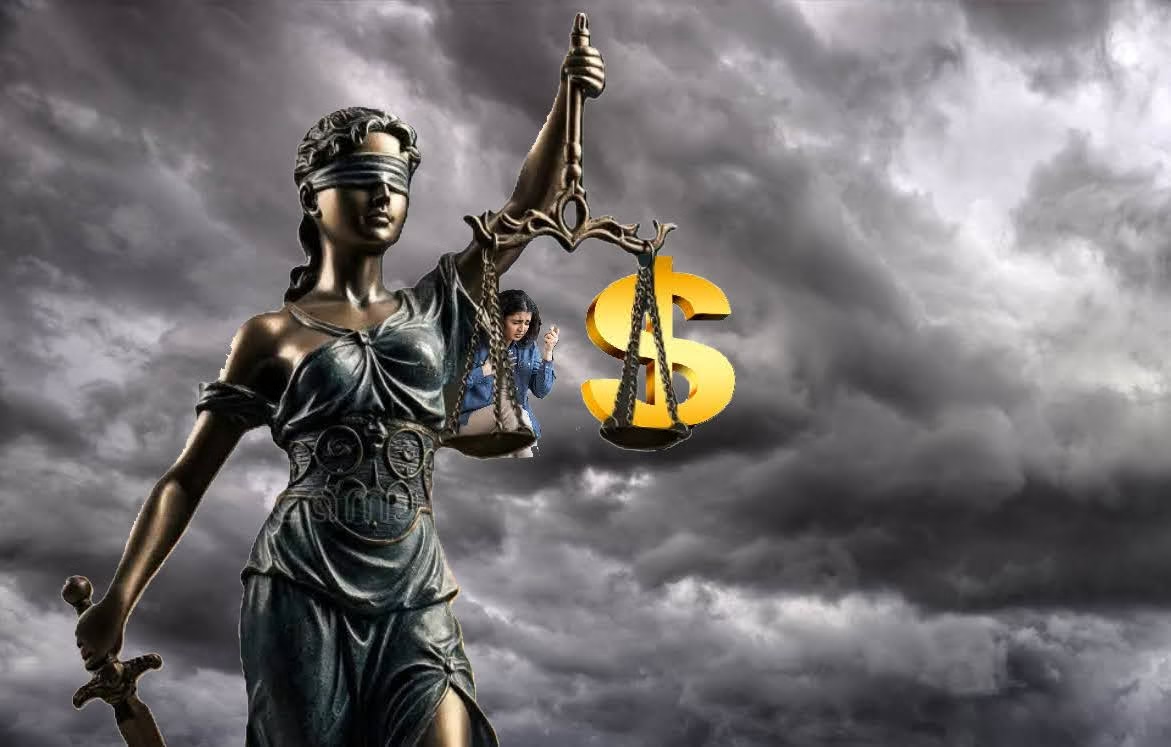
Trump EPA Scraps Health Benefits to Spare Business Costs
Ever since the Ronald Reagan administration, the Environmental Protection Agency has weighed the costs of environmental regulations to polluters against their benefits to public health. The benefits have routinely outweighed the costs, not by 2-1 or 3-1 but by double digits. But now, without fanfare — without a public process, as required by law — the Trump EPA has simply decided to stop counting them, setting them to zero and thus letting polluters off the hook.
“Ignoring potential health benefits” [this way is] “looking at the issue with industry-provided blinders,” said Ed Avol, USC emeritus professor of environmental health. “The driving purpose for these standards under the Clean Air Act is the protection of human health for current and future generations. If health considerations (such as these health benefits calculations) are removed from consideration, the resulting calculations will by definition be less health-protective and biased towards increased and undue exposure.” he said. “This announced approach is simply not based on sound science or best-practices regarding public health protection.”
The magnitude of what’s being ignored is staggering. For example, in a study covering all Clean Air Act regulations 1970 to 1990, EPA reported benefits ranging from $5.6 to $49.4 trillion, in 1990 dollars, with a mean, or central tendency estimate, of $22.2 trillion versus a cost of $523 billion — a ratio of $42 in benefits for every dollar in costs.
But now, based on the false claim that “the EPA historically provided point estimates [of health benefits] instead of just ranges” and that this misleads the public, Trump’s EPA is arbitrarily setting those estimates to zero. It flatly stated that “the EPA is no longer monetizing the benefits from PM2.5 and ozone” in a final rule issued Jan. 12, weakening emission regulations from combustion turbines at gas-burning power plants.
That same day, the New York Times reported that the changes had been underway for a while, based on “internal agency emails and documents” it had reviewed. But none of this was done in public, as required by federal law under the Administrative Procedures Act (APA). And with its mental gymnastics, Trump’s EPA was actually trying to deceive the public in the same way it falsely accused the EPA of doing previously. The lawlessness and dishonesty were strikingly similar to how RFK Jr. and his appointees have gone about attacking public health — particularly vaccines.
The Times’ account didn’t dig deeper into the underlying lawlessness, which was obvious to Random Lengths from past cases we’ve covered. Seth Johnson, a senior attorney at Earthjustice, confirmed our understanding.
“Basic administrative law generally requires EPA to go through a notice-and-comment process when it issues a final rule,” Johnson said. “That means the public must generally be given the opportunity to comment on important aspects of a proposal. EPA didn’t provide any hint in its proposal or its notice reopening the comment period that it was thinking about stopping monetizing public health benefits. That deprived the public of an opportunity to comment on this big change.”
But legal reality and public theater are light-years apart.
On X, Trump’s EPA chief, Lee Zeldin, falsely claimed “the EXACT OPPOSITE” of the Times’ headline was “the actual truth.” But on Bluesky, Natural Resources Defense Council senior attorney John Walke responded to Zeldin’s “dishonesty & theatrical indignation” with a detailed documented response. Random Lengths spoke with Walke to shed further light on what was going on.
First, we asked, wasn’t uncertainty built into EPA’s methodology?
“Yes of course, and that’s what the ranges are for,” Walke said. “EPA acknowledges that uncertainty, it’s standard economic practice and scientific practice to do so. This is a straw man to carry out a conclusory political outcome, in my opinion.”
And wasn’t Trump’s EPA doing exactly what it accused past EPAs of doing — misleading the public with false certainty?
“That’s exactly right,” Walke responded. “When the agency declares that either costs or benefits are going to be treated qualitatively rather than quantitatively, they assign a zero dollar value to those items.
“So from now on, in cost-benefit analysis, you will see two things: On the benefit side of the equation, you will see zero dollar benefits assigned to the whole array of health benefits associated with reductions in smog and soot — ranging from days missed from school or work, ER visits, bronchitis, asthma attacks, premature death avoidance, things that have been part of the cost benefit calculation for four decades. And then on the cost side, you will see uncertain and self-serving industry compliance costs assigned very specific dollar values.
“So they are accepting uncertainty when compliance costs are at issue. So the issue is really not certainty or uncertainty. The issue is a conclusory political outcome, because that’s what they want to achieve.”
If this had been a good-faith process, it would have unfolded quite differently. To do things properly, “One would not do what they did here,” Walke said: reveal the decision “for the very first time in a final rule making, in an obscure regulatory document called an economic impact analysis, where no notice was given to the public at the proposed rulemaking stage, or the stage where an economic analysis was prepared for the proposal for this action.”
On top of that, “You would not see two or three conclusory paragraphs where the word ‘uncertainty’ is thrown around with literally six or seven different concepts, so one cannot even figure out what the driver is supposed to be here.
“They talk about the uncertainty of assigning dollar values. They talk about the uncertainty of harm at low levels. They talk about the uncertainty of the linear relationship between harm and exposure. It’s like they threw the word ‘uncertainty’ at a wall, and tried to associate as many concepts as they could.”
If done properly, “What you would see, is them announcing this, for the first time, in a proposed rulemaking or an advance notice of proposed rulemaking, where they lay out the full case for why they believe these things are uncertain, where they address past studies and rulemaking this and reports for the public explaining why these things were previously considered certain, and worthy of monetization for four plus decades.”
After that, “You would invite input from the public, you would take that input, you would respond to those comments in a public way, the way that administrative law requires one to act.” Then, “You would issue a final rule responding to all those comments, laying out all the explanations, addressing all the counterpoints, all the agencies’ own prior statements and studies, and then there would be an opportunity for judicial challenge to that.”
Obviously, none of that occurred. Which makes it a clear violation of the APA.
“There’s a very famous Supreme Court decision called the State Farm decision,” Walke said, “where the court decades ago laid out the framework for reasoned decision-making by an agency: evidence that the agency has fully considered the problem, that the agency has considered counter evidence, that the agency has identified what the controlling factors are, and that they’ve addressed those controlling factors. None of that was deployed here.”
The lawlessness on display here is hardly unique. “Just as a citizen, I’m struck by the remarkable parallels and echoes with actions that they are taking across the federal government, with immigration and law enforcement, and invasions of other countries,” Walke said. “They are acting in completely ahistorical, unconventional, illegal ways at odds with all past practice, even under their first administration.”
And as an environmental lawyer, he’s seen other examples of unprecedented conduct in his field. As an example, he cited a case where the Trump EPA and Justice Department asked a federal court to “just void the standards” for soot (PM2.5) pollution, “not by reaching the merits of the case that had been fully briefed when EPA was on the other side,” but just ignoring it. “I’ve been a clean air attorney for over 30 years. I’ve never seen anything like this in my life,” he said.
More broadly, Walke said, “We’re just seeing levels of unprecedented recklessness and I think in this case they were itching to eradicate benefits because there have been not just tens of billions, but trillions of dollars in benefits that outweighed compliance costs to industry. And they realize that all of these [regulatory] rollbacks [being planned] were going to generate dis-benefits” that would generate public alarm and opposition. “They didn’t want the public to know how much harm this was causing, so they zeroed out those harms so that the dollars would never be revealed.”
The particular comparison with RFK Jr.’s attack on public health is “spot on,” Walke said. “In both instances, it brings to mind the adage that power corrupts, absolute power corrupts absolutely.” In both cases, “There are no norms or accepted scientific consensus that they are not prepared to ignore and overturn in order to carry out what by all appearances is a frenzied agenda by a one-term administration that has Stephen Milleresque chaos at its heart. … You see this parallel across all agencies and departments and issues. It is even by comparison to the first Trump administration starkly more extreme than what we saw in that administration.”
“Ozone and PM standards, levels, and emissions in the Harbor Bay area have been an ongoing challenge for decades,” Avol said. “If this approach is adopted, it will affect local considerations. California historically has been allowed to set its own state standards, but the Trump administration has been at odds with California over so much of its environmental approach that any comfort that CARB’s independence will not be challenged in this arena as well may be short-lived.”