
Ostensibly, the main purpose of a theatre review is to provide intel for those who might be interested in a particular play to help them decide whether it’s worth their time and money (a calculation that varies by taste).
But when every performance of a show is sold out before the reviewer can put proverbial pen to paper, he — in this case, me — is free simply to memorialize, to contribute to the historical record of time, place, artistry, &c.
In April 2026, playwright Annette Sanchez realized a dream. Inspired (as she explained before the performance I saw) by someone with the surname Rooney (author Sally Rooney?) to make the art you want to see in the world, she jumped at the chance when fellow CSULB alums the Garage Theatre offered to let her produce her Seven Days to Mexican in their little black box. Half of the people there were her friends, she said — a point of pride rather than self-deprecation, I think. Sanchez seems to have a sense of the people for whom she’s writing — and they were pleased to be there.
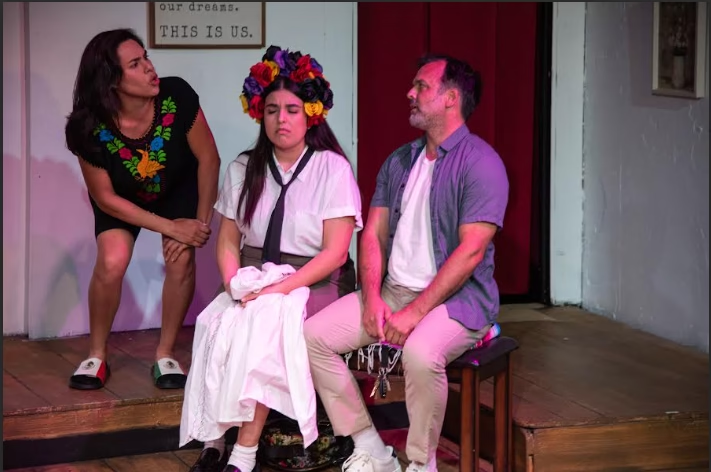
After brainy Blake (Karol Avila) gets a D on a school project about her cultural heritage, mom Sylvia (Evelyn Menchaca) — who, despite being “just a brown girl from the hood,” ella no habla español due to her father’s efforts to make her so Anglo that she might be spared the ostracization he suffered as a little brown boy who didn’t sound like his paler Americano peers — is racked with guilt (not to mention that the D makes her look bad to her PTA pals). “I whitewashed all of us!” she laments (one of the play’s funnier lines). They’re not even Dodgers fans, por el amor de Dios: they have season tickets to the frigging Angels! But with Blake getting a second bite at la manzana, Sylvia’s got one week to learn about and instill the forsaken culture. But perhaps one’s culture isn’t as clear-cut as it may seem on the surface? All of this evolves and resolves in predictable fashion, hitting some familiar tropes along the way (such as parent interrupting kid’s school presentation à la Crazy Stupid Love).
Because Sanchez’s primary focus may be (per the program notes) “continuously striv[ing] to create inclusive art so all children can point to a page, a screen, a stage and shout ‘I see me!’,” I’m not sure how much worth there is here in taking a close look at the script. Should we wonder why Sylvia works so hard to “correctly” enounce ‘taco’ when it’s maybe the best example you could come up with of a word whose pronunciation doesn’t appreciably change across the border (as opposed to, say, “Mexico” and “México” — the obvious choice within the premise of this play)? Are we to blame for paying close enough attention to know that Blake’s final presentation includes smartphone video of events we saw on stage but that she never shot? And mightn’t a month, rather than a week, have been more credible even within the play’s comedic universe? (Tell me “A Month to Mexican” doesn’t have a nice ring to it.)
Whatever one thinks about this writing-workshoppy stuff, what should definitely be of use to Sanchez and director Karla Ojeda’s future theatrical endeavors is considering how to improve the mechanics of staging a play — which matter regardless of what sort of script you have. During intermission I overheard Sanchez muse on how the audience didn’t applaud at the end of Act One. While she was absolutely right to note that audience vibes can vary unpredictably from one night to the next, the real issue here was that, from lighting and sound cues to line delivery and blocking, every scene change was a problem — something that can be easily improved in subsequent productions with a little thought and study. As much as the audience around me (overflowing the planned number of seats — lucky a bunch of folding chairs were on-hand) was enjoying the show, fixing nothing but the scene changes would have doubled their overall response.
Although the cast brings the requisite energy for this ultralite comedy with a heart, as a point of comparison it would be interesting to see this show were it informed by acting advice Dennis Hopper says he received from James Dean: When you take a drink, don’t act taking a drink, just drink the drink. Too often in Seven Days to Mexican we see actors acting dancing, arguing, crossing themselves, etc., rather than simply doing it. Sure, this sort of material hardly demands Daniel Day-Lewis-esque immersion; but if (for example) the screwball antics of Lucille Ball work — far more over the top than anything in Seven Days to Mexican — it’s because we see Lucy really doing those screwy things, rather than watching Lucille act them. Bebe la bebida.
A cast standout is Martin Morales, particularly in his turn as Raul, a Mexican whose speech patterns make Sylvia sound like Charo. Although Sanchez invests Morales’s three characters with her funniest bits, Morales had us laughing with just “I am Raul.”
I wouldn’t be a bit surprised if the people who made the world-premiere run of Seven Days to Mexican a complete sellout (in the good sense) come away satisfied. Whether they (should) watch the play with a critical eye is a separate question. But whatever the case, Sanchez and her team are getting to live a dream. Nothing wrong with that.
Seven Days to Mexican
Times: Thursday–Satuday 8:00 p.m.
The show runs through April 25.
Cost: $23–$28 (Thursdays 2-for-1); closing night w/afterparty: $40
Details: thegaragetheatre.org
Venue: The Garage Theatre, 251 E. 7th St., Long Beach