
“If you have some drug dealers in your country and you’re the president, you don’t necessarily put the president in jail for 45 years.” That’s what Trump said in December, justifying his pardon of one of the biggest drug-traffickers ever sentenced in federal court, former president of Honduras Juan Orlando Hernández, who played a key role in importing more than 400 tons of cocaine to the US.
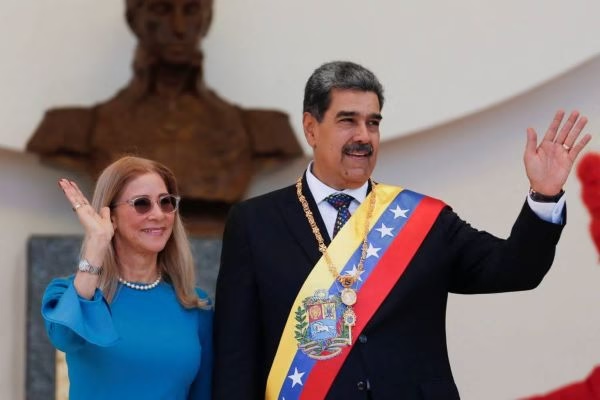
But a month later, Trump changed his mind, ordering the kidnapping of Venezuelan President Nicolás Maduro, who US intelligence has said had no role in the Venezuelan drug trade.
In one sense, there was nothing new here: for decades, if not generations, US military and intelligence agencies have used drug charges—true or false—to go after political enemies at home and abroad, while letting so-called “allies” get away with murder. This pattern has played out across the globe, as recounted in Alfred McCoy’s 2003 book, The Politics of Heroin: CIA Complicity in the Global Drug Trade. But it’s been especially intense in Latin America, where, for example, the US-backed Contra terrorists were financed by their own drug-dealing as well as illicit US arms deals with Iran, which exploded into the Iran/Contra scandal. So this latest pairing is just what old hands might expect.
But that’s hardly the only way to make sense of what just happened. Trump had two very good reasons to want to change the subject right now: first, the escalating Epstein files scandal. And second, Special Prosecutor Jack Smith’s just-released videotaped testimony that his investigation “developed proof beyond a reasonable doubt that President Trump engaged in a criminal scheme to overturn the results of the 2020 election and to prevent the lawful transfer of power.”
Naturally Trump didn’t want cable tv talking about the biggest crime of his life all weekend long, just before the 5th anniversary of his failed coup. Better to commit a new crime—kidnapping a foreign leaders—that the talking heads would not know how to make sense of.
But Trump’s personal motives aren’t the only way to make sense of what happened. Judah Grunstein, Editor-at-large of World Politics Review, suggested four more on Bluesky:
There are really four levels to what happened last night: US, regional, global and Venezuela.
- On the US level, this is clearly illegal, part of Trump II’s broader assault on rule of law….
- On the regional level, this is part of an attempt to impose a new order on the Western Hemisphere….
- On the global level, this is the latest breach in the foundation of a liberal international order that, for all its failings and hypocrisies, remains better than any historical alternative….
- It is on the level of Venezuela that this story is most uncertain and unclear….
Divvying things up this way is immensely clarifying. The illegality of kidnapping a foreign leader (#1) should be perfectly clear, along with its continuity with the countless ICE kidnappings that have mobilized the American people against the Trump regime. But it’s also (#3) clearly a blow against the law-based liberal international order established after WWII, as civil rights lawyer David Cole made clear on Democracy Now! on Monday:
If Mexico were to bomb gun manufacturers in the United States because our guns are killing thousands of Mexicans every year in Mexico, we wouldn’t say that’s OK. Trump said that Biden was an illegitimate president. If Russia invaded the United States and abducted Biden to put him on trial in Russia, we wouldn’t say that’s OK. The whole premise of the international order is that we respect each other’s borders.
And when we do this, we just give a green light to Russia. Why should it stop at Ukraine? We give a green light to China: Go into Taiwan. This is really putting us on — putting the world on a very, very dangerous course.
In a word, it risks plunging the whole world into an abyss. But it’s nothing new for Trump. He’s a bully who hates rules, and loves other bullies who’ll help him break everything in his way.
In the aftermath, Trump was quite clear where his interests lay. He spoke repeatedly about getting back “our” oil from Venezuela—an utterly false rewriting of history—as if it could be captured as easily as Maduro had been, ignoring a welter of detailed reasons things would be much more complicated. He even said we’re “in charge” of Venezuela, when we obviously were not.
Instead of focusing on the messy details of what plausibly might be done in Venezuela, Trump was far more interested in making grandiose threats to invade or take over a whole list of his personal targets—Greenland, Columbia, Mexico, you name it. He was truly high on his own macho supply. But the leaders of the countries he threatened had every reason to take his threats seriously, given what had just happened—not a war, but a “special military operation” exactly as Putin had intended for Ukraine.
The move clearly excited his MAGA base. MAGA influencers who’d supported Trump because he opposed neocon interventionism were suddenly thrilled he was doing precisely what they’d previously denounced.
But more than that: by shifting focus away from domestic matters, where Trump’s policies have destroyed GOP support, it gave Trump the chance to regain the political offensive. Establishment Democrats seem poised to repeat their hapless response to Bush’s Iraq War folly—a folly that ultimately gave us Obama, who opposed the war, and Trump, who ran on big lie that he’d opposed it, too.
The question now, as then, is what do Democrats stand for instead? When Obama was elected, Democrats belatedly had a chance to address what Grunstein rightly called the “failings and hypocrisies” of the liberal international order. Obama initially seemed interested in doing that, most notably with his Cairo speech, addressed in part to Muslim world. But the follow-through was utterly lacking, as was laid bare by our muddled response to the Arab Spring.
One thing should be clear—not just for Americans, but for the whole world: the best way to spread democracy is to practice it. And carefully note the enemies standing in your way, and those who excuse them, and give them cover. It’s either that, or back to the world that brought us WWII.