

Looking Back, Looking Forward: De facto Segregation in South San Pedro
When I returned home to San Pedro from Korea in 1960, San Pedro was still the town of my youth. Not much had changed from when I left. Today, Oliver Street is still cooking. The old housing projects (except Rancho San Pedro) are gone, and old Beacon Street has disappeared. But thankfully, God’s country on North Meyler Street is there except for those I knew who lived there from the 1950s through the 1980s.
The de facto segregation in San Pedro—particularly south of 6th Street toward the ocean—remained unchanged. It had always been that way. With very few exceptions, African Americans were unable to buy or rent homes near San Pedro High School.
This exclusion was baked in from the start when this land was developed after Rudecinda Sepulveda de Dodson sold that 880-acre portion of the old Sepulveda ranch to the Averill-Weymouth company during the first decade of the 1900s. Herbert Averill promised then that “they would enforce restrictions sufficiently rigid to ensure the development of the property along attractive and substantial lines and declare they would make it the sightliest part of the harbor region.”
These legal restrictions remained until the political and legal battles over redlining in the late 1960s struck them down with the passage of the Rumsford/Unruh Act, its reversal by Proposition 14, and the proposition’s reversal by the US Supreme Court decision in Reitman v. Mulkey.
But even with this bit of progress and other steps taken through the 1970s, the facts remain: I am a longtime Pedro resident. My family members had attempted to rent property in South San Pedro, and we were still given the cold shoulder and deemed not “good enough” to live here.
Race is a social construct that prioritizes in access to power, wealth, and resources. In this system that prizes whiteness, black folks are automatically deemed unworthy, unqualified, and ineligible, despite all of us being God’s children.
Will de facto segregation always exist in San Pedro? Nobody knows. It appears that the attitude: persona non grata (thanks but no thanks) will always be part of the rules. Of course, there is also something called NIMBY (not in my backyard). We may be friends, but not in my backyard. The attitude appears to say: we are not a television show like “The Neighborhood,” and there is no ideal or happy ending here.
At best, Black Americans are bearable to those in Southwest San Pedro, and at worst, condescended to. Residents in San Pedro know the problem of de facto segregation exists in Southwest San Pedro, and hide it by suborning or gaslighting. This is identified as head turning and being part of the problem. Can you find the word hypocrisy in your dictionary? If you continue to turn your head from this reality, you are enabling de facto segregation.
John R. Gray, Wilmington
U.S. Army South Korea, Joint Security Area
728 Military Police Honor Guard Platoon
Narbonne High Girls’ Basketball Team Targeted in Van Burglary After Tournament
My daughter’s high school basketball team (Narbonne High School, Harbor City) was participating in a tournament at Mark Keppel High School in Alhambra. Shortly after they finished their game, I received a phone call from my daughter that no parent ever wants to receive. She was screaming and sobbing so hard she couldn’t get her words out. For a moment, I thought they had been in a car accident or that someone had been seriously hurt. The last time I heard that kind of terror in her voice was in 2020, when I learned my father had been in a fatal car accident.
After the tournament, the team went to the local Raising Cane’s restaurant to have dinner. When they returned to their van, they found it broken into and completely ransacked. Everything was stolen: their game jerseys, basketball shoes, warm-up sets, personal backpacks, school laptops, Beats headphones, iPads, homework, clothing, and other personal belongings.
My daughter even had an open-book final exam coming up. All her notes and materials were in her backpack, and they are gone.
These girls are distraught. They have worked so hard this season, and now they face another heartbreaking setback. They have a tournament game tomorrow (Wednesday, 12/10) at home, yet they have nothing to wear, no uniforms, no gear, nothing. The assistant coach filed a police report with the local police department, but understandably, the girls are devastated.
This is more than a story about theft. It is about a group of young student-athletes who had their hard work, their sense of safety, and their personal belongings taken from them in minutes. They deserve community support, and attention to what happened may help lead to answers – or at least rally people around them so they can continue their season.
A GoFundMe page has been created to raise $5,000 to support Narbonne’s girls’ basketball team. More information is available at gofund.me/c63c0362f.
Virchus Ferguson
San Pedro
Military Grade
I was 11 years old on May 4,1970 living 12 miles from KSU. Later my siblings and I graduated from there.
The national guard used military grade ammunition. Two students were killed directly. Two others from a ricochet and piercing through a car trunk 300 plus feet away. That ammunition was considered lethal at 5 miles.
This sculpture is about 70 feet away. The sheets are 1/2 inch thick.
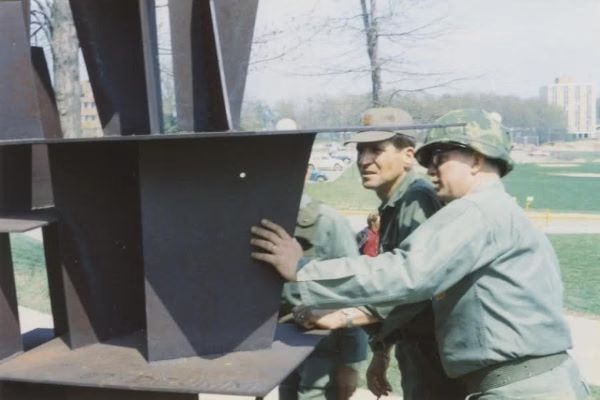
The idea of giving military grade arms to civilian police who do not require them, much less have training or the recertification required in the military is an anathema.
May 4,1970 should be a lesson to be heeded and not forgotten.
Michael A Rolenz
Harbor City