
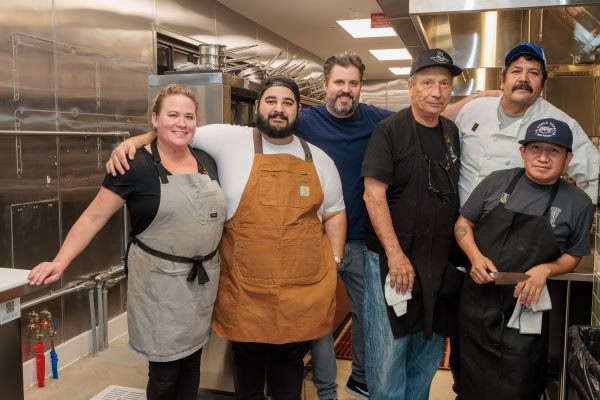
This past First Thursday, Dustin Trani and his family reopened Majestic Café at the Spanish Colonial Revival landmark most San Pedrans remember as Harbor View House — now rebranded as Harbor House. The name nods to its storied past as a YMCA recreation center for servicemen at Fort MacArthur, which once offered 300 dormitory rooms, a gym, running track, banquet room, patio, pool, boxing and wrestling rooms, and a coffee shop. Four million men during World War II found respite and temporary quarters, and it was a magnet for film and television celebrities such as Bob Hope and Lucille Ball from Hollywood’s Golden Era.
With the opening of Majestic in those hallowed walls of Harbor House, vestiges of old San Pedro will be rooted in this harbor town’s heart.
Trani traces his family’s culinary roots back to his great-grandfather, Filippo, who immigrated to the United States in the late 19th or early 20th century via Ellis Island. Filippo settled in Keystone Acres (now Carson), an area rich with olive oil vineyards, before eventually partnering to open the Majestic Café on 7th Street in San Pedro, directly across from the LaSalle Hotel. Initially a pool hall with a minimal menu — chili beans, beef stew and wet-beef sandwiches — the café catered to longshoremen, providing both food and recreation with pool tables in the back.
As his grandfather, born in 1924, grew older, the family expanded its involvement in the restaurant, with brothers and relatives contributing to the business.
“Chef Boyardee was contracted out of Cleveland, Ohio, to produce canned rations going to the Army during World War II, which had these little raviolis,” Trani explained. “These people in Middle America had never eaten Italian food 10 years before America entered into World War II, were craving this stuff now. That’s when these Italian immigrants started making what they called American-Italian. And so basically, Chef Boyardee paved the way for Italian cuisine in the United States.”
Over time, the Majestic Café’s offerings evolved from simple American fare to include Italian-inspired dishes, marking the beginning of the family’s long-standing culinary legacy in San Pedro.
Trani emphasized the distinction between authentic Italian cooking, which is regional, light and ingredient-focused, and American-Italian adaptations with heavier sauces and cheese. While his family practiced traditional Italian cooking at home, the restaurant adapted to local tastes, creating a bridge between Italian heritage and the evolving American palate. These early foundations set the stage for the family’s ongoing presence in San Pedro’s dining scene, blending tradition, adaptation and community engagement.
Trani explained the distinction between authentic Italian cuisine and its American adaptations, emphasizing that traditional Italian cooking is highly regional, light and ingredient-driven. “In Italy, dishes vary by region depending on local produce, cheeses and techniques; pasta is the centerpiece, with sauces serving only as accents. Garlic is used for flavor, not to overpower the dish, and meals are meant to highlight balance, subtlety and freshness,” said Trani.
In contrast, American-Italian cuisine evolved to suit U.S. tastes, often incorporating heavier sauces, more cheese and richer preparations, resulting in dishes like veal parmesan, fettuccine alfredo, and other comfort-food staples. Trani noted that Italian immigrants, including his own family, initially cooked traditional dishes at home, while restaurants in the early 20th century catered to American palates with simple, hearty meals. Over time, Italian-American dishes became prevalent, particularly after World War II, when soldiers returned craving the Italian-style rations they had eaten abroad.
Trani highlighted that this evolution allowed Italian cuisine to flourish in the U.S., creating the American-Italian category known today. While distinct from authentic Italian traditions, it remains a beloved and culturally significant cuisine.
Trani detailed the evolution of his family’s restaurants, beginning with the original Majestic Café on Seventh Street (1925–1978), which later moved to Trani Square (1978–1988) due to city development. J. Trani’s Ristorante opened in 1990, emphasizing family-style dining and community engagement. Trani highlighted the careful preservation and restoration of historic buildings, valuing architecture and local history in each space. Dockside was designed for a more social, sharing-style experience, while the new Majestic aims to revive the Prohibition-era supper club concept, combining entertainment, innovative audio, and American-Italian cuisine. Each location reflects a unique vision tailored to its neighborhood and clientele.
All of the Trani family’s restaurants are guided by excellence, longevity and community. Trani noted that central to their success has been the cultivation of dedicated, long-term staff who share the vision and work ethic necessary to deliver both exceptional food and service. Trani stresses that dining is more than the food itself — it is about the complete experience, where attentive, knowledgeable service elevates a meal from good to memorable. The restaurants prioritize communal, family-style dining, encouraging guests to share dishes and enjoy a celebratory, social atmosphere matching the vibrancy of dining cultures found in Louisiana.
Trani, a homegrown chef, is deeply committed to San Pedro, viewing this harbor town as a place where growth and reinvention are still possible. He takes pride in being part of a small group of enduring, family-owned businesses in the area, seeing it as both a responsibility and an opportunity to enhance the community.