
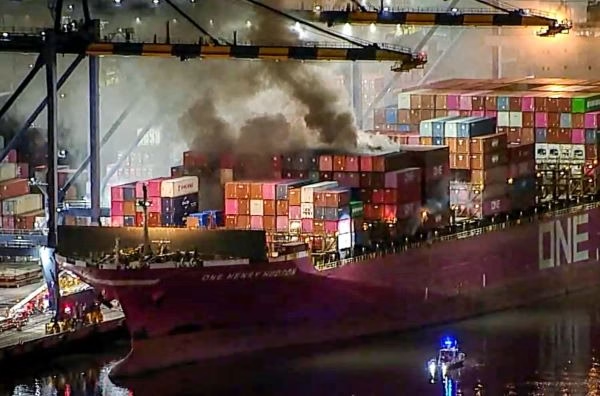
Fresh off their victories in a 15-year fight against a pollution regulation known as an indirect source rule (ISR), the ports of Los Angeles and Long Beach once again promoted themselves as the greenest ports in the world, with their Clean Air Action Plan Update, presented at Banning’s Landing on Dec. 9. But community members and their allies in environmental justice and public health organizations were not impressed.
“There’s been a lot of finger-pointing about what happened with the port ISR, but the bottom line is that port communities still lack the strong pollution protections needed to breathe clean air, and cargo volumes are increasing,” said Davina Hunt, a climate policy director for Pacific Environment.
As usual, the ports led with their best news: All major pollutants are down from CAAP’s 2005 baseline levels, even as freight volume is up 44%, and there is a great deal that the ports are doing, as they went on to explain. But Janet Gunter, one of three local activists who initiated the first legal challenge to local port pollution in 2001, noted what the ports ignored. “After 25 years, the port regions are still responsible for the ‘worst air quality’ in the state,” Gunter said. “After all these years, the region continues to be the number one source of air pollution!”
The long-term reductions are impressive—though most gains were made more than a decade ago. Diesel Particulate Matter (DPM) is down 90% vs a 77% goal set for 2023, NOx (nitrogen oxides) is down 70% vs 59% goal, and SOx (sulfur oxides) is down 98% vs a 93% goal. Greenhouse gases (GHG), which weren’t part of the original plan, are down 10%. But the comparison to last year is less encouraging.
“While the latest CAAP update presents emissions down per container, actual total port NOx, PM, and greenhouse gas emissions increased between 2023-2024, leaving communities still burdened with increased port pollution,” said Dori Chandler, policy advocate with the Coalition for Clean Air.
For the year, PM emissions were up 15%, NOx up 6%, and GHG up 5%, while freight volume was up 20%.
The ISR being considered by the South Coast Air Quality Management District was replaced at the last minute with a memorandum of understanding (MOU) whose main focus was zero-emissions infrastructure plan development, leaving pollution reduction in a state of limbo, with the promise of future discussions of voluntary measures, known as “CAAP plus.”
This echoes what the CAAP update revealed. A major focus was the Technology Advancement Program (TAP), which helps accelerate the development of clean technologies to become commercially available and widely used. Projects completed in 2024 included a Pasha’s liquified natural gas (LNG) repowered vessel, George II, a Pacific Harbor Line locomotive charger, and a Toyota Tsusho hydrogen fuel cell top handler. And 2025 recommended projects included a hybrid excursion vessel and infrastructure, advanced truck charging infrastructure, innovative cargo-handling equipment charging and a retrofitted zero-emissions tugboat.
The diversity of projects reflects both the scope of the challenge and the dedication of the ports to take them on. There was progress with initial deployment, with the Port of Long Beach System-wide Investment in Freight Transport (SWIFT) program as a prime example. It includes zero-emission cargo-handling equipment, shore power systems and harbor craft engines. Five different projects were described, with a total of $209 million in funding. Similarly, the Port of LA’s Marine Emissions Reduction project, with $30.9 million from the California Air Resources Board (CARB) and $31.5 million in matching funds and in-kind contributions, is engaged in funding deployment of a new passenger ferry with Tier 4 engines and a diesel particulate filter, and two zero-emission capable hybrid excursion boats.
Yet, for all of this, the pressing matter of truck pollution was essentially glossed over. There are just 528 battery electric trucks and 101 hydrogen fuel cell trucks in service at the ports today, out of more than 18,000 registered. The long-delayed clean truck fee of just $10 went into effect in 2022 and is clearly too low. As a result, “the fund is too small,” said longtime port activist Peter Warren. “They don’t want to charge the container fee that has the shippers pay a substantial part of the pollution.”
The complexity of challenges involved was illustrated in response to a question about hydrogen funding near the end of the meeting. Funding hydrogen from a fossil fuel source obviously doesn’t reduce greenhouse gas emissions. But, “The intent of this program is to keep the current existing hydrogen truck fleets operating and on the road.” Jacob Goldberg, POLB’s Manager of clean energy and resiliency, explained. With the current price of hydrogen at about $35/kilogram, fleets won’t survive without subsidies, and the market for clean hydrogen will never develop. “This program is a stopgap intended to keep them moving,” Goldberg explained.
Renee Moilanen, POLB’s director of environmental planning, provided more context. “We often come to these meetings, and we make presentations on discrete programs that we are working on,” she said. “But what we’re really trying to do at the port is create a portfolio of different levers that we can pull to make sure that zero-emission trucks get on the road.”
People in the trenches at the ports and activists in the community share common concerns and often have similar systemic perspectives, as Moilanen’s comments reflect. However, port leadership is a different matter, and there’s a long-standing lack of trust.
“We’re monitoring closely the ports pushing zero-emissions technologies,” said Adrian Martinez, an Earthjustice attorney. “Emissions increased in 2024 compared to 2023, and we cannot afford for that to happen again. We need to really double down on advancing zero-emission trucks, cargo equipment, harborcraft, ships and locomotives. People will be monitoring closely how effective the CAAP Plus Measures will be because the community and region need strong measures to drive down pollution.”
“We’ve seen MOUs come and go, and their voluntary nature means commitments can evaporate overnight — leaving frontline communities in a perpetual limbo,” Hunt warned.