Home Blog Page 110

Prune Plum Torte Report

0


By Ari LeVaux, Columnist

If you cue up the internet search engine of your choice and type “Marian B”, the autofill will complete your query: “Marian Burros’ Plum Torte Recipe.” Suffice it to say I am not the first person to write about this spellbinding dessert, which seems to have more fans than the Boston Red Sox. The recipe was first published by the New York Times in 1983, and re-published by the paper every fall for the next dozen years.

The recipe calls for Italian prune plums. Also known as purple plums, these small, tart fruits don’t often make it to supermarket shelves. So it has always been a mystery to me that the torte could be so popular when its key ingredient is so niche and hard to find for most readers. Because the recipe is completely intolerant of any other type of plum.

I once attempted to make the torte with the incorrect type of plum, thinking I could somehow defy a physical law of the universe that dictates otherwise. Instead of purple Italian plums, I used the kind of big, sweet, and watery round plums that one typically finds at the grocery store. Typical plums, in other words, rather than prune plums, which are firmer-fleshed and have lower moisture content. My wrong-plum experiment was a failure. It was decidedly inferior to a year-old torte that had been made correctly and frozen, which says as much about the torte’s storability as its insistence on only this type of plum.

But in a major shake-up of the Marian B plum torte universe, I have recently discovered that it can also be made with strawberries. This makes the torte accessible to the masses, rather than the few of us lucky enough to inhabit some charming small town with an abundance of backyard plums. Not only that, but a majority of testers, including both of my kids, actually prefer the strawberry version. I write this in a hushed voice, out of respect for the shockwaves it might create. But it needs to be said.

This revelation happened at a food festival in Whitefish, Montana, where there was a pizza stand serving elk sausage pizza. There was a strawberry torte in the pastry case, and I ordered a slice. At this point, I was unsuspecting, but when I bit into the torte, I immediately recognized it as the one true torte, only made with strawberries rather than purple plums. And the strawberry rendition was absolutely amazing. Every bit as impressive and perfect as the purple prune plum rendition.

Given how popular this recipe became, even when it’s made with an ingredient that most Americans could never find, the news that it can be made with strawberries is a game-changer. Nobody has any excuses. Everyone should have lots of torte.

Marian Burros’ Original Plum Torte

It must be made with either Purple Italian Prune Plums or strawberries. No substitutions, as these are the only known fruits with the correct balance of sweet, tart, and moisture content.

Being a torte, there is no crust to worry about. The batter has enough butter that it wouldn’t dream of sticking to the pan, and when sliced, it holds together just fine. So the crust will not be missed.

The quantities listed are for one 9-inch torte. You will need a 9-inch springform pan to make it.

Ingredients

1 cup all-purpose flour, sifted

1 teaspoon baking powder

Pinch of salt

1 stick of butter, room temperature soft

3/4 cup sugar

2 eggs

12 purple Italian prune plums, pitted or split in half; or two pints of strawberries, sliced in half.

2 teaspoons sugar + 1 teaspoon cinnamon to sprinkle on top

Procedure

Pre-heat oven to 350.

Combine the flour, baking soda, and salt in a medium bowl.

Cream the sugar and butter in a cake mixer. Add the eggs, followed by the dry ingredients. Mix until fully combined.

Spread the batter into a 9-inch springform pan. Arrange the plums atop the batter in concentric circles, skin side up. Or if using strawberries, arrange them cut sides down on the batter.

Sprinkle the top of the torte with the extra sugar and the cinnamon.

Bake the torte for 40 minutes. If it starts to brown before that time has passed, test the batter with a toothpick. If it comes out clean, the torte is done.

Allow to cool for 20 minutes and enjoy. If you wish to freeze it, let it cool overnight, wrap in foil, and seal the foiled torte in a plastic bag.

Twelve Kings, One Vision, Terence Toy’s Sacred Soundtrack to the Season


Like many artists who have continued to make music for two, three and four decades, their art, both in content and sensibility, matures following the contours of the peaks and valleys of a life lived.

The acclaimed LA-based arranger, producer, composer, Terence Toy has DJed throughout the world for nearly 40 years, shaping deep house and jazz with soulful precision.

Twelve years ago, Toy’s Refuge 8: Air Dawn Water Autumn, used layered beats, vocals and jazz-inspired instrumentation to blend rhythm, emotion and spirit on every track, transforming the dance floor into a sanctuary of sound, joy and connection.

Five years ago, Toy’s Think: George Floyd, blended jazz, house and protest anthems to channel outrage and hope with the aim of using sound art in support of activism at the time.

On Nov. 25, he’s releasing a new project, We 12 Kings, an inspired Christmas album dedicated to his mother, Rubye Toy Mackey, and his own evolving faith.

“She would ask me, how come I don’t do any music for the Lord? And all of my music is devil music,” said Toy.

“[Those] exact words. My mom was an avid Christian, and I didn’t even really know what that meant at the time.”

His mother shaped his musical life from the start — buying him an organ at age 6 and drums at 10, which he played for 20 years. “I carried that comment for a while,” he said. “This project is about the birth of Christ.”

We 12 Kings became a deeply spiritual collaboration among 12 male artists. Originally intended to include both male and female artists, it evolved organically into a brotherhood of men.

Drawing on the biblical symbolism — from the 12 tribes of Israel to the 12 apostles — Toy felt that We 12 Kings was the perfect title to convey the masculine strength and the sacred purpose of the album. The artwork visually represents this sense of divine authority and collaboration, inviting listeners to experience the album as a royal and holy gift. It is a testament to how a creative vision can evolve into something more profound than originally imagined.

Toy has explored sacred themes before. While signed to Universal, he produced the eight part series, Praise Him, but when the label refused to release it, he published it independently through his Refuge label.

“I definitely pondered why can’t we listen to Christmas music all year round?” he said.

That query catapulted him to try again. He started a project in 2016, but Toy said it wasn’t good enough or big enough because, at the time, he didn’t know what he was doing. Now the songs sound quite different, with more arrangement and production.

From deep house revivals of gospel hymns to hip-hop and drum-and-bass transformations, We 12 Kings bridges secular and spiritual worlds. Spoken word, rap and lush instrumentation create joy that radiates through every track. The album’s original compositions and reinterpretations invite listeners to rediscover familiar melodies in new, soulful ways.

WE12KINGS Terence Toy 1
Terence Toy’s Christmas Album, “We 12 Kings.”
Photo courtesy of Toy.

Toy admits the process tested him.“On one hand,” Toy said, when speaking about the challenges he experienced, “I learned too much; on the other hand, not enough.”

One of Toy’s goals is to have every percussion sound on his tracks done either by himself or another percussionist. He often works with Carlos Fisher and Munyungo Jackson. And between those three, they don’t really need any other help. Other percussion heard on songs with his partner, Smash, is done digitally. Toy was inspired to do an unplugged rendition of Silent Night, featuring JonMykal who can sing: falsetto, soprano, alto tenor, baritone and bass. Once you hear it there won’t be any question, JonMykal’s ethereal voice was made for this classic. Aside from acoustic guitar, Toy had to decide what instruments to use while unplugged and have it sound great. So, he performed body percussion, doing finger snaps, face slaps, hand claps and hambone.

When you hear any instrument on a Toy track, there’s always a musician playing it, any instrument you can think of. Toy revealed he does a Q&A with the singers or rappers he works with. He asks, what are their top five instruments, then bases the track around those instruments,always giving it a fresh sound, he said.

The challenges Toy experienced from knowing too much came from his arrangement mind,” for example, on The First Noel.

“As time started to descend with getting the project finished, I met this kid, D’Andre Franklin, on the train. We were going to do this medley of five songs with D’Andre. He and I and Smash were choosing the songs [and] running out of time. D’Andre was singing a seven-part harmony [I thought] why can’t I just arrange something and let him shine?” Toy recalled.

That’s what he did. D’Andre sang The First Noel a cappella, in a seven-part harmony.

“When it comes to making decisions as an arranger, if it comes in my head, don’t second, [guess] it,” Toy said. “The second I come up with something, if I laugh about it, that’s what I run [with].”

He said the challenge comes in the pushback. In another instance, Toy used a lyre, similar to a small harp, on his version of We Three Kings. Everybody pushed back on this choice. Now, Toy said, it’s their favorite song. The instrument truly elevates the song with a mesmerizing ostinato phrasing between the lyre and flute throughout the composition. The number opens with the lyre, slips into a slow drum and bass groove that merges into turntablism, eventually mixing a mashup of spoken word with scratching, all crescendoing to a halt — into Crushboy Zack’s honeyed, “We three kings of Orient are.” A lone reverberating bass drumbeat propels the song forward, buoyed by heavenly strings and flute. At 11 minutes and change, the progressive arc of We Three Kings will transport you on a stirring, meditative journey.

It features lyre and guitar, both by “Maestro” Brian Forbes (whose dexterity on strings will blow you away), percussion — sometimes disparate — and improvisational flute by Jaay Dover, singer Crushboy Zack, rap by Jose Torres and spoken-word by Toy.

Toy said it feels amazing that he got this record done. There were “serious tough times.” There were a few times too, when he was going to quit, but he prayed on it.

“And sometimes immediately, I heard God’s answer,” Toy said. “‘I got you, keep moving forward. People are going to appreciate this.’”

Next year, Toy will begin We 12 Queens. Musicians are already sending him demos.

This is a sublime Christmas album but with a different spin. The eclectic We 12 Kings draws you in through its phenomenal arrangements, masterful musicians and the memories that will play in your mind’s eye as you take it in. Listeners need not be religious to truly appreciate it.

We 12 Kings is available in Los Angeles at Amoeba Records (to be played on loop at the store), Pinky Rose and Titanic Hats.

Terence Toy hosts “By Any Jazz Necessary” Tuesdays 7 p.m. on www.m4gradio.com

Details: www.terencetoy.com

Blue Tsunami


Democrats Sweep Elections Nationwide, Prefiguring End To Trump Rule

Democrats easily won the four most high-profile contests on Nov 4—and much, much more—often making history in the process. New York City, Virginia, New Jersey and California led the way. There were 13 statewide races, and Democrats won every one, several by more than 20 points.

Zohran Mamdani became the first Muslim mayor of New York City, winning more than 1 million votes for the first time since 1969. In Virginia, Abigail Spanberger was elected the first woman governor in Virginia history, while Ghazala Hashmi was elected Lt. Governor, becoming the first female Muslim elected to an American statewide office. Hashmi was first inspired to run for office by Trump’s 2017 Muslim travel ban. In New Jersey, Mikie Sherrill became the first Democratic female governor, winning a third straight term for the Democrats, which no party has done since 1961. And here in California, Prop 50 passed overwhelmingly, allowing redistricting to respond to the Texas redistricting ordered by Trump.

Democrats also won 13 GOP-held seats in the Virginia House of Delegates, turning a narrow 51-49 majority into a near supermajority (a level not seen since the 1980s) and setting the stage for congressional redistricting in that state as well. Virginia statewide margins were also indicative of a congressional blue wave next year, following the pattern of the last several cycles. In Georgia Democrats won two seats for public service commissioner by 24 points, their first statewide wins since 2006. In Pennsylvania all three Democratic state supreme court judges won their retention elections, putting an end to fears of GOP election shenanigans there at least until 2029, while Philadelphia progressive prosecutor Larry Krassner won a landslide re-election. And in Mississippi, Democrats won a state senate seat, ending the GOP supermajority for the first time since 2013. In Maine a MAGA voter suppression amendment was defeated, while a red-flag amendment passed, making it easier for family members to petition a court to restrict a potentially dangerous person’s access to guns.

Democrats also won a wide range of important local races, gaining control of longtime strongholds like Erie County, Pennsylvania and Onondaga County in upstate New York, which Democrats haven’t won since the 1970s. They also won school board elections in Pennsylvania, Colorado and Texas that were key to MAGA resurgence after the J6 insurrection. Tellingly, they swept the Central Bucks School District races, getting rid of the last of the Republicans on the body where the 2020s anti-trans school board movement was born. An ICE-friendly sheriff was also defeated in the county, as part of a Democratic sweep of Bucks Country offices.

“The sun may have set over our city this evening, but, as Eugene Debs once said, I can see the dawn of a better day for humanity,” Mamdani said in his victory speech. “If there is any way to terrify a despot, it is by dismantling the very conditions that allowed him to accumulate power. This is not only how we stop Trump, it’s how we stop the next one.”

New Report from Corporate Democrats Falsely Claims Medicare for All Is “Unpopular”

This week began with the release of a report titled “Deciding to Win,” claiming to light the way “toward a common sense renewal of the Democratic Party.” But the first mention of healthcare is so far from reality that the authors might have more accurately titled their report “Deciding to Lie.”

The report declares that Medicare for All is in the category of “unpopular economic policies.” The claim is false. But it’s in sync with the corporate sensibilities and wishful thinking of party operatives like James Carville, whose praise of the document appears on its first page.

In fact, for many years, public opinion on Medicare for All has been clearly favorable. But the authors of the report, who call themselves The Welcome Team, will have none of it.

Shoddy research is required for The Welcome Team (which claims to “represent the middle”) to dismiss Medicare for All as an “unpopular” economic policy. It is, of course, clearly unpopular with the health insurance companies that fund and influence corporate “Third Way” Democrats.

  • An Economist/YouGov poll of more than 1,500 adult citizens, conducted in July of this year, found that Medicare for All was supported by 59% of those polled (including 36% who “strongly support”) — and opposed by only 27. Medicare for All was supported by almost every demographic group, including ideological “moderates” (67% to 17%) and those who identify as “independents” (57% to 24%/56% to 18%). The only demographics with a majority opposing it were Trump supporters, conservatives or Republicans/Republican-leaners.

  • Despite fervent opposition from Wall Street and health insurance companies, the Medicare for All Act was introduced in April of this year with more than 100 co-sponsors in the House of Representatives.

  • Gallup’s annual healthcare survey in November 2024 asks a similar, but different, question — whether “it is the responsibility of the federal government to make sure all Americans have healthcare coverage” or not. The percentage responding yes has risen to 62%, while just 36% said no.

  • In 2020 Democratic primaries in Southern states that pitted Bernie Sanders (a Medicare for All supporter) against Joe Biden (an opponent), most Democrats supported Medicare for All (according to NBC News exit polls) even in states that Biden won overwhelmingly. In Mississippi, where Biden bested Bernie by 81 to 15%, six in 10 Democrats in exit polls supported replacing all private health insurance with Medicare for All vs. 32% opposed.

What’s especially important about the recent Economist/YouGov poll and similar polls going back years is that Medicare for All is popular with the public despite a near-total exclusion of media pundits who support the policy — whether at the New York Times or New York Post, whether at CNN or Fox News. In mainstream media, the policy is rarely uplifted and regularly denigrated.

During the 2020 Democratic primaries, for example, journalists regularly pressed Bernie Sanders for the price tag of his Medicare for All proposal, but defenders of the private-insurance-dominated system were never pressed on the costs to society of sticking with the status quo — which is far more expensive (due to bureaucracy, huge CEO salaries and insurance company profits).

While the polling is clear, so is the agenda of the “Deciding to Win” authors and their backers in the corporate Democratic Party establishment. They were likely pleased with the headline that one media outlet gave to coverage of the report on Monday: “Left-Wing Ideas Have Wrecked Democrats’ Brand, New Report Warns.” But pretending that Medicare for All is unpopular indicates how far their elitism has taken them from the concerns of most people in the United States.

________________________________

Jeff Cohen is co-founder of RootsAction.org, a retired journalism professor at Ithaca College, and author of Cable News Confidential: My Misadventures in Corporate Media. In 1986, he founded the media watch group FAIR.

The World Series


Seven Days of Distraction From the Other Tragedies of LA and the Nation

The entire City of Los Angeles, or at least everyone who watches Major League Baseball, sat on the edge of their seats as the Toronto Blue Jays nearly won the seventh and deciding game of the World Series. It was the Blue Jays’ game to lose, but the Dodgers narrowly snatched victory from the jaws of defeat. Winning yet again the championship title, the city erupted into fireworks, celebrations, and cheer, as it seemed to be the elixir for all the troubles and tragedies of the city’s recent times. People just needed to feel good about something again.

For a brief seven days, much of the news cycle was focused on the Dodgers versus Blue Jays matchup, soaking up attention away from the Orange Felon occupying the White House. People were riveted to their TV screens, watching every pitch, foul ball, home run and error. Not paying attention to the demise of the East Wing of the White House or the corruption of those paying for this insult. The fact that the Republican shutdown was going to starve SNAP recipients or end Head Start programs for millions of Americans was just background noise to the spectacle of the World Series.

Yes, all televised sports have become more spectacle than sport. From the national anthem to the air force flyovers, from halftime extravaganzas with big-name stars to the commercials and sponsorships — sports are a means to pacify the masses with circuses and games. Sports is infotainment. I believe America has always relied upon sports as a means of distraction. By comparison, politics is slow, boring, not very sexy (unless there’s a sex scandal), and most political figures are old, pedantic, and not very entertaining.

Reality Infotainment is not unlike the gladiators in the Roman Colosseum fighting wild beasts or killing Christians; it carries some of the same elements of aggression and lust. As I think about it, this infotainment craze is exactly what brought us the reality TV presidency of the Orange Felon. All of the bullying bullshit, threats, revenge prosecutions and tariffs are just as easily explained as a performance of distraction.

Even the cruelty of the government shutdown — the removal of millions of poor and working-class Americans from food subsidies and the firing of thousands of government workers — is all just for show. Meanwhile, the Felon in the Oval Office and his family quietly expand massive contracts for the war machine in a time of virtually no declared wars — unless, of course, he decides to start one with Venezuela to once again divert our attention from the Jeffrey Epstein files or the genocide in Gaza.

You see, the reason why the U.S. House of Representatives is in a month-long-plus recess is to avoid seating the newly elected Arizona Democrat, Adelita Grijalva, who will be the 218th vote to force the vote on releasing the Epstein files. This is a threat to the Orange Felon because if there’s one thing that will split the MAGA nuts, it is connecting him and his billionaire buddies with sex trafficking of underage girls.

The recently released memoir by Virginia Roberts Giuffre, Nobody’s Girl, was a driving force in exposing what federal prosecutors later called a sex trafficking ring in which Jeffrey Epstein and Ghislaine Maxwell exploited hundreds of minors and young women. Giuffre’s memoir is poised to tell more of her story: It was published posthumously, months after Giuffre died by suicide at age 41.

However, keeping the masses distracted, keeping the courts backed up with lawsuits, and terrorizing the blue cities with ICE raids just distracts from the one thing that will take him down. Remember, it was the MAGA QAnon folks who were accusing the Democrats of being pedophiles — what happens when the truth gets revealed and the table’s turned?

He has unleashed the worst instincts of American racists and neo-Nazis, pardoned some of the worst criminals, and broken so many laws just to enforce his demented dictatorship. He is the tyrant that our founding fathers warned us about, and all of the legal and moral norms have been broken to satiate his cruel ego.

And yet his MAGA movement is starting to implode, turning its own hate on itself. I’ve seen this before, as hate begets more hate and eventually turns on itself. And it is enervating to watch it every day all the time, on all the different media. Which is why it is such a relief to watch baseball, where there actually are rules. The umpire calls the balls and strikes, then there’s instant replay if one team challenges an out. The games are usually over in nine innings, but don’t end until there’s a clear winner.

The Orange Felon’s reality TV show never seems to end, even when he loses 64 times in court, is impeached, indicted and convicted. Clearly, the laws of our country need to be more clearly defined, like baseball. When you are out, you are out. And if you argue with the umpire, you can get thrown out of the game.

What America needs is a good umpire with the balls to yell, “You are out!”

Work Hard, Be Kind, Be Bold


Justice Jackson’s Advice to Future Leaders

On Oct. 23, Cal State Dominguez Hills President Thomas Parham welcomed U.S. Supreme Court Justice Ketanji Brown Jackson to the 2025 Presidential Distinguished Lecture, framing the evening as both historic and deeply symbolic.

Addressing a full auditorium and overflow rooms, Parham linked the occasion to two milestones in the pursuit of justice — the 78th anniversary of W.E.B. Du Bois and the NAACP’s An Appeal to the World to the United Nations, and the 70th anniversary of the Montgomery Bus Boycott that propelled Dr. Martin Luther King Jr. into national prominence.

Invoking those anniversaries, Parham reminded the audience that higher education must remain “truth-tellers about the night side of American democracy,” urging students and citizens to “walk the streets with dignity rather than ride the bus in humiliation.” He praised those who chose principle over convenience and called on future generations to carry their legacy through civic action and intellectual honesty.

Reflecting on the university’s social justice roots after the 1965 Watts Rebellion, Parham described CSUDH as a model of inclusive excellence — 91% students of color, 65% women — and a place where access and transformation define success. “We will judge our worth,” he said, “by the number of lives we uplift, not the number of students we keep out.”

He traced the evolution of the Presidential Distinguished Lecture Series, launched in 2018 to foster courageous dialogue on issues shaping society. Past speakers have included Olympian Tommy Smith, then Rep. Karen Bass, Dr. Michael Drake, and musician Kenny G. Bringing Justice Jackson to campus, Parham said, fulfilled the series’ vision of elevating public discourse and modeling leadership grounded in integrity.

Introducing Jackson, Parham reflected on her groundbreaking path — from Harvard to the U.S. Sentencing Commission, from federal judge to the first Black woman on the Supreme Court — likening her journey to Maya Angelou’s Phenomenal Woman, a portrait of intellect, perseverance, and grace under pressure. He revealed that the 18-month effort to bring her to campus began in 2023 and culminated serendipitously in his final year as president. He described her as “the smile from the ancestors for the progress she represents,” a living embodiment of possibility.

As expected, Justice Jackson avoided commenting on current cases, instead centering her lecture on her memoir Lovely One and the values that shaped her life. Offering three enduring lessons —.work hard, be kind, and be bold — she credited her parents, both educators, for instilling a belief that “ordinary people can do extraordinary things.” She spoke of humility and kindness, recalling a childhood moment when her mother taught her compassion for those with fewer opportunities.

Jackson shared how courage guided her advocacy for retroactive sentencing reform during her tenure on the U.S. Sentencing Commission, despite professional risk. She traced her lineage to grandparents who rose from segregation-era poverty through determination and education, underscoring the intergenerational belief in progress through learning.

Candid about the isolation she faced as a Black woman in predominantly white spaces, Jackson cited community and faith as her moral grounding. Quoting Toni Morrison, she warned that racism can distract and derail purpose, urging students to stay focused and resilient. She closed with a reflection on legacy, hoping to be remembered as “a communicator and inspiration” — especially for children who see themselves reflected in her story. Her message was clear: civic engagement, kindness and collective commitment are essential to preserving democracy.

Starving the Poor


Trump’s SNAP Cut-Off Is Just One Facet of a Multi-Layered Rollback of Food Aid

From its very first day, the Trump administration cut off food and medical aid for children. It began with children primarily in Africa and Asia, but now it’s coming for American kids, with skyrocketing health care costs and cut backs in food aid both threatening to kick in ahead of the holidays.

The government is shut down as Democrats are demanding the extension of Affordable Care Act marketplace subsidies, without which millions of Americans will no longer be able to afford health care. And the Trump administration has been using the shutdown as an excuse to cut off food stamps (Supplemental Nutrition Assistance Program, or SNAP) for 42 million Americans, even though there was no such cut-off the last time Trump was in office during a shutdown.

“No American should have to worry about whether they can afford their next meal,” said Rep. Nanette Barragán on Oct. 28 in a press conference at Toberman Neighborhood Center. But for one in every eight Americans — and almost one in every four children — that was set to happen with the threatened cut-off of SNAP benefits on Nov. 1, before two courts intervened on Oct. 31.

“Irreparable harm will begin to occur if it hasn’t already occurred in the terror it has caused some people about the availability of funding for food for their family,” U.S. District Judge McConnell of Rhode Island said in his oral ruling. But Trump, who held a lavish Great Gatsby-themed party at Mar-a-Lago later that same day, still refused to simply do what he did in the last shutdown, pretending there was some confusion. Then on Nov. 3, his lawyers said that only half-payments would be made, using the existing contingency fund, but nothing more, and that payment delays could last “months.” Trump then posted on social media that no funds would be released until the shutdown ended. Regardless of what happens next, it’s just the sharpest and most recent blow against food security from the Trump administration.

“Every day at Toberman Neighborhood Center, we see parents skipping meals so their children can eat and seniors stretching what little they have just to survive. When programs like SNAP are delayed or held back, it’s not numbers on a page; it’s families in crisis,” said Toberman CEO Dr. Lupe Rivera, who called the cut-off “a direct threat to the health, education and stability of our families who are already pushed beyond their limits.”

In the first weeks of the Trump administration, almost half a billion dollars worth of foreign food aid was cut off, with shipments frozen in place and left to rot, as children were starving in Asia and Africa. Now San Pedro, Wilmington and Carson are in the cross-hairs, along with every other community in America, as Trump is holding back 10 times as much food aid. Of the 42 million people nationwide, there are 1,548,619 recipients in LA County, and approximately 133,540 individuals in Random Lengths’ circulation area, according to data provided by county officials. This includes 488,184 children 18 years or younger countywide, and approximately 39,700 children in our circulation area.

The numbers help to grasp the full magnitude of the devastation being caused, but it’s felt at the individual level.

“At Toberman, we see this human side of suffering every single day,” Rivera said. “It is a mother, who skips dinner for her child to have something to eat. It is a senior who chooses between groceries and medication. The teenager who struggles to concentrate in class, not because of a lack of motivation, but because their body is fighting exhaustion and hunger at the same time.”

The last is particularly tragic. “For youth, the effects of hunger begin quickly. Within hours, the body begins to lose energy, the brain struggles to focus and over time the consequences become severe, and the youth suffer long-term health issues. Let me be clear about something: hunger steals potential. This is why our work matters,” she said. “Programs that support housing, education, employment, yes they are definitely critical. But none of them can succeed without the basic nutrition. … Hunger halts progress and multiplies inequity.”

To help address the emergency, the county has directed $10 million to the LA Regional Food Bank, and has mobilized internal giving systems as well. But the food crisis comes in the shadow of the looming health care crisis as well, Supervisor Janice Hahn noted. “Hardworking LA County residents can’t afford to see their health care premiums double and I am proud of our members of Congress who are fighting hard to prevent it,” Hahn said. “While their fight continues, the county stands ready to meet this moment and we have marshalled resources to get food to people who need it during this shutdown.”

The cut-off was just the latest and most dramatic of Trump’s many attacks on food security, along with a recent attack on knowing the consequences. During his first 100 days, Trump cancelled multiple food and agricultural programs, including three that totaled roughly $1.6 billion. One provided $500 million to deliver food directly to food banks. Locally, this resulted in the cancellation of 107 truckloads of food scheduled for the Los Angeles Regional Food Bank. The other two provided funding for schools and state, tribal and territorial governments to purchase food produced locally or regionally. These were funds appropriated by Congress which Trump illegally and unconstitutionally cancelled.

Then, in July, the GOP budget bill cut $186 billion from SNAP (known as CalFresh in California) in addition to $1.1 trillion cut from Medicaid and the ACA marketplace — all to give massive tax cuts to the wealthy and large corporations. This translates into 4 million people losing benefits, and another 19 million facing benefit cuts, with different cuts coming in stages, starting Oct. 1. In California, at least 754,000 people could lose their entire monthly benefit, including 74,000 lawfully present noncitizens such as asylum seekers, refugees, parolees and trafficking victims, and another 3 million households face reductions according to the California Budget & Policy Center.

The impacts of these cuts will be more difficult to trace because of another Trump administration action: In September, it announced the cancellation of the annual hunger survey, which has been in place since the mid-1990s. Not only will it make the problem of hunger and food insecurity more difficult to track, the cancellation violates the spirit, and possibly the letter of a law that Trump himself signed in 2019, the Foundations for Evidence-Based Policymaking Act.

The SNAP cuts in the budget bill were implemented by a multi-layered increase in what’s known as administrative burdens, bureaucratic requirements (often justified to fight fraud and abuse), which have the actual effect of significantly reducing the number of qualified recipients who receive aid.

On Oct. 1, sociologist Pamela Herd wrote a substack post explaining how this was done. She’s the co-author of Administrative Burden. Policymaking by other Means, the landmark book on the subject. Abortion access and voting rights were two prime examples Herd cited from the book, when Random Lengths spoke with her, saying that “conservatives at least for a while had been using the strategy,” but “The Trump administration has taken it to a different level in terms of the extent to which they’re employing them,” in concert with Republicans in Congress.

This applied to added work requirements for Medicaid in their budget bill, for example. “Most of the people who will lose coverage are not going to lose coverage because they are no longer eligible. They’re going to lose coverage because they can’t figure out how to document that they’re meeting these work requirements. And states will really struggle to have sufficient capacity to implement those changes without just kicking a lot of people off the program unintentionally,” she said.

“The same with food stamps, changes to SNAP,” she added. More subtly, they’re “shifting a lot of SNAP costs to states by charging them more when states make errors,” which are inevitable, given “the complicated design eligibility structure for snap,” she noted. “But now when they make those mistakes, the federal government is going to charge them a lot of money.” As a result, North Carolina is dropping SNAP entirely. “They designed the legislation to put states in this box, this impossible position,” Herd summed up.

Here in LA County, the projected number of those who must meet work requirements currently is 211,281, according to the Department of Social Services. Its error rate of 10.16% is below the statewide and national averages, both of which are 11.35%. But this error rate itself is somewhat erroneous, as it includes errors that have no bearing on eligibility.

Locally, the cut-off threat was dire.

“The withholding of $317 million from the LA County economy each month the government shutdown continues will have a multiplier effect on businesses, specifically grocery stores, farmers markets and food retailers in low-income communities,” a representative from the LA County Department of Public Social Services told Random Lengths via email. “According to the USDA, every SNAP/CalFresh dollar spent stimulates $1.54 in economic activity, all of which will come to a halt as CalFresh benefits are withheld. The USDA research further indicates that 80% of SNAP/CalFresh benefits are spent within two weeks of being issued; this does not only meet the household’s food purchasing needs but also supports local jobs and contributes to economic output. With this delay, businesses will see direct and immediate decline in revenues.”

While the massive hit of a complete cut-off seems to have been avoided as Random Lengths goes to press, the long-term reductions in SNAP spending will have similar harmful effects. They will be less dramatic, less headline-grabbing, but for those losing benefits, the effects will be just as devastating. And with skyrocketing healthcare costs from the GOP budget bill, more and more people will be needing SNAP to get by, even as the program is forced to shrink.


Cinqué Lee’s A Rare Grand Alignment Headlines San Pedro’s 14th Annual SPIFFest


The San Pedro International Film Festival kicks off this weekend with a lineup that includes award-winning environmental documentaries and independent features such as A Rare Grand Alignment, written and directed by Cinqué Lee.

In an interview with Random Lengths News, Lee described A Rare Grand Alignment as a deeply personal and nostalgic film inspired by childhood friendships that began in grade school. The story emerged from reconnecting with old friends—some he hadn’t seen in decades—and reflecting on what might have been if they had all stayed close.

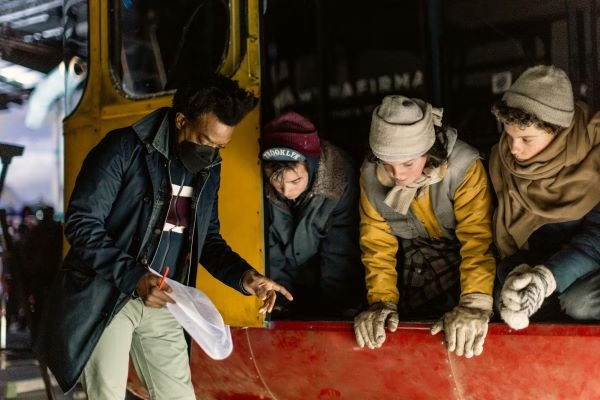
Set in 1982, the film follows a group of kids trapped in a cable car during winter, blending coming-of-age drama with elements of psychological suspense and apocalyptic tension as they imagine everything from nuclear war to the end of the world.

Lee, the younger brother of acclaimed filmmaker Spike Lee, has credits as an actor, writer, and director dating back to the 1980s. His credits include acting in School Daze and co-writing Crooklyn with his sister, Joie Lee. His directing filmography includes Nowhere Fast (1997), UR4GIVEN (2004), Window on Your Present (2010) and Burn Out the Day (2010).

For A Rare Grand Alignment, Lee wrote much of the script in an old, nearly abandoned loft owned by a friend’s family. He said the isolation—without heat, gas or a smartphone—became a creative advantage. The production was deeply emotional, with cast and crew often brought to tears during filming.

The film also marked the first production by a new studio founded by the creator of the mobile game Clash of Clans. The studio used cutting-edge LED volume technology—a massive high-definition screen that allowed Lee to shoot scenes with real-time rear projection rather than green screen effects. Lee said the technology perfectly matched his vision and helped evoke authentic performances from the young cast. Despite only four weeks of pre-production, he said he “flew by the seat of his pants” and was proud of the final result.

Lee will participate in a panel discussion following the screening of A Rare Grand Alignment at Starlight Terrace Theaters at 5 p.m. Nov. 9.

Out of Plain Sight is a gripping investigative documentary that exposes the long-term environmental and health impacts of DDT dumping off the coast of Southern California. The film follows UC Santa Barbara professor David Valentine and Los Angeles Times journalist Rosanna Xia as they uncover decades of ecological neglect, revealing a story that remains unresolved and unsettling. The documentary gained national attention, sparking public outrage and a congressional inquiry.

Produced by Xia and brothers Austin and Daniel Straub, the film premiered at the 2025 Santa Barbara International Film Festival, where it won the Audience Choice Award. It has since screened widely, including opening night at the Slamdance Film Festival in Los Angeles, and at the Cleveland, Miami, and Environmental Film Festivals. It received the Shared Earth Foundation Award for Advocacy in Washington, D.C.

The film begins with a startling 2011 discovery: corroded barrels on the seafloor between Catalina Island and the Palos Verdes Peninsula. Using archival footage, Out of Plain Sight traces the history of DDT—from its rise and regulation to its enduring ecological legacy. Scientists explain why recovering the barrels is virtually impossible: much of the chemical has already leached into sediments, and the boundaries of the dumping sites remain unknown.

The documentary delves into the science of contamination, showing how DDT moves through marine food chains. Lanternfish carry the chemical from deep ocean depths to the surface, where it enters predators such as sea lions, whose cancer rates are among the highest in the animal kingdom. Even now, condor eggs show the effects of DDT more than 50 years after its ban, illustrating the intergenerational toll of environmental toxins.

The film also highlights the painstaking work behind the investigation—from data collection to long-term monitoring. Valentine emphasizes persistence and dedication in science, while the filmmakers explore the human side of research and journalism.

Ultimately, Out of Plain Sight warns that DDT represents countless chemicals released into the environment with minimal oversight and lasting consequences for public health and ecosystems. Scientists continue to map contamination, study microbial breakdown, and advocate for greater research support. The film challenges viewers to consider environmental responsibility and the vital role of science in shaping the future.

The San Pedro International Film Festival, or SPIFFest, announced its 14th annual celebration Oct. 19, showcasing a diverse selection of independent films, documentaries, and special screenings Nov. 7–9. The festival continues to cultivate the local arts scene, foster creative expression and bring residents and visitors together through the power of cinema.

This year’s festival coincides with the debut of the “Second Saturday ArtWalk,” from 1 to 7 p.m. Nov. 8, organized by downtown San Pedro’s art community. The event will transform the area into a vibrant corridor of galleries, music and food, further cementing San Pedro’s reputation as a hub of creativity and cultural connection.

“This partnership between film and art celebrates what makes San Pedro so unique,” said Ziggy Mrkich, SPIFFest founder and festival director. “Each year, the San Pedro Film Festival brings our community together to celebrate creativity, diversity, and shared stories. We’re thrilled to expand that celebration through the Second Saturday ArtWalk — a new way to experience the spirit of San Pedro.”

The 2025 festival features an eclectic lineup from emerging and established filmmakers, highlighting stories that reflect the rich cultural tapestry of San Pedro and beyond. In addition to screenings, SPIFFest will host panel discussions, Q&As, workshops and events celebrating the art of storytelling and local talent.

Highlights include Out of Plain Sight, directed by Xia and Daniel Straub, and several local premieres, along with a screenplay competition for emerging writers. Festival passes and tickets are available at SPIFFest.org, where visitors can also find the full schedule of showtimes and ArtWalk activities. The SPIFFest Mixer will be held Saturday night at Wunderkammer at Crafted.


Parham’s Final Act, Bringing Justice Ketanji Brown Jackson to CSUDH Before Retirement


Dr. Thomas Parham, president of Cal State University Dominguez Hills, is retiring from his post, effective at year’s end. And the world only learned of it after pulling off a major win in getting Supreme Court Justice Ketanji Brown Jackson to be the guest lecturer at the school’s President’s Distinguished Lecture series.

Under his leadership, Dominguez Hills has grown in size and in prestige as the school’s administration and the City of Carson’s elected officials have grown closer over the past seven years.

Dr. Thomas Parham emphasized that Dominguez Hills’ Presidential Distinguished Lecture Series is not just any lecture series. When he arrived at CSUDH in 2018, he envisioned the university as a space where pressing societal issues could be explored through rigorous discourse, elevating conversations beyond personalities to focus on critical topics.

The series began in 2018 with Tommy Smith, marking the 50th anniversary of his Black Power salute at the Mexico Olympics. His lecture, Silent Gesture: Can Athletics Be Used as a Platform for Social Justice?, drew 456 attendees plus overflow, signaling the series’ impact. Since then, the series has featured notable figures, including Xavier Becerra, former attorney general; a former secretary of the U.S. Department of Health and Human Services; then Rep. Karen Bass; Kenny G; artist Tony Scott; and several prominent news anchors.

Dr. Parham hopes the lecture series continues after his retirement. While this upcoming event will be the last he presides over, he sees it as a foundation for the campus to carry forward a tradition of critical, high-level discussion.

Landing Supreme Court Justice Ketanji Brown Jackson for the series was an 18-month process involving “framing the narrative about what we are asking, why it was important for her to consider coming, given the zillions of requests she undoubtedly gets.” Dr. Parham initially invited her for 2026, before publicly announcing his retirement, then successfully rescheduled for 2025 without revealing his reason. The invitation came together through careful planning, crafting the right message, and some luck. Ultimately, her participation was shaped by the compelling mission of the series and the meaningful dialogue it would bring to campus.

While the lecture series and the rapid growth of Dominguez Hills University are highlights of his tenure, Dr. Parham also takes credit for improving the university’s relationship with the City of Carson. Before his arrival, the campus had been sued twice by the city within three years over who should serve as the California Environmental Equality Act “lead agency” for CSUDH’s Master Plan, known as “University Village.”

Under Mayor Albert Robles, the city argued that it — not CSUDH or the California Office of Planning & Research — should control the environmental review process. The city claimed the university undertook major developments without consultation and had not contributed its fair share to the community. Litigation began in late 2017 through early 2018, but the city ultimately lost the case.

Following the election of Lula Davis-Holmes as Carson’s new mayor, Dr. Parham seized the opportunity to build bridges. He met with every council member and the new mayor, hosting lunches at Uncle Darrow’s New Orleans Grill to discuss the university’s value to the city. Drawing on his experience from Irvine, a city that integrates its university into civic life, he encouraged Carson’s leaders to treat the university as the city’s greatest asset and collaborate rather than litigate.

The city responded positively, supporting the campus master plan approval, signing a memorandum of understanding, and presenting CSUDH with a ceremonial key to the city. Today, the university and Carson maintain a collaborative partnership, with university leaders participating on city committees, co-hosting events, and promoting the campus through city banners, demonstrating a strong, mutually supportive relationship.

Dr. Parham noted that Dominguez Hills has a vision for broader collaboration across campus departments — arts, culture and advancement — to engage the city, provide meaningful student experiences, and benefit the community, though it is still emerging. The university has already partnered with the city on programs like rehabilitation services and student internships, helping train future professionals.

He emphasized that CSUDH can leverage its resources — like land and the theater department — to create facilities such as a Performing Arts Center, serving both instructional purposes and the community. Such initiatives require vision, courage, and thinking beyond traditional approaches.

Regarding sustainability, Dr. Parham said his legacy is not about his personality but the principles and standards of excellence he established. By embedding a culture of collaboration, he hopes future leaders and the community will continue to elevate the campus and maintain these partnerships. His tenure serves as an invitation for the city and the university to keep building on what has been started.

RPV City Council Reviews Landslide Impact and Dewatering Efforts

RANCHO PALOS VERDES — At the Nov. 4 city council meeting, city staff gave a comprehensive update on the landslide emergency and the impact of deep dewatering wells. From September-October 2025, movement continued to slow considerably, decreasing from an average rate of 1.8 inches per week within the active landslide area, to 1.46 inches per week. As a reminder, Southern California Edison or SCE previously stated that a continued and sustained reduction in land movement near its electrical infrastructure to less than 1 inch per week would be necessary for the utility to consider re-energizing the Portuguese Bend Community Association neighborhood, which has been without service since September 2024.

The city’s deep dewatering wells have removed over 370 million gallons of groundwater from the toe of the Portuguese Bend Landslide since last fall, with eight wells currently pumping out approximately 1 million gallons per day. The Klondike Canyon Landslide Abatement District’s two deep dewatering wells are removing approximately 400,000 gallons per day, and the Abalone Cove Landslide Abatement District’s 16 dewatering wells (including seven original wells and nine deep dewatering wells) are removing approximately 165,000 gallons per day. The combined dewatering efforts are believed to have had a dramatic impact on reducing land movement.

City staff continues to “winterize” Upper Altamira Canyon and Portuguese Canyon for the rainy season, with this work expected to be completed by late November or early December. Staff is performing maintenance elsewhere in the landslide area where these measures are already in place.

Finally, the council renewed for 60 days the local emergencies in the landslide area and the temporary prohibition of motorcycles and bicycles along a two-mile stretch of Palos Verdes Drive South.