
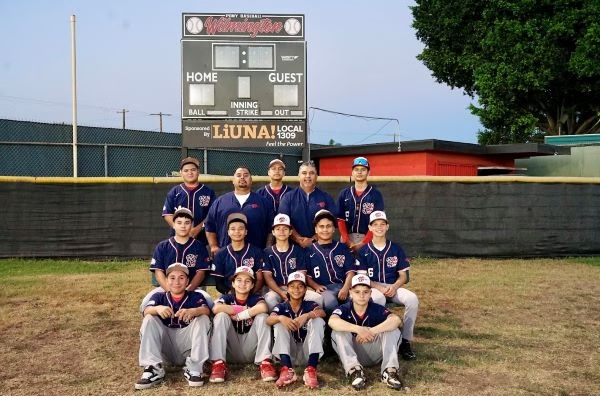
Wilmington PONY League All-Stars Carry Forward a Legacy of Mentorship
Last month, Wilmington’s 11U and 13U PONY League All-Stars swept the district, sectional and regional championships, winning more than trophies and bragging rights. Their 2026 championship run represents generations of community investment, mentorship, resilience and volunteerism in a working-class neighborhood where youth sports offer opportunities for personal growth and belonging.
These young players earned something less tangible but just as enduring: community pride. It is the stuff of which local legends are made and stories are recounted for decades.
Resilience, however, is not something easily taught. It is a hard-earned durability forged through setbacks and adversity.
Coach Joe Hernandez knows that firsthand. His son Joe, the team’s pitcher, broke his arm before the All-Star season, seemingly ending his chances of playing.
“We weren’t expecting him to pitch when he came back,” Hernandez said. “But then the doctors cleared him sooner than expected. He completely took over hitting, pitching and fielding. He just completely came back focused.”
Joe had broken his arm the previous year, too, forcing him to miss that season’s All-Star run.
“We were like a game or two short of what we accomplished this year,” Hernandez recalled. “We were right there.”
This year, Joe and his teammates found a way to go further.
Hernandez readily identified the players whose contributions helped propel the team through the championship run. He singled out PJ DeLeon as a standout pitcher and catcher, praised Ary Guzman’s steady play at shortstop and Ziggy Cardenas’ work at second base, and highlighted the youngest player, Jax Chavez, as a fixture in the Wilmington All-Stars’ infield and an ace left-handed hitter.
“We just had a really good core of kids,” Hernandez said.
From Four Losses to a Championship Run
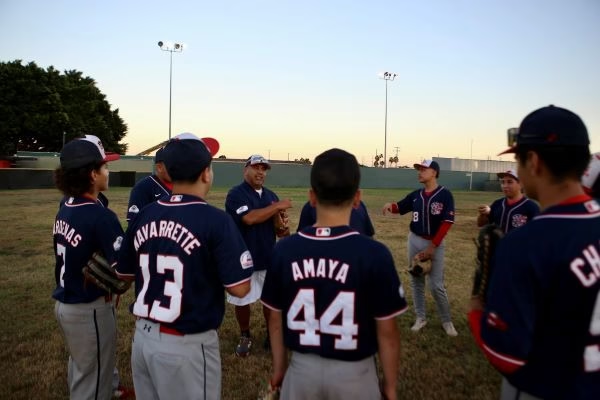
The All-Star season began in spring 2026, and its opening chapter looked nothing like the ending. Drawing top players from teams across the Los Angeles Harbor Area, the All-Stars lost their first four games as the players worked through the growing pains of learning to play together.
By the midpoint of the season, however, the team was beginning to turn a corner. Players developed stronger chemistry and confidence, and their teamwork, discipline and perseverance helped reverse the early losses. Hernandez credits the turnaround to collective effort rather than individual talent alone.
“What we’re really working on is the mentality,” he said. “I think that’s what they need to overcome. We’re trying to teach them to stay calm even though things are going wrong. Just stay calm and overcome.”
That composure became one of the team’s defining strengths.
“When we fell behind, they didn’t lose it,” Hernandez said. “They kept it together. They knew their opponents were about to rally, but the Wilmington All-Stars showed patience and kept working hard. And then we always prevailed in the end.”
Teaching that kind of resilience requires preparation, repetition and reflection. Hernandez encourages his players to think through their decisions before the action unfolds, rather than waiting until the ball is hit to decide what to do.
“We were constantly teaching them to prepare before they have to do the work,” he said. “Like telling yourself, ‘If I get this ball, this is what I’m doing.’ Instead of deciding after you get the ball.”
The same principle applies at the plate, where each at-bat offers another chance to learn and improve.
“Every ball is a brand-new opportunity to do right, to do better,” Hernandez said.
Coaches reinforce those lessons by asking players to examine their decisions: What were you thinking on that play? How could you have done it differently? The questions are repeated throughout practices and games, turning individual experiences into lessons the entire team can carry forward.
Add those small lessons together, Hernandez suggested, and they become something larger: resilience.
A Family Tradition on the Field
Hernandez’s connection to Wilmington baseball spans decades. He played at the park from the mid-1980s through 1990, and all three of his sons have participated in PONY League baseball there. His oldest son is about 30, his middle son is 26, and his youngest, Joe Jr., is 13.
His family’s history reflects a pattern familiar throughout the program. Many players have fathers, uncles, brothers or other relatives who once played at the same park. Former players return as coaches, passing along athletic skills and the values they learned from the adults who guided them.
The result is an intergenerational tradition of participation, teaching and mentorship. The players may change, but the relationships and responsibilities connecting them remain.
That tradition is especially visible at the team’s baseball field at the corner of Opp Street and Banning Boulevard, where a bust of John Mendez Jr. watches over the park.
Mendez, a Wilmington community leader whose work touched generations of local young people, served as director of Wilmington Teen Post 108 from 1966 to 1973. His legacy offers a historical lens through which to understand the community investment that continues to sustain youth programs like PONY League baseball.
A Wilmington native and Phineas Banning High School graduate, Mendez attended the U.S. Jaycees Leadership School before entering the Army in 1948. He served for four years, attaining the rank of sergeant first class and serving as a field first sergeant before his discharge in 1952.
After returning to the Los Angeles Harbor Area, Mendez held several jobs before becoming director of Wilmington Teen Post 108 in 1966. The multiservice community teen center offered young people opportunities that extended well beyond recreation.
During the Lyndon B. Johnson administration, federal Great Society initiatives directed resources toward urban communities and programs serving disadvantaged young people. Wilmington Teen Post 108 used that broader environment of public investment to help connect local teenagers with organized activities and opportunities for advancement.
Young people could participate in sports ranging from boxing to baseball, pursue summer employment and, for a time, publish a newspaper. The Teen Post became a place where young people could develop skills, find adult guidance and build relationships that might shape the rest of their lives.
Mendez left the Teen Post in 1973 to join the staff of Los Angeles City Councilman John S. Gibson Jr. As Gibson’s field deputy, he was responsible for the operation of the councilman’s district office. He later served under Gibson’s successor, Councilwoman Joan Milke Flores.
His public service was only part of his contribution. A biographical account of Mendez’s career credited him with founding at least 13 community organizations and programs, securing grants for at least 24 programs and serving on the boards of at least eight organizations. He also co-chaired the Wilmington Parade and Fiesta del Grito.
Mendez was called the voice of the Pilots, not just because he was the official game announcer for Banning High School. His influence, however, cannot be measured by an organizational tally alone. It is also reflected in the lives of people who found direction and purpose through their relationships with him.
The Lessons That Outlast the Game
Roger Sanchez, a former Wilmington gang member who became assistant director of the Wilmington Teen Center in 1986, credited Mendez with helping him change his life.
“I had no father when I moved to Wilmington, so I looked to John Mendez as my father figure,” Sanchez told the San Pedro News-Pilot. “He taught me a lot.”
Sanchez described how he followed Mendez around the center, helping wherever he could.
“I became Mr. Mendez’ shadow, following him, helping him wherever I could at the center. I grew up there.”
Before becoming assistant director, Sanchez volunteered at the center for years. He worked mornings and gave his evenings to young people, taking them on field trips and to tournaments and sporting events.
The work echoed the mission Mendez had helped establish: creating safe, supportive spaces where young people could find encouragement, learn responsibility and discover possibilities beyond their immediate circumstances.
That same spirit lives on in community programs where former players become coaches, families return to the same fields across generations, and volunteers invest their time in children who may someday do the same for others.
The Wilmington PONY League All-Stars’ 2026 championship is a story of athletic achievement. It is also a story about what happens when young people have teammates who believe in them, coaches who teach them to persevere and a community willing to invest in their future.
The trophies will mark the season. The lessons — and the relationships that made it possible — can last a lifetime.