
By Devonte Barr, Reporter
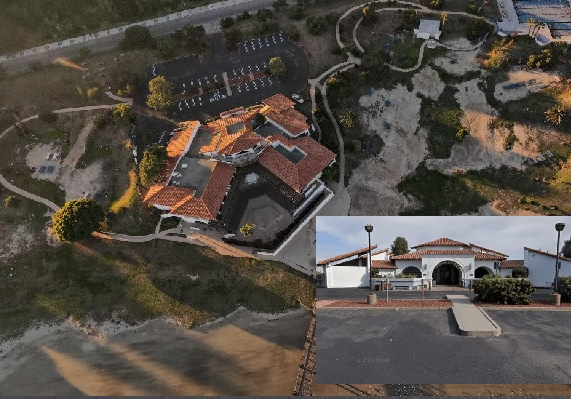
At the Central San Pedro Neighborhood Council meeting on Jan. 20th, Port of Los Angeles spokesperson Mike Galvin faced pointed questions about facilities expected to host Olympic sailing in 2028, including the Cabrillo Beach Scout camp in the inner-harbor of Cabrillo Beach. Port officials say more than 3,000 spectators could attend a single day of competition — a projection that feels increasingly unstable given how little has changed at the Outer Harbor over the last decade.
Under sustained questioning, Galvin acknowledged what many residents already knew but had rarely heard stated so plainly: the aquatic facilities have suffered years of neglect, lacked a long-term operating plan, and offered no binding guarantees of community access once the games conclude.
“Some of the internal systems have not been well-maintained over the last 10 years,” Galvin said. The admission was striking — not because it surprised anyone in the room, but because it confirmed on the record that a public waterfront asset had been allowed to deteriorate until an international event forced attention.
Those “internal systems” aren’t abstract. They include restrooms, docks, electrical infrastructure, and safety features — the basics required for any venue expected to handle thousands of visitors. The port is now racing the Olympic clock to address them, but only to a limited extent. Galvin made clear that the Harbor Department does not intend to operate the facility after the games.
“Our intent is not to be the operator long-term,” he said. Instead, once the Olympics conclude, the port plans to put the site back out for competitive bidding.
That single sentence carries major implications. It signals that the port’s priority is making the site functional enough to pass Olympic standards, not committing to what it becomes afterward. The long-term future — who runs the facility, who can afford it, and who gets priority access — is being deferred to a future operator who doesn’t yet exist.
When asked about current users, including local youth sailing programs and community boating groups, Galvin struck a careful tone. A future operator, he said, would be “expected to accommodate current users.” But expectation is not an obligation. There is no written access agreement, no enforceable standard, and no mechanism preventing a future operator from reshaping the facility around private memberships, higher fees, or restricted use.
The people who rely on the waterfront now are being asked to trust a process that has yet to be designed.
The port keeps pointing to “partnerships,” but the details fall apart under a microscope. Galvin clarified that the Boy Scouts’ role was largely limited to amphitheater decking, with the port funding the rest. This remains a taxpayer-backed facility in a working-class community that has spent decades absorbing diesel fumes, truck traffic and industrial noise for the sake of port operations.
The Olympics are now being framed as the payoff. In theory, thousands of spectators could bring hotel bookings, restaurant traffic, and long-needed economic activity. But that only happens if San Pedro is allowed to participate. If access narrows, prices climb, or local programs are pushed aside, the benefits won’t land here — they’ll pass straight through.
Transparency remains the missing ingredient. The port operates with an annual budget exceeding $1.5 billion, yet there is little public clarity on how much of that investment will meaningfully reach San Pedro — or how much will be spent simply bringing facilities up to minimum safety standards before being handed off.
Galvin repeatedly emphasized “long-term community benefit” during his remarks. The phrase sounds reassuring, but it isn’t a plan. What is concrete is the port’s current approach: address safety issues, host the games, then solicit bids from a long-term operator.
“We’ll make the basic improvements needed,” Galvin said, “and then put it back out for a competitive long-term operator.”
“Basic improvements” set the floor, not the ceiling. “Competitive operator” introduces market forces into a space that has historically functioned as public infrastructure. There is nothing in that framework stopping San Pedro residents from being pushed aside once the Olympic banners come down.
That uncertainty is why Neighborhood council members aren’t asking for Olympic promises, but written guarantees — proof that existing programs won’t be displaced and that community access won’t be sacrificed for a global event.
Local youth sailing programs are already questioning whether they’ll be priced out or pushed aside after 2028. And looming over everything is the operator question. Will the facility go to a private yacht club? A marina corporation? A nonprofit with genuine community roots — or one that simply uses the word “community” as marketing language?
The Olympics are being sold as climate leadership, economic opportunity and neighborhood investment, but San Pedro has seen this cycle before: big promises, short timelines and vague legacies. If the port can’t commit now, in writing, to real investment and enforceable access, there’s little reason to believe the post-2028 future will look any different once the boats sail and the cameras leave.