
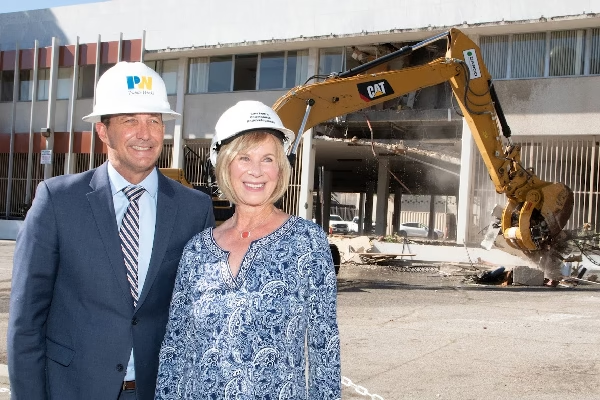
On Dec. 2, 2025, the LA County Acting Chief Executive Officer Joseph M. Nicchitta sent Southern Pacific Realty Partners, LLC a letter basically cancelling the former San Pedro Courthouse development at 505 S. Center St., in San Pedro. The letter gave notice that “The Option Agreement is set to automatically and uncontestably terminate, and be of no further force or effect, on December 31, 2025.” As of that date, the contract was canceled. The failure of the SPRP developers to even break ground on the project after five years frustrated and angered LA County Supervisor Janice Hahn, who is now looking for other options.
The problem is that for months, the San Pedro Chamber of Commerce and the San Pedro Property Owners Alliance (commonly known as the PBID) had lobbied Hahn to extend the contract. This was seen by some as being a conflict of interest, seeing as how Elise Swanson, the executive director of the chamber, had added William M. Cockrum IV (one of the partners on SPRP) onto the board of directors.
This is just one more example of the speculative blight that has plagued parts of San Pedro’s business district for years, decades even, like the vacant lot where the Dancing Waters Night club was torn down or the vacant lot on Pacific Avenue at 22nd Street. That and several other commercial properties lay fallow or have become an eyesore in the community. The term in real estate is called “land banking,” and there’s multiple examples of investors just sitting on properties until prices rise.
Long-time observers of the development projects will recall the vacant lot where the Centre Street Lofts now stands was empty for 30 years as part of the Beacon Street Redevelopment project. And many others will recall the demolition of Old Beacon street in the 1970s that was celebrated with a street party organized by the chamber. A decade later there was some great remorse when adaptive reuse became the new thing. Clearly there has been a series of mistakes over the decades to redevelop and regenerate business in the business district of San Pedro.
There have been several “celebrated losses” that have created a certain blight on the business district that it has then tried to compensate by other means. The PBID was specifically created to address signs of blight, and yet there’s still a significant vacancy rate in the greater business district that is now attempting to be addressed by the JEDI Zone façade improvement area from First to 14th streets on Pacific Avenue. The problem there is that it was slow to get started and underfunded.
Two decades ago, the Urban Land Institute did a study of San Pedro, which concluded that this town needs 5,000 new residential units to activate its core.
That report also lists the “native arts district” as one of the top three assets to rejuvenate the town. All of this has had little success in changing the economic future of San Pedro, even the delayed redevelopment of the waterfront hasn’t helped.
There has not been 5,000 new units built, the arts district has not been significantly supported after the first $500,000 was invested by the CRA and much of the new developments are not priced to retain either artists, promote small businesses, or provide housing for the local workforce.
The significant piece that has never been discussed or overcome was the loss of 30,000 good paying jobs from 1980 to 1992, which was more than half of the workforce at that time. These were the shipyard jobs, cannery workers, the San Pedro fishing fleet and later the U.S. Navy shipyard on Terminal Island — mostly good union jobs. Nearly every family from San Pedro who lived here before 1980 probably has one or more family members who worked these jobs. It was what built the middle class in Pedro. The dramatic loss of those jobs caused a real estate crash in values in the 1980s that only recently has come back.
Yet, some community leaders still believe that there’s going to be some magic cure in the future like West Harbor and its amphitheater, the new cruise terminal with the promise of tourism dollars flowing in to save San Pedro. One recent report from the Port of Los Angeles stated (without giving a source) that every cruise ship that docks in San Pedro brings $1.4 million in economic benefit.
Supervisor Hahn, on the other hand, has soured on the promise of more housing being the cure. “I’m taking a fresh look at this property and what the options might be for it,” she said recently.
She doesn’t think it has to be housing, but it could be something else, “Perhaps workforce training or the ILWU museum … I’m open to considering any new options.”
In the meantime the PBID is having a budget crisis because Southern Pacific Realty Partners, LLC apparently didn’t pay their property taxes, a portion of which funds them.