



At last week’s press conference introducing Jim McDonnell as the new Chief of the Los Angeles Police Department, Mayor Karen Bass called him “a leader, an innovator, and a change-maker” and “one of America’s finest police professionals”; and McDonnell stated his desire to “ensure respectful and constitutional policing practices.”
But some of the lowlights from his March 2010–November 2014 stint on the same job in Long Beach make you wonder.
PHOTOGRAPHERS, BEWARE!
In June 2011, an LBPD officer detained Sander Roscoe Wolff for taking pictures of a refinery from a public street. “If an officer sees someone taking pictures of something like a refinery,” McDonnell said when questioned about the incident, “it is incumbent upon the officer to make contact with the individual.” He also noted that under his leadership the LBPD was “on-line” with all instructions contained in LAPD’s Special Order No. 11, a post-9/11 overreach that instructed its officers to write “Suspicious Activity Reports” on behaviors as innocuous as taking notes, using binoculars, asking about an establishment’s hours of operation, and taking pictures or video footage “with no apparent esthetic value.”
Wolff’s detention came a month after I was enringed by eight L.A. County Sheriff’s deputies for suspicion of taking pictures of the Long Beach Courthouse (a perfectly legal activity in which I wasn’t actually engaged). Ironically, McDonnell was Sheriff by the time the L.A. County settled a lawsuit filed by the American Civil Liberties Union on behalf of myself and two photographers to overturn the Sheriff’s Department’s pertinent policies and practices, which violated the First and Fourth Amendments. The settlement included providing new training so that deputies better understood that they should not be “interfering, threatening, intimidating, blocking or otherwise discouraging a member of the public” from photographic/videographic activity. “[…] Members of the public, including the press, have a First Amendment right to observe, take photographs and record video in any public place where they are lawfully present.”
Not like L.A. has a shortage of people taking pictures on the slowest day, but with a World Cup, Olympics, and Super Bowl coming to town within the next five years, there will be all kinds of rationalizations for violating people’s rights in the name of security.
HOLDING OFFICERS TO ACCOUNT FOR EXCESSIVE FORCE? NOT SO MUCH
For incidents occurring between December 2010 and December 2013, the City of Long Beach paid at least $9.5 million in judgments and settlements related to claims of police using excessive force. That’s in addition to the $6.5 million a jury awarded the family of Doug Zerby, who was unarmed when police gunned him down on the steps of a friend’s apartment building.
All told, Long Beach coffers were lightened by over $20 million for such claims during McDonnell’s tenure. Even so, LBPD records show that out of 167 internal investigations into possible excessive force, only two of his officers received any sort of discipline.
TRANSPARENCY? DON’T COUNT ON IT
In June 2011 a judge called out the LBPD for “us[ing] what I refer to as strong-arm tactics to knock down the doors of the collective without a warrant and without exigent circumstances.”
McDonnell certainly did not seem to want the public to know what his officers were doing. In response to a series of 2014 Public Records Act Requests, the LBPD claimed that literally no public records existed pertaining to 88 raids of medical-marijuana dispensaries between September 2009 and September 2013, keeping them out of sight under the catch-all that even those from four years earlier were “investigative records [and therefore] exempt from disclosure.”
But that’s nothing compared to what McDonnell’s officers did to keep the public in the dark. Widespread allegations that it was standard operating procedure for officers to smash all surveillance cameras during dispensary raids were proven true in June 2012 when they failed to locate all the cameras and DVRs at the THC Downtown Collective and were recorded methodically seeking out cameras and smashing them with batons. “No matter how you look at it, [footage of the raid] seems to me to violate the Fifth Amendment and the Fourteenth Amendment, which bar the deprivation of property without due process of law,” said ACLU attorney Peter Bibring. “For a police officer to take something and smash it is depriving someone of property without due process. […] Cops can’t destroy property. They can confiscate it; they can’t destroy it.”
That same footage also caught an officer stepping on the neck of employee Dorian Brooks while he lay face-down, hands over his head, fully compliant. Long Beach paid out $50,000 to avoid going to trial on that one.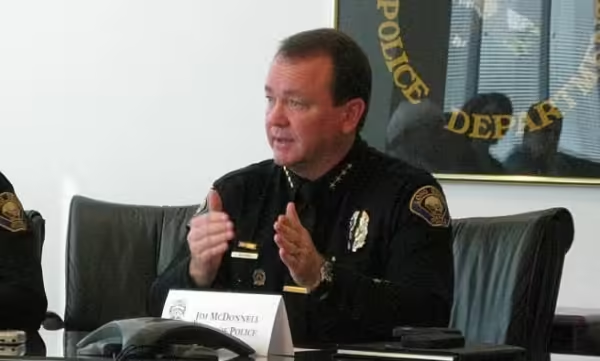
SOME PEOPLE WILL SAY ANYTHING TO GET THEIR WAY
During a time when an increasing number of cities across the country officially relegated marijuana offenses as the lowest level police priority, McDonnell not only lobbied the city council against allowing even medical marijuana dispensaries — this in a city whose residents voted in favor of legalizing pot for recreational use way back in 2010 — he made clear his willingness to siphon resources from combating violent crime in order to go after dispensaries. “We have been asked to devote more resources in the gang detail and the enforcement of realignment, prohibited possessors, property crime, and human trafficking,” he told the council in December 2013. “Opening the door to marijuana dispensaries will severely limit our ability to respond to these and other items requested by the council.” (He did not respond to numerous inquiries about how allowing dispensaries to operate would inherently limit the LBPD’s ability to combat these crimes.)
And on at least one occasion he provided the council with false information in the effort to get them to do his bidding. At a June 2012 council meeting, McDonnell claimed that only a complete ban on dispensaries (as opposed to a “two-tiered” system, where some dispensaries were permitted while others were disallowed) would enable the city “to get on the list to be able to work with the U.S. Attorney and the DEA to be able to do asset forfeiture, to be able to seize the assets of those that are selling within the city. We can’t do that as long as we have the two-tiered system where the City has somewhat sanctioned the 18 [dispensaries] and not the rest.”
But both the U.S. Attorney’s Office and the Drug Enforcement Administration confirmed that this was simply untrue. “There’s no ‘list’ that we have,” said a DEA spokesperson. “[McDonnell’s claim] sounds like it’s an internal issue.” “There is no specific ‘list,’” a U.S. Attorney’s Office spokesperson concurred. “[… T]he marijuana industry is illegal and subject to federal enforcement wherever it is found.”
Whether McDonnell was ignorant or lying, it’s not what you want from your top cop.
The “Blue Lives Matter” and “Defund the Police” crowds can easily agree on one thing: that whatever police officers we have — especially in leadership positions — be honest, compassionate, pragmatic, and ethical. It will be in all of our best interests if Chief Jim McDonnell does better in Los Angeles than he did in Long Beach. He’s got a big, important job. Let’s not just hope for the best, but demand it. (That includes you, Ms. Mayor.)