
New Port Director Frames Climate Goals Around Labor Collaboration
A day after the Jan. 15 State of the Port address, newly installed Port of Long Beach Executive Director Dr. Noel Hacegaba sat down with Random Lengths News to expand on his vision for the port’s future — one rooted in the idea that zero emissions and job protection are not mutually exclusive. That framework, long championed by labor and environmental advocates, centers on a 2050 strategy driven by collaboration rather than automation alone, with Pier S envisioned as a global model for human-operated, zero-emissions terminals.
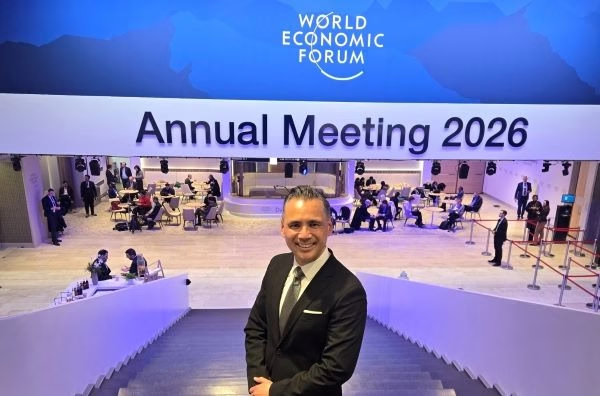
The following week, Hacegaba was the only American port director invited to speak at the World Economic Forum in Davos, Switzerland, where he planned to share that vision on the world stage.
Throughout the interview, Hacegaba emphasized what he called the “Long Beach way”: bringing labor, terminal operators, and the port together to pursue innovation and emissions reductions without leaving workers behind. He pointed to the Long Beach Container Terminal as proof that clean technology and good union jobs can coexist.
“[The Long Beach Container Terminal] was a development that put us on the map in terms of zero emissions — the cleanest terminal operation,” said.Hacegaba. “When you look at both the operational and workforce pieces, the Long Beach way was to ensure that our partners had a meeting of the minds with the labor union. They found a way and charted a path forward to make that project a reality.”
Hacegaba said his broader philosophy is to bring all parties to the table and chart a path toward a future that leverages innovation while investing in a highly trained workforce.
“That’s why yesterday, at the State of the Port, I said that as we build a port of the future, we’re going to tackle — together — challenging and sometimes uncomfortable conversations,” he said. “But I’m very optimistic that if we bring all the parties together and look for a path that leaves no one behind, we can get there.”
Holding a doctorate in public administration, Hacegaba framed the port’s future around a legally binding 2050 net-zero mandate, even as cargo throughput is expected to double. He stressed that meeting both goals will require a shared, multi-step process involving labor, industry, and the broader community — rather than a one-size-fits-all automation solution.
“The objective yesterday was to cast a new vision — and it’s a call to action,” Hacegaba said. “It’s going to take all of us working together to get there. The real question is how we reach net zero by 2050 while doubling our throughput. That’s why yesterday was step one in a multi-step process that includes labor as a critical partner.”
As part of that approach, Hacegaba highlighted the proposed Pier S development as potentially the first conventional, zero-emissions terminal in the world — demonstrating that ports can meet climate goals using human-operated equipment and reinforcing that sustainability is not a zero-sum game.
Hacegaba succeeded longtime Executive Director Mario Cordero, who retired at the end of 2025 after a seven-year tenure.