
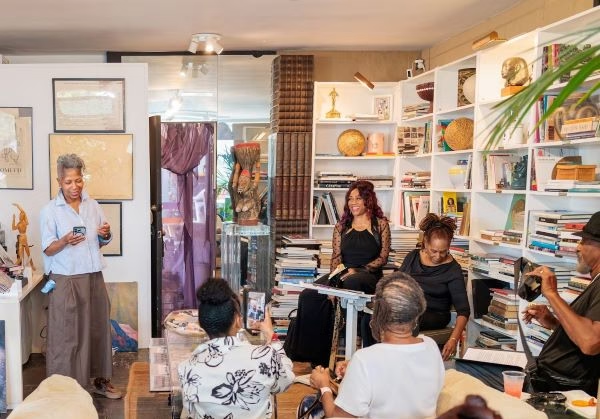
This past Sunday, I attended the book signing for Secrets of Shady, the novel by Windy Barnes Farrell and Carly Clark. The book grew out of the one-woman show Barnes Farrell performed as the title character, written and directed by Clark.
For me, the experience was surreal for three specific reasons.
First, there was The Den, a creative space where art, books and culture are sold; a space regularly transformed into a stage where cultural leaders speak, create and move the world from our little corner of San Pedro. The Den is a place where art, culture and commerce sit together like bosom buddies, attracting like-minded people into its orbit like the salons of yore.
This past June, queer culture icon Adele Bertei read from her book, No New York: A Memoir of No Wave and the Women Who Shaped the Scene. Last month, the venue hosted a meet-and-greet for L.A. mayoral candidate Nithya Raman.
Secondly, there was the celebration of Shady Henderson, the fictional blues singer at the center of Secrets of Shady, in the presence of Black women’s excellence at The Den.
I learned the day before the book signing that Carly met Windy while producing and mounting a theater production titled North on South Central Avenue. Windy was performing in another theater production at the time. Carly saw it, was impressed and invited Windy to work on North on South Central Avenue.
During the COVID-19 pandemic, Carly produced The Secrets of Shady with Windy. After two productions, Carly decided she didn’t want to mount another large production anytime soon.
“I want to write another piece,” she told Windy. “I want to do a one-woman show.”
Windy had always been fascinated by the Chitlin’ Circuit.
“So I said, ‘Well, let me see what I can come up with,’” she recalled. “My brain started clicking, and Shady Secrets was born.”
As they developed the story, the two discovered that their writing styles complemented each other in ways neither had anticipated.
Their strengths were different but remarkably compatible. Clark brought years of experience as a published author, while Barnes Farrell drew on her background as a songwriter, poet and storyteller. Barnes Farrell said she leaned on Clark as a writing mentor and learned a great deal from her.
At the same time, their shared instincts for brainstorming and storytelling allowed them to create characters with distinct personalities, energy and independence.
Their writing process reflected that chemistry. They met every Wednesday, divided chapters and assignments, and returned the following week with their individual sections. Yet when the pieces came together, the writing blended so seamlessly that they often couldn’t tell who had written what.
“I can’t tell who’s writing what,” Barnes Farrell said. “You know, it’s hard for me. I couldn’t even do it, and I know we both couldn’t.”
That ability to merge their individual voices into a unified story became one of the defining strengths of their partnership.
The collaboration also allowed them to transform Clark’s one-woman-show concept into a larger literary world. By bringing the characters from the performance into the book, Barnes Farrell and Clark were able to expand their stories and give them greater depth and individuality. Their creative partnership has since opened the possibility of adapting Secrets of Shady into a play and a film.
Listening to the women talk about their collaborative process was, for me, an example of excellence I’d like to hear more of. The reading also caused me to think about the real-life heroines of Shady Henderson’s era — women who were not only performers on the Chitlin’ Circuit but, at times, owners of the venues themselves.
Like my own great-grandmother, Rosezeal Risher, who ran Club Delissa on Central Avenue in the mid-1960s, just doors down from the legendary Club Alabam and the Dunbar Hotel.
The secrets of ambitious women navigating eras of misogyny and racism in business and entertainment could fill libraries.
My great-grandmother was from Chicago. She moved to Los Angeles from Chicago in the 1950s. Before that, she had lived in a city where Black entertainment, business and culture were flourishing despite the barriers imposed by segregation.
For a short period in the 1960s, she owned and operated Club Delissa on Central Avenue with her youngest daughter, my Aunt Cordia. It was a venue featuring fine dining and live entertainment.
In our family, she was known as Mother Dear.
When she was alive, I heard only occasional whispers about the old days, stories the adults told when they thought the children were asleep. Stories about the bands that would have the club jumping. The food served with white-glove table service. Mother Dear’s preference for being chauffeured around in her Cadillac.
And then there was the woman who carried a pearl-handled peacemaker — or widowmaker, depending on your perspective — in her purse.
I say this now because the physical evidence of Club Delissa that I’ve found is scarce: an old business card, an alcohol license, advertisements in The California Eagle and Southwest News, old black-and-white photographs and the oral histories passed down through the family.
But that is enough to make me wonder about the world she inhabited.
It makes me think about Central Avenue, the home of what was once called “race music” — essentially music of every genre produced and performed by Black people — from the 1940s through the 1960s. Black music stars performed at such celebrated venues as Club Alabam and the Dunbar Hotel, places that were part of the broader network of the Chitlin’ Circuit.
These were not merely places where people came to hear music. They were gathering places, businesses, cultural institutions and, in many cases, expressions of Black self-determination.
That brings me to the third reason Sunday felt surreal.
Oct. 1 marks the beginning of National Arts & Humanities Month. Thirty-three years ago, the observance was expanded from a week into a month-long celebration designed to raise public awareness and participation in the arts and humanities and give governments and businesses an opportunity to demonstrate their support for them.
I’ve never thought business owners and artists needed an excuse to support the arts.
Historically, artists and business owners have often been at the leading edge of free expression and the creation of spaces where that expression can flourish.
I was reminded of the Golden Ass Cafe, founded by Glen and Louise Bye in San Pedro in 1961. San Pedro police launched sting operations for indecency after finding nude paintings displayed at the coffeehouse and arrested Glen Bye.
To make his point, Bye kept the paintings up rather than hiding them.
I was also reminded of the late San Pedro resident Hope Foye and the trouble she encountered as a singer performing at racially integrated venues in Greenwich Village, Manhattan. The trouble was so good that the House Un-American Activities Committee eventually came calling.
This harvest month is as good a time as any to consider the transformative power of the arts — and their ability to draw people together.
There’s a clown in the Oval Office painting the country red and gold, with gilded trim and an aesthetic in which everything is outsized and patriotic to the point of farce, who presents a clear and present danger to this republic.
But places like The Den remind us that culture is about more than dollars and cents. They create spaces where artists can tell stories, writers can preserve memories, musicians can make noise, and people can gather long enough to remember that they are part of something larger than themselves.
That is what I saw Sunday at The Den: two Black women turning a fascination with the Chitlin’ Circuit into a story, a story into a book, and a book into another gathering place.
And maybe that is one of the secrets of Shady.
To get your copy of Secrets of Shady, visit secretsofshady.com. It would make a fine holiday gift.