
Home Blog

Welcome to “The Kill Zone”

Life and Death, Courtesy of Jones Chemicals in the Harbor Gateway

By Rick Thomas, Columnist and Harbor Gateway Community Activist

They call themselves “neighbors.”  

And wanted us to respond to them using the same title.

“Them” being Jones Chemicals, Inc., that is. 

Neighbors?

How about… polluters?

Residents learned at a recent Harbor Gateway South Neighborhood Council meeting, hosted at Councilman Tim McOsker’s new field office at the Enclave, that Jones Chemicals, Inc. wants to introduce itself to the community.  

More on the Enclave as you continue reading… but drumroll please… “Let’s bring to the stage… Jones Chemicals, Inc.!”

For those of us who live in Harbor Gateway, Jones Chemicals, Inc. hasn’t brought goodwill or welcome mats.

Jones Chemicals, Inc.?  

They’ve brought nothing more than danger. And misery. And chaos.

They are nothing more than environmental polluters.

Not neighbors.

Jones Chemicals’ footprint is just steps from the modular-built Cheryl Green Boys & Girls Club facility, because the soil is too contaminated for permanent foundations. Also, I live in that neighborhood. What the Del Amo Action Committee now calls “The Kill Zone.” 


It’s called “The Kill Zone” because of that environmental polluter known as Jones Chemicals, Inc. The place where toxins seep into the ground, cloud the air, and kill residents in the Harbor Gateway.  

But silence echoes in the chambers of City Hall.

Until now.

Thanks to the Del Amo Action Committee — DAAC for short — residents are finally organizing. 

But let me be clear: one mistake from Jones Chemicals, Inc. dumping chemicals here, one lapse in containment or oversight, and the results could be catastrophic.

I want more Christmases. More time to sing along with The Whispers: “And this Christmas will be a very special Christmas… for me.” 

But that future isn’t promised — not here. 

Not in “The Kill Zone.”

Cancel Christmas, pal. 

Politicians are shaking hands with corporations like Jones Chemicals, Inc., while those same corporations are poisoning us as law enforcement institutions cling to the motto “to protect and serve” — but who, exactly, are they protecting and serving?

Apparently not us.

Here in the “The Kill Zone,” families breathe and step onto chemicals they can’t even pronounce. Children walk past fenced-off “cleanup sites” on their way to school or to the Cheryl Green Boys & Girls Club. Asthma, rashes and unexplained illnesses have become a way of life for those of us living here.

All from the likes of Jones Chemical, Inc. 

For a time, I tried to play the game. I believed maybe, just maybe I could be transactional — trade a little favor by being quiet for a little safety — a little leverage for a little peace of mind. 

I thought I could work with the system. 

Maybe work within the system.  

But I can’t sell out my community in the Harbor Gateway.

I just can’t.

That ain’t me.

And that community, by the way, is stretching into the Harbor City section of Tim McOkser’s Council District 15.  

More to come on that.

I’d rather work for free, for the people who actually live here — the ones who actually breathe the toxic air and walk on the toxic ground, rather than sell out to weak politicians.   

Or sell out to those who are supposed to protect and serve.

Because they are killing us, slowly but surely. Murdering the safety of our communities…

And it’s unacceptable.

There’s no negotiating with rot that allows a company like Jones Chemicals, Inc. to operate just feet from children’s playgrounds and homes.

It’s not a negotiation.

It’s a fight.

I won’t tell the whole story, but I will give a hint or two on what may be coming. But until our air is clean, our soil is safe, and our children can play without fear of contamination, the Del Amo Action Committee isn’t backing down.

And neither am I.

Let’s circle back to that neighborhood council meeting at Tim McOsker’s new office, located in the ultra-modern retail/office complex on 190th Street. You’ve probably driven past the Enclave, but if you blink, you’ll miss it. There’s Nook, the popular coffee shop, Trademark Brewery, the Long Beach Fish Grill (still on my to-do list), and one of my favorites — 123 Pho.

This place is cool.

Buzzing.

Optimistic.

But dig a little deeper, and you’ll see what’s festering beneath the surface of this office complex.  Because guess who rents office space at the Enclave along with Councilman Tim McOsker?

Jones Chemicals, Inc.

The environmental polluters.

That’s right — Councilmember McOsker’s office is on the first floor, and Jones Chemicals? 

Ninth floor. 

Same building. 

Same air.

I don’t need PhD-level intelligence to do the math here. Truly my minus-7 credits in a baccalaureate degree in political science at Temple University are enough education for me to be able to read between the lines.  

Mama didn’t raise no fool!  

Brings to mind the phrase, “There are no secrets in life, just hidden truths that lie beneath the surface.” 

That quote comes from an appropriate character in the Showtime television series Dexter. The lead character was a serial killer, so he fits right in with what’s going on with the environmental polluters known as Jones Chemicals, Inc.

I liked Dexter when it was on Showtime, but watching it is different than, well, living it.    

At the neighborhood council meeting, sitting right in front of me was Tim Ross, vice president of operations for Jones Chemicals, Inc. He looked familiar, and for a moment I couldn’t place him. 

But then it clicked — Tim Ross from Jones Chemicals, Inc. manages the trucks I’ve seen rolling through residential streets, transporting hazardous materials.

I’ve met him before.  

That was the first time he was rude to me.  

So, when it came time for questions, of course I spoke up.  With all the sarcasm I could muster, I asked, “Oh, so your trucks are the ones — marked with ‘JCI’ — driving illegally down residential streets, past children and families and cats and dogs and chickens and ducks and veterans and yes, even gangbangers, right?”

Alright, I embellished a bit, but you see my point.

He didn’t like that.

Not one bit.

But guess what, Tim Ross?

I don’t care.

This community has fought hard to stop tractor trailers and other big rigs from using residential streets to get to the freeways to make their deliveries.  We understand fully where we live and that it’s not going to get any better. More real estate is now available for other trucking firms to locate in the Harbor Gateway.  

It’s a byproduct of where we reside. 

But we don’t have to live in “The Kill Zone.”

We’re going to see a lot of trucks in the hood. We worked with the trucking companies on Denker Avenue to stay the hell off residential streets in the Harbor Gateway. The Los Angeles Police Department collaborated with this community to put up signage to prevent that nasty practice from continuing. 

So then I learned from Tim Ross that Jones Chemicals, Inc. was given the OK to roll down residential streets. So, I asked the question aloud, “Who gave you, Jones Chemicals, Inc., permission to go down residential streets in our community?”

I didn’t like the answer. But I can be transactional if I get what I need to protect members of my community. So it’s not about me.

For now.

Back to that neighborhood council meeting.

After my question, Tim Ross from Jones Chemicals, Inc. went on a slight tirade.

He was rude to me, again.

“Our trucks don’t come down those streets and if you see any of our trucks going down those streets, I will fire that driver!” he shouted.

“All right, calm down fool,” I said. 

OK I said that to myself. I’m a runner not a fighter.

“Um, Tim Ross from Jones Chemicals, Inc.? Would you like to see the photos… of your trucks… going down Del Amo Boulevard?” 

Pissed off. I left. I was done. 

Everything stinks here as Jones Chemicals, Inc., the polluters in the Harbor Gateway, are the developers of the so-called “The Kill Zone.” Maybe I should have asked, “Why the hell is Jones Chemicals, Inc., the polluters, not our neighbor, introducing themselves to a community of residents that they are killing?”   

In a text that night I wrote to Councilman McOsker about what took place in HIS office. 

“I am just stunned.” 

Environmental polluters… Jones Chemicals, Inc. 

Tim McOsker texted back that he would take care of it in the morning. I texted, “If this were San Pedro we wouldn’t be having this conversation.”

There were a lot more words in that conversation. But it’s just another example of how the elected leaders and those that are supposed to be looking out for the best interest of the communities they represent, don’t.

They just don’t.

But “We don’t give up until the clock says zero.” Sports verbiage I heard this year from an NBA all star who competed to the point where he will miss a full year of future contests and competition because of a torn achilles tendon in Game 7 of the NBA championship.

You don’t give up “until the clock says zero.”

“… our office has received numerous concerns from residents regarding truck traffic associated with your facility along Del Amo Boulevard,” Councilman Tim McOsker wrote in a letter to Tim Ross at Jones Chemicals, Inc.  

“Our office will be coordinating with the Los Angeles Department of Transportation to install the appropriate signage along Del Amo Boulevard to ensure compliance and improve safety and quality of life for nearby residents,” he continued.

I guess sometimes you gotta be a prick, and well, rude, to get shit done. 

“Continued violations may result in further enforcement action.”

Well, that could have been a bit stronger, Tim. I might have written something like, “Continued violations WILL result in further enforcement action.” 

Jones Chemicals, Inc. is killing human beings in the Harbor Gateway. 

There’s no “may result” rather “will” result.  

Jones Chemicals, Inc. went through an Environmental Protection Agency inspection in 2024 and the EPA determined that Jones Chemicals, Inc. had seven… I repeat, seven “areas of concern” that needed to be addressed at their Harbor Gateway facility.

Seven  “areas of concern.”

Seven.

Just one area of concern is troubling enough. But seven?

That’s just this location. 

Do a search for Jones Chemicals, Inc. and another one of their environmental polluting sites pops up.  This is in Caledonia, New York. From the EPA report on issues at that location they wrote, “Spills occurred during the transfer and repackaging of many of these chemicals, contaminating soils and groundwater with hazardous chemicals.”

Jones Chemicals, Inc. are long time, serial, environmental polluters because this report in Caledonia, New York was written by the EPA back in 1986.

Yeah, these are the guys I want to be in bed with so let’s welcome them into the neighborhood, right?  

No.

I can easily say no.  

In future posts I will focus on the Del Amo Action Committee with respect to Jones Chemicals, Inc. The Del Amo Action Committee wants Jones Chemicals, Inc. shut down. 

The community wants them shut down as well.

“As we proceed,” in the words of the philosopher Biggie Smalls, I will share the response to a letter sent to Jeffrey Jones, chairman and CEO of Jones Chemicals, Inc. Said letter was sent by Rep. Nanette Barragán, who represents our community now. 

 “… the most recent EPA inspection found the company failed to maintain their responsibilities as required by federal law, “ she wrote about their Harbor Gateway location. 

Jones Chemicals, Inc. must respond back to her in 60 days from the May 22, 2025 correspondence.  

Not “may” respond.

Must. 

I’ve met Rep. Nanette Barragán.  

Several times.

Um, quick note to Jeffrey Jones, Jones Chemicals, Inc. chairman and CEO…

PSSST!  

I would respond back to her sooner rather than later if I were you.         

Stay tuned.  

This is just the pilot… maybe I should pitch this story to Showtime.  

I know.  

This is not funny.

In a time where I just want to produce Christian stand up comedy shows and heartwarming content about military wives on military bases saving lost dogs, I gotta deal with the mess about Jones Chemicals, Inc. polluting our community.   

OK then, I will.

This is just the first episode of many more episodes to come concerning the drama and the tragedy known as “The Kill Zone,” directed and produced in surround sound, Technicolor and IMAX by the environmental polluters in the Harbor Gateway known as Jones Chemicals, Inc. 

Airport Workers Push For Alternative Jet Fuels

Unlike the controversies over bio-fuels, there’s virtual unanimity for including jet fuel in the overall phase-out of fossil fuels in California’s transportation sector. The only questions are “Will it begin quickly?” and “Will it be done right?” Dozens of union airport workers, including union officers, showed up at the California Air Resources Board public hearing on the Low Carbon Fuel Standards update on September 28 to demand that it will.

“I developed pneumonia, asthma, and diabetes. I have respiratory problems,” said Oscar Antonio, a 23-year airport worker. “I am exposed to airplane fumes all day long,” said LAX cargo worker David Goddard. “On really bad days, I have trouble catching my breath and it’s difficult to breathe. A lot of my coworkers have developed asthma and breathing problems.”

“In 2019, I was diagnosed with COPD. No, I’m not a smoker, but I guess I breathe jet fuel on a daily,” said Jovan Houston, LAX worker and SEIU-USWW executive board member.

COPD, or Chronic obstructive pulmonary disease is a common lung disease causing restricted airflow and breathing problems.

“I live seven minutes from LAX. So when I lay in my bed at night, I see jet fuel flying, dumping over my house. This is the type of air that I breathe on a daily basis.”

“Even though I work inside the terminal, my job at the airport exposes me to air pollution that impacts my health and the health of my coworkers,” said security officer Davonni Sturdivant. “I have asthma and the pollution and smell of the fumes that I am exposed to on the job definitely makes it worse. The fumes come into the terminal sometimes and I have trouble breathing and I get bad headaches and migraines from it.”

“SEIU members are here in solidarity with other black immigrant communities fighting for environmental justice,” said Armando M. “We support the farm worker communities fighting to end air pollution from methane crediting. We stand in solidarity with the communities living near pollution jet fuel refineries. We are suffering from the same health impacts.”

How quickly and strictly CARB acts in response will become apparent in the months ahead.

Read the main story of this sidebar.


LA County Assessor Prang ― What LA County Residents Need to Now About Their Property Taxes

Over the past three years, California has lost nearly a million people to states like Texas due to the housing affordability crisis. It’s bad enough that during a time when folks are concerned about generational wealth and passing on assets to their children without being taxed into oblivion, Californians passed two tax-related amendments over the past three years. It will be three if the repeal of the voter-enacted changes to property tax rules for transfers between family members gains enough signatures in time for the 2024 November ballot.

Last month, Random Lengths News publisher James Allen interviewed Los Angeles County Property Assessor Jeffrey Prang about these stress points and more. The interview can be viewed at www.randonlengthsnews.com.

Prang was first elected to County Assessor’s office in 2014, but before that, he served on West Hollywood’s city council for nearly 18 years.

“I also have been working in the public sector for most of my adult life. I was a city administrator,” Prang said. “I spent a number of years in the City of Los Angeles, working for the city council and then later at the Department of Animal Services.”

Among the topics of conversation between the two was the disparity in the way the state treats wealthy families and corporations in regard to property assessments. 

Oftentimes corporations with long-term leases with the Port of Los Angeles would sell or merge with another corporation without necessarily triggering a reassessment in the same way a homeowner would when selling his primary residence. Like when Union Oil sold its refinery to ConocoPhillips. 

One would think that the sale of a refinery would trigger that kind of assessment because it’s basically a transfer of property. But it doesn’t. This is true for all of the many different properties that are held by a corporation that buys another corporation. As a result, the people of the county and the state are actually being shortchanged behind these corporate sales. 

Prang agreed, noting that under California law, in order for a sale or transfer of property to cause a reassessment, 50% ownership has to change. 

“This is actually a loophole that really only benefits corporate entities where they transfer less than 50% of an asset, sometimes over a period of time, and not trigger a reassessment,” Prang said. “So they can keep the property taxes low.” 

Prang highlighted Michael Dell’s 2006 purchase of Fairmount Hotel in Santa Monica, the CEO of Dell Technologies. The hotel was assessed somewhere around $80 million, but the new market value of that hotel was closer to a quarter billion dollars. 

That would have been almost a three-time increase in property taxes. So instead of purchasing the property to take full ownership, Dell assembled a limited liability company, or LLC, where he and members of his family purchased a minority share, and then that LLC purchased the hotel. Because no one individual or entity got 50% ownership, it was not considered to be a transfer even though 100% control of the hotel changed, the law determined that 50% ownership did not change. Thus, it was not really assessable. 

“That’s really inequitable,” Prang said. “It’s the part of the system that really needs to be changed.

Even the Howard Jarvis Taxpayers Association, the defenders of Prop. 13, indicated that the law was not intended to create strategies to evade taxation. It was intended to stabilize taxation. Prop. 13 is the 1978 California Constitutional amendment that rolled back most local real estate assessments to 1975 market value levels, limited the property tax rate to 1 percent plus the rate necessary to fund local voter-approved bonded indebtedness, and limited future property tax increases to a maximum of 2% per year.

“This 50% rule is done by statute,” Prang said. “So they can pass a law that says, those properties can be reassessed, but no one has been able to get it done.”

Prang surmises that advocates in favor of reforming Prop. 13 don’t want to do it piecemeal.  

“They want the whole thing to go away,” Prang said. “They are afraid that if they just take little pieces of it to try to fix those broken pieces they will lose their momentum toward greater reform.”

Prang said he doesn’t agree with that perspective. 

“I’ve been in government now for most of my adult life and I’ve learned sometimes the incremental approach to change, though not very satisfying, is the best way.” 

The career administrator noted that Prop. 13 is so polarizing, that it’s almost impossible to have a rational conversation. It’s not as if there isn’t consensus in the state legislature, Prang said.

“There’s this legal corporate loophole, which allows them to transfer property without being reassessed. There are very few people who think that’s a fair and equitable system,” Prang said.

“If we can agree in Sacramento that there is a solution to that and address it, maybe we can look at other elements of the law that might also need to be looked at. We just need to have all sides recognize that no law is perfect.”

Prang argues that this zero-sum state of politics in regard to Prop. 13 is what leads to poorly crafted legislation having unintended consequences. He called the 2020 Property Tax Transfers, Exemptions, and Revenue for Wildfire Agencies and Counties Amendment known as Prop. 19, a dumpster fire.

“It’s an absolute crappy piece of legislation rushed through the legislature in the last week of the legislative session,” Prang said. “They didn’t do their due diligence. They didn’t vet it through expert assessors who are responsible for administering it.” 

Prang noted that after Prop. 19’s passage, his office spent the next couple of months trying to dissect it and find out what they could and could not do to implement it.

“The legislature gave us two months to put it into effect,” Prang said. “I can tell you that we could not have done it in less than 12 months. Eighteen to 24 months was much more realistic because it totally changed the way we operate. [The legislature] didn’t give us any resources in terms of personnel or money even though it changed the way that our operation works. 

“So let me tell you what Prop. 19 does. It does two things. One is, I think a lot of people would think it’s beneficial … it allows seniors over the age of 55, the disabled, and people who are victims of natural disasters like a flood or earthquake to transfer their property taxes when they sell their home and buy a new one. So if you owned your home since 1990 and have a relatively low tax base, you can buy a new house and take that tax base with you. So you’re not going to pay new taxes in your new more expensive home. It allows you to move anywhere in the state of California to buy a home of any value and to transfer that tax base three times, or if you’re married — six times, so the tax base becomes portable. 

“So seniors, especially, want that sort of stability. The challenge with that is you lose revenue by stabilizing those taxes, so local governments were very concerned. So, what the authors did to compensate, and they didn’t talk about this publicly because it’s not very popular, but they eviscerated family inheritance benefits,” Prang said. “Under the old law, if you were a parent and you want to leave your property to your children, you can leave them your home and up to a million dollars and other property, without being assessed. So, your kids will have a tax increase. Prop. 19 rolled a lot of that back. Under Prop. 19, the only property that your children can inherit without reassessment is your primary residence. There are some conditions to that. So for them to adhere to your home and the tax base one, they have to move into that house within 12 months and they have to file the homeowner’s exemption and as long as they want that tax base to continue, they must live there in perpetuity. 

Secondly, it puts a cap on how much value of that home can be transferred to the children that would be exempt from taxes or transfer the old tax base. The rule of thumb is that if the house is worth less than a million dollars, you will inherit the home and your taxes will remain the same if it’s over a million dollars.  The median sales price of a single-family home in LA County is about $900,000 ― that’s half the properties in the county. The value over 1 million dollars will be assessed at market value. The first million dollars, you’ll inherit your parents’ rate over a million dollars, and you’ll get a market rate. And for those people who inherit their parents’ home and don’t plan to live in it, that home will be reassessed to market rate which may cause them to have to sell the property, Prang explained. 

Indeed, the past August, the California Attorney General’s office released the Repeal of Voter-Enacted Changes To Property Tax Rules For Transfers Between Family Members. The initiative has to gain 874,641 valid signatures in order to get on the November 2024 ballot. The deadline is Feb. 20.    

October Art Walk ― The Lights, Sights, and Sounds of First Thursday in San Pedro

0

By Baraka Noel

A sky tinged with lilac blessed the journey to 6th Street. Cooling air, a welcome respite from the day’s
heat.

Leashed dogs. The trolley. A gentle breeze animating flags around the neighborhood. Curbs lined
with trash bins and dogs barking, distantly. Birds flocking to rooftops. Lights hung festively across
the avenue.

Young folk in black t-shirts, carrying skateboards. Masks on a few faces. Folks talking on the street.
“What’s your dream job?” A lively back and forth. “Dream? That means, like, everything … right?”
The Tuna Fish Painting Co. held a pop-up shop by The Crazy Fish Grill, bookended by Salsas
Chingona and Latina Baker’s spooky desserts in their street vendoring debut.

Fresh copies of Record Collector magazine were delivered outside the Grand Emporium. A sign by Heart’s Respond welcomed visitors to a small gathering, where a fellow in a little chair drew upon an easel while a few musicians tuned their instruments.

One couldn’t help but notice the conviviality of Compagnon Wine Bistro. Thomas Compagnon
shared his strong opinion that First Thursday “takes all the parking away… pushes our regulars
away.” He explained, “Even though we were busy last night, that wasn’t always the case for First
Thursday… to give more incentive they have to come up with new ideas and have more art galleries
open later. The last few months, it’s been pretty low… We’re better off any given Thursday… I
think it’s a great event… It’s been going on for so long … Enough of the food trucks being close to
the restaurants… If people are going to be coming for the food trucks; it shouldn’t be called the art
walk. It should be the food truck festival.”

Thomas went on to talk about his restaurant. A “french bistro in downtown San Pedro … French
food … everything from scratch, including all the stocks and braising… local supplies … We use
Alma Farms, a local farm located behind Target. They are becoming a big part of the community
[with] kids programs … teaching kids to grow and plant.”

Friendly conversation bubbled out from the curated fancy of the Art and Curiosities Shop.
Art appreciators mingled in hushed tones at Menduina Schneider. The gallery’s curators, Alejandra
and Jorge Schneider asked passersby to “immerse [themselves] in the magic of finding works that not
only will marvel … but also transform.”

A band called Douglas was booked to play outside, on the corner of 6th and Mesa. Their Boogie amp
stacked onto a Fender. Their bassist locked in with his drummer, back turned on a public who
filtered the performance through lit phone screens.

The singer warned his audience to “hold on, it’s almost here” as a large brown shaggy dog arrived;
tongue bouncing to the tempo. “Hold on, it’s coming.”

Listeners hovered nearby. One barefoot dancer holding a stuffed monkey. The air of a club, waiting
for the drop. By the food trucks, a crackling loudspeaker blared out: “Nine!”

Curbside, the incongruous offerings of Cousins Maine Lobster. Grilled cheese seafood and their
hypnotic video loop, like something in the realm of Philip K. Dick. Surrounded by smiling families
and wise-eyed adolescents; a screen displayed its narrative concerning cousins, Jimmy and Sabine.
Hobnobbing with the likes of Jon Favreau and Freddie Prinze Jr, thanks to their success on Shark
Tank.

The street vendor block party went on: Inglourious Funnels. Crepes Bonaparte. Deli Doctor. Bison
Burger. Eagle Rock BBQ.

Down the block, a man seemed to prophesize. “They know when a new ice age is coming,”
murmured the solitary elder gentleman. LA Harbor’s Masonic Lodge manned a table outside
Goodfellas sports bar.

Further along, sidewalk capoeiristas chanted melodies against percussive polyrhythms.
Tambourines, maracas and atabaque. Maculeles held upright. Scooters and skaters. Street
musicians, representing Capoeira Batuque South Bay.

Arteluta Capoeira's monthly Roda at the First Thursday Art Walk. Photo by Arturo Garcia-Ayala
Arteluta Capoeira’s monthly Roda at the First Thursday Art Walk. Photo by Arturo Garcia-Ayala

Buono’s offered up free slices on their corner of Centre St. An instant hotspot; teens chasing one
another, sharing tater tots.

Off The Wall Art Designs opened its doors with a candy offering. Saucer eyed owl in the window.
Gregory Koosed welcomed visitors and heralded Halloween. A spunky gallery; its signature texture
and cobbled-together style. The two-wheeled muscle power of a versus bike and splash-toned
Interceptor motorcycle on display by the front entrance. Outside, passersby were greeted with
candy and warnings of thievery.

Nearby, next to Crimsin Cocktails stood a Tim Burtonesque purple-clad scarecrow slash skeleton.
Cake pops, baked with love, hawked on the sidewalk by mobile young vendors. What appeared to be
a child-run mini bodega out front of Badfish Clothing Company. Cinnamon buns served up in the
entrance of Old School Vintage.

The singer from Douglas inquired, “Anybody seen any UFOs lately?” before an ode to hitting ‘Rock
Bottom’. The First Thursday sidewalks were resplendent with Hello Kitty and Pokemon, totes and
mini satchels; laughter and moving shadows. Earrings for sale.

A cheerful Red Cross Club posed for photographs beside Sunken City Books. In an adjacent tent,
visitors were met with offerings of bubble tea. Gostosas catering truck nestled away from the
sparkling lights of town as the Roundtrip Collective displayed their wares.

Jovial friends consoled each other, “It’s not always sunny, but it will be tomorrow.”

Backdoor Studios invited entrance into the workspace of Jules Wolfe and her lushly colored denim
jackets. She shared her process. “Oil on canvas. Everyone thinks they’re acrylics, but they’re not …
Oil is more vibrant, more rich. Acrylics dry, and your brushes get wrecked.”

Out in the hall, hung a stark unframed canvas of wheat-pasted news and magazine clippings. Fresh
rosemary for interested pedestrians.

Meeting goers piled out of the Grand Annex Concert Hall. A man in sunglasses, on a bicycle,
tendered an invitation to The Sardine’s newly opened next-door space. Douglas gained traction with
a mix of locals caught in the groove. Karaoke echoed from Brouwerij West.

The trolley stopped at Mesa and 7th; passing Godmother’s Saloon and approaching the harbor.
Rhythm and blues-laced pop sounds serenaded the smattering of convivial travelers.

Trios of dark-haired teenagers climbed aboard. A night of masks and painted faces. An impromptu
sidewalk capoeira crowd swelled. The trolley’s driver, Tony, stopped at 10th and Mesa.
And night continued, as everybody moved along their path.


Taxing Billionaires To Fund Healthcare And Restore (Some) Fairness


Proposition 40—the billionaire tax—has a dual character: what it is and what it symbolizes. What it is, on the one hand, is a modest one-time tax of 5% on the wealth of billionaires (still leaving their tax rate lower than others in the top 1%), that will be used to make up for cuts to health care and food assistance in the GOP’s so-called “One Big Beautiful Bill,” which also gave massive tax cuts to those same billionaires and their companies.

Nothing about the bill itself justifies the hysterical attacks on it. There’s no billionaire mass exodus over such a modest one-time tax, nor is investment fleeing either. California has attracted 80% of all new venture capital funding in America this year—after the wealth tax initiative was announced—compared to about 50% before 2025, as noted in a letter by six Nobel Prize-winning economists who support Prop 40.

They also put the tax’s modest size into perspective. “Over the 2019-2025 period, the total amount of California income tax paid by billionaires amounted to only 1.6% of their $1.4 trillion wealth gain,” they wrote, “much less than what ordinary Californians pay on their paychecks.” In fact, others in the top 1% pay 12% in income taxes, so the one-time wealth tax would still leave them paying barely more than half what the rest of the 1% pays, just for one single year. And they have up to five years to pay it.

What Prop 40 symbolizes, on the other hand, really could be earthshaking. This is the first billionaires tax in the world, and the first wealth tax in America. And that’s what the billionaires are really afraid of. “Proposition 40 offers the first opportunity for the people to start reining in the power of billionaires,” the Nobel laureates wrote. “If the state that houses some of the country’s most powerful billionaires votes to tax their wealth, it will kickstart a movement to tax ultra-high-net-worth individuals in other states — and eventually at the federal level and in other countries. As Californians head to the polls, their vote may well come to be seen as a turning point in the battle between democracy and oligarchy.”

In essence, what Prop 40 does is reverse some of the damage done when the GOP cut more than a trillion dollars from health care spending and more than $200 million from food assistance, to give tax cuts to wealthy Americans. To counter this, Prop 40 is estimated to raise to $100 billion, with 90% of the revenue devoted to offsetting Trump/GOP cuts to Medicaid and 10% devoted to offsetting cuts to food assistance.

Not all billionaires oppose the tax. Nvidia’s CEO Jensen Huang has said he would be “perfectly fine” with it, and Tom Steyer is actively supporting it. But Google co-founder Sergey Brin—whose wealth is based on initial public funding from the National Science Foundation (NSF), DARPA, and NASA— is a leader among a tight-knit group of billionaires opposing the measure with everything they’ve got—not just baseless fearmongering mentioned above. An early idea—never implemented—was buying a signature-gathering firm hired to qualify Prop 40, but what they settled on was creating new organizations to defeat Proposition 40, along with promoting two poison-pill propositions—41 and 42—that would nullify Prop 40 if they got more votes.

The most prominent organization was Build a Better California, funded mostly by Brin to the tune of a hundred and two million dollars as of late summer. Other pop-up groups were Golden State Promise and Stop the Squeeze. True to their nature as billionaires, they set out to create a whole new ecosystem of groups just to defeat Prop 40—not for the fearmongering reasons they give, but because of its symbolic nature, as a potential “turning point in the battle between democracy and oligarchy.”

These groups are financing campaigns against Proposition 40, and Build a Better California is also backing Propositions 41 and 42—two newer initiatives that, if passed, could nullify the wealth tax

Polls show Democratic voters strongly behind it, roughly 3-1, and the state Democratic Party endorsed it as well. But prominent California Democrats—led by Gavin Newsom—have come out against it, echoing the billionaires’ fearmongering. This profound split between the Democratic base and the politicians supposedly representing them has been seen across the country this year, as insurgent candidates with democratic socialist support have repeatedly beaten much better-funded establishment picks. It’s too early to tell how this will play out here in California, but the opening for a new wave of candidates seems undeniable.

Not only did Newsom come out against Prop 40, he more recently endorsed Prop 42, which would not only invalidate Prop 40 if it got more votes, but it would also ban any future wealth tax as well. The endorsement “runs counter to his own Democratic Party and some labor unions,” CalMatters noted, but “It also aligns him with some of the wealthy tech donors with whom he’s maintained longstanding relationships dating back to his days as mayor of San Francisco.”

So, what exactly would the billionaire-backed propositions do? Each of them builds on different anti-tax campaign strategies of the past.

As described in the state voter guide, Prop 41 “Nullifies state taxes enacted after January 1, 2026 that exempt their revenues from voter-approved state spending limit,” which the billionaire tax does. That’s really all you need to know about it.

But it doesn’t just block the billionaire tax, as the League of Women Voters explains. The League opposed the spending limits in the 1979 Gann Initiative “because its spending limit was too inflexible to assure adequate government services in an uncertain future. Prop 41 would extend that constraint to new tax revenue.”

The voter guide also says that Prop 41 “Requires pre-election and recurring audits of programs funded by new special taxes.” Once a tax initiative gained 25% of the signatures needed to make the ballot, an audit would be required, and it would have to include identifying ways to reduce costs by 10 percent—which is a perversion of how normal, objective audits work. It takes the conservative assumption that government spending is inherently wasteful and tells the auditor to find ways of justifying the assumption, regardless of the facts. The resulting “audit” would thus give the assumption of government waste the false appearance of objective fact.

Since special taxes are proposed to meet previously unforeseen needs, the contrary assumption that 10% cuts could be made instead is particularly perverse. Ebenezer Scrooge would be delighted.

While Prop 41 relies on the rhetoric of “protecting taxpayers from wasteful government spending,” Prop 42 takes a different tack: “they’re not coming after billionaires, they’re coming after you!”

Prop 42 would ban any wealth tax whatsoever, but as CalMatters explains, “Proponents primarily argue that middle-class workers’ retirements and pension accounts should never be taxed as assets before the gains are later taxed a second time as income, even though there is no such proposal.” Indeed, any such proposal would be far too unpopular to be passed into law.

If that really was the problem that Prop 42’s authors were worried about, they could have written the proposition to only protect workers’ retirement and pension accounts from any future wealth taxes. But of course, that wasn’t what they were worried about at all. They’re just gaslighting about what they’re trying to achieve. Still, that was enough to get Gavin Newsom on board. “We all agree that Californians deserve to have their retirement and life savings protected from new state taxes so those savings are there when they need them,” he said in a statement supporting Prop 42.

But the League of Women Voters, which opposes it, has a very different view. “Prop 42 would lock broad new restrictions on state taxing power into the California Constitution, limiting California’s ability to respond to future needs,” they say. “The ban goes far beyond retirement savings. It would prohibit new state taxes on the ownership or control of a wide range of personal property, including stocks and other financial assets, business interests, art, intellectual property, retirement accounts, and other savings and assets.”

To put it more simply: do you really think that Google co-founder Sergey Brin would spend $10 million several times over to protect workers’ pensions from a non-existent threat? Or is he just trying to defeat the billionaire tax to avoid paying half of his fair share for just one year?

Returning to a point made earlier, billionaires would have up to five years to pay the full amount owed. If things keep going as they have, their increased wealth will easily more than cover the tax’s cost.

But there’s a much higher looming cost they’re ignoring, according to economist Dean Baker, an early predictor of both the dotcom and the housing bubble bursts. “If the collapse of the AI bubble is like the collapse of the tech bubble, the billionaires could lose half of their wealth, ten times as much as the hit from the wealth tax,” Baker told Random Lengths.

The recurrent rise and bursting of bubbles in an under-regulated economy is far more damaging to the economy than a modest wealth tax would be. In fact, a wealth tax would be economically beneficial. As the Nobel laureates wrote in their letter:

What will allow California to thrive in the future is not letting a handful of billionaires live tax-free: it is adequate public spending on health, education, and public infrastructure, key engines of economic growth to which it is only fair to ask the ultra-wealthy to contribute.


Charter Reform 2.0: McOsker Heads Committee Writing Next Chapter

The saga of Los Angeles Charter reform began a new chapter on Sept. 30, with the first meeting of the City Council’s Ad Hoc Committee on Charter Review, after the vast majority of previously proposed reforms were scuttled earlier this year. Councilmember Tim McCosker, who chairs the committee, set an ambitious goal: final reports “no later than summer recess, so we can spend August through October, cleaning up and finalizing recommendations.” And he proposed a tight four-part thematic schedule to get there: governance (institutional structure) from September through November, service delivery in December and January, workforce issues from February through April, and representation (democratic reforms) May through July.

But the public comments that began the meeting were a stark reminder of how badly the process he inherited has failed. “In keeping with my other fellow prisoners, I’m celebrating my 128th hour of charter meetings in attendance,” said James Moore.

“We heard a ton of public comment about police accountability,” said Jason Enright, with LA Forward. “We heard a ton of public comment about council expansion. And it seems like for political reasons, this committee was created as an effort to kill those reforms. So, we’re really looking at all of you, to prove that public perception wrong.”

While some expressed bitterness and/or exasperation over popular proposals that were dropped, others expressed renewed determination to see them adopted. Top concerns cited were democracy reforms, police accountability reforms, and defense of immigrants.

On democracy reform, two speakers recalled how much work has already been done.

Former Santa Monica Mayor Mike Feinstein promised to reintroduce mapping work for council expansion ranging from 21 to 45 seats “for both single seat and multi-seat districts” that accommodates all major demographic groups, and to put the committee in touch with the experts responsible for the work, as well as with experts and educators involved in introducing ranked-choice voting in New York City.

Hunter Futo, with Public Democracy LA, spoke in support of incorporating jury-like deliberative processes into the city’s decision-making process, as was done with the charter reform process itself.

“They bring together randomly selected groups of residents who reflect the city, give them balanced information from all sides of an issue and ask them to generate recommendations the city can act on,” Futo explained. “Culver City and the State of California both launched similar programs this year.”

Similar civic assemblies have grown popular in Europe after a landmark Irish assembly played a watershed role in liberalizing the country’s abortion law, finding a broad consensus that had eluded elected politicians for generations.

In addition to McOsker, councilwomen Eunice Hernandez and Katy Yaroslovsky weighed in with complimentary remarks about removing some things from the charter.

“During my first term, I lost count about how many walls I ran into because of the city constitution, because of the charter, the limits that were placed on our ability to govern … just to get a contract out, just to get services done,” Hernandez said.

“We need to remove barriers that make it hard to govern,” Yaroslovsky echoed.

The meeting’s main feature was a stage-setting historical presentation about the charter by Raphe Sonenshein, executive director of the 1990s appointed Charter Reform Commission.

“When it comes to the City of Los Angeles, reform is in our blood, it’s in our history,” Sonenshein said. “The reform movement in this country started on the East Coast, with a very kind of elite view that was fighting against political machines in New York and Chicago, but it took off when it moved west,” he said. “California really fell in love with reform,” citing the election of reform governor Hiram Johnson and the direct democracy reforms he championed — the initiative, referendum and recall.

Even before that, Sonenshein cited the development of charter rule. “Most states did not allow local charters until late in the 19th centuries,” with California and Missouri leading the way. “California in 1879 created one of the first home rule constitutions,” and by 1888 LA had adopted its first charter.

Civil service (rather than patronage), non-partisan elections and the recall (even before it went statewide) were three progressive features of LA’s earliest charters, culminating in the 1924 charter, which was subsequently modified, but endured without fundamental change until 1999.

Sonenshein’s history left out some important details, however. Voting alone wasn’t enough to cement the 1924 changes. It took a lawsuit against the city to expand the city council from 9 to 15, and to switch from at-large to district elections. The suit went all the way to the state Supreme Court, where the reformers prevailed unanimously. The city government’s resistance to change then has a familiar ring today.

Fast forwarding to the 1999 charter reform, Sonenshein left no doubt that the threat of secession was a crucial driver of the reforms. “The community itself was at-risk,” he said. “We believed every day that we went to work, that if the city broke apart, it would be the worst possible thing that could happen to the city.”

For all the system’s failures driving charter reform this time, there is no similar existential threat to the city government, and that’s arguably why change has been so difficult to come by.

But there is a much broader threat to democracy worldwide, and city governments have an important — even vital — role to play in combating that threat by showing what democracy can deliver at the most immediate level. Zohran Mamdani’s leadership in New York City — made possible in part by ranked-choice voting — is a stellar example of that.

Charter reform is a more complex, long-term process than electing a mayor, but for laying the foundations for a resilient democracy, it’s ultimately even more important.

The committee’s next meeting is scheduled for Oct. 21. At that time, “We’ll look at the principles and framework that should guide our work, including what properly belongs in the Charter and how we evaluate proposals as they come before the committee,” McOsker said in his Oct. 3 newsletter.

The Scariest Halloween Is Always Before A November Election

For the past 10 years, the scariest Halloween has arrived every other year, and the one we’ve feared the most was an orange-tanned monster given to long-winded, never-ending speeches about everything xenophobic and grabbing women by their private parts.  His shtick hasn’t changed: it’s a rerun of fear-mongering of his latest pick of people he likes to hate. Only this time, he’s dug really deep into his bag of tricks to pull out the “red scare” trope, calling Democrats communists and accusing anyone who supports universal health care as being evil and “anti-American. Curiously, recent polling shows that some 79% of Americans believe that a Medicare for all system would be preferable to the for-profit health model of patchwork plans, hospital chains and private insurance.

The reasoning goes that access to healthcare and public K-12 education should be a right rather than a privilege. The idea isn’t radical. All Western-style democracies but ours have free universal health care. Yet in this land of the free, medical bankruptcies are one of the top three reasons people become homeless. One would think that after the COVID pandemic, everyone would realize that public health is a national concern and that if large parts of our country aren’t protected we are all exposed to the next virus– like what’s happening with the measles outbreak.

The same is true with higher education. In most western European nations if you are accepted into the university it’s basically free. Here our students get into scary debt that takes years to pay off– that you can’t file bankruptcy on. The rationale for this is of course a higher level of education brings greater economic and political stability.

The irrational rantings of the Orange Felon have gone from horrible to horrific starting back with the War on Iran and the closure of the Strait of Hormuz. This debacle, as you all well know, has raised the price of gas and diesel, exposing how we as a nation are still economically tied to the oil industry for damn near everything – scary isn’t?

This of course has raised inflation on everything from beans to beer and slowed true economic growth down along with the crazy quilt of tariffs which seem to come and go with the whims of a horny ferret sniffing for a female in heat.

Then we have the political investigations of his political enemies – former special prosecutor Jack Smith, US Rep. Ilhan Omar (whose DC house was raided by DHS agents).

And then this list of people and groups: 

James Comey: Former FBI Director James Comey was indicted by a grand jury after federal prosecutors were replaced, following public and private demands from President Trump for his prosecution.

  • ActBlue: On April 24, 2025, President Trump issued a presidential memorandum directing the Justice Department to investigate the Democratic fundraising platform ActBlue.
  • Elected Officials and Critics: Federal agencies have increased scrutiny and actions against high-profile political critics, including US Rep. Ilhan Omar mentioned above.
  • Elections and Local Offices: Federal authorities, under FBI Director Kash Patel, conducted operations including a raid on Georgia’s Fulton County Election Office related to 2020 election records.
  • Liberal Organizations and Non-Profits: The administration has expanded investigations into progressive civil society groups, liberal non-profits, and higher education institutions.
  • And let’s not forget his continued attacks on the US media, correspondents, comedians and some musicians

It doesn’t take much these days to be called “an enemy of the people” a term that would seem to qualify for the man using that term the most.

The scariest part of this election is not so much whether the democrats win majorities in the house and senate– it’s how this tyrant will once again try to derail our duly elected government once he loses again.

It’s going to be a scary Halloween and November 3rd may just become the new Día de los Muertos.

Energy and loving attention to detail make kitschy “Reefer Madness: The Musical” funnier than expected

0

In the United States, Schedule I substances are illegal supposedly because they are categorically unsafe, with no accepted medicinal use and a high potential for abuse. Putting aside questions of whether the government should be in the business of criminalizing choices consenting adults make about what we put in our own bodies, heroin and fentanyl are not unreasonable representatives of Schedule I.

The unreasonableness required to put cannabis in the same category is profound indeed. Nonetheless, despite an ever-increasing number of states choosing a different approach since California became (in 1996) the first to legalize its medicinal use, cannabis was Schedule I until just six months ago.  

The story of how such unreasonableness reigned for so long is tied to a protracted nationwide campaign to demonize cannabis — or marihuana, as the propaganda started calling it in the early 20th century. The 1936 film Reefer Madness was part of that campaign, depicting the effects of cannabis use with such absurd caricatures that you’d think the whole thing was satire if you didn’t know better.

How do you satirize something so unintentionally self-satirizing? Reefer Madness: The Musical takes a shot by going all-in on silly plus it’s-funny-because-it’s true. And while this is not a foolproof formula for success — especially when the music doesn’t stand up on its own merits — Long Beach Playhouse brings so much joie de vivre that you’d have to come to the theater in a pretty bad mood to not have a good time while you’re there.

We, the audience, are gathered here today to hear about the evils of marihuana as exemplified by “the Harper affair,” a tragic tale that plays out before our eyes as a sort of flashback, as we watch goody-two-shoes high-school sweethearts Jimmy Harper (Teddy Larkin) and Mary Lane (Kacey Oschack) come to drown in a cesspool of manslaughter, murder, sex-trafficking, baby-selling, and cannibalism — all because of this “Demon Weed.”

Although Reefer Madness: The Musical is (obvs) a musical, the music qua music doesn’t matter; rather, it’s all about the overall energy and tone. To that end, clearly director Rovin Jay was less interested in assembling a cast of great singers — talent that would be superfluous to this material — than in making sure each role was assigned to an actor who would unabashedly embrace its ludicrousness and run with it.

Start with Derek Rubiano as The Lecturer, who addresses us with a perfectly honed oily sententiousness that lets us in on every joke without ever dropping a metacontextual earnestness, as he sporadically interrupts the action to moralize &c. His every utterance of “marihuana” is italicized, letting us know what an invasive (read: Mexican — ew!) species this is on good ol’ American (White) soil. And the more often Rubiano steps into role after supporting role within the Harper affair proper, the funnier it gets.

As the weed-crossed lovers, Larkin and Oschack are properly aw-shucks and gee-whiz both before and after their fall into (to quote from the film’s original poster) “drug-crazed abandon.” Among the rest of a cast-without-a-weak-link, Alex Pierdant stands out not only as a constantly giggling pot-fiend (vocally evoking South Park’s underpants gnomes), but also during his hilarious turn as a baby sold to support his mother’s habit. (“REEFER makes you SELL YOUR BABIES…for DRUG MONEY” reads the post-song placard toted by Olivia Cusick, the play’s equivalent of a ring-card girl in boxing.)

The triumph of that small but unforgettable Act One moment is partly due to Christina Bayer’s costume design, which is inventively cheesy and more elaborate than we have any right to expect for a show this kitschy, not just perfectly complementing the action but earning several laughs all on its own. Alex Shewchuk’s low-tech props do the same.

The fact that the music doesn’t matter hasn’t led choreographer Sonya Randall to simply phone it in. Despite the tight confines of the Playhouse’s Studio Theater stage, every number is full of vim and vibrancy. Similarly, Jay’s blocking presents each moment for maximum effect and keeps our eyes aswivel. 

With a title like “Reefer Madness: The Musical,” RM:TM seemed destined to be cute but ultimately cloying. However, thanks to how thoughtfully the Playhouse brings it to life, this is a show that starts out fun and builds on that momentum. 

Reefer Madness: The Musical at Long Beach Playhouse
Times: Fri–Sat 8 pm, Sun 2 pm
The show runs through November 15.
Cost: $36
Details: (562) 494-1014; LBplayhouse.org
Venue: Long Beach Playhouse, 5021 E. Anaheim St., Long Beach

Barragán and McOsker Deliver $3 Million for Normandale Recreation Center

0

By Rick Thomas, By Columnist

There were children in bright yellow, blue, and pink sports uniforms. Families gathered around. There was food. Community organizations. And right in the middle of it all… a check for $3 million.

Now that will get your attention.

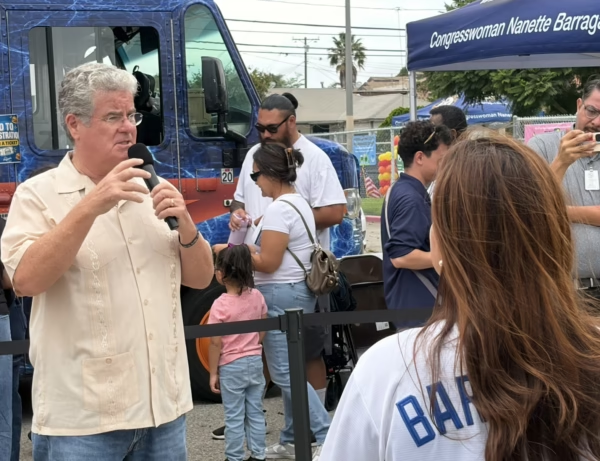
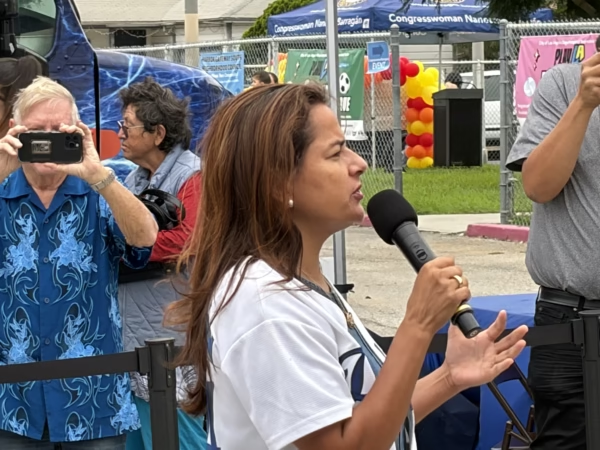
Congresswoman Nanette Barragán joined Los Angeles City Councilmember Tim McOsker at Normandale Recreation Center to celebrate funding for improvements at a facility that means a great deal to the people who live around it.

Including me.

Councilman Tim McOsker. Photo by Rick ThomasMy day had started a few miles away at Wishing Tree Park in Torrance, where the Del Amo Action Committee was participating in a California Clean Air Day event. From there, it was over to Normandale Rec Center in Harbor Gateway.
Two parks. Two community gatherings. And plenty of reasons to pay attention to what is happening in this part of the South Bay.

At Normandale, the oversized ceremonial check identified the City of Los Angeles as the recipient and Normandale Recreation Center upgrades as its purpose.

Three…million…dollars.

For a neighborhood that has spent far too many years feeling overlooked, that is welcome news.

One photograph from the afternoon tells the story particularly well.

Children wearing their PlayLA uniforms stood alongside adults gathered around the check. Behind them were tents bearing Congresswoman Barragán’s name and the insignia of the Los Angeles Department of Recreation and Parks. A basketball hoop rose above the gathering.

The kids were right there in the middle of the picture.

And that is exactly where they belong in this conversation.

When we talk about investing in a recreation center, we are talking about the places where children practice, play, and develop friendships. Where families gather. Where neighborhood events give residents a reason to come out and spend time together.

For those children, the value of this investment will be measured in what they can use, what they can participate in, and whether their families feel comfortable bringing them there.

That is where the $3 million needs to make a difference.

Barragán addressed the gathering with a microphone in hand, wearing a Dodgers jersey. McOsker also spoke, standing among the residents rather than behind some distant Council desk.

They were here.

And for Harbor Gateway, showing up matters.

LAPD’s Harbor Division was also represented at the event. Plans described for the center include a satellite police location intended to strengthen the public safety presence there.

That deserves attention as the improvements move forward.

Families should be able to enjoy a neighborhood recreation center with confidence. Children should be able to participate in activities, and the people working there should have the support they need to keep the facility welcoming and safe.

I have spent plenty of time writing about public safety concerns in Harbor Gateway. Residents know those concerns do not disappear because a check is presented. A police presence, functioning facilities, and consistent recreation programming all have roles to play. The community needs to understand how those pieces will work together at Normandale.

Barragán grew up in Harbor Gateway. She knows this community from personal experience. McOsker has given this neighborhood attention that I believe has been missing for too long.

Their work together on this investment deserves recognition. I ask questions when something is wrong. Anyone who has read this column knows that. But when elected officials help bring resources into our neighborhood, I believe in acknowledging that, too.

Rep. Nanette Barragan. Photo by Rick Thomas.

This is what government should be doing.

Taking the tax dollars we contribute and putting them to work in places residents actually use. Supporting children. Improving public facilities. Giving families more opportunities close to home.

The next step is making sure residents can follow the progress: what will be upgraded, when the work will happen, and how activities will continue while improvements are underway. Those are reasonable questions. Clear answers will help keep the community involved.

There is more ahead at the recreation center, including Halloween, Christmas, and other community events. If you have not visited, give it a look.

And stay tuned to this channel… Sorry. After more than 30 years in media and marketing, that phrase still finds its way out.

What I saw at Normandale was a community ready to use and enjoy its public space. The children around that check made the purpose of the investment easy to understand. Now comes the work of turning that funding into improvements they can experience.

Thank you, Congresswoman Nanette Barragán and Councilmember Tim McOsker. Harbor Gateway deserves this investment—and continued attention long after the photographs are taken.

Letters to the Editor: Call for a True Arts District to Take Shape, PBID Ignores Local Artists, and Middleton Makes Her Case on Mayoral Vote

Arts District and the Commitment to Public Art

   As a local business owner in downtown San Pedro, I want to express my strong desire to see a true arts district take shape here.

  The art committees and Arts United are making efforts, and I appreciate that. Still, I believe there is far more that could be done. Putting resources into night markets filled with vendors—many of whom are neither local nor artists—does little to strengthen San Pedro’s identity as an arts community.

  The First Thursday Art Walk has increasingly become a night market, and it is now being advertised as such, with the term “Art Walk” being dropped from the new advertising altogether. This makes the Art Walk itself feel like an afterthought. I am all for change and the introduction of new events, but not at the expense of a longstanding San Pedro art tradition. We can build something new without losing what made the Art Walk important in the first place.

  I have spent time in arts districts across more than half a dozen cities. What stands out in successful arts communities is a genuine, visible commitment to public art. San Pedro has that opportunity right in front of us. We have walls. We have public spaces. What we largely lack is a consistent presence of art that announces, “This is an arts community.”

I am not a native of San Pedro, but I have lived and worked here for nearly ten years. I built one business, then a second, and I have fallen in love with this community. That is why it bothers me to see many of the same vacant storefronts on Sixth Street that were empty when I first arrived. Those empty spaces are a missed opportunity.

  I encourage the PBID, property owners, and the City to issue meaningful calls for art: invite artists to design storefront windows, install temporary sculptures, create murals, and activate vacant storefronts. The artists are already here and ready to work. What they need is space, opportunity, funding, and a clear signal that the community and property owners want them here.

  Public art should be front and center—not an afterthought. If we call ourselves an arts community, let’s make it look like one.

  I feel the same way about West Harbor. I believe it will be a tremendous addition to San Pedro, even if some local residents remain skeptical. Right now, however, the blank white walls give portions of the development a temporary-structure feel rather than that of a welcoming destination. Murals and other public art could transform the atmosphere. If that is not already part of the plan, I believe it should be.

  This letter comes from one of San Pedro’s biggest fans—someone who simply wants downtown’s arts community to look and feel like the creative place it already is!

Sincerely,

 David Winthrop Hanson

The Winthrop Gallery of Art & Curiosities

Gallery Three Six One


PBID Ignores Local Artists and Prioritizes Shipped-In Vendors and Food Trucks.

Artists started First Thursday to showcase the local art community. It was a laid-back affair, with visitors stopping by art studios and galleries to see art and to engage with the creators. First Thursdays gave artists a way to gain exposure, talk with visitors, and attract new collectors. It was an important part of the local artists’ ecosystem. This has now been replaced by a Night Market ignorant of the local art scene. 

The people in charge seem to have forgotten what First Thursdays were about and are blatantly ignorant of what artists want or need. Instead, they have chosen to kill off a well-liked event with a big circus unrelated to the local art community.

It’s easy to promote San Pedro as a vibrant art community in marketing talk, but it seems harder to actually nurture it. I see the Night Market as a slap in the face of the local art community. A slap by people who should know better.

Peter Scherrer, 

Founder, solo Gallery


Why I am Voting for Nithya Raman for LA Mayor

Nithya Raman is the best bet for Mayor of  LA.  I urge you to vote for  Nithya Raman for Mayor.

Raman has a clear vision for LA:  “I’ve been privileged to serve for the past five years,” Raman said. “I started with a strong focus on serving my constituents, addressing everything from streetlights to preventing evictions and responding to homelessness.  Under Bass’ leadership  the city’s ability to respond to residents has deteriorated.  I think there are a lot of people out there who are frustrated, too, who want the city to work for them. That is  not happening.  I promise  a city government focused on basic services, housing and accountability.”

Consider this:  Bass’ signature issue is homelessness but her Inside Safe program is a total failure.  She wants to look good by “closing out encampments” but she is spending  $84,000 per homeless person per year to house them in hotels with 40% of the homeless leaving the program  (quoted from the LA Times)  because it simply doesn’t work to lock people up with no access to family, friends, pets, or cooking just so the Mayor can say she closed some encampments.  I do not want $84,000 per person of my tax dollars wasted.

The agreement between the City and the Olympic Committee is so weak that the City could be stuck with billions of unpaid costs from the Olympics  for “bread and circus expenditures”.   This is also the wrong time to commit to a new convention center.  Bad decisions all around.  Bass is simply a poor manager of city resources.   And her big donors the LA Police Department and Air BNB cannot solve her problems.

And all of this is nothing compared to what Bass has done to the Harbor community and the ILWU.  When Bass ran in 2022, she had virtually  no base in the Harbor area.  I was Vice President of the Harbor Commission at the time  (having been appointed by Mayor Garcetti).  I hosted an event for over 100 people to introduce the Mayor to the Harbor community.  I told her that all I wanted in return was the opportunity to sit with her and tell her what our workforce and community needed from her and the Port.  She never met with me.

I was up for re appointment in 2024.  Gary Herrera was President of ILWU Local 13.  Mayor Bass assured Gary and our Councilman Tim McOsker that  “there is no problem with Diane’s  reappointment.  We love her and she is doing a good job”.

Bass waited until the day before my  term was up to announce she was NOT reappointing me.  The ILWU was outraged.  For the first time in 30 years there would be no labor rep on the Harbor Commission. Mayor Bass had numerous opportunities since  2024 to appoint an ILWU member.  She passed every time. 

She also refused to support the ILWU request for “no public money for automation”. 

We know who Mayor Bass is:  someone who cannot be trusted. 

Don’t give her another four years to double cross us.

Nithya Raman has committed to uphold the Cooperative Agreement that will lead to zero emission equipment on the waterfront.  She has (on Instagram) issued a clear statement that “no public funds should be used for automated equipment that eliminates jobs on the waterfront”.  

Let’s give Raman a chance.  She has to do better than Bass.  VOTE FOR  NITHYA RAMAN FOR MAYOR OF LA.

Diane Middleton

San Pedro 

The Renaissance of Mata Ortiz


How a Piece of Pottery Saved  the town of  Mata Ortiz in Chihuahua, Mexico

     Spencer MacCallum was a slender, well-educated  man who, for reasons I was never quite sure of, ended up in San Pedro as a night watchman at Angels Gate Cultural Center in its early days. You wouldn’t know it by looking at him in his crumpled hat and work clothes, but he had a degree in art history from Princeton and a masters of art in social anthropology from the University of Washington.

Clearly a very smart guy, who spoke with a slight stutter, as I recall, and came from a notable family. MacCallum and his grandfather founded the Science of Society Foundation, and in 1970 he published a booklet, The Art of Community, as well as his 2003 articles “The Enterprise of Community: Market Competition, Land, and Environment” and “Looking Back and Forward”.

MacCallum was a lecturer at the Independent Institute, an American libertarian think tank founded in 1986 by David J. Theroux, based in Oakland, California. Although by the time he landed in Pedro, he was mostly an itinerant garage sale hunter who on the weekends mapped out all of the advertised sales in this area and hit everyone of them before noon. He was always looking for something, but unlike many he didn’t seem to keep very much. He did, however, have an eye for anything that looked like antiquity.

So, as it happens… Spencer and I got to know each other because of his book, The Art of Community, which he, in his odd stuttering way, tried to explain to me until he just handed me a copy. In The Art of Community, MacCallum argues that the property relations in a community fundamentally determine the physical structure and dynamics of the community. This explains a lot about the current state of the San Pedro Arts District.

 I think it was Muriel Olguin who introduced us.

However, the strangest synchronicity was that when Suzanne and I went to Baja California for Christmas we ended up camping on a somewhat deserted beach south of Mulegé, south of Santa Rosalia. When we woke up in the morning we came upon a campfire of people, and lo, it was Spencer with his family cooking breakfast. They invited us to eat and we were hungry.

It was some time later when he told me about a strange discovery he made while traveling in New Mexico.

In his usual treasure hunting mode, he stopped at a secondhand store and came across a curious piece of pottery. It was curious because it looked like an imitation of the ancient Casas Grande pottery, but it clearly was not very old. In fact, it looked quite new, but finished with the same technique and design motifs of the ancient pottery Spencer knew about. In 1976, Spencer visited what he called “a junk shop” on the U.S.-Mexico border. He spotted some beautifully painted clay pots with no manufacturer marks or names. 

“I knew as soon as I saw the pots that whoever made them was someone special — someone who truly knew [himself or herself],” Spencer later recounted. All the junk shop owner knew about the pots was that they were sold by some people from Mexico.

 Like a detective, he followed the trail of the origin of this pot a hundred miles south of the border to find a dusty little adobe village of Mata Ortiz, in a wide, fertile valley long inhabited by indigenous people. There Spencer discovered the maker of this pot, Juan Quezada. The town didn’t have running water nor electricity, with just dirt roads and a few buildings inhabited by mostly family and relatives of Quezada. He was a very humble maker of pots but a real craftsman in the design of the discovered prehistoric pottery fragments from the ancient Paquimé (Casas Grandes) culture. 

 In Spencer’s broken stutter of Spanish, he got Juan’s story and then bought several of his pots with U.S. dollars. He returned to San Pedro satisfied that he had made a true anthropological discovery of a village sustained by the artistry of this one man. This in many ways fit into his philosophy of Art of Community thinking.

MacCallum brings Quezada to San Pedro

It was somewhere about 1986 that McCallum brought Quezada to San Pedro with his brothers to do a demonstration. The unique part of his craft was that he didn’t use a potter’s wheel to throw perfectly cylindrical ceramics — ­ they were hand-built. He would start by using a bowl, placing a handful of clay into it and forming it against the side. Then using coils of clay to build on top of this foundation, turning it slowly by hand. He kept this up until he reached the desired height, in the process smoothing out the side, turning it repeatedly. When he was done, you couldn’t tell this was a hand-built ceramic pot. I was amazed.

At this time Quezada was selling his pots for under $100 each, which for him was a great deal. Spencer continued to buy and in the beginning paid him $500 a month for three years and collected his works for the next 30 years, and gradually his reputation began to grow. He started to get international recognition and art buyers started to make the trip down to Mata Ortiz — his prices began to grow with the demand until the pots that once earned $65 were bringing $650 and then $7,500.

At this point all of Quezada’s family started making pottery, too, and it became the life blood of Mata Ortiz. It was a village collective enterprise and it was a true success. Now I’m not sure how much McCallum took credit for making this happen but it sure fits into his Art of Community philosophy as a proof of concept. Today it has been called the Renaissance of Mata Ortiz with Galería Juan Quezada, a showcase gallery in the home of the founding father of Mata Ortiz pottery.

     The pottery is now world famous and celebrated by the Mexican government and the story of McCallum’s discovery has become legend.

 Quezada taught his family and neighbors. Today, nearly 300 households and master artisans in Mata Ortiz create fine, signed ceramic art collected globally and displayed in major museums like the Smithsonian. There have been many shows in San Antonio, El Paso, California and other prominent museums throughout North America. There is even an Amazon documentary called The Renaissance of Mata Ortiz.

It has become a cultural tourism magnet for Pablo Carrillo, a second-generation guide with more than 30 years of experience in northern Mexico. He takes travelers on a four-day, three-night Mata Ortiz trip departing from Tucson and includes round-trip transportation, bed-and-breakfast accommodations, visits with local pottery artists and guided stops at Paquimé and Cueva de la Olla.

Before McCallum died he sold his collection of about 250 pieces of the pottery to the San Diego Museum of Man for a reported $1.2 million. This is a true testament to his legacy. 

 Spencer McCallum is most widely known for leading an economic and cultural transformation in the area surrounding the city of Casas Grandes in Chihuahua, Mexico. This regional renaissance has an unlikely source: hand-made pottery and Spencer’s totally unreasonable commitment to promoting it.

As reported by Alison DaRosa on Jan. 11, 2013, “Roads in the village itself remain unpaved. Here and there newer or enlarged homes stand beside century-old mud-brick adobes. Today most homes have indoor plumbing and electricity. Satellite dishes cling to rooftops.” And, “When I first visited, the village had two telephones. Today a few of the more prosperous potters have high-speed Internet, websites and Facebook pages. Most have phones; many have cellphones. Now the village has four schools — kindergarten through high school. Youngsters wear uniforms and huddle in computer labs. The high school opened a year ago. “Before the road was paved [in 2008], students traveled by van to school in Colonia Juárez — four hours a day to get to and from school,” says potter Diego Valles. “Now our kids can walk to school. My wife is off taking our oldest daughter to piano lessons.”

And this is what art can do for a poor community and create a true Renaissance!

Spencer McCallum died on Dec. 17, 2020 at the age of 88 in Casas Grandes, Mexico.

See our eulogy here: https://tinyurl.com/MacCallumeulogy

Hundreds Attend AltaSea’s Blue Hour Celebration


On Oct. 10, AltaSea welcomed more than 500 attendees to its Blue Hour celebration, honoring pioneers in the blue food sector, including celebrity chef and restaurateur Andrew Zimmern, who received the organization’s Innovation Award. Lifetime ocean advocates Philippe and Ashlan Cousteau presented the award.

Zimmern, an Emmy Award-winning television personality, chef and author, has used culinary experiences to promote cultural understanding while advocating for ocean health, sustainability and responsibly sourced food.

“The future of humanity is inextricably tied to the future of our oceans,” Zimmern told the crowd.

“The ocean covers more than 70% of the planet, regulates the climate, produces roughly half of Earth’s oxygen and supports billions of people who depend on it for food and livelihoods,” he said. “Yet, for generations, humanity has treated the ocean as an inexhaustible resource.”

“Well, the bill has arrived,” Zimmern said.

He called for responsible aquaculture, restored wild fisheries, protection of marine biodiversity and sustainable farming of shellfish and seaweed where supported by science. Developing better feeds and production systems, he said, must go hand in hand with ensuring seafood producers earn a decent living.

“We can grow a blue food economy that nourishes people while helping protect the ecosystems that make that nourishment possible,” Zimmern said. “But we have to do it intelligently. We have to measure the impacts. We have to hold ourselves accountable.”

Zimmern warned that warming oceans, strained marine ecosystems, declining wild fisheries and threats to coastal communities are making it increasingly difficult to feed a growing global population.

Some of the most important solutions to the world’s broken food system, he said, may come from the water.

That is where AltaSea comes in. Built on a historic pier with access to the deep ocean, the nonprofit’s 35-acre campus supports ocean science, ocean-related businesses and innovative education programs. It collaborates with local nonprofits, including the LA Maritime Institute, and emerging companies.

Zimmern highlighted AltaSea’s work advancing responsible aquaculture, marine robotics, ocean exploration, renewable energy, cleaner marine transportation and research into carbon storage and climate resilience. The organization also connects researchers, investors and emerging companies to help turn new technologies into businesses that create jobs and address environmental challenges.

Its educational programs introduce young people to careers in marine science and ocean technology, including fields that barely existed a generation ago.

Zimmern emphasized that the blue economy must benefit coastal communities and workers, not just investors and businesses.

“The blue economy cannot become another economy where a handful of people prosper while the communities most dependent on the ocean are left behind,” he said. “Regeneration has to include people.”

He urged attendees to invest in science, people, ideas and institutions developing solutions to the climate and ocean crises rather than leaving future generations to repair the damage.

Blue Hour featured chef demonstrations, culinary creations, live music, entertainment, art made from food, Blue Robotics exhibits and ocean-inspired food and drinks. More than a dozen restaurants and culinary programs, including Los Angeles Harbor College’s culinary division, offered tastings that showcased local food businesses and sustainable dining.

Attendees contributed more than $50,000 to support AltaSea’s Ocean STEM programs, which provide free educational opportunities to students throughout Los Angeles. The programs introduce students to careers in the blue economy, from marine conservation and underwater robotics to clean energy.

The Wonderful World of French Butter


By Lynn Nishimura, Columnist 

My previous article was about French cheese. But did you know how many  different things can be made from cow’s milk? Cream, cheese, yogurt, butter— and much more. 

Today, let’s talk about butter. 

Butter is an emulsion of milk fat and water, and the way it is produced can  range from beautifully traditional to highly industrial. It can be made by hand in  a wooden churn, produced in small batches, or manufactured on a much larger  scale. 

The result can be unsalted butter, salted butter, or the deliciously rich beurre  de baratte, traditionally churned for a distinctive texture and flavor. French brands such as Président, widely available in French supermarkets and  in the US, are also commonly found in brasseries and cafés. But if you are on a  quest for delicacies and signature products, seeking out butter from a local  dairy producer is a wonderful way to discover regional flavors while supporting  smaller producers. Buying directly from local producers helps keep more of the  economic benefit within the region. This is what is known as the French circuit  court approach. 

How Is Butter Enjoyed in France? 

Butter isn’t necessarily served automatically with a basket of bread, although it  certainly can be if you ask! 

More often, bread and butter appear alongside a cheese or charcuterie board,  or even an oyster platter. 

Just as in fine-dining restaurants, you may have seen beautifully presented  portions of butter: elegant little pyramids from a local dairy, textured cones,  decorative molds, or specialized tools used to create fresh butter rosettes and  curls directly onto the plate. 

Some artisanal producers still make butter using traditional methods and,  depending on the product, raw (unpasteurized) cream. This can give the butter  a particularly rich and distinctive character. Interestingly, pasteurization itself  has French origins: Louis Pasteur developed the process in the 1860s while  working to prevent wine from spoiling. The technique was later applied to milk  and many other foods and beverages. As in the United States, France also  permits the production and sale of certain dairy products made from raw milk  or cream, subject to specific regulations. 

You can also find smaller creameries producing butters flavored with  ingredients such as lavender, smoked salt, Brittany seaweed, and Espelette 

pepper. Le Beurre Bordier is particularly well known for its wide range of  flavored butters. 

There are many other excellent artisanal producers as well, and discovering  these flavored butters is part of the fun. 

In France, butter can become much more than something you spread on toast  with homemade jam. It can be an ingredient, a tasting experience, and even a  little gourmet souvenir. 

Where to Discover French Butter in Paris 

If you’re visiting Paris, Galeries Lafayette Gourmet is a great place to explore.  On the lower floor, you’ll find an impressive gourmet food market filled with  French specialties, gifts, and beautiful products to take home. It’s a wonderful  place to browse, even if you don’t necessarily want to spend a fortune. There is also Le Butter Shop, a Paris address known for its selection of local  and artisanal butters, including traditional beurre de baratte and other specialty  products. It is a fun place to look for harder-to-find French butter and discover  smaller producers. And, of course, don’t overlook the small cheese shops and  fromageries, where you may also discover regional butters and other local  specialties, depending on the producer. 

A Few French Butter Terms to Know 

French butter comes in several familiar varieties: 

Beurre doux — unsalted butter 

Beurre demi-sel — lightly salted butter, particularly associated with  

Brittany 

Beurre salé — salted butter 

And then there is beurre de baratte, traditionally churned butter known for its  rich, creamy character and distinctive texture. 

So have some fun with butter this summer. 

Spread it simply on a good piece of bread, pair it with cheese or oysters, use a  flavored butter to finish a dish, or incorporate it into a favorite cake or pastry. Sometimes, the simplest French pleasure is just good butter on good bread  with cheese. 

Or perhaps a classic jambon-beurre—the wonderfully simple French ham-and butter sandwich. 

Bon appétit—and enjoy your butter!

RLn’s Superior Court Judges Endorsements


Seat 64: Deputy Public Defender Rhonda Haymon

Rhonda Haymon has more than 25 years of experience as a public defender and is endorsed by a trio of judges with similar backgrounds — judges Holly Hancock, George Turner, and Ericka Wiley — as well as four of the five county supervisors, including Janice Hahn, and a wide range of organizations. La Defensa, which has played a leading role in shifting LA County from a punitive to a restorative model of justice, said this in endorsing her: “Haymon defines public safety as the presence of peace, security, and conditions that allow individuals and communities to thrive, not merely the absence of crime. She is among the most explicitly restorative of the judicial candidates we evaluated.”

Seat 65: Anna Slotky Reitano.

In 2022, Reitano was part of the original Defenders of Justice slate of public defenders running for county judicial office. She advanced from the primary, but lost with 44.7% of the vote. Since then, she’s broadened her experience, working in civil litigation with the LA County Counsel.

In a dual endorsement, Knock LA said, “She emphasizes the breadth of her experience in law as preparing her for an office that might take her to civil trials, family court, or any other branch of the legal arena. During her time as a public defender, she emphasized the importance of mental health diversion and treatment.”

While we chose to endorse Reitano, her opponent, Justin Clayton, is a career public defender with management experience who is also a recognized champion of restorative justice. We agree with Knock LA, which said, “It’s a shame that two qualified candidates are stuck in competition for a single office,” and while we hope Reitano wins, we hope that Clayton will run again in the near future, when we’ll be happy to endorse him.

Seat 87: Deputy Public Defender Anthony Bayne

Anthony Bayne is a public defender with a quarter century of broad experience, which has earned him endorsements from over 30 judicial officers. While not as explicitly progressive as others we’ve endorsed, he has earned the endorsement of scores of his fellow public defenders, as well as labor organizations, including all regional ILWU locals. Knock LA concludes its endorsement, “His broad experience with the courts at every level puts him head and shoulders above his competition for the seat.”

Seat 131: Deputy Alternative Public Defender David Ross

David Ross has served for more than 25 years in the alternative public defender’s office, which handles cases where there are multiple defendants or conflicts of interest between them that would disqualify the public defender. He’s represented more than 10,000 indigent clients, litigated 113 jury trials, and handled roughly 2,000 preliminary hearings. He previously worked as a journalist for a decade.

Knock LA says, “He’s both the progressive choice and the most qualified candidate.” La Defensa says, “Ross believes bias is an issue within the judicial system and that it is the judge’s job to weed out biases and prejudices.” And, “On sentencing, he believes a defendant’s background, including poverty, trauma, mental health, and substance use, is relevant, and he has applauded changes in the law that give judges more discretion in sentencing. He has advocated for alternative sentencing, diversion, and mental health diversion for his clients throughout his career, and he views these practices as playing a critical role in correcting injustices.”

Ross’s long list of organizational endorsements includes all regional ILWU locals as well as the Coast Longshore Division.